

A few years ago, the pay difference between a cloud engineer and someone managing on-premise servers was easy to explain but hard to really feel. Now in 2026, that difference is impossible to ignore. If you work in IT or are considering a tech career, this is a gap you need to understand.
What Do These Engineers Actually Do?
Most people in IT already know these roles exist—but they describe them differently depending on where they work.
A cloud engineer spends their day inside platforms like AWS, Azure, or Google Cloud. They are not touching physical hardware. They are writing configurations, setting up pipelines, and managing storage and compute—all from a laptop. The infrastructure runs in someone else’s data centre, and the cloud engineer’s job is to use it well.
An on-premises engineer does much of the same conceptual work, but the hardware is real and nearby. Servers in a rack. Network switches in a cabinet. Cooling systems humming in the background. When something breaks, they are the ones physically walking into that room.
The Numbers: What Each Role Pays in 2026
Here is a quick comparison of average salaries in the United States in 2026:
|
Role |
Entry-Level Avg. |
Mid-Level Avg. |
Senior Avg. |
Top Earners |
|
Cloud Engineer |
$120,000 |
$151,000 |
$168,000 |
$195,000+ |
|
On-Premise / Infra Engineer |
$85,000 |
$117,000–$134,000 |
$145,000 |
$163,000 |
The gap at the entry level is noticeable. But at the senior level, it becomes significant—we are talking about a $20,000 to $30,000 or more difference in base pay. When you factor in bonuses and stock, cloud engineers at top companies can pull in over $177,000 in total compensation on average.
On-premise engineers, by contrast, have seen slower salary growth. Salary.com’s data tells a pretty flat story for infrastructure engineers—the median pay sat around $118,520 in 2023 and had barely budged two years later. That kind of stagnation does not happen in a role that the market is rushing to fill.
Why Is the Gap Growing?
There are clear reasons why cloud engineers are getting paid more — and why that gap keeps widening each year.
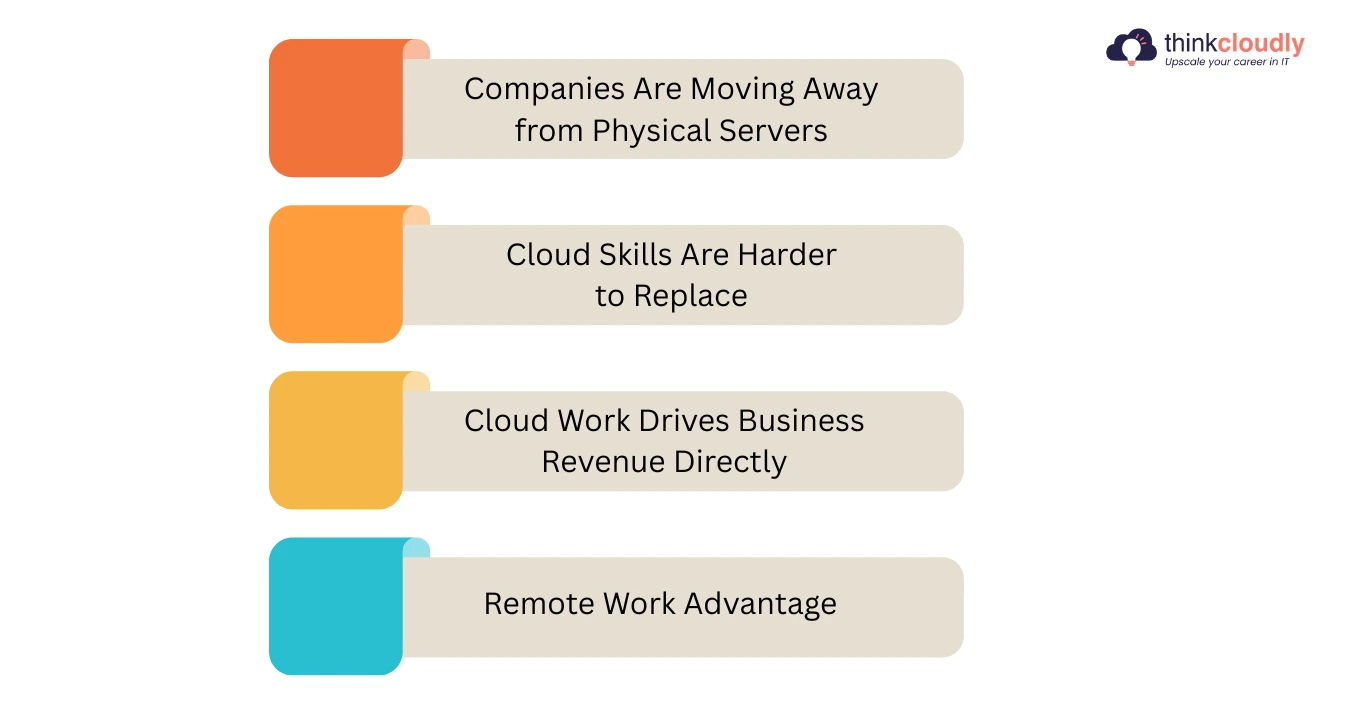
1. Companies Are Moving Away from Physical Servers
Over 94% of enterprises will already be using cloud services by 2025, and that number keeps climbing. When a company migrates to the cloud, they need fewer people managing physical hardware—and more people who understand AWS, Terraform, Kubernetes, and cloud security.
The demand for on-premise specialists is shrinking in most industries. The demand for cloud engineers is doing the opposite.
2. Cloud Skills Are Harder to Replace
There is a real shortage of people who can build and manage cloud infrastructure well. This drives salaries up. Cloud talent is genuinely hard to find right now. Companies are not paying six figures for it out of charity — they are paying because they cannot find enough people who actually know what they are doing.
Getting certified is not just a resume checkbox. Multiple 2026 salary reports show that engineers with credentials like AWS Certified Solutions Architect or Google Cloud Professional are pulling $10,000 to $20,000 more per year than those without the same experience but with a different piece of paper on the wall.
3. Cloud Work Drives Business Revenue Directly
Cloud engineers sit right next to the money. Cut unnecessary compute spend — the CFO notices. Fix a slow API — customers stay. Push a feature to production faster — the product team wins. Every decision a cloud engineer makes shows up somewhere in the business numbers, and companies know it.
On-premise work, by contrast, is often invisible when it works well. A server running smoothly in a basement does not generate excitement in a boardroom — but a cloud engineer who just saved $40,000 in monthly compute costs absolutely does.
4. Remote Work Advantage
Cloud engineering is almost entirely remote-friendly. You can configure a server in Virginia from your home in Colorado. This means cloud engineers can compete for jobs across the entire country—and pick the highest-paying offers.
On-premise roles often require you to physically be at the data centre. That limits your job options and your negotiating power.
Is On-Premise Engineering Dead?
Not at all, but it is changing.
Some industries will always need physical infrastructure. Heavily regulated industries move slowly — and for good reason. A hospital cannot just shift patient records to AWS overnight. A bank dealing with strict compliance rules cannot always use a shared cloud environment. Defence contractors, utilities, and large manufacturers often have the same constraints. These organizations are not going anywhere, and they still need strong infrastructure—talent on-site—with salaries that reflect how critical that work actually is.
The key insight is this: purely on-premise engineers who have no cloud skills are the ones falling behind. Those who know both worlds — who can manage a hybrid environment — are in a much stronger position.
A hybrid infrastructure engineer who understands both on-premise setups and cloud platforms can command salaries that compete with dedicated cloud roles.
What Does Job Growth Look Like?
The numbers from the Bureau of Labour Statistics put cloud-related role growth somewhere between 12% and 22% through 2030. That range is wide, but even the low end is well above average for any occupation. Overall, tech jobs are expected to grow at around 15% through 2032.
For traditional IT infrastructure work, the picture is quieter. Some of those roles are disappearing through mergers and budget cuts. Others are being redefined to include cloud responsibilities. The job title might stay the same, but the skill set companies actually want has shifted.
So, What Should You Do?
Whether you are already working in IT or just starting your journey, here is what the data suggests:
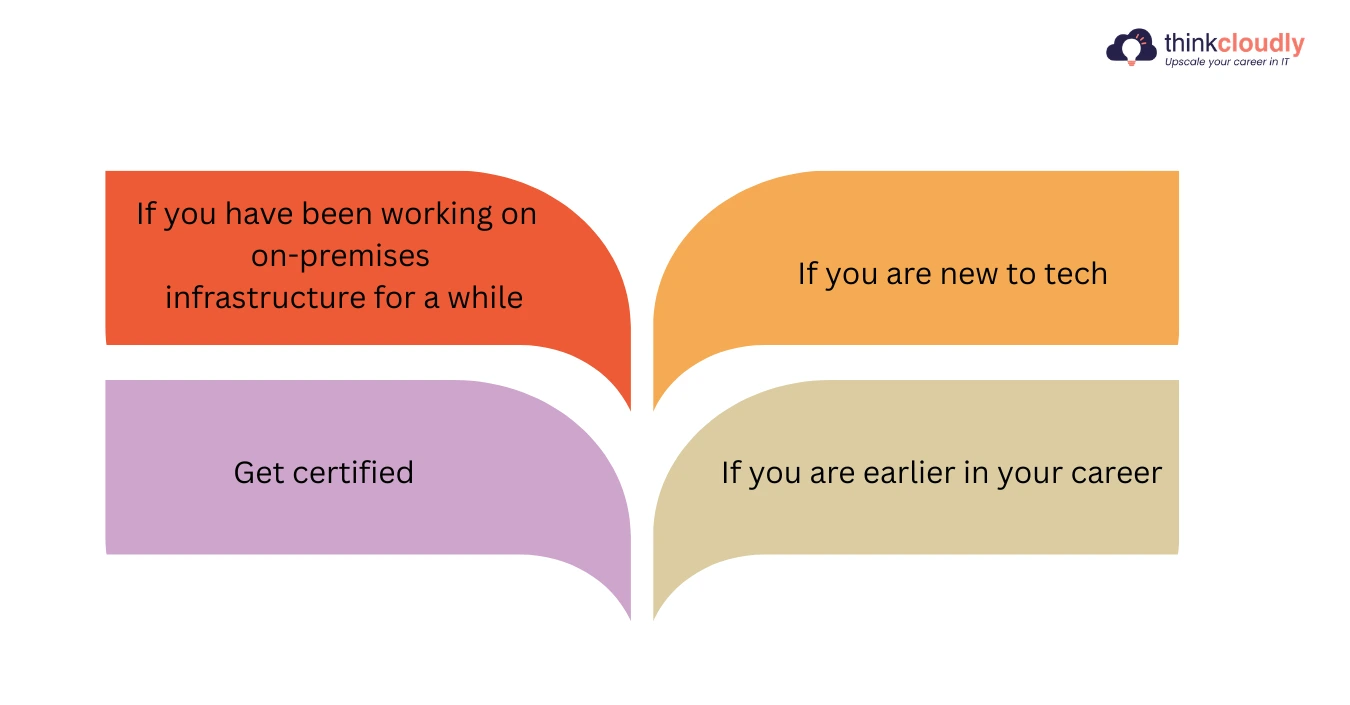
If you have been working on on-premises infrastructure for a while
The skill set you already have is not worthless — it is actually a head start. Understanding how physical networking works, how storage behaves under load, and how systems fail in the real world—cloud engineers who came from on-premise backgrounds often make better architects because of it. The missing piece is usually hands-on cloud practice and a certification to show employers you have made the move.
If you are new to tech
Cloud engineering is one of the best career paths available right now. It offers high starting salaries, strong remote options, global demand, and a clear growth path.
Get certified
AWS, Google Cloud, and Azure all have certification paths that employers recognize. These credentials directly influence your salary, especially early in your career. If you are not sure where to begin, look at three or four job listings for roles you want and note which platform they mention most — AWS, Azure, or Google Cloud. That single filter tells you more than any comparison article will.
If you are earlier in your career
Prioritize getting comfortable with at least one major cloud platform before anything else. AWS has the most job openings. Azure dominates enterprise environments. Google Cloud pays well at senior levels. Pick one, go deep, then branch out.
A Note on How to Learn
If you are looking to make the switch or level up, how you learn matters just as much as what you learn.
A lot of people start with free resources—YouTube walkthroughs, blog posts, and documentation. These are useful for building familiarity, but they rarely get you to job-ready. The reason is simple: reading about deploying a containerized application on Kubernetes is completely different from actually doing it, debugging it when it breaks, and understanding why it broke.
The engineers who move fastest are the ones who combine structured learning with hands-on labs—real environments where mistakes have consequences and fixes require actual thinking. Build something. Break it. Fix it. Deploy it. That cycle is what interviewers are actually testing for, whether they say so directly or not.
The job market in 2026 has no patience for engineers who can only talk about cloud concepts. Hiring managers want people who have done the work — even if that work happened in a personal project or a guided lab, not a Fortune 500 company.
Final Thought
The salary divide between cloud engineers and on-premise engineers is not going away. If anything, it is going to get wider as more companies finish their migrations and double down on cloud-native tools.
Those skills are learnable. The certifications are real, the job openings exist right now, and engineers are making this transition every single month. The gap between cloud and on-premise pay is wide—but it is not a wall. It is a distance you can cover with the right training and enough consistency.
Sources & Further Reading
The data and statistics in this article are drawn from the following sources:
- Built In — Cloud Engineer Salary in the US (2026) — average base and total compensation figures for cloud engineers across the United States
- Glassdoor — Cloud Engineer Salary (2026) — average and top-percentile cloud engineer salary data reported by US employees
- Indeed—Cloud Engineer Salary in the United States (May 2026)—average cloud engineer salary drawn from active US job postings
- Salary.com — Infrastructure Engineer Salary (May 2026) — average and median salary benchmarks for infrastructure engineers in the United States
- Glassdoor—Infrastructure Engineer Salary (May 2026)—average and top-percentile infrastructure engineer pay reported by US employees
- KORE1 / Shoolini — Cloud Engineer Salary Guide 2026 — certification salary premiums and skill-based pay increases for cloud engineers
- Research.com — Cloud Computing Degree Careers (2026) — projected job growth rates for cloud engineering roles through 2030
- DataCamp — Cloud Engineer Salaries 2026 — cross-platform salary comparison and average base pay analysis for US cloud engineers
- ZipRecruiter — Infrastructure Engineer Salary (May 2026) — average annual pay and salary range distribution for infrastructure engineers in the US
- SalaryExpert — Infrastructure Engineer Salary in the United States (2026) — employer-reported average salary data for US infrastructure engineers
All salary figures reflect United States market data collected and published in 2026. Individual compensation may vary based on experience, location, certifications, and employer.