According to the 17th Annual State of Agile Report published in 2025, 71% of organizations globally now use agile in some capacity, and the demand for qualified Scrum Masters has never been higher. If you have been wondering how to become a Scrum Master in 2026, you are asking exactly the right question at exactly the right time.
The role is well-compensated, genuinely in demand, and more accessible than most people assume. You do not need a computer science degree. You do not need years of software development experience. What you need is a clear understanding of the Scrum framework, the right certification, and a deliberate plan for building practical experience.
This guide gives you that plan, step by step.
How to Become a Scrum Master: Understanding the Role First
Before mapping out the path, it helps to understand what a Scrum Master actually does day to day.
A Scrum Master is not a project manager in the traditional sense. They do not assign tasks, own the delivery timeline, or hold people accountable through authority. Instead, they are a servant leader whose primary responsibility is to help the Scrum team work as effectively as possible.
In practical terms, this means:
- Facilitating Scrum ceremonies including daily standups, sprint planning, sprint reviews, and retrospectives
- Removing obstacles that slow the team down
- Coaching the team on Scrum principles and Agile ways of working
- Protecting the team from external interruptions during a sprint
- Working with the Product Owner to keep the backlog healthy and prioritized
According to ISACA and LinkedIn Talent Insights 2025 data, the average Scrum Master salary in the United States sits between $105,000 and $135,000, with senior and enterprise-level roles reaching considerably higher. It is a role that rewards genuine understanding of people, process, and team dynamics over purely technical skill.
Step-by-Step Roadmap to Become a Scrum Master in 2026
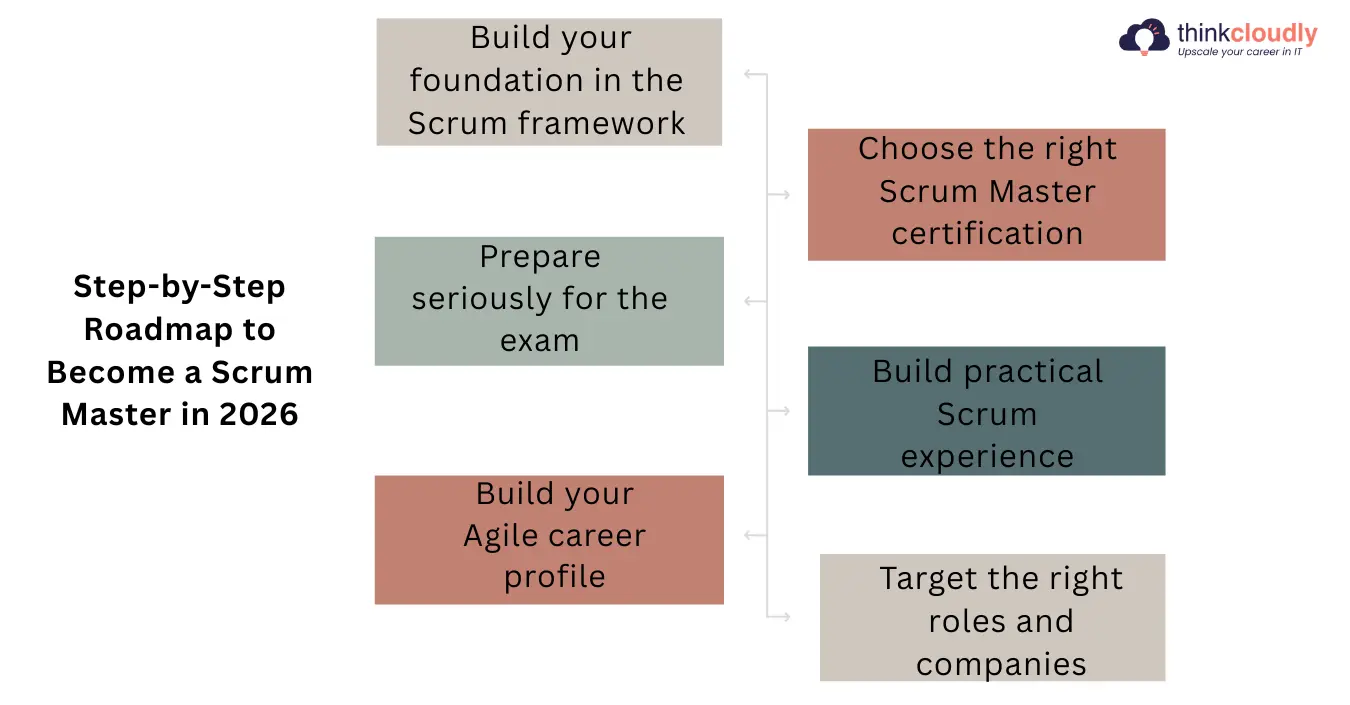
Step 1: Build your foundation in the Scrum framework
Before pursuing any certification or applying for any role, spend time genuinely understanding what Scrum is and how it works. The Scrum Guide, which is the official reference document for the Scrum framework and is available free at Scrum.org, is the starting point. It is approximately 13 pages long and covers all the roles, events, artifacts, and core commitments that define Scrum.
Read it carefully and more than once. Many candidates rush past this step toward certification, and it shows clearly in interviews and on the job. The Scrum Guide is not long, but it is dense with meaning. Take time to understand not just what the rules say but why they exist.
Supplement the Scrum Guide with free resources from Scrum.org and the Scrum Alliance, both of which publish articles, webinars, and learning materials for people new to the framework.
Step 2: Choose the right Scrum Master certification
The certification you pursue will depend on your learning style, budget, and the type of roles you are targeting. Two certifications dominate the market in 2026.
CSM (Certified Scrum Master) from the Scrum Alliance requires completion of a two-day training course delivered by a certified Scrum trainer before you can sit the exam. The exam consists of 50 questions with a passing score of 74%. Total cost typically ranges between $1,000 and $1,500, including the mandatory training. The certification expires every two years and requires renewal through Scrum Education Units.
PSM I (Professional Scrum Master) from Scrum.org requires no mandatory training. You study independently, pay a $200 exam fee, and sit the assessment when ready. The exam has 80 questions and a significantly higher passing threshold of 85%. Once you pass, the certification does not expire and carries no renewal fees.
Both are widely recognized by employers. CSM tends to have stronger name recognition with HR departments and non-technical hiring managers. PSM I is increasingly respected in technology-focused environments where the higher passing threshold signals genuine knowledge.
CSM vs. PSM:
|
Factor |
CSM (Scrum Alliance) |
PSM I (Scrum.org) |
|
Training required |
Yes, two-day course |
No mandatory training |
|
Exam questions |
50 questions |
80 questions |
|
Passing score |
74% |
85% |
|
Cost |
$1,000 to $1,500 |
$200 |
|
Expiry |
Every two years |
Does not expire |
|
Best suited for |
Structured learners, career changers |
Self-directed learners |
|
Employer recognition |
Strong across all sectors |
Strong in technical environments |
Regardless of which path you choose, pairing your self-study with quality scrum master courses can significantly improve your first-attempt pass rate.
Step 3: Prepare seriously for the exam
The preparation phase is honestly where most people either set themselves up or fall short, regardless of which certification they are going after.
Start with the official materials. For PSM I, the Scrum Guide is your foundation, and the free Scrum Open assessment on Scrum.org is the closest thing you will find to the actual exam experience. For CSM, your two-day trainer covers the exam content directly, so showing up engaged and taking good notes goes a long way.
For PSM I especially, do not book your exam until you are consistently scoring above 85% on full practice assessments. The passing threshold gives you almost no room for error, and the questions are designed to test how well you apply concepts, not just whether you can recall them.
If reading alone is not getting certain topics to click, many candidates find that enrolling in dedicated scrum master courses helps bridge the gap between reading the Scrum Guide and actually applying concepts under exam pressure.
Step 4: Build practical Scrum experience
A certification gets you in the conversation. Experience is what closes the deal. Employers in 2026 want to see that you have actually operated inside a Scrum environment, even if that happened through volunteer work, a side project, or contributing to a neighboring team.
If your current workplace uses any form of Agile, offer to facilitate a retrospective or help coordinate sprint planning. Small facilitation moments still count. Nonprofits are another underused option since many run projects using Agile approaches and genuinely welcome structured support. If your company is going through an Agile transformation, raise your hand for that work. It is one of the fastest ways to accumulate real experience with your name attached to it. Open source communities are worth considering too, since many use Scrum or Kanban and are open to contributors who bring process thinking to the table.
Step 5: Build your Agile career profile
Before you start applying anywhere, spend time on how you are showing up professionally, starting with LinkedIn. Recruiters are actively searching for Scrum Master candidates, and they are reading profiles carefully before deciding who to contact.
Update your headline to reflect where you are headed, something along the lines of Scrum Master and Agile Practitioner, CSM Certified, helping teams deliver value iteratively. Add your certification to the Licenses and Certifications section with the correct issuing body and date. Write a summary that tells your transition story clearly, grounding it in your actual facilitation experience, team coaching work, and Agile project management involvement.
Posting occasionally about what you are learning also helps more than most people expect. A short reflection on a retrospective technique you tried or a Scrum principle you worked through recently builds your visibility with recruiters and signals the kind of curious, engaged mindset that genuinely strong Scrum Masters tend to have.
Step 6: Target the right roles and companies
Being selective about where you apply matters as much as how you apply. Not every Scrum Master role is the same, and not every company actually practices Scrum in a meaningful way.
Look for organizations that have been running Scrum for several years. They tend to have clearer role definitions and offer real growth rather than just a title. Search specifically for junior Scrum Master, associate Scrum Master, or Agile coordinator listings since these are built for people entering the field and typically ask for certification and some facilitation background rather than years of prior experience.
Also look beyond the technology sector. According to the 2025 State of Agile Report, Agile adoption is growing fastest in financial services, healthcare, marketing, and government. These industries often have far less competition for Scrum Master roles than tech does, which creates a noticeably better environment for someone making an Agile career switch.
What the Scrum Master career path looks like beyond entry level
Once you are in your first role, the progression is fairly well defined. Moving from junior to senior Scrum Master typically takes two to three years and requires deeper coaching abilities along with evidence that your teams are actually improving. Getting from senior Scrum Master to agile coach means developing broader organizational influence, the capacity to work across multiple teams at once, and often additional credentials like ICP-ACC or SAFe Agilist.
At the top of the path, Agile Coach to Head of Agile Transformation is a leadership position focused on driving Agile adoption across an entire organization at the executive level. Many Scrum Masters also layer in the Advanced CSM from the Scrum Alliance or PSM II and PSM III from Scrum.org as they grow, both to deepen their knowledge and to signal continued commitment to the craft.
Skills That Set Exceptional Scrum Masters Apart
Technical knowledge of the Scrum framework is the entry ticket. What separates good Scrum Masters from exceptional ones is a combination of interpersonal and facilitation skills that develop with deliberate practice.
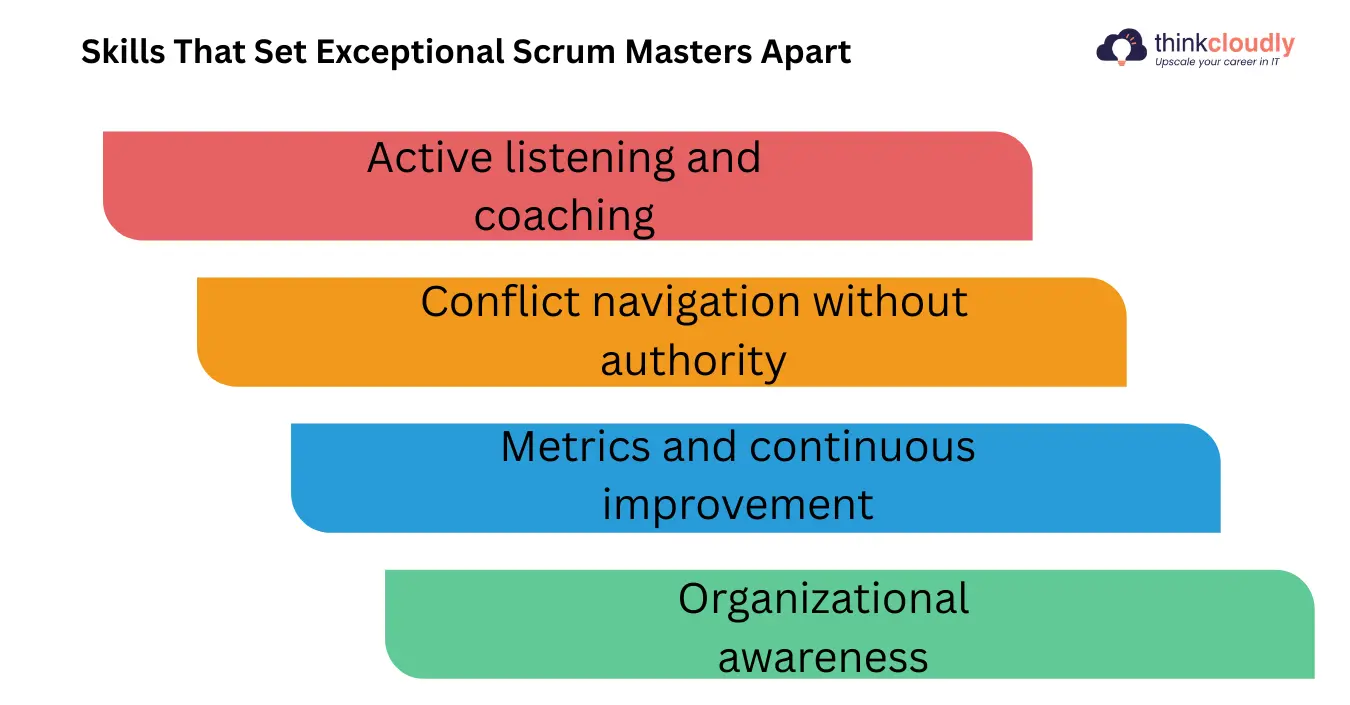
Active listening and coaching
There is a real difference between hearing what someone says and actually listening to what they mean. Scrum Masters who bring genuine attention to retrospectives and one-on-ones build trust quickly, and that trust is what gets people to share the real problems instead of the polished version. Coaching takes this further. Asking the right question at the right moment does far more than handing someone an answer. It is how teams gradually stop looking to the Scrum Master for solutions and start finding their own, which is the whole point.
Conflict navigation without authority
Here is what makes this role genuinely challenging: you are responsible for the health of the team, but you have no power to tell anyone what to do. When tensions come up, and they always do eventually, the only tool available is the ability to bring people into a productive conversation without picking a side or pushing a particular outcome. That skill, holding space for disagreement without letting it derail the team, is what separates Scrum Masters who are merely present from those who are actually effective.
Metrics and continuous improvement
Numbers tell a story, but only if you know how to read them and explain them to the right audience. A Scrum Master who can translate sprint velocity, cycle time, and team capacity into language that stakeholders actually understand earns credibility that opinions alone never could. More importantly, it gives you something concrete to stand behind when you are making the case for what the team needs.
Organizational awareness
No team exists in isolation. The Scrum Masters who consistently make an impact are the ones who understand the larger environment their team is working inside: which stakeholders carry influence, where resistance to Agile project management practices tends to come from, and how to move through those dynamics without triggering defensiveness or stalling progress. Reading the organization as clearly as you read the team is what allows you to protect one while working constructively within the other.
Conclusion
The path to become a Scrum Master in 2026 is well-defined, achievable, and genuinely rewarding for the right person. The Scrum framework provides the foundation. The right Scrum Master certification opens the door. Practical experience and a visible professional profile close the deal.
The CSM, Scrum, and PSM I certifications are all legitimate starting points depending on your learning style and budget. The Agile career market is growing across industries, and the Scrum Master career path has clear progression for those who invest in their skills consistently.
What matters most is not how quickly you collect credentials but how deeply you understand the principles behind them. Teams can feel the difference between a Scrum Master who knows Scrum and one who lives it, and so can hiring managers.
Invest in the right scrum master courses early — they compress months of trial-and-error into structured, exam-ready knowledge. Start with the Scrum Guide. Pick your certification. Build your experience deliberately. The rest follows.
Sources and References
- Digital.ai. 17th Annual State of Agile Report 2025: Agile Adoption, Frameworks, and Workforce Trends. (2025)
- Scrum Alliance. Certified Scrum Master Certification Requirements and Salary Data 2025.
- Scrum.org. Professional Scrum Master PSM I Certification: Exam Details and Pricing 2026.
- LinkedIn Talent Insights. Scrum Master Hiring Demand and Salary Benchmarks 2025.
- Glassdoor. Scrum Master Salary Report: Entry, Mid, and Senior Level Compensation 2025.
- Project Management Institute. Pulse of the Profession 2025: Agile and Hybrid Approaches in Practice.
- Forbes. The Most In-Demand Agile Certifications and Career Paths in 2025.
- Coursera. Global Skills Report 2025: Agile and Scrum Learning Trends.
- Burning Glass Technologies. Labor Market Analytics: Scrum Master Job Posting Frequency and Requirements 2025.
- Harvard Business Review. Why Agile Coaching and Scrum Master Roles Are Growing Beyond Software in 2025.
- CompTIA. IT Industry Outlook 2026: Agile Skills, Scrum Certification Value, and Workforce Trends.
- McKinsey and Company. The Agile Organization in 2025: Scaling Agile Across Industries and Functions.