
Only 170,000 professionals worldwide currently hold the Certified Information Systems Auditor credential, yet the demand for qualified IT auditors is growing faster than the supply can keep up with. If you have been considering whether the CISA certification is worth pursuing in 2026, the answer is embedded in that gap.
Organizations across every industry are under increasing pressure to demonstrate that their information systems are secure, compliant, and operating as intended. Regulators are tightening requirements. Cyberattacks are increasing in frequency and sophistication. Boards of directors are asking harder questions about technology risk. The professionals who can answer those questions with authority are the ones holding the certified information systems auditor credential, and employers are paying accordingly.
This guide covers everything you need to know about CISA certification in 2026, from exam structure and cost to career outcomes and how it compares to other leading credentials.
CISA Certification in 2026: What It Is and Why It Matters
The CISA certification is issued by ISACA, a global professional association focused on IT governance, audit, risk, and security. ISACA has been issuing the CISA credential since 1978, making it one of the oldest and most established certifications in the information technology field.
The certified information systems auditor designation is specifically designed for professionals who audit, control, monitor, and assess information technology and business systems. It is not a general cybersecurity certification. It is a specialized credential that sits at the intersection of IT and business governance, which is precisely why it is valued so heavily in regulated industries like banking, healthcare, insurance, and government.
According to ISACA’s 2025 State of Cybersecurity report, IT audit and assurance roles were among the top five most difficult positions for organizations to fill globally. CISA certification value has grown significantly in recent years as a direct result of this talent shortage combined with rising regulatory demands.
Who Should Pursue the CISA Certification?
CISA is not an entry-level credential. ISACA requires candidates to have a minimum of five years of professional experience in information systems auditing, control, or security before they can be fully certified. Up to three years of that experience can be substituted through relevant education or other qualifications.
The credential is most relevant for professionals working in or targeting the following roles:
- IT auditors and senior IT auditors
- Information security managers
- IT risk and compliance professionals
- Internal audit managers
- IT governance specialists
- Enterprise risk management professionals
- Chief information officers and chief audit executives
If you are earlier in your career, pursuing CISA now is still a sensible move. You can pass the exam before meeting the experience requirement and apply for certification once your work history qualifies. Many professionals follow exactly this path.
CISA Exam Structure: What You Are Actually Being Tested On
The CISA exam consists of 150 multiple-choice questions to be completed in four hours. It is available in multiple languages and can be taken at authorized testing centres or through remote proctoring.
The exam is organized across five content domains, each weighted according to its importance in real-world IT audit and governance practice:
|
Domain |
Topic |
Exam Weight |
|
Domain 1 |
Information Systems Auditing Process | 21% |
| Domain 2 | Governance and Management of IT |
17% |
|
Domain 3 |
Information Systems Acquisition, Development and Implementation | 12% |
|
Domain 4 |
Information Systems Operations and Business Resilience |
23% |
| Domain 5 | Protection of Information Assets |
27% |
The exam is scored on a scale of 200 to 800, with a passing score of 450. ISACA updates the exam content regularly to reflect changes in the IT landscape, and the most recent content refresh was completed in 2024 to ensure alignment with current enterprise risk management practices and emerging technology risks.
CISA Certification Cost in 2026
Understanding the full cost of obtaining CISA certification is important for planning your investment accurately.
- Exam registration fee: ISACA members pay $575. Non-members pay $760. Given that ISACA membership costs approximately $135 per year and provides additional resources including discounted study materials and access to ISACA publications, most candidates find membership worth obtaining before registering.
- Rescheduling fee: $50 if you reschedule more than 48 hours before your exam date. Changes within 48 hours incur a higher fee.
- Annual maintenance fee: Once certified, CISA holders pay $45 per year if they are ISACA members or $85 per year as non-members to maintain their certification status.
- Continuing Professional Education: CISA holders must earn 120 Continuing Professional Education hours over every three-year period, with a minimum of 20 hours per year. Some CPE activities carry costs depending on the provider.
- CISA certification training: Preparation courses vary widely in cost. ISACA’s own official review course runs from $895 for members to $1,095 for non-members. Third-party CISA prep courses from providers like Simplilearn, Infosec Institute, and SANS range from $500 to $2,000 depending on format and depth.
Total investment from preparation through first certification typically falls between $1,500 and $3,000 for most candidates when all costs are factored in.
CISA Certification Value: What It Does for Your Career
This is the section that matters most to most people reading this, and the data in 2025 and 2026 is genuinely compelling.
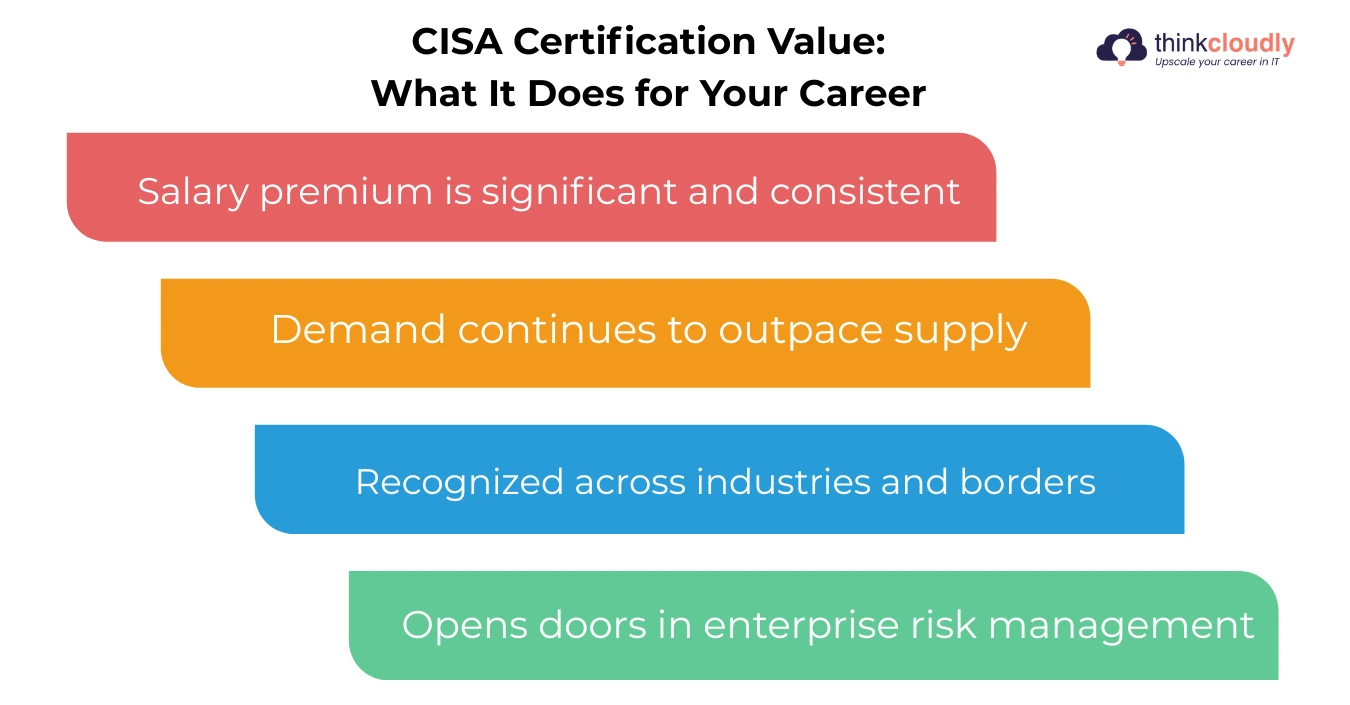
Salary premium is significant and consistent
According to ISACA’s 2025 Global Salary Survey, CISA-certified professionals earn a median salary of $132,000 in the United States, compared to $104,000 for comparable professionals without the credential. That is a gap of approximately 27% in favour of certification holders, and it has been consistent across multiple years of survey data.
Demand continues to outpace supply
The Bureau of Labour Statistics projects that information security analyst roles, which include IT auditors, will grow by 32% through 2032, significantly faster than the average for all occupations. With the CISA holder pool remaining relatively small at around 170,000 globally, qualified candidates continue to face a favourable hiring environment.
Recognized across industries and borders
CISA certification is recognized by employers in over 180 countries. It meets the requirements of frameworks including COBIT, ISO 27001, and SOX compliance programs. For professionals seeking international mobility or working with multinational organizations, this global recognition is a significant practical advantage.
Opens doors in enterprise risk management
As organizations build out their enterprise risk management functions in response to increasing regulatory pressure, the CISA credential signals exactly the combination of IT knowledge and audit discipline these roles require. Many CISA holders move into senior governance, risk, and compliance leadership positions within five to eight years of certification.
How to Prepare for the CISA Exam
Start with the official ISACA resources
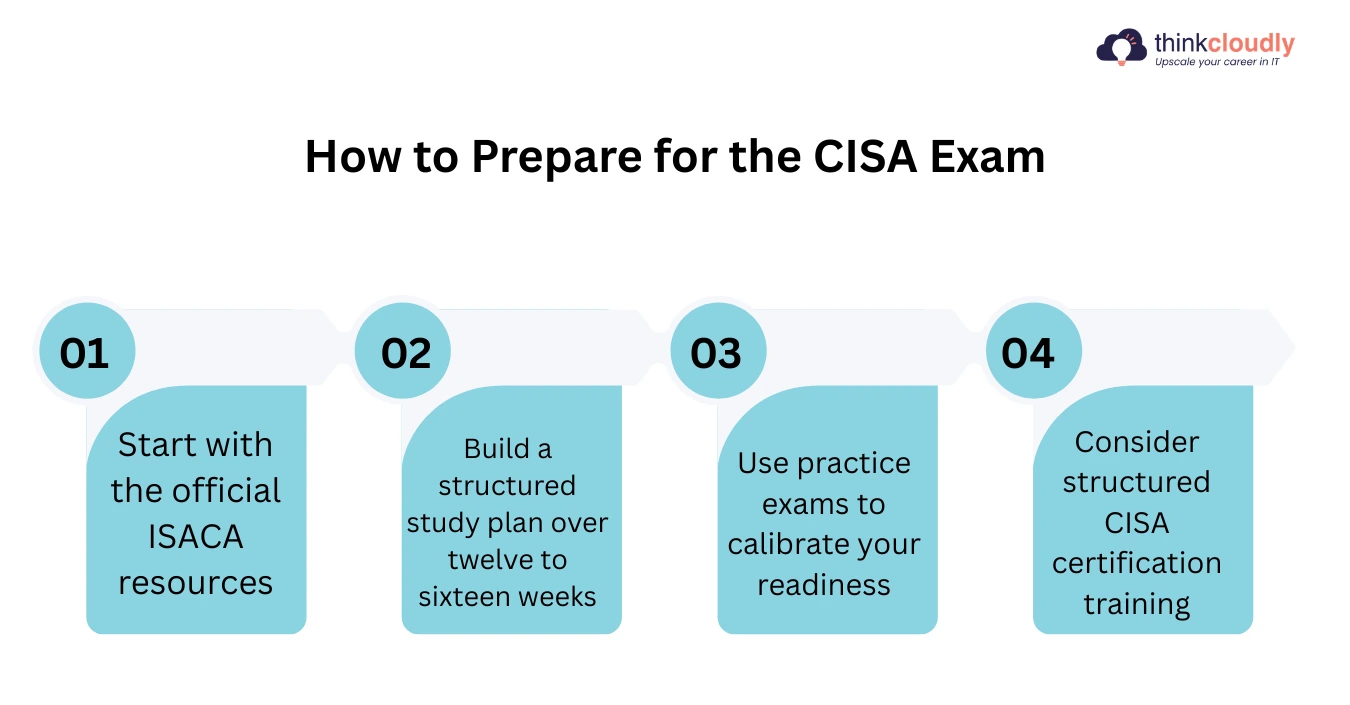
The ISACA CISA Review Manual is the primary study resource and covers all five exam domains in depth. The CISA Question, Answer, and Explanation database, commonly called the QAE, gives candidates access to practice questions formatted identically to the actual exam. Both are available directly from ISACA and are considered essential rather than optional.
Build a structured study plan over twelve to sixteen weeks
Most successful candidates report spending between 150 and 200 hours in total preparation. Spreading that over twelve to sixteen weeks with a consistent daily or weekly study schedule is more effective than cramming. Allocate study time proportionally across domains based on their exam weighting, spending more time on Domain 5 and Domain 4, which together represent 50% of the exam.
Use practice exams to calibrate your readiness
Practice exams are not just useful for testing knowledge. They train you to manage time under pressure and become familiar with how ISACA phrases its questions, which has a specific logical style that takes some adjustment. Aim to score consistently above 70% on full practice exams before booking your actual exam date.
Consider structured CISA certification training
For candidates who prefer guided learning or who find certain domains challenging, CISA prep courses provide structure and instructor support that self-study alone does not offer. ISACA’s official review course and well-regarded third-party providers are both viable options depending on your learning style and budget.
CISA vs. CISSP: Which Should You Pursue?
This is one of the most common questions among professionals evaluating their options, and the answer depends on what you want to do with your career.
|
Factor |
CISA |
CISSP |
|
Issuing Body |
ISACA | ISC2 |
| Primary Focus | IT audit, control, and governance |
Information security management |
|
Experience Required |
5 years in IT audit or security | 5 years in two or more security domains |
| Exam Questions | 150 questions, 4 hours |
125 to 175 adaptive questions, 4 hours |
|
Best Suited For |
IT auditors, risk and compliance professionals | Security managers, CISOs, security architects |
| Average US Salary | $132,000 (2025) |
$141,000 (2025) |
|
Global Recognition |
180 plus countries | 170 plus countries |
| CPE Requirement | 120 hours over 3 years |
120 hours over 3 years |
The clearest distinction is this: CISA is the credential for professionals whose work centres on auditing, assessing, and governing information systems. CISSP is the credential for professionals whose work centres on designing, implementing, and managing security programs. Many senior professionals hold both, particularly those in CISO or chief audit executive roles.
If your career is oriented toward IT audit, risk, and compliance, CISA is the more directly relevant and strategically valuable credential. If you are moving toward security architecture or security leadership, CISSP may be the stronger primary investment.
Conclusion
The CISA certification in 2026 represents one of the most clearly justified investments available to IT audit and governance professionals. The certified information systems auditor credential sits at the intersection of two trends that are not slowing down: increasing regulatory complexity and a persistent shortage of qualified IT audit talent.
The benefits of CISA certification extend beyond salary. The credential opens doors in enterprise risk management, signals a level of rigour that employers across industries recognize, and provides a career foundation that remains relevant as technology and compliance requirements continue to evolve.
Whether you are actively working in IT audit, transitioning into governance and risk, or planning your career path for the next five years, the CISA certification value in 2026 is as strong as it has ever been. The gap between supply and demand is not closing quickly, and that gap works directly in your favour.
Sources and References
- ISACA. CISA Certification: Official Exam and Certification Requirements 2026. (2026)
- ISACA. Global Salary Survey 2025: IT Audit, Risk, and Security Compensation Data. (2025)
- ISACA. State of Cybersecurity 2025: Workforce Trends and Skills Gap Analysis. (2025)
- Bureau of Labour Statistics. Occupational Outlook Handbook: Information Security Analysts. (2025)
- ISC2. CISSP Certification: Official Requirements, Exam Structure, and Salary Data 2025. (2025)
- Glassdoor. CISA Certified Professional Salary Trends and Compensation Data 2025. (2025)
- LinkedIn Talent Insights. IT Audit and Compliance Roles: Hiring Demand and Certification Preferences 2025. (2025)
- Forbes. Most Valuable IT and Cybersecurity Certifications in 2025. (2025)
- Burning Glass Technologies. Labor Market Analytics: CISA Certification Frequency in IT Audit Job Postings 2025. (2025)
- Coursera. Global Skills Report 2025: Cybersecurity and IT Governance Learning Trends. (2025)