
Can one certification actually change where your career goes? Or is it just a piece of paper that costs you time and money?
These are the questions most people don’t ask out loud—but almost everyone is thinking when they first hear about CISSP.
The honest answer is it depends on the certification. Most don’t move the needle much. But CISSP has a track record that’s hard to ignore. In 2026, there are 4.8 million cybersecurity program jobs worldwide with no one to fill them. Companies are hiring, budgets are being approved, and senior security roles are sitting open for months because qualified candidates are hard to find. CISSP holders sit in a different category from the average applicant — they earn significantly more, get called in for interviews more often, and are trusted with leadership roles faster. This blog is going to walk you through why that’s still true in 2026, what’s changed this year, and whether it’s the right move for where you are in your career right now.
The Certified Information Systems Security Professional has been around since 1994. That’s over three decades in an industry where most tools, threats, and frameworks become obsolete within five years. So, the question isn’t just whether CISSP certification is still relevant—it’s worth asking why ISC2 CISSP is still relevant and has outlasted so many of its competitors and whether that staying power means anything in 2026.
Let’s dig into the real numbers, the recent changes, and what this certification actually means for a career in security today.
What Exactly Is CISSP Certification — and Who Is It For?
If you’re not from the tech world, here’s the simplest way to understand CISSP: think of it as the MBA of cybersecurity. It doesn’t just test whether you can hack a system or set up a firewall. It tests whether you understand how organizations think about security—risk, governance, architecture, legal compliance, and everything in between.
Issued by ISC2 (the International Information System Security Certification Consortium), CISSP certification covers eight domains of security knowledge—from how to design secure systems to how to respond when things go wrong. It’s built for professionals who are moving into senior roles: security architects, security managers, chief information security officers (CISOs), and IT directors.
The catch? You need at least five years of paid, full-time work experience in at least two of those eight domains before you can even sit for the exam. This isn’t a security certification you can grab fresh out of college. That’s entirely by design — and it’s a big part of why employers trust it.
The 2026 Numbers: What the Data Actually Shows
Here’s where things get interesting. Forget the marketing fluff — what does the 2026 job market actually say about CISSP?
1. Salary Reality in 2026
According to Glassdoor data compiled as of February 2026, the median total salary for CISSP holders in the US sits at $164,000. Research.com, in an analysis published in March 2026, puts the average at $131,000 — with CISSP holders earning a 37% pay premium over their non-certified peers doing the same work. To put that in perspective: if you’re earning $90,000 without the cert, a CISSP badge could reasonably move you to $123,000+ in the same industry, often without changing employers.
At the senior end, roles like Security Architect pull an average of $152,308, while Security Engineers average around $113,903.
2. Job Demand in 2026
In 2026, there are 70,082 U.S. job listings that explicitly require CISSP certification — meaning it’s listed as a prerequisite, not just a nice-to-have. Beyond that, CyberSeek data from 2025 shows that 89% of hiring managers will not even interview candidates for security certification roles if they lack relevant certifications. That’s not a soft preference — it’s a hard filter operating before your resume reaches a human.
The U.S. Bureau of Labor Statistics projects 29% job growth for information security specialists through 2032, which is roughly four times faster than the average for all other occupations. The demand isn’t slowing down.
What Changed in 2026: The ISC2 Waiver Shake-Up
One of the biggest news items in the CISSP world this year is a change that took effect April 1, 2026: the ISC2 certification program cut its CISSP experience waiver list from approximately 50 certifications down to just 25.
What does this mean in plain terms? Previously, if you held certain other certifications — like CEH (Certified Ethical Hacker), CISA, CRISC, or OSCP — you could use those to waive one year of the required work experience. Starting April 2026, those shortcuts are gone for many credentials. ISC2 CISSP removed several heavyweights from the approved list, keeping primarily its own internal certification pathway intact (like CCSP, its cloud security cert) and a narrowed set of vetted credentials.
This is a significant move. It makes CISSP harder to shortcut into and signals that the ISC2 certification program is doubling down on the experience requirement as a core part of what makes the certification credible. If you were planning your certification path banking on a waiver that’s now gone, you’ll need to rethink your timeline.
The 2025 ISC2 Workforce Study: What the Industry Is Really Saying
In December 2025, ISC² released findings from its annual Cybersecurity Program Workforce Study—the largest to date, with 16,029 cybersecurity professionals surveyed across North America, Latin America, Asia-Pacific, Europe, the Middle East, and Africa.
The findings paint a picture of an industry under pressure but stabilizing:
- 88% of respondents reported concrete consequences from skills shortages at their organizations
- 33% said their organizations don’t have the resources to adequately staff their security teams
- Budget cuts (36%) and layoffs (24%) both decreased by one percentage point from the previous year—a small but meaningful sign of stabilization
- The global gap in unfilled cybersecurity program positions sits near 4.8 million
- 30% of respondents cited the inability to find people with needed skills as a primary driver of shortages
- 15% noted that AI adoption is causing genuine uncertainty about which skills will even be needed in the near future
The AI point is worth dwelling on. The cybersecurity skills landscape is shifting fast, and certifications that focus on principles—risk management framework, security architecture, and governance—are better positioned than purely technical credentials to remain valuable as specific tools and threats evolve.
CISSP Certification vs. Other Major Certifications in 2026
Here’s how CISSP stacks up against its closest rivals right now:
|
Certification |
Issuing Body | Focus Area | Avg. Salary (US) | Holders Globally |
Experience Required |
|
CISSP |
ISC2 | Broad security mgmt & architecture | $131K–$164K | 152,000+ |
5 years (2+ domains) |
|
CISM |
ISACA | IT governance & risk management | $150K | 70,000+ |
5 years (3 in mgmt) |
|
CISA |
ISACA | Audit & compliance | ~$120K | 175,000+ |
5 years |
|
CEH |
EC-Council | Ethical hacking / pen testing | ~$95K | Varies |
2 years |
|
CompTIA Security+ |
CompTIA | Entry-level security fundamentals | ~$75K | Varies |
None |
CISSP carries the broadest recognition in senior security certification job postings and delivers one of the highest salary premiums. CISM can slightly edge it on average salary in management-focused roles but covers fewer domains and is narrower in scope. CEH is more appropriate for hands-on penetration testers — it’s a different type of credential solving a different problem.
For anyone targeting a CISO, security director, or senior architect role, CISSP certification remains the most universally respected credential to have on a resume.
The Four Things That Make CISSP Certification Different from the Rest
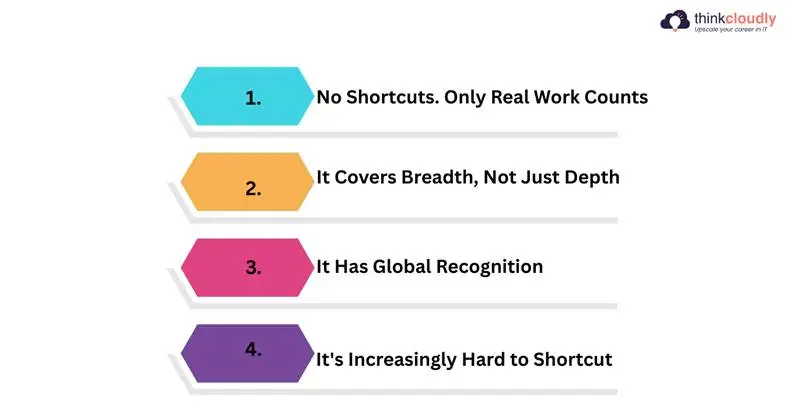
1. No Shortcuts. Only Real Work Counts.
The five-year experience requirement isn’t just a bureaucratic hurdle. It’s the mechanism that keeps CISSP from becoming a paper credential. You cannot memorize your way into it without having actually worked in the field. This is precisely why employers trust it more than certifications that anyone with enough study time can pass.
2. It Covers Breadth, Not Just Depth
CISSP’s eight domains range from Security Governance and Risk Management Framework to Software Development Security. This breadth is sometimes criticized—”jack of all trades, master of none”—but it’s also what makes CISSP holders effective in senior roles where they need to communicate across technical, legal, financial, and executive teams. A CISO who only understands network security is a liability. CISSP is designed to produce well-rounded leaders.
3. It Has Global Recognition
With over 152,000 certified professionals worldwide, CISSP is recognized across industries and borders in a way that many regional or vendor-specific certifications are not. Whether you’re working in financial services in New York, tech in Singapore, or government contracting in Brussels, the credential travels with you. Organizations that take security governance seriously…consistently list CISSP as the expected credential for leadership hires.
4. It’s Increasingly Hard to Shortcut
The April 2026 waiver changes mean the bar for entering the CISSP path is rising, not falling. That sustained rigor is part of what keeps the credential valuable. If the ISC2 certification program had made it easier to obtain, it would dilute the very thing that makes it worth pursuing.
How to Prepare for CISSP Certification in 2026?
For senior professionals looking to bridge this gap and step into executive leadership, the Certified Information Systems Security Professional (CISSP) credential remains the undisputed gold standard. However, preparing for this elite certification is notoriously difficult. The exam is delivered through a complex Computerized Adaptive Testing (CAT) system that probes your high-level governance and risk management framework mindset—not just your technical memorization.
Candidates need to make a dramatic shift in the way they study for the CISSP exam. To navigate this huge body of knowledge, you need a strategic study of architecture and manage your preparation as an enterprise project. If you are a hands-on professional who wants to learn these complex concepts quickly and efficiently, then the ThinkCloudly Cybersecurity Online Training Courses can help you to build a solid structured path under the guidance of experts.
The Three Pillars of 2026 CISSP Success:
-
Think Like a Risk Executive: The most common reason brilliant engineers fail the CISSP is attempting to answer questions as a technical fixer. The exam wants you to think like a manager.
-
Target the Heavyweight Domains: While you must understand all eight domains, focus heavily on Security Governance and Risk Management (Domain 1), Identity and Access Management (Domain 5), and Security Operations (Domain 7).
-
Practice with Adaptive Simulation: Since the live CAT exam automatically cuts off once it determines your competency with 95% confidence, you must train your mental endurance by taking timed, mixed-domain practice exams that simulate scenario-based questions.
Understanding the 2026 CISSP Experience Matrix
The path to full certification requires a serious professional background. If you do not meet the direct criteria below, you can still test to become an Associate of ISC² while you build up your active years of experience.
|
Requirement Path |
Mandatory Experience Time | Permissible Waivers |
Key Strategy Element |
|
Standard Route |
5 years of full-time experience across 2 domains. | None |
Document your past security roles meticulously. |
|
Education Route |
4 years of full-time experience across 2 domains. | 4-Year Bachelor’s or Master’s degree in IT/CS. |
Map your degree modules to the core domains. |
|
Credential Route |
4 years of full-time experience across 2 domains. | 1 active credential from the verified ISC² list. |
Confirm your specific certification remains on the updated list. |
At the end of the day, earning this elite credential is about finding the balance between technical depth and high-level managerial authority. You’re running a disciplined study plan, breaking the domains down into organized weekly milestones, and building your confidence with recognized industry mentors as you plan for long-term professional success.
Is CISSP Certification Still Worth It in 2026?
The honest answer: yes — but only if you’re at the right stage of your career.
If you have fewer than three years of security experience, CISSP is not your next move. Start with CompTIA Security+ or ISC2’s own Certified in Cybersecurity (CC) credential to build the foundation. Then accumulate experience. If you have four to six years under your belt and you’re eyeing management, architecture, or consulting roles, CISSP is arguably the highest-ROI security certification you can pursue. The 37% salary premium, the job listing filter that favors certified candidates, and the global recognition all point in the same direction.
The 2026 data don’t show a credential in decline. It shows a credential that’s gotten stricter about who earns it—and that’s a good sign for everyone already holding it and a clear goalpost for everyone working toward it.
Sources
- ISC2 – 2025 Cybersecurity Workforce Study (December 2025)
- Research.com – Is the CISSP Certification Worth It (March 2026)
- Coursera – CISSP Salary Guide (February 2026)
- Training Camp – ISC2 Cuts CISSP Experience Waiver List (February 2026)
- Axis Intelligence – Best Cybersecurity Certifications 2026 (March 2026)
- ExamCert – Is CISSP Worth $749 in 2026 (March 2026)
- EITT Academy – CISSP vs CISM vs CISA 2026
- ISC2 PRNewswire – 2025 Workforce Study Press Release (December 2025)
- ISC2 – 2025 Cybersecurity Hiring Trends Report
- Deepstrike – Top Cybersecurity Certifications 2025 (October 2025)
- GRSEE – Best Cybersecurity Certifications 2026 Expert Comparison (January 2026)
- Certified CISSP – ISC2 Closes Free CC Program (May 2026)