
Scrum adoption is under pressure in 2026. Half your code is drafted by an AI assistant, half your team hasn’t badged into an office since 2023, and last week someone on Slack proposed scrapping the daily standup. If you’re wondering whether the framework your delivery model rests on still earns its keep, you’re not alone.
“Scrum is dead” is a favourite take on LinkedIn and in conference halls. AI is compressing release cycles, hybrid work has rewired collaboration, and Agile project management keeps shifting faster than playbooks can capture. So here’s the real question: is Scrum dying, or are organizations reshaping it into a leaner version? After years inside these teams, my answer leans toward the second—so let’s look at what the 2026 data, not the hot takes, says about Scrum adoption.
Why People Think Scrum Is Dying in 2026
The “Scrum is dead” story rests on three genuine shifts worth naming honestly.
Rise of AI-Powered Development Teams
GitHub Copilot and coding agents have collapsed timelines that once defined a sprint. When a two-week feature ships in an afternoon, the old ceremony cadence can feel like overhead. But AI speeds up how work gets built, not what to build or in what order — and those decisions are exactly what Scrum adoption exists to structure. The framework is being stress-tested, not retired.
Scrum Fatigue Across Organizations
Ask any developer for their biggest gripe, and “too many meetings” lands fast: standups that drift into status theatre, retros that change nothing, and reviews nobody reviewed. That burnout is earned — but it’s a failure of practice, not of the Scrum framework itself. Real organizational agility depends on leaders who back iterative delivery, not teams handed a board and told to get on with it.
Teams Moving Beyond Traditional Scrum
More teams now blend Scrum with Kanban, lean delivery, and continuous flow—evolution, not abandonment. The teams I watch still run planning, retrospectives, and refinement religiously—solid Agile project management—but drop rituals that don’t serve their workflow.
2026 Data on Scrum Adoption: What the Numbers Actually Show
Perception and data tell different stories, and the data is far calmer than the feed suggests. If Scrum adoption were truly collapsing, the numbers would have cracked by now.
Scrum Remains the Most-Used Agile Methodology
Across nearly two decades of Digital.ai‘s State of Agile research, Scrum has stayed the most widely used framework in every edition, with Scrum-Kanban blends the most common combination. Frameworks come and go; the heartbeat of delivery stays at the team level—the evolution of enterprise Agile, not its collapse. Numbers back this up clearly — 63% of Agile practitioners across 80 countries actively use Scrum, making it the single most dominant framework globally. Meanwhile, overall Agile adoption has reached 94–95% of organizations worldwide, a clear sign that the ecosystem Scrum anchors is anything but shrinking.”
Large Enterprises Still Invest in Scrum Training
Enterprise Agile transformation hasn’t slowed; it’s grown up. Organizations stopped asking “should we do Agile?” years ago; now they ask how to deliver value across forty teams. The latest State of Agile findings capture the shift: ~84% now use AI in delivery, yet governance and leadership alignment lag behind. (Source: Digital.ai State of Agile 2024)
Certification Demand Is Growing
Demand for CSM, Professional Scrum Master (PSM), and SAFe framework credentials keeps climbing, not cratering. Hundreds of thousands hold active Scrum credentials, and employer appetite for SAFe-aligned skills rises as enterprises scale Agile transformation is a clear signal Scrum adoption is anything but finished.
How Scrum Has Evolved Since 2020
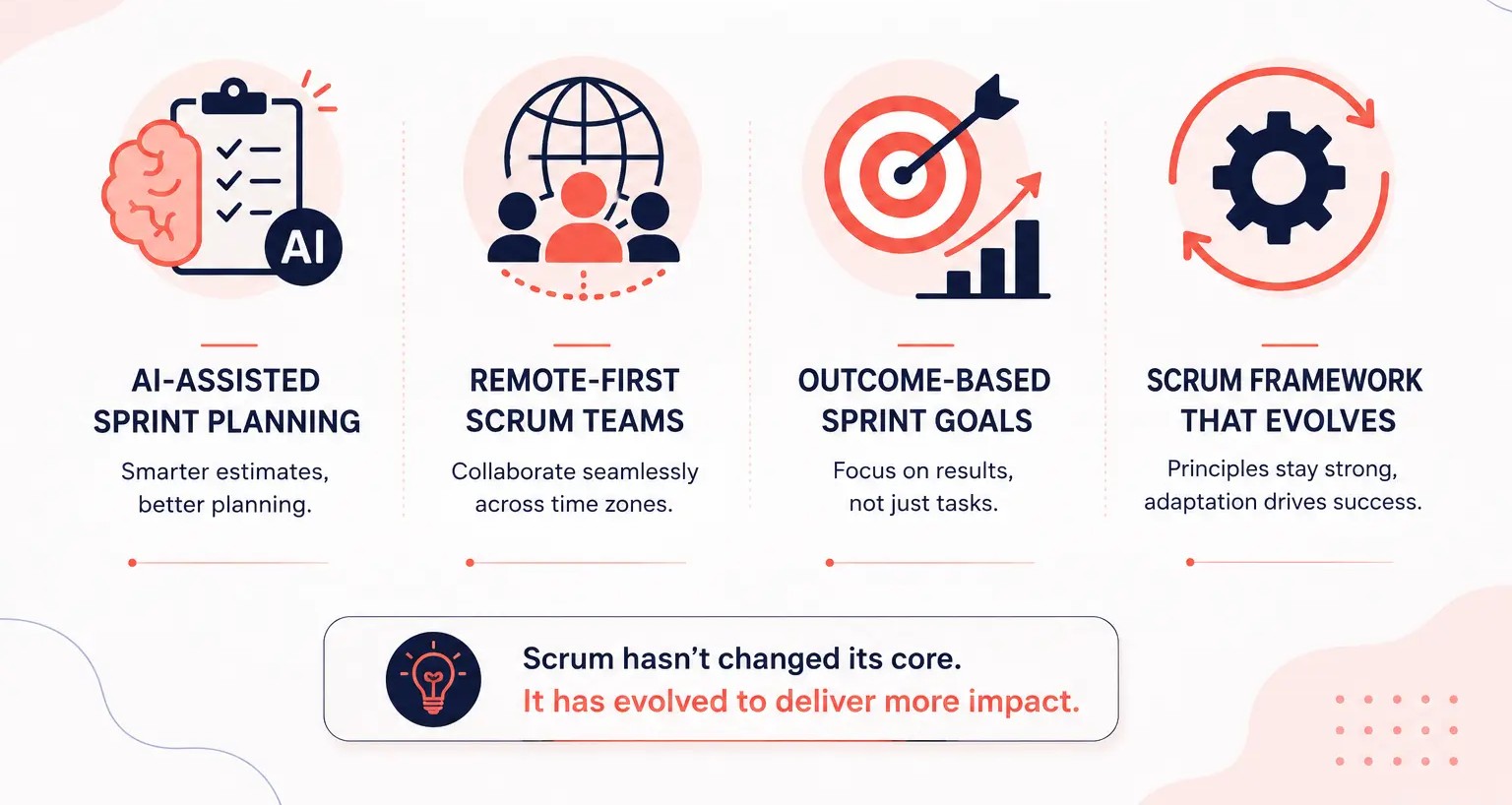
Most coverage stops short here. Scrum adoption in 2026 looks nothing like 2019: the framework hasn’t died; it’s moulted. The principles held; the application changed, and reading that shift is the key to the Agile future. In every team I’ve worked with through this shift, the ones that adapted fastest weren’t the ones with the best tools—they were the ones whose Scrum Masters understood why each ceremony existed, not just how to run it.
AI-Assisted Sprint Planning
Planning now often opens with AI-generated estimates from velocity history, flagged dependencies, and draft backlogs—tools like LinearB, Jira’s AI features, and GitHub Copilot are already embedded in how mature Scrum teams operate. Teams still decide; the grunt work shrinks. The Scrum framework supplies the structure; AI, the data crunching—an upgrade, not a threat
Remote-First Scrum Teams
Ceremonies built for one room now run on async updates, recorded stand-ups, and live digital boards. Distributed teams are the norm, and organizational agility now means collaborating across time zones. Oddly, this helped: the written artifacts’ remote work demands made the Scrum framework more transparent than the whiteboard era.
Outcome-Based Sprint Goals
Older Scrum measured success by tickets closed. Mature agile project management measures outcomes—did conversion rise? Did retention move? Tying sprints to results rather than activity is one of the healthiest shifts shaping the Agile future.
Scrum vs SAFe vs Kanban in 2026
Much of the confusion comes from blurring Scrum with the frameworks built around it. Here’s how they compare:
|
Factor |
Scrum | SAFe |
Kanban |
|
Team size |
Small, single team | Enterprise, multi-team |
Any size |
|
Planning unit |
Sprint | Program Increment |
Continuous flow |
|
Flexibility |
Medium | Lower |
High |
|
Governance |
Medium | High |
Low |
|
Best fit |
Product teams | Large-scale coordination |
High-variability work |
Enterprise Agile and Organizational Agility: Why They Need Scrum
Enterprise Agile isn’t just Scrum scaled up — it’s Scrum made intentional across the whole organization. Organizational agility means the ability to sense change and respond faster than competitors, and that capability lives or dies at the team level. Scrum provides the heartbeat—the sprint cadence, the feedback loops, the daily alignment—that enterprise Agile programs depend on staying grounded. Without it, SAFe becomes a governance framework with no delivery engine underneath.
Companies aren’t replacing Scrum with the Scaled Agile Framework or Kanban — they’re combining them. A typical enterprise Agile transformation runs Scrum at the team level, layers the SAFe framework on top for coordination, and lets Kanban handle operational flow. Recent data shows ~74% of organizations run hybrid or blended models rather than one pure framework, with the SAFe framework near 44% adoption at scale. Scrum isn’t shrinking — it’s one ingredient in a larger system. That’s maturity, not decline.
Where Scrum Adoption Is Growing Fastest in 2026: Industry Breakdown
Some are leaning in harder than ever — where regulation, risk, and speed collide.
AI & SaaS Companies
Fast product teams rely on sprint cadence to ship incrementally while layering AI on top. Disciplined Agile project management keeps that speed from becoming chaos.
FinTech & Risk-Heavy Industries
Risk, audit, and GRC readers should lean in. Financial services teams use sprint reviews and retros as compliance checkpoints—clean control points for change documentation, audit trails, and sign-off. If you already think in controls, Scrum’s rhythm maps onto your world more naturally than you’d expect.
Healthcare Technology
Health-tech teams adopt Scrum to ship regulated change in small, reviewable increments, not risky big-bang releases. Here, organizational agility means absorbing shifting compliance rules without derailing the roadmap. I’ve seen this firsthand—health-tech teams using sprint reviews as literal sign-off gates for compliance documentation. It works better than any waterfall checkpoint I’ve observed
Government Digital Transformation
Public-sector programs once synonymous with waterfall now run Scrum-based delivery, often paired with the SAFe framework for coordination. Agile transformation in government has moved from novelty to default.
4 Challenges That Slow Scrum Adoption — And How to Fix Them
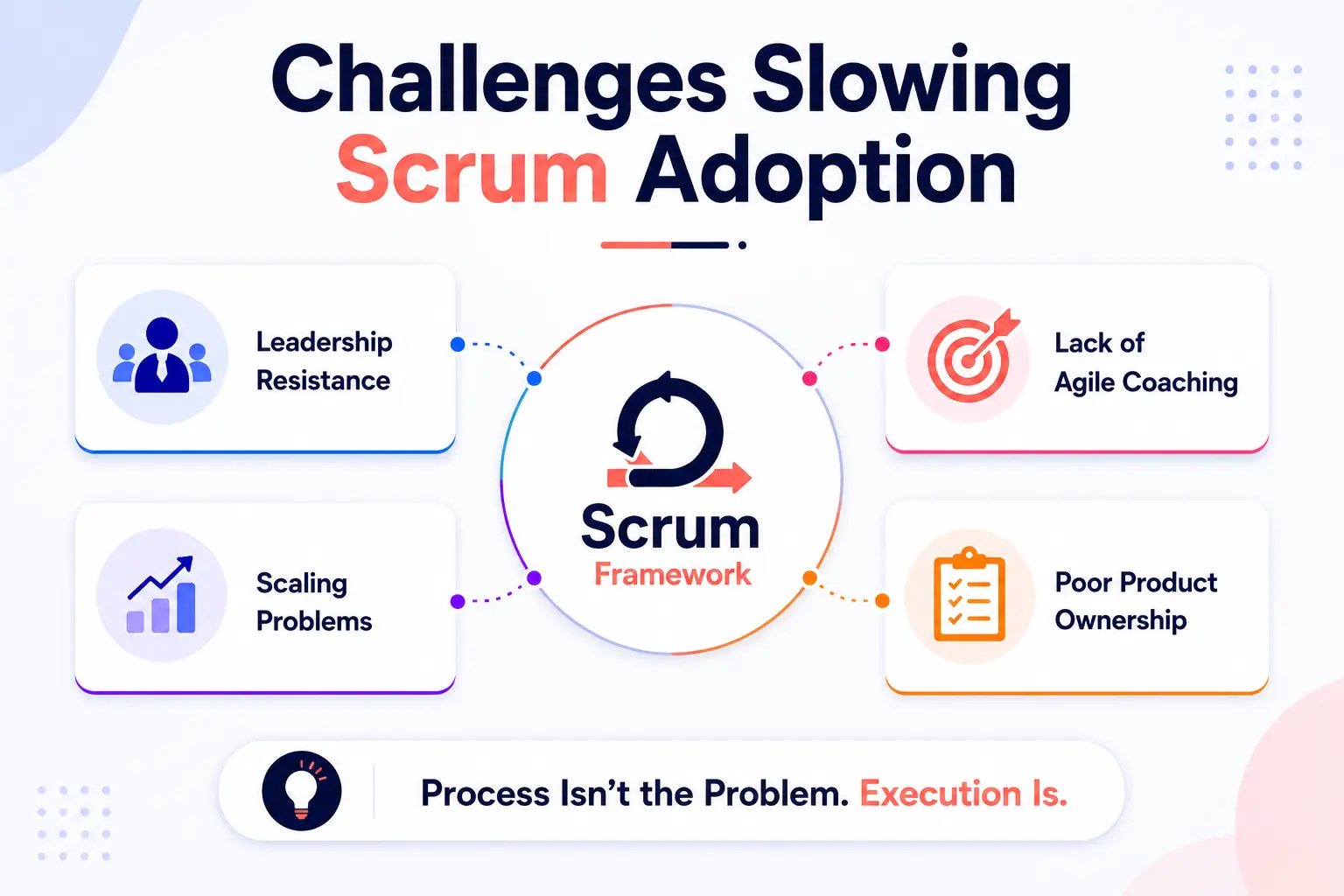
The framework usually works—implementation quality is what varies. Most stalled rollouts trace to four fixable patterns, not the method.
Leadership Resistance
Executives wanting fixed scope and dates clash with iterative delivery, stalling enterprise Agile before it starts. Organizational agility is a leadership capability first and a team-level one second.
Lack of Real Agile Coaching
Sending five people to a two-day course and calling it Agile transformation is the most common own goal I see. Without ongoing coaching, ceremonies hollow out, and the Scrum framework loses its edge.
Scaling Problems
What runs for ten people fractures across fifteen teams without coordination—the gap the SAFe framework was built to close. Scale without it and you get “zombie Scrum”: all ceremony, no outcome. Enterprise Agile at scale needs deliberate design, not more sprints.
Poor Product Ownership
A Scrum framework is only as strong as the person ranking the backlog. Vague criteria and weak prioritization stall more rollouts than any tooling gap—and that’s fixable.
What the Agile Future Looks Like
No credible signal points to Scrum disappearing — only to it becoming the governance layer around faster delivery.
AI-Augmented Scrum Teams
Expect AI copilots embedded in planning, retrospectives, and grooming—assisting human judgment, not replacing it. In that model the Scrum framework matters more, not less: someone must govern what the machines produce.
Data-Driven Sprint Planning
The Agile future of planning isn’t gut feel—it’s predictive analytics on velocity, cycle time, and dependencies, validated by judgment. Mature enterprise Agile programs already work this way.
Continuous Delivery + Scrum
Sprints and continuous deployment keep blurring. Code ships continuously while ceremonies anchor strategy and feedback—a model many enterprise Agile organizations already run. Expect this blend to define the Agile future and the next wave of Agile transformation.
Hybrid Agile Ecosystems
The Agile future isn’t “Scrum vs everything.” It’s deliberate combinations—Scrum, the SAFe framework, Kanban, and lean—chosen by team size, industry, and governance needs. Maturity in 2026 isn’t which framework you pick; it’s how intentionally you design the system, the real measure of organizational agility and the endgame of serious Agile transformation.
Career ROI: Scrum Master Salary, Demand, and Certification Value in 2026
For career changers, students, and professionals crossing over from audit, risk, or compliance, Scrum adoption skills pay well—and the numbers back that up clearly.
The national average Scrum Master salary in the US is $126,833 per year, according to Glassdoor’s June 2026 data drawn from over 10,000 anonymous salary submissions. ZipRecruiter’s June 2026 data puts the figure at $120,688, while PayScale reports a median of $106,876—the lower number reflects a higher share of early-career respondents in their dataset. For a mid-level Scrum Master with 3–5 years of experience and an active certification, realistic base salary expectations sit between $110,000 and $135,000 in most US markets.
What Does a Scrum Master Earn by Experience Level?
- Entry level (under 1 year): $72,000–$94,000
- Mid-career (3–5 years, certified): $110,000–$135,000
- Senior (7+ years): $130,000–$162,000
- SAFe-credentialed / Release Train Engineer: $150,000–$200,000+
Source: Glassdoor June 2026, Built In 2026, ZipRecruiter June 2026.
Which Industries Pay Scrum Masters the Most?
Industry matters as much as experience. Glassdoor’s 2026 industry breakdown shows these top-paying sectors for Scrum Masters in the US:
- Aerospace & Defense: $140,238 median (SAFe at scale + security clearance premium)
- Human Resources & Staffing: $138,844 median
- Energy, Mining & Utilities: $137,313 median
- Financial Services: $134,331 median (Mastercard, Morgan Stanley, Silicon Valley Bank)
- Management & Consulting: $134,170 median (Accenture, Deloitte)
The aerospace premium exists for a clear reason: these teams don’t just run Scrum—they run SAFe across dozens of programs with regulatory oversight and cleared personnel requirements, which compresses the candidate pool and pushes compensation up sharply.
Does Certification Actually Raise Your Salary?
Yes, measurably. Glassdoor’s data for Certified Scrum Masters specifically shows a median total pay of $143,262—roughly $16,000 more than the general Scrum Master median. That gap reflects both employer filtering (many enterprise ATS systems screen for CSM explicitly) and the practical capability signal a certification carries.
CSM (Certified ScrumMaster): Broadest market access, most recognized in corporate HR systems. Best for professionals entering the role or moving across industries.
PSM (Professional Scrum Master): Harder exam, lower cost, respected by technical hiring managers. Best cost-to-knowledge ratio.
SAFe SM: High demand in enterprise environments where the Scaled Agile Framework is the operating model. Finance and aerospace roles often list this as preferred or required.
The BLS projects a 6% employment growth for project management specialists between 2024 and 2034 — roughly in line with the average across occupations. Combine that with Scrum-specific salary premiums and the low barrier to first certification, and the effort-to-opportunity ratio is one of the strongest in enterprise delivery roles.
Ready to start your certification path? Explore our Scrum certification courses.
Is Scrum Adoption Dead or Still Growing?
The honest verdict: Scrum adoption isn’t dying — it’s maturing. Rigid ceremonies are changing, enterprise demand for structured delivery is rising, and AI is accelerating execution inside the framework, not erasing it. Hybrid models are the reality, not a death knell.
The teams winning at Agile project management in 2026 aren’t running textbook ceremonies—they grasp why those ceremonies exist and adapt them: AI-assisted planning, async standups, and the SAFe framework layered on for coordination. The Scrum that’s genuinely dying is the hollow, checkbox kind. Real, outcome-driven Scrum is the backbone of the Agile future, and the organizational agility it builds is what 2026 rewards. Focus on outcomes over rituals, and Scrum adoption keeps growing — well beyond 2026.