
Here is a number that should make any team leader pause: According to Agile Data Reports 94% of organizations worldwide now report using Agile practices—yet only 11% have reached a high level of maturity in those practices. That gap — between doing Agile and being Agile — is not a process failure. It is an agile mindset failure. And right now, in 2026, it is quietly draining team energy, slowing value delivery, and killing the results that organizations originally adopted Agile to achieve. If your team is running standups and managing sprints and still feeling like something is off, this blog is exactly what you need to read.
Why the Agile Mindset Gap Exists—and Why It’s Getting Worse?
Most organizations approach Agile transformation the same way they approach a software installation. They bring in a consultant, train teams on Scrum ceremonies, buy JIRA licenses, and call it done. The rituals are in place. The tools are running. But the thinking has not changed. This is the core of the agile mindset gap:
adopting Agile practices without adopting Agile principles.
And the 2025–2026 data makes the cost of this gap painfully clear. A Boston Consulting Group study found that nearly 70% of Agile transformations fail to meet their stated objectives. A TransformXperience analysis found that 84% of large enterprises either abandon or lose momentum within 18 months of launching their Agile programs. Jeff Sutherland, co-creator of Scrum, estimates that 47% of all Agile transformations fail outright.
These are not technology failures. They are not sprint planning failures. They are culture failures—and Agile culture failures specifically. Teams attend all the right ceremonies while continuing to think in the old ways: waiting for permission, avoiding risk, and measuring success by activity rather than by outcomes. As McKinsey’s 2025 State of Agile Report found, 91% of executives identify an organizational Agile mindset as the single most critical capability for navigating rapid business change. The will to change is there at the top. The shift in day-to-day thinking is not, and that is precisely the gap that is costing teams their results.
Agile ways of working cannot be installed from the outside. They have to be grown from the inside, through deliberate shifts in how people think, decide, and collaborate every day.
What an Agile Mindset Actually Looks Like in Practice?
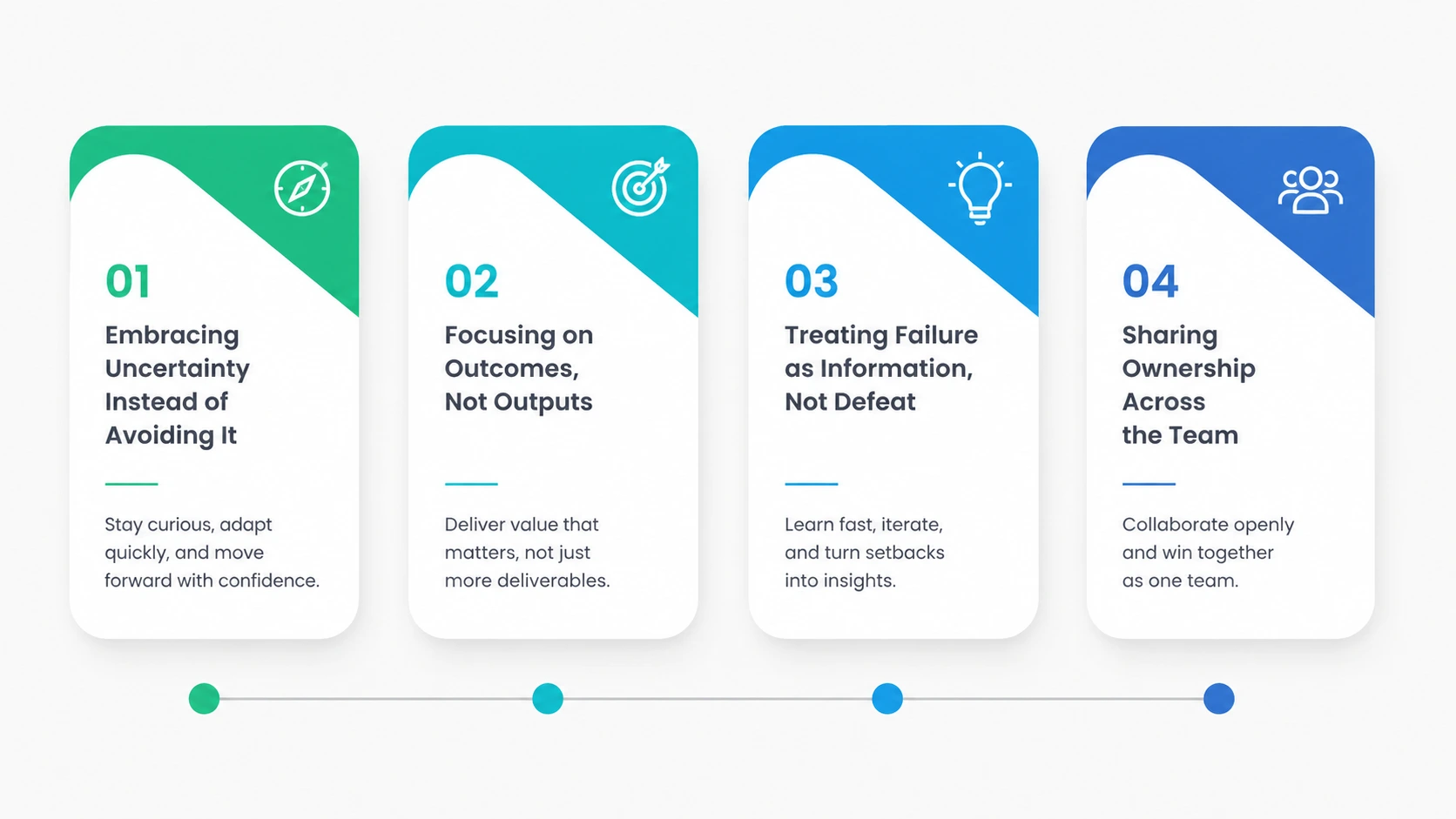
Understanding what an agile mindset is matters as much as understanding what it isn’t. It is not a personality type, and it is not something you develop in a two-day workshop. An agile culture is built around four daily behaviors that shift how decisions get made and how teams interact.
1. Embracing Uncertainty Instead of Avoiding It
Traditional project management is designed to eliminate uncertainty before work begins. An agile mindset does the opposite—it plans for the fact that requirements will change, that customer needs will evolve, and that the best path forward will only become visible through incremental delivery and feedback. Teams with this thinking treat every sprint not as a box to tick but as a learning loop.
2. Focusing on Outcomes, Not Outputs
This is where value delivery takes center stage. A team without an Agile orientation measures itself by how many tickets it closes. A team with a genuine agile mindset measures itself by whether customers are actually better off. The State of Agile 2026 found that only 29% of teams are currently judged by value delivered—meaning the majority are still optimizing for the wrong thing.
3. Treating Failure as Information, Not Defeat
Continuous improvement requires psychological safety—an environment where people feel safe pointing out what is not working without fear of blame. Without it, retrospectives become performative, problems get buried, and teams repeat the same mistakes sprint after sprint. This is an agile culture deficit, not a process one.
4. Sharing Ownership Across the Team
Siloed accountability—where one person carries the outcome—is the enemy of business agility. An Agile-minded team distributes ownership, makes decisions collectively, and holds shared accountability for results. Deloitte research confirms that organizations with mature Agile frameworks achieve 47% faster product development cycles and 73% higher quality scores.
The Five Signs Your Team Has an Agile Mindset Gap
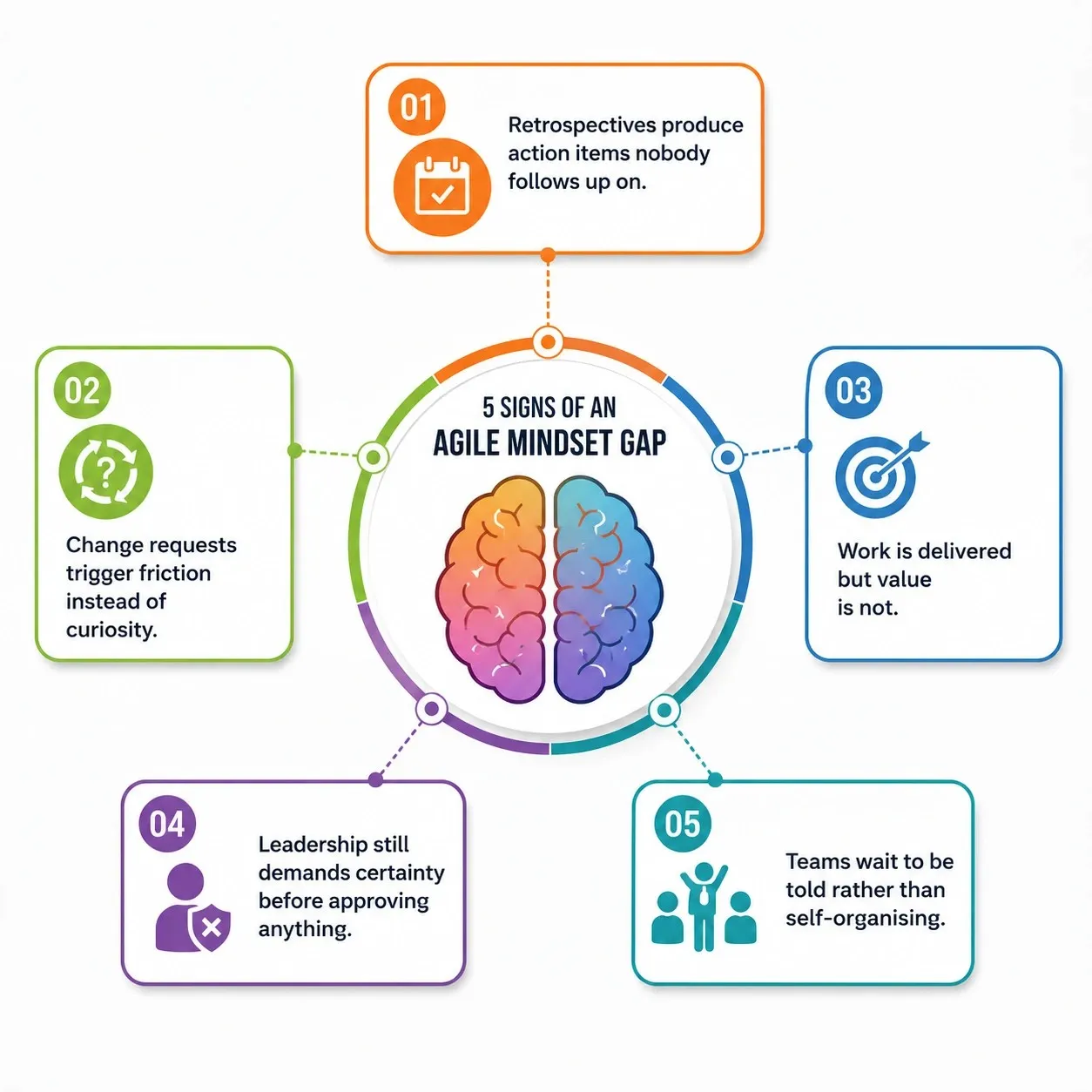
Before you can close a gap, you have to see it clearly. These five signals appear in teams that have adopted Agile Ways of Working in structure but not in spirit.
- Retrospectives produce action items nobody follows up on. When continuous improvement is only a meeting on the calendar—and the outcomes from that meeting do not change how the team actually works—the mindset gap is visible. Agile transformation stalls most often not in the sprint but in the system around it.
- Change requests trigger friction instead of curiosity. If your team reacts to new information with resistance rather than adaptation, that is an agile mindset problem. True business agility means welcoming the pivot, not tolerating it.
- Work is delivered but value is not. A completed sprint that does not move a customer outcome is a symptom of a team focused on incremental delivery of tasks rather than incremental delivery of genuine customer value. There is a meaningful difference between the two.
- Leadership still demands certainty before approving anything. Adaptive leadership is the organizational fuel for agile transformation. When leaders require full-plan certainty before greenlighting work, they undermine the speed and flexibility that Agile is supposed to provide. Research found that effective adaptive leadership characterized over two-thirds of successful digital transformations—and that 90% of those that failed lacked it.
- Teams wait to be told rather than self-organizing. Autonomous, empowered decision-making is a cornerstone of agile ways of working. When teams consistently wait for management approval before acting, the structure may be agile, but the culture is not. The 2026 State of Agile report confirms that 42% of respondents cite resistance to change as the single biggest impediment to agile—and almost all of that resistance is cultural, not technical.
Agile Mindset Gap — Symptoms, Root Causes, and Fixes
|
Symptom |
Root Cause |
Fix |
|
Retrospectives have no visible impact |
Weak Continuous Improvement culture |
Leaders must visibly act on retro outputs every sprint |
|
Teams resist mid-sprint change |
Agile Culture not embedded |
Reframe change as information, not disruption |
|
Delivery without customer outcomes |
Value Delivery metrics absent |
Replace velocity targets with outcome-based KPIs |
|
Leadership requires certainty first |
Adaptive Leadership gap |
Train leaders in Agile governance and autonomous decision-making |
|
Teams wait for approval before acting |
Agile Ways of Working not internalised |
Define and communicate team-level decision rights |
|
Transformations stall within 18 months |
Surface-level Agile Transformation |
Change funding models, culture, and measurement systems together |
|
Poor collaboration across functions |
Siloed ownership model |
Build shared accountability into sprint goals |
|
Knowledge stays in silos |
No Business Agility infrastructure |
Introduce Communities of Practice and embedded Agile coaching |
How Adaptive Leadership Closes the Agile Mindset Gap
The most overlooked lever in closing the agile mindset gap is leadership behavior. Agile transformation programs almost universally focus on teams—training Scrum Masters, coaching Product Owners, and running team-level workshops. But the evidence consistently shows that the ceiling of any Agile program is set by how leaders behave, not by how teams are structured.
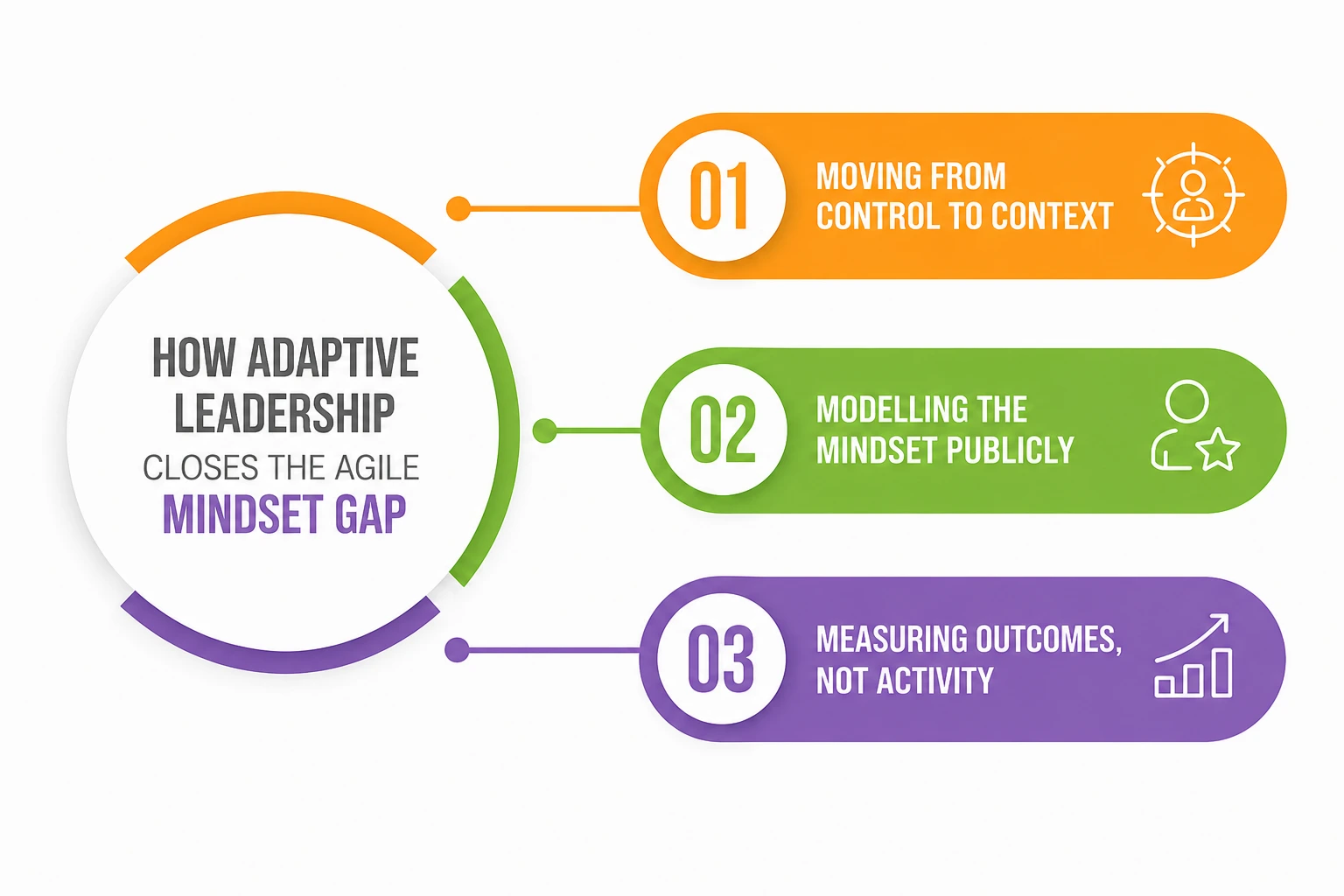
Adaptive leadership in an agile context means three specific things.
-
Moving from Control to Context means that rather than approving every decision, leaders define the why and the boundaries, then trust teams to figure out the how. This is what enables genuine business agility at scale. When teams understand the goal and are trusted to reach it, they move faster, adapt more readily, and take more accountability for outcomes.
-
Modelling the Mindset Publicity is non-negotiable. Leaders who talk about embracing uncertainty in all-hands meetings but demand fixed-scope commitments in budget reviews are sending contradictory signals. Teams follow what leaders do, not what they say. McKinsey’s analysis found that treating Agile as a checklist leads to only a 53% success rate—while a genuine mindset commitment changes outcomes dramatically.
-
Measuring Outcomes, Not Activity is a decision that only leaders can make. The shift from velocity charts to value delivery metrics signals to every team what actually matters. When leaders reward continuous improvement over task completion, the whole organization’s focus shifts with them.
ING Bank’s Digital Platform Tribe is a real example. When leaders rebuilt trust, shifted to transparency, and focused on agile principles rather than agile ceremonies, Net Promoter Score rose 60 points and employee engagement reached 88% within a single year.
Building an Agile Culture That Actually Sticks
Here is something Agile Ways of Working frameworks rarely say plainly: you cannot train your way to an Agile culture. Culture is built through repeated experiences—what leaders reward, what gets discussed in tough conversations, and what happens when someone admits a mistake. The organizations that close the agile mindset gap do it by changing three structural things simultaneously.
-
Funding Models—Annual project budgets are structurally incompatible with incremental delivery. Moving to quarterly, outcome-based funding cycles gives teams the financial flexibility to iterate and pivot rather than deliver a plan that was outdated six months into execution. This single structural shift accelerates Business Agility more than almost any team-level intervention.
-
Measurement Systems — Teams measure what matters. If your dashboards track sprint velocity and ticket closure rates, your teams will optimize for exactly those things—not for value delivery. Replacing activity metrics with outcome metrics (customer satisfaction, cycle time, business impact per sprint) creates an environment where an agile mindset can naturally take root.
-
Psychological Safety—Continuous improvement cannot happen in environments where raising a problem is seen as causing one. Wavestone’s research from February 2026 confirms that many Agile Transformation programs fail because implementing tools and processes is far easier than changing culture and mindset. Leaders who build safety — who visibly accept feedback and act on it — convert that cultural resistance into momentum.
Incremental Delivery Is a Mindset, Not Just a Method
Incremental delivery is widely understood as a technical practice—breaking work into smaller chunks that ship frequently. What is less widely understood is that true incremental delivery requires a thinking shift that most teams have not fully made. “Genuine incremental delivery” means being willing to ship something useful but not perfect, gather feedback that may challenge your assumptions, and change direction based on what you learn. This requires a tolerance for imperfection at every level — from the developer who ships an MVP to the executive who approves funding for something that might pivot. Agile transformation programs that treat incremental delivery as a scheduling technique—chopping a big plan into fortnightly releases—miss the point entirely. The 2026 data from Easy Agile reflects this clearly: organizations moving back to core Agile principles and values are outperforming those focused on ceremony compliance.
Business agility follows naturally when incremental delivery is understood as a learning strategy, not just a delivery strategy. Teams that ship incrementally and use the feedback they receive are the ones building genuine competitive advantage in 2026. The global enterprise agile transformation services market is estimated to record a CAGR of 19.50% by the end of 2026—which is a clear signal that adaptive leadership and agile culture investment is paying off for those who get it right.
Conclusion
The data in 2026 does not leave room for ambiguity. Agile transformation is failing at scale—not because the frameworks are broken, but because the agile mindset underneath them has not been genuinely developed. Value delivery, adaptive leadership, continuous improvement, business agility, and genuine agile ways of working are not outcomes of running ceremonies. They are outcomes of changing how people think, how leaders behave, and how organizations measure success.
The teams and organizations that have closed this gap share a common pattern: they stopped treating Agile transformation as a project with an end date and started treating it as the operating system of how they work. They built an agile culture on psychological safety and outcome-based measurement. They gave their leaders the space and the training to practice adaptive leadership in real conditions. And they committed to incremental delivery not as a method but as a philosophy—learning from every iteration and adjusting without apology.
If your team is feeling the symptoms described in this blog, the agile mindset gap is real, and it is costing you results. The question is not whether to close it. The question is where to start — and based on everything the 2025–2026 evidence tells us, the answer is always the same: start with the mindset, and the methods will follow.
Sources
- Wifitalents—Agile Data Report, February 2026
- Edstellar — Why Agile Transformations Fail, 2026
- Echometer—23 Agile Stats: The Hard Truth About What Works, February 2025
- Rework.com — Agile Mindset Organisational Competency Framework, 2025
- StarAgile—State of Agile 2026
- Agile Leadership Day India — Leading Agile Transformation, January 2026
- Soocial—Digital Transformation Failure Statistics, 2023
- Easy Agile — Agile in 2025: 8 Trends Reshaping Delivery, November 2025
- Monday.com — Agile Transformation Roadmap, March 2026
- Wavestone—5 Reasons Your Agile Transformation Is Failing, February 2026
- Businessmap — 17 Agile Statistics You Need to Know in 2026
- eSparkBiz — Dive into 60+ Agile Statistics for 2026, January 2026