
If you’ve ever watched a company scramble before an audit—spreadsheets flying, emails piling up, someone hunting for a policy document last updated in 2019—you’ve seen exactly the problem that compliance management software was built to solve.
For students stepping into fields like IT, finance, healthcare, or corporate law, understanding this category of software isn’t optional trivia. It’s working knowledge of how modern organizations actually stay on the right side of the law, day after day, without losing their minds in the process.
This guide breaks down what the software actually does, the features that separate a strong platform from a weak one, and why it has become close to mandatory for any organization operating under real regulatory pressure.
By the end, you should be able to explain the category confidently in an interview, a case study, or a classroom discussion—not just recite a definition.
What Is Compliance Management Software?
Compliance management software is a digital system that helps organizations track, manage, and prove that they are meeting the laws, standards, and internal rules that apply to them. Instead of chasing down documents in shared drives or relying on one overworked compliance officer’s memory, the platform centralizes everything: policies, evidence, deadlines, and audit trails, in one place.
As Vanta explains, the right platform turns compliance from a manual, resource-draining process into something that runs continuously and scales as the business grows—automating evidence collection and monitoring controls around the clock instead of relying on periodic, manual checks. That shift, from occasional check-ins to continuous monitoring, is really the whole point of the category.
Put simply, this software is the operational backbone of an organization’s oversight structure. It doesn’t just store documents—it actively monitors whether an organization is living up to its obligations in real time and flags the moment something drifts out of line, long before an external auditor ever gets involved.
Why Regulatory Compliance Matters More Than Ever
Regulatory compliance used to mean a once-a-year scramble before an external audit. That’s no longer realistic. Laws like the GDPR in Europe, HIPAA in healthcare, and industry frameworks like ISO 27001 or the NIST Cybersecurity Framework now expect organizations to demonstrate ongoing, provable diligence — not a one-time checklist ticked off before an inspector arrives.
According to GDPR.eu, organizations that process the personal data of EU residents must be able to demonstrate, at any point, that appropriate technical and organizational measures are in place. That’s a continuous obligation, not an annual event, which is exactly why manual tracking methods keep failing the organizations that still rely on them.
Strong regulatory compliance also does more than avoid fines. It protects customer trust, reduces legal exposure, and — in industries like healthcare and finance — can be the deciding factor in whether a company is even allowed to keep operating.
For businesses working across multiple countries or industries, keeping up with shifting regulatory requirements by hand is close to impossible. A single missed update to a data-privacy law or a financial-reporting rule can mean fines, lawsuits, or reputational damage that takes years to repair.
Core Features of Compliance Management Software
Every vendor packages things a little differently, but most platforms converge around the same essential capabilities. Here’s a quick breakdown of what to expect:
|
Feature |
What It Does |
Why It Matters |
|
Centralized Policy Repository |
Stores every policy, procedure, and version history in one searchable location | Removes confusion over which version of a policy is current |
|
Automated Reporting Dashboards |
Generates audit-ready reports on demand instead of by hand |
Cuts weeks of manual report-building down to minutes |
|
Risk Assessment Tools |
Identifies and scores gaps against required standards |
Lets teams fix issues before they become violations |
|
Regulatory Change Tracking |
Monitors updates to laws and standards automatically |
Keeps the organization aligned with new obligations |
|
Audit Trail & Evidence Collection |
Logs every action, approval, and change automatically |
Provides proof of compliance instantly during an audit |
|
Workflow Automation |
Routes approvals, reminders, and sign-offs automatically |
Reduces human error and missed deadlines |
|
Third-Party & Vendor Monitoring |
Tracks whether partners and vendors meet the same standards |
Extends accountability beyond the organization’s own walls |
This table alone explains why so many organizations now treat this category of tooling as infrastructure rather than an optional add-on. A platform that only checked one or two of these boxes would leave dangerous gaps in coverage.
Policy Management: The Foundation of Every Framework
Policy Management is where most compliance programs either succeed or quietly fall apart. Outdated, scattered, or contradictory policies are one of the most common findings in failed audits, and they’re almost always avoidable.
A good system solves this by giving every policy a single home, complete with version control, approval workflows, and automatic reminders when a document is due for review.
Effective policy management also means employees can actually find and understand the rules that apply to them, instead of policies living in a folder nobody opens.
When this is handled well, training records, acknowledgments, and updates are all tied together—so there’s a clear, timestamped record that staff were informed of changes, which matters enormously if a regulator ever asks who knew what and when.
Compliance Reporting: Turning Effort Into Proof
Compliance reporting is the part regulators, auditors, and boards actually care about—not the effort behind the scenes, but the proof that it worked. Manually assembling this kind of documentation used to take compliance teams days or weeks per audit cycle, pulling screenshots and sign-off emails from a dozen different systems.
Modern compliance reporting tools pull data directly from connected systems—HR platforms, IT infrastructure, and financial software—and turn it into dashboards and exportable reports in real time.
As Resolver notes, doing this well is about more than ticking boxes; it’s about protecting the organization from the risks that come with manual, error-prone processes. That kind of automation removes much of the manual burden, freeing compliance officers to focus on judgment calls instead of paperwork.
Governance Framework: Connecting Policy to Strategy
A governance framework is the structure that ties an organization’s rules, decision rights, and oversight together—it’s the “who decides what and how do we prove it” layer sitting above individual policies.
This kind of system supports the governance framework by giving leadership visibility into risk exposure across the whole organization, not just isolated departments buried in their own spreadsheets.
Under frameworks like NIST CSF 2.0, governance is treated as a core function in its own right, not an afterthought bolted onto technical controls. That reflects a broader shift: boards and executives are now expected to actively own compliance outcomes, and a strong governance framework — backed by real-time software rather than static spreadsheets — is how that ownership becomes demonstrable rather than aspirational.
Regulatory Requirements: Staying Ahead of the Curve
Laws change constantly, and tracking every relevant update across every jurisdiction is a full-time job on its own. A capable platform includes built-in libraries of regulatory requirements mapped to frameworks like GDPR, HIPAA, SOX, PCI DSS, and ISO 27001 and updates those mappings as the underlying rules shift so nobody has to monitor legislative bulletins by hand.
This matters because falling behind on regulatory requirements rarely happens all at once. It happens gradually, one missed update at a time, until a small gap becomes a genuine violation. Automated tracking closes that gap before it ever becomes a headline or a fine.
Benefits of Compliance Management Software
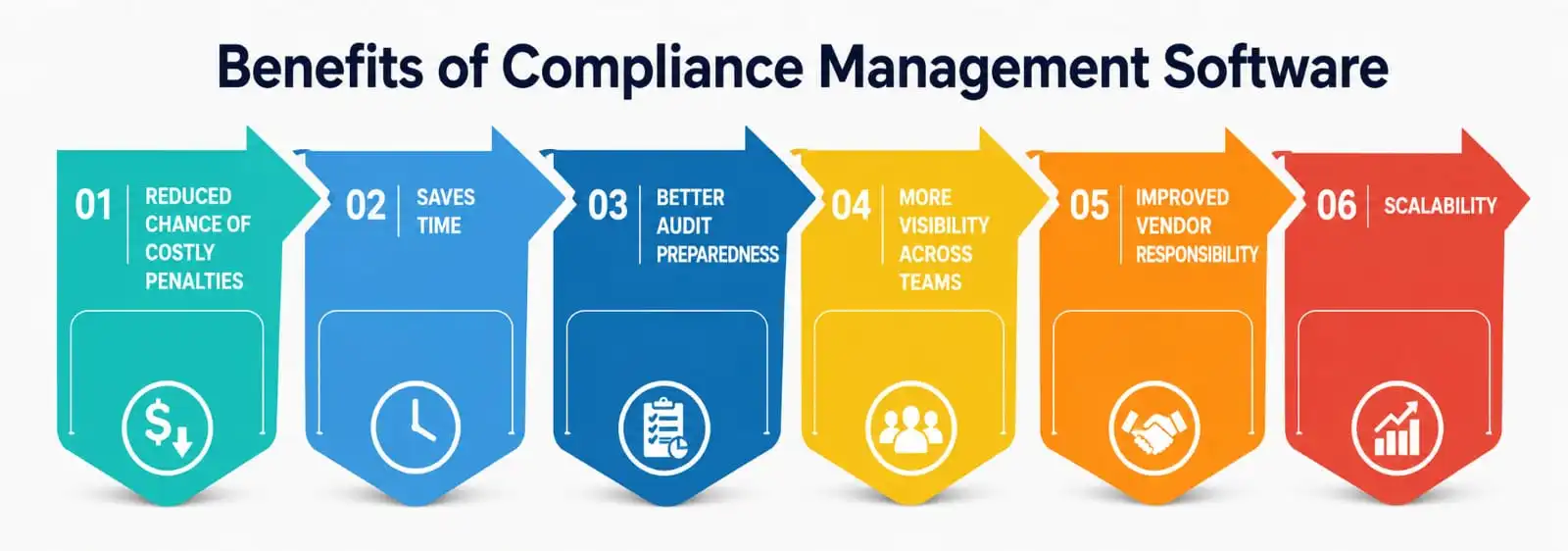
- Reduced chance of costly penalties. Real-time monitoring catches the gaps before regulators do, preserving day-to-day regulatory compliance rather than reconstructing after the fact.
- Saves time. Automated evidence collection can save hundreds of manual hours per audit cycle.
- Better audit preparedness. Documentation is always up to date and not thrown together the week before an audit because of a deadline.
- More visibility across teams. Leadership can get a view of compliance status across the entire organization rather than siloed reports.
- Improved vendor responsibility. Third-party risk is managed as rigorously as internal risk.
- Scalability. As Veriforce notes, these systems can accommodate multiple locations and changing obligations without having to be rebuilt from scratch every time the business grows.
The combined benefits are driving organizations to consider this class of tooling as essential infrastructure, rather than a “nice to have,” particularly in regulated industries where the cost of getting it wrong is measured in millions, not inconvenience.
How to Select the Right Compliance Management Software?
There’s no one platform that fits all organizations, and choosing the wrong one can be as costly as having no system at all. When selecting compliance management software, consider:
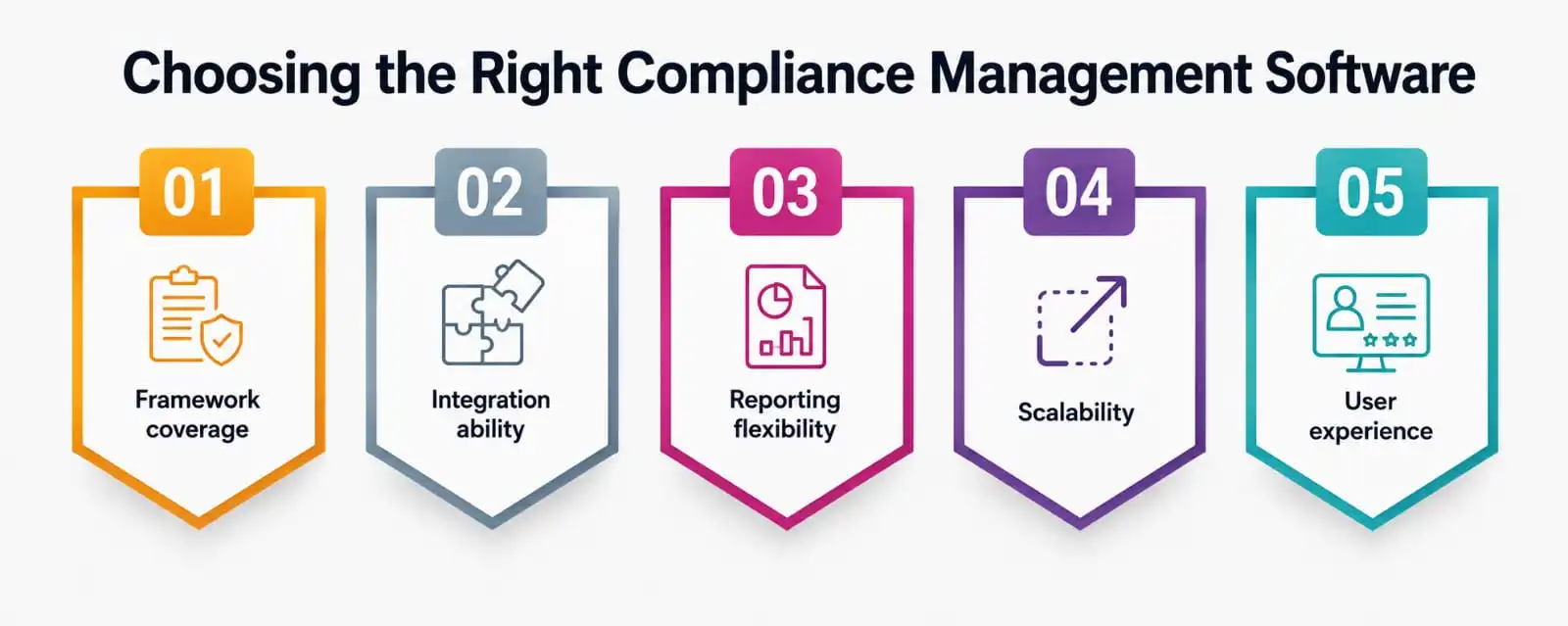
- Framework coverage — does it really support the particular standards your industry needs?
- Integration ability — can it connect to your existing HR, IT, and finance systems without heavy custom work?
- Reporting flexibility — can compliance reporting be customized for different stakeholders, since auditors, executives, and regulators all want different views of the same data?
- Scalability — will it still work cleanly if the organization doubles in size or enters a new region next year?
- User experience — will non-specialist employees actually use it correctly, or will they route around it?
As ZenGRC highlights, robust security features — encryption, role-based access, and audit trails — are non-negotiable given how sensitive compliance data tends to be. A flashy dashboard means very little if the underlying data isn’t properly protected.
Why Does This Matter If You’re a Student?
For students studying business, IT, law, or risk management, this software isn’t just something you’ll use later in your career—it’s something you’ll be evaluated on. Compliance officer, GRC analyst, IT auditor, and data-privacy specialist are all roles built almost entirely around exactly these tools.
Understanding how policy, reporting, and oversight tie together gives you a genuine head start over classmates who only know the theory of regulatory compliance without ever having seen how it’s actually operationalized inside a real organization.
It’s also worth remembering that this field rewards people who can translate legal language into practical workflows. Knowing the vocabulary—policy management, audit trails, risk scoring, governance—is useful, but being able to explain why each piece exists and what breaks when it’s missing is what actually stands out on a resume or in an internship interview.
A Personal Note
I’ll be honest about something most guides gloss over: no software fixes a broken compliance culture. I’ve seen organizations buy expensive platforms and still fail audits because the tool was treated as a substitute for judgment rather than a support for it.
The best system makes good practices easier to follow — it doesn’t manufacture good practices out of nothing. If you take one thing from this piece, let it be this: the software is the scaffolding, not the building. The people using it still have to care about getting it right, every single day, not just the week before an audit.