
If you’re a business, law, or finance student, you’ve probably heard “compliance” and “risk management” used almost interchangeably in lectures, internships, and case studies. They’re not the same thing, though the confusion is understandable—the two functions sit right next to each other on almost every org chart, and in most companies today they’re expected to work together under a single umbrella known as compliance risk management.
Understanding where one ends and the other begins isn’t just an academic exercise. It’s the kind of distinction that shows up in interview questions, case competitions, and eventually, in the job itself.
This guide breaks the two concepts down in plain language, shows you exactly where they overlap, and explains why compliance risk management has become the standard way organizations now talk about protecting themselves from both legal exposure and operational surprises.
What Is Compliance?
Compliance is the practice of following the rules—laws, regulations, industry standards, and internal policies—that apply to your organization. It’s rule-following in a structured, documented, and auditable way.
A compliance team’s job is to make sure the company doesn’t break the law, whether that law relates to data privacy, workplace safety, anti-bribery, tax reporting, or industry-specific rules like banking or healthcare regulations.
At its core, legal compliance is about avoiding violations before they happen. The U.S. Securities and Exchange Commission, for example, requires investment advisers to adopt written policies reasonably designed to prevent violations of federal securities laws and to review those policies at least once a year—a requirement detailed in the SEC’s own risk alert on investment adviser compliance programs. That single requirement captures the essence of compliance work: write the rules down, follow them, check them regularly, and be ready to prove it.
Good compliance work depends heavily on how well policies are created, updated, distributed, and tracked for employee acknowledgment. Without that discipline, even a well-intentioned compliance program falls apart, because nobody can follow a rule they’ve never seen or that hasn’t been updated to reflect the latest regulation.
What Is Risk Management?
Risk management is a broader, more forward-looking discipline. Instead of asking, “Are we following the rules right now?” it asks, “What could go wrong, how likely is it, and how bad would it be?” Risk management covers financial risk, operational risk, cybersecurity risk, reputational risk, and yes, regulatory risk—the risk that a change in law or enforcement priorities could hurt the business, as the Corporate Finance Institute explains in its overview of regulatory risk.
Two frameworks dominate how organizations structure this work. The Committee of Sponsoring Organizations of the Treadway Commission (COSO) built the Enterprise Risk Management framework, which ties risk directly to strategy and performance rather than treating it as a side function.
Separately, the International Organization for Standardization published ISO 31000, a globally recognized guideline for identifying, analyzing, evaluating, and treating risk across any type of organization, regardless of size or sector.
Regulatory risk management, specifically, is the slice of this discipline focused on anticipating how new laws, rule changes, or shifting enforcement trends could affect the business and building in flexibility before those changes actually hit.
It’s proactive by design, while compliance tends to be reactive to rules that already exist. Strong regulatory risk management means legal and risk teams are reading the regulatory horizon together, instead of waiting for an enforcement action to force a policy rewrite.
Compliance vs. Risk Management: A Side-by-Side Look
|
Aspect |
Compliance |
Risk Management |
|
Core question |
Are we following the rules? |
What could go wrong, and how bad would it be? |
|
Time orientation |
Present-focused; reacts to existing laws |
Future-focused; anticipates potential threats |
|
Primary tool |
Policies, procedures, legal compliance checklists |
Risk assessments, heat maps, scenario planning |
|
Owner |
Compliance officer, legal counsel |
Chief risk officer, risk committee |
|
Failure looks like |
Fines, sanctions, license revocation |
Financial loss, reputational damage, operational disruption |
|
Success looks like |
Clean audits, zero violations |
Threats identified and mitigated before they materialize |
Where Does Compliance Risk Management Come In?
Here’s the part students often miss: in practice, almost no company treats compliance and risk management as fully separate departments anymore. The overlap between them is so large that most organizations now run a unified function called compliance risk management, which combines rule-following with forward-looking risk assessment so that regulatory obligations are treated as risks to be actively managed, not just boxes to be checked.
Think about it this way. A bank doesn’t just need to comply with anti-money-laundering laws today—it needs ongoing risk assessment processes that constantly re-evaluate whether its current controls are strong enough for tomorrow’s regulatory environment, customer base, and transaction volume.
That’s compliance and risk management fused into one continuous cycle: identify the rule, assess the risk of non-adherence, build a control, monitor it, and adjust as the regulatory landscape shifts. This is also why the combined discipline has become a career path in its own right, rather than something split awkwardly between two unconnected teams.
Job postings increasingly ask for candidates who understand both legal compliance requirements and risk assessment methodology, because employers have realized that treating these as siloed functions leaves dangerous gaps.
Audit Readiness: Where the Two Disciplines Prove Themselves
If compliance and risk management are the theory, audit readiness is the test. Being audit-ready means an organization can, at any moment, produce the documentation, controls, and evidence that show it has actually been doing what its policies say it does—not just claiming to.
Deloitte’s guidance on audit readiness services makes an important point: a lack of preparation doesn’t just slow an audit down, it can also surface internal control deficiencies that damage stakeholder confidence and cost far more in fees and reputational fallout than staying prepared year-round.
That’s a lesson worth remembering before your first job interview in this field—auditors aren’t the enemy; poor preparation is. Strong audit preparation rarely happens by accident. It’s the natural output of good compliance risk management: if a company has been tracking its obligations, documenting exceptions, and reviewing controls on a rolling basis, an audit becomes a formality rather than a fire drill.
Organizations that treat this preparation as a once-a-year scramble, by contrast, tend to be the ones that generate the most negative findings.
Policy Management: The Operating System Behind Both Functions
Neither compliance nor risk management can function without disciplined policy management. Policies are where abstract legal obligations and risk appetites get translated into concrete, day-to-day instructions for employees—what data can be shared, what approvals are required before a vendor contract is signed, and how a security incident gets escalated.
Good policy management involves version control, scheduled review cycles, clear ownership of each policy, and a system for tracking who has read and acknowledged each update. When it’s weak, two things tend to happen: employees rely on outdated guidance, and the organization can’t prove during an audit that current policies were actually communicated. Both are serious problems for legal exposure and for the broader risk posture of the business.
Mature organizations increasingly link their internal policy systems directly to their risk registers so that every policy is mapped to the specific regulatory or operational risk it’s meant to address. That mapping is, again, a hallmark of a genuinely integrated program rather than two departments working from separate spreadsheets.
Compliance Reporting Software: Where Technology Fits In
Manual, spreadsheet-based tracking used to be the norm for both compliance and risk teams, but it doesn’t scale. That’s why most mid-size and large organizations now rely on compliance reporting software to centralize evidence, automate control testing, and generate the reports regulators and auditors expect to see.
A good platform typically does three things well: it maintains a live record of every control and policy, it flags gaps or overdue reviews before they become findings, and it produces audit-ready reports on demand instead of requiring weeks of manual document-gathering.
For a student heading into this field, it’s worth knowing that this kind of tooling has become just as central to the job as legal knowledge—most compliance and risk roles today expect at least basic comfort navigating a GRC (governance, risk, and compliance) platform.
The rise of this technology is really a reflection of how compliance risk management has matured as a discipline. When rules, risks, and evidence all live in one connected system, it’s far easier to see how a single regulatory change ripples across multiple risk areas—something that was nearly impossible to track by hand.
Building a Compliance Risk Management Program: Practical Steps
For students trying to picture what this looks like on the job, here’s a simplified version of how organizations typically build out compliance risk management from scratch:
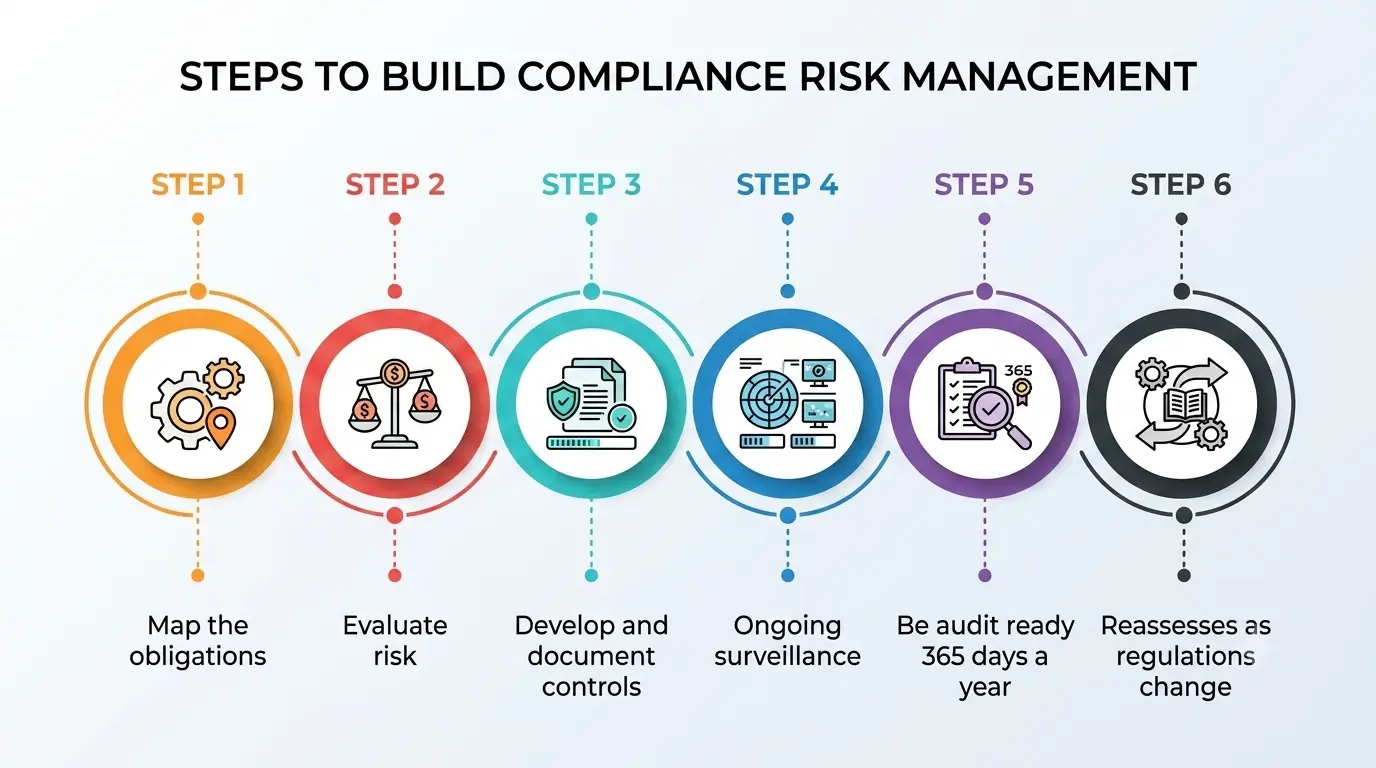
- Map the obligations. Identify every law, regulation, and internal policy that applies to the bbusiness—thisis the legal compliance foundation everything else builds on.
- Evaluate risk. For each obligation, assess the probability and consequences of non-compliance. That is where regulatory risk management thinking comes in, and frameworks such as COSO or ISO 31000 provide a starting structure.
- Develop and document controls. Disciplined documentation and version control to translate each risk mitigation strategy into a written and traceable policy.
- Ongoing surveillance. Instead of putting together ad hoc compliance reporting software, monitor control effectiveness, identify exceptions, and maintain evidence in real time.
- Be audit-ready 365 days a year. Think of each quarter as a potential review trigger so you are always ready and not scrambling at the last minute.
- Reassesses as regulations change. Regulatory risk management isn’t a one-time project—laws change, and so should the controls built around them.
Done well, this cycle is what separates a reactive, compliance-only shop from an organization that has genuinely embedded compliance risk management into how it operates.
Conclusion
Compliance and risk management ask different questions—one looks at whether you’re following today’s rules, the other looks at what could go wrong tomorrow—but neither works well in isolation anymore.
The organizations that handle this best treat compliance risk management as a single, continuous discipline: mapping obligations, assessing risk, documenting policy decisions, staying consistently prepared for audits, and leaning on the right technology to keep it all connected. For students entering this field, that integrated view is exactly what employers are now hiring for.
A Personal Note
I’ve written more than a few compliance explainers over the years, and this is the topic where I most often see students get tripped up—not because the concepts are hard, but because textbooks tend to teach compliance and risk management as if they live in separate chapters. In the real world, they don’t.
If you’re preparing for interviews in this space, my honest advice is to stop memorizing definitions and start asking, “How would this rule actually get monitored, documented, and proven during an audit?” That single question will make you sound like someone who’s already done the job, not just read about it.