

Every organization, no matter its size, runs into moments where something threatens to go wrong. A key client cancels a contract without warning. A cyberattack takes internal systems offline for two days straight. New environmental regulation forces a factory floor to change how it operates overnight.
None of these situations are surprising to companies that plan for them, because they’ve already built a structured way to see problems coming and respond before the damage spreads. That structured approach has a name: corporate risk management.
This guide breaks down what corporate risk management actually is, why businesses of every size rely on it, and how the process works in practice, from the first risk-spotting conversation to the final response plan.
If you’re a student trying to understand this subject for a case study, an exam, or your first job in finance or operations, you’re in the right place.
What Is Corporate Risk Management?
Corporate risk management is the process organizations use to spot potential threats to their operations, finances, reputation, and strategic goals, and then decide how to handle each one before it turns into a real loss.
It isn’t a single department’s job or a once-a-year checklist tucked away in a compliance folder. Done properly, it runs through every level of a company, from the boardroom setting overall risk appetite down to a warehouse supervisor flagging a faulty piece of equipment before it fails.
At its core, the discipline asks three questions on a loop: What could go wrong? How likely is it, and how bad would it be if it happened? What are we going to do about it?
Companies that answer these questions consistently tend to survive shocks that put less-prepared competitors out of business — the 2008 financial crisis and the global supply chain chaos of 2020 both showed, in very public ways, what happens when an organization skips this discipline.
Corporate risk management sits under a wider category often called enterprise risk management (ERM), which treats risk as something to manage holistically across the whole business rather than in separate departmental silos.
Why Business Risk Management Matters More Than Ever?
Markets move faster than they used to. A single rumor on social media can knock a stock price down within hours. One unpatched server can expose millions of customer records overnight. Because of this speed, business risk management has shifted from being a compliance checkbox to being a genuine competitive advantage, and leading companies now treat it as an active line of strategy rather than a defensive afterthought.
Companies with mature business risk management practices tend to raise capital more easily, because investors and lenders see a lower chance of nasty surprises down the line.
They also recover faster from disruptions, since response plans already exist instead of being written in a panic at 2 a.m. And because employees know exactly how issues get reported and handled, problems tend to surface earlier — while they’re still cheap and easy to fix, rather than after they’ve snowballed.
None of this means risk management stops bad things from happening. It means the organization isn’t caught flat-footed when they do.
Risk Identification and Assessment: Where It All Starts
You cannot manage a threat you haven’t noticed yet. That’s why risk identification and assessment sits at the very front of the process, before anything else can happen. This stage involves gathering input from every corner of the business — finance, legal, IT, operations, HR — to build an honest list of things that could derail the company’s objectives.
Risk identification and assessment typically lean on a mix of tools: interviews with department heads, historical loss data, industry benchmarking, scenario workshops, and sometimes independent external audits.
Once a risk is identified, it gets scored along two dimensions — how likely it is to happen, and how much damage it would cause if it did. Plotting risks on a simple likelihood-versus-impact grid, often called a heat map, helps leadership decide where to spend limited time and budget first.
Good risk identification and assessment isn’t a one-time exercise. New risks emerge as a business grows, enters new markets, adopts new technology, or faces new regulation, so this step repeats on a regular cycle — usually quarterly or annually depending on the industry and how fast it moves.
Enterprise Risk Assessment vs. Traditional, Siloed Risk Management
Older approaches to risk handled each department’s problems separately. The finance team worried about currency exposure, IT worried about outages, and legal worries about lawsuits, with little conversation happening between them. The problem with that model is that risks rarely stay in their lane. A cybersecurity breach — IT’s problem — becomes a legal liability within days and a reputational crisis within the same week.
An enterprise risk assessment fixes this by looking at the organization as one connected system instead of a collection of departments. Rather than five separate reports, it produces a single, ranked view of the company’s total risk exposure, with clear ownership assigned to each item on the list.
This is the approach recommended by ISO 31000, which pushes organizations to weave risk thinking into governance, planning, and everyday decision-making rather than treating it as a side activity handled by one team.
Running a proper enterprise risk assessment also makes it far easier for a board of directors to see the full picture in a single meeting, instead of stitching together five inconsistent departmental reports written in five different formats.
Risk Response Strategies: Deciding What To Do
Once a risk has been identified and assessed, the organization needs an actual plan. This is where risk response strategies come in. There are generally four categories to choose from:
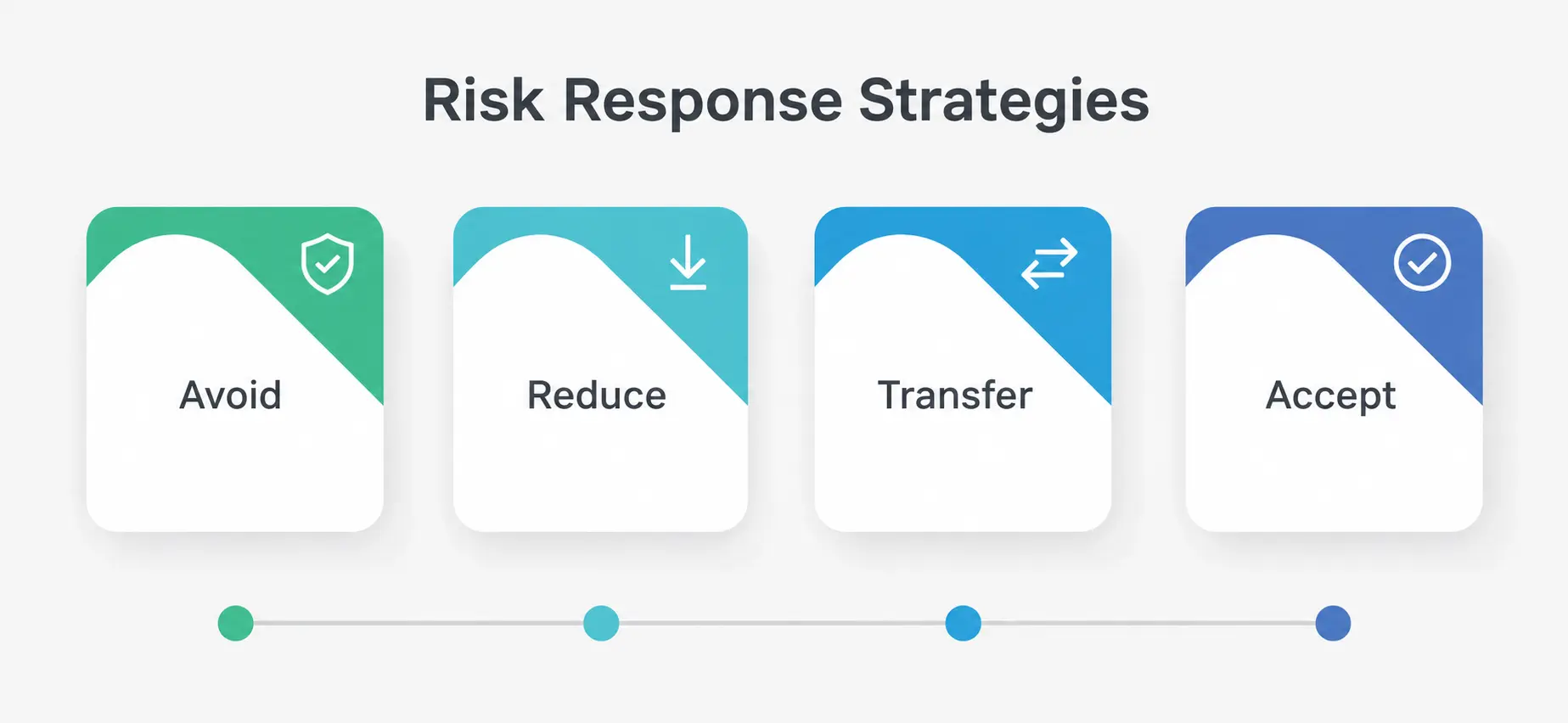
- Avoid — change plans entirely to sidestep the risk, such as exiting a market with unstable currency controls.
- Reduce — take action to lower either the likelihood or the impact, like installing backup servers or diversifying suppliers.
- Transfer — shift the financial burden elsewhere, most commonly through insurance or contractual clauses.
- Accept — acknowledge the risk and keep monitoring it, usually because the cost of addressing it outweighs the potential damage.
Choosing among these options isn’t guesswork. It depends on the company’s risk appetite — how much uncertainty leadership is genuinely willing to tolerate in pursuit of its goals — combined with a straightforward cost-benefit comparison.
A small manufacturer facing a rare, low-impact risk might simply accept it, while a bank facing a rare but catastrophic risk, like a major data breach, will almost always choose to reduce and transfer it through multiple layers of protection at once.
The best risk response strategies get written down, assigned to a named owner, and reviewed on a set schedule — not left as a one-off decision buried somewhere in a meeting’s minutes.
Risk Management Best Practices Every Organization Should Follow
Across industries, a handful of risk management best practices show up again and again in companies that handle uncertainty well:
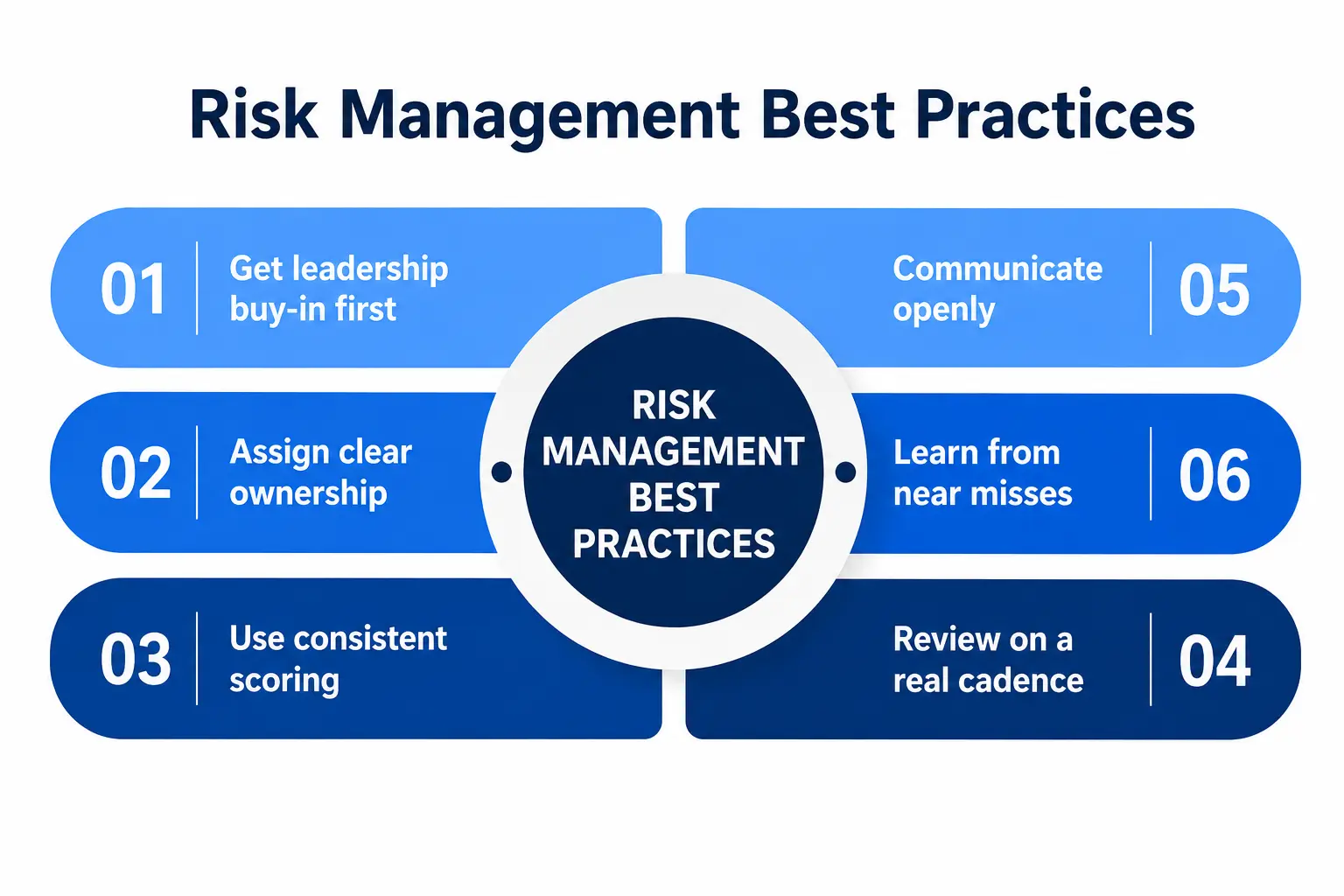
- Get leadership buy-in first. Risk management best practices only stick when the board and senior executives visibly support them, not just the compliance team working alone in the background.
- Assign clear ownership. Every identified risk needs one named person accountable for tracking it and responding when needed.
- Use consistent scoring. Rating risks on the same likelihood-and-impact scale across every department keeps comparisons meaningful.
- Review on a real cadence, not once a year. Markets and technology move too fast for an annual review to stay useful on its own.
- Communicate openly. Employees at every level should know how to report a concern without fear of being blamed for raising it.
- Learn from near misses. A problem that almost happened is free information about a weakness in the system — treat it that way instead of ignoring it.
Companies that follow these practices consistently tend to spend less time firefighting and more time on actual growth, simply because fewer surprises hit them all at once.
A Quick Look: Common Business Risks and How Companies Typically Respond
|
Type of Risk |
Example |
Typical Response Strategy |
|
Financial Risk |
Currency fluctuation, bad debt |
Hedging, credit checks, diversified revenue |
|
Operational Risk |
Equipment failure, supply chain delay |
Backup suppliers, preventive maintenance |
|
Compliance Risk |
New data protection law |
Legal review, staff training, regular audits |
|
Reputational Risk |
Product recall, negative press |
Crisis communication plan, quality control |
|
Strategic Risk |
New competitor, market shift |
Scenario planning, product diversification |
|
Cybersecurity Risk |
Data breach, ransomware attack | Encryption, employee training, cyber insurance |
This table is a simplified snapshot — real enterprise programs assess dozens of specific risks within each category, but the underlying pattern of identify, assess, and respond stays the same across all of them.
Frameworks That Guide Corporate Risk Management
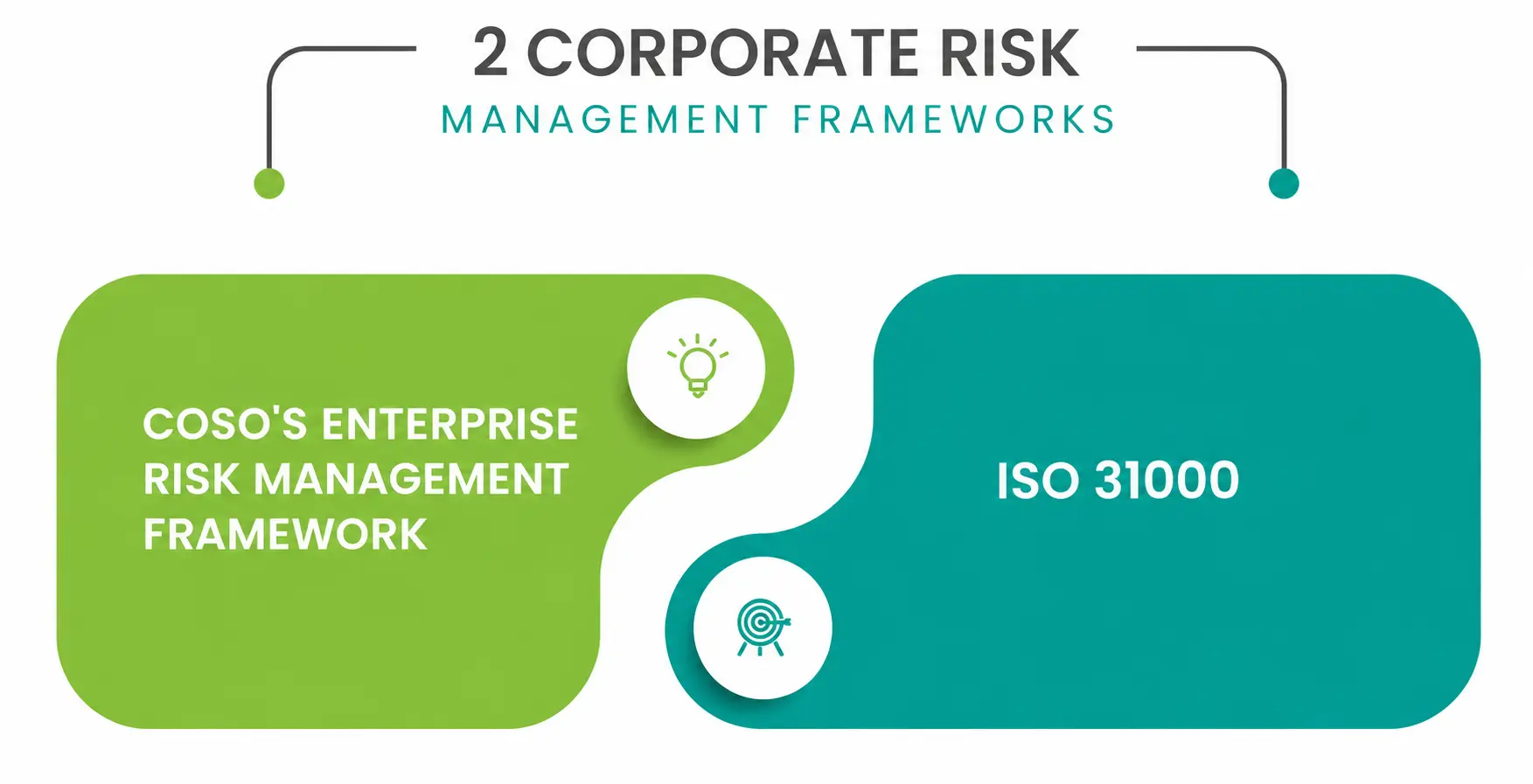
Most organizations don’t build their corporate risk management approach entirely from scratch. They lean on established frameworks that have already been tested across thousands of companies. Two of the most widely used are:
-
COSO’s Enterprise Risk Management Framework, which organizes risk management around governance and culture, strategy and objective-setting, performance, review, and information sharing.
-
ISO 31000, an international standard built on principles and guidelines rather than a rigid checklist, letting organizations of any size or sector adapt it to their own situation.
Neither framework is legally required in most jurisdictions, but investors, auditors, and regulators increasingly expect to see evidence that a company follows one of them, especially in finance, healthcare, and energy.
Common Mistakes Companies Make in Business Risk Management
Even well-intentioned business risk management programs go wrong in fairly predictable ways. Treating risk management as a paperwork exercise instead of an active, living discipline is the most common failure — a risk register nobody updates after the initial workshop is worse than useless, because it creates false confidence that everything is under control.
Another frequent mistake is putting risk ownership entirely on one compliance officer instead of spreading accountability across the department heads who actually see the risks up close, every single day.
Some companies also focus only on downside risks and ignore the upside — the genuine opportunities that come from taking a calculated, well-understood risk. Corporate risk management, done right, isn’t only about avoiding losses; it’s also about knowing which risks are actually worth taking because the potential reward clearly justifies them.
Final Thoughts
Corporate risk management isn’t about eliminating uncertainty — that’s simply not possible in any real market. It’s about building a repeatable system so that when something does go wrong, the organization already knows who’s responsible, what the options are, and how fast it can move.
Students studying this topic should walk away with one core idea: it works best as a continuous habit woven into everyday decisions, not a document that gets dusted off once a year right before an audit.
A Personal Note
I’ve sat through enough post-mortems after things went wrong at a company to notice a pattern: it’s almost never the risk itself that causes the real damage — it’s the absence of a plan for it.
Every organization I’ve studied that came through a crisis in reasonably good shape had done the boring work months earlier: written down what could go wrong, assigned someone to own it, and actually rehearsed what they’d do.
The companies that scrambled afterward usually knew about the risk too; they just never turned that awareness into a plan. If you take one thing from this piece into your next case study or your first job, let it be that — awareness without a plan isn’t preparation, it’s just anxiety with extra steps.