
Every business, whether it’s a roadside chai stall or a multinational bank, is really just a bet on an uncertain future. You spend money now, hoping customers show up later, prices stay stable, laws don’t change overnight, and nothing embarrassing leaks onto social media.
Most of the time, that bet works out fine. But every so often, it doesn’t — and that’s the entire reason risk management exists as a subject. If you’re a commerce or management student, you’ve probably heard the phrase “risk management” thrown around in textbooks without much real-world context. So let’s fix that here.
This guide walks through the major types of risk in business in plain language, with examples you’ll actually remember during an exam or a job interview, not just definitions copied from a slide deck.
Why Learning About Types of Risk in Business Actually Matters?
Here’s the thing nobody tells first-year students: you don’t need to run a company to deal with risk. If you ever manage a college fest budget, freelance for a client, or even just plan a family business’s next move, you’re already doing informal risk management.
Understanding the types of risk in business isn’t a topic you memorize and forget after the semester — recruiters in finance, operations, and consulting roles actively test for this kind of thinking in interviews, because spotting risk early is what separates a good employee from a great one.
Businesses don’t fail because risk exists. They fail because nobody saw it coming, or saw it and ignored it. That’s the gap this guide is trying to close.
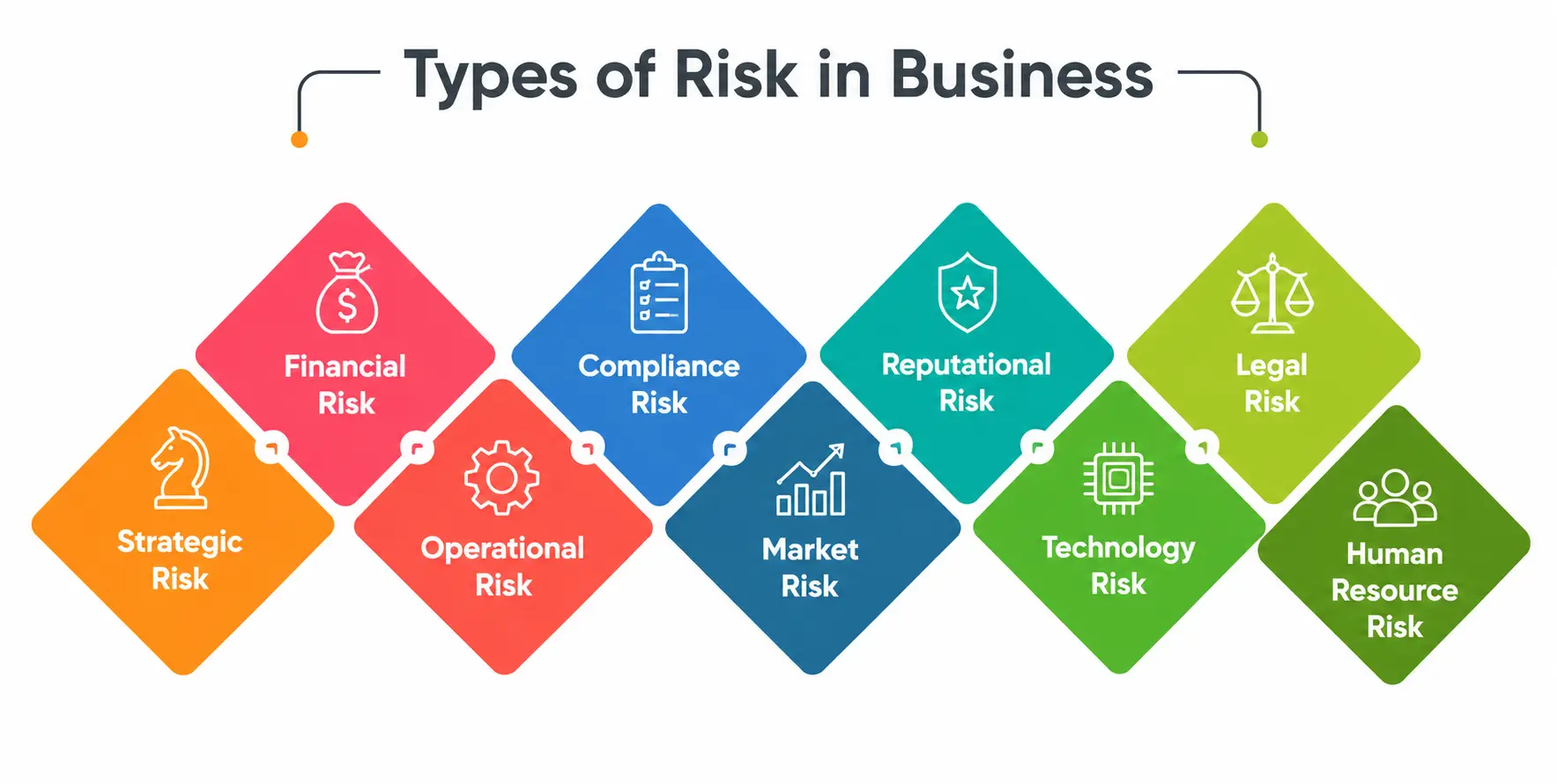
Types of Risk in Business at a Glance
Before going deep into each category, here’s a quick table that maps out the major types of risk in business so you can see how they differ.
|
Risk Type |
What It Really Means |
Who Feels It Most |
|
Strategic Risk |
Poor decisions about direction, competition, or long-term positioning |
Founders, boards, senior leadership |
|
Financial Risk |
Cash flow problems, debt exposure, or currency losses |
CFOs, investors, lenders |
|
Operational Risk |
Day-to-day breakdowns in processes, supply chains, or people |
Managers, frontline staff |
|
Compliance Risk |
Failing to follow laws, industry rules, or internal policy |
Legal and compliance teams |
|
Market Risk |
Losses from shifting prices, demand, interest rates, or competition |
Traders, sales teams, product heads |
|
Reputational Risk |
Damage to public trust and brand image |
Marketing, PR, and the whole company |
|
Technology Risk |
Cyberattacks, system outages, or outdated infrastructure |
IT teams, but really everyone downstream |
|
Legal Risk |
Lawsuits, contract disputes, and regulatory penalties |
Legal counsel, management |
Keep this table in the back of your mind — every section below unpacks one of these rows with a real example.
Strategic Risk
Strategic risk shows up when a company bets on the wrong direction — a bad merger, an ignored competitor, or a product line that stops making sense.
Kodak is the textbook case here: it invented the digital camera in-house and still lost the market because leadership kept protecting its film business instead of pivoting. Nothing about that failure was illegal or poorly executed operationally — it was a strategic misread of where the industry was heading.
Students often confuse strategic risk with “bad luck,” but it’s usually the opposite. It’s the risk you create by choosing one path over another, fully within your control at the time the decision was made.
Financial Risk
Financial risk is anything that threatens a company’s ability to stay up-to-date with its financial obligations — debt payments, payroll, supplier invoices, etc. This includes credit risk (people who owe you money or loans not paying you back), liquidity risk (not having cash on hand even if you are “profitable” on paper) and currency risk for companies that operate internationally.
For example, a small exporter who prices his goods in dollars but pays his staff in rupees can lose money due to currency movements, even if he sells the same number of units each month. That is the purest form of financial risk – not a product failure, not mismanagement, but exposure to numbers moving against you.
Operational Risk
Operational risk is part and parcel of the daily business of a business: a supplier missing a delivery deadline, a factory line breaking down, or an employee making a costly manual error. It’s not as dramatic as strategic risk, but it happens a lot more, which is why it quietly costs companies more over time.
Boeing’s 737 MAX crisis is a heavy but useful example for students: manufacturing and process failures compounded with internal pressure to ship faster, turning an operational weakness into a full-blown corporate crisis that also spilled into reputational and legal territory.
That’s a good reminder that these risk categories rarely stay in their own lane — one failure tends to drag others along with it.
Compliance Risk
Compliance Risk is the risk of financial loss, penalties, or restrictions that come from failing to follow laws, regulations, or internal policies. It’s one of the most underestimated risk categories among students, mostly because it sounds boring compared to strategy or technology — until you see the fines involved.
Wells Fargo’s fake-accounts scandal is a well-known case of this going wrong: employees opened millions of unauthorized accounts to hit sales targets, and the bank ended up paying billions in penalties and lasting damage to customer trust.
According to Ncontracts’ regulatory guide, Compliance Risk arises from failing to meet applicable laws, regulations, ethical standards, or contractual obligations — and regulators judge companies not just on the violation itself, but on whether a real program existed to catch it. If you’re building a career in banking, healthcare, or any regulated industry, this is a subject worth mastering early.
Market Risk
Market Risk is the uncertainty that comes from forces largely outside a company’s control — interest rate changes, currency swings, commodity price shifts, or a sudden change in customer demand. Unlike operational risk, you can’t fix it by improving internal processes; you can only prepare for it and hedge against it.
Airlines are a great example: fuel is one of their biggest costs, and jet fuel prices move with global oil markets, not with anything the airline itself does. The U.S. Securities and Exchange Commission’s investor education portal explains how nearly every asset class — stocks, bonds, currencies, commodities — carries some degree of Market Risk, and that businesses and investors alike need strategies to manage exposure rather than eliminate it entirely, since it can’t be eliminated.
Reputational Risk
Reputational Risk is the threat to how a business is perceived by customers, investors, employees, and the public. It’s tricky because it doesn’t always start with something illegal — sometimes a company does everything technically right and still gets hurt because public expectations shifted faster than the business did.
In an influential Harvard Business Review piece on the topic, the authors argue that companies are most exposed to Reputational Risk when their public image is stronger than their actual behavior, because that gap eventually closes — usually in public, and usually painfully.
Volkswagen’s “Dieselgate” emissions scandal is a good real-world case: the company was caught rigging emissions tests, and the resulting fallout cost it billions in fines, lawsuits, and years of rebuilding trust with regulators and customers.
Technology Risk
Technology Risk covers threats tied to a company’s digital systems — data breaches, cyberattacks, software failures, or simply running on outdated infrastructure that can’t keep up with demand. It’s grown faster than almost any other risk category over the last decade, simply because more of business now happens online.
The Equifax data breach of 2017 is one of the most cited examples in this space: a known software vulnerability went unpatched, exposing sensitive data for nearly 150 million people.
The U.S. NIST’s Cybersecurity Framework exists specifically to help organizations of every size understand, manage, and reduce Technology Risk in a structured way, rather than reacting only after something breaks. For students eyeing careers in IT, product, or operations, this is quickly becoming one of the most in-demand areas of risk expertise.
Legal Risk
Legal risk overlaps with regulatory obligations but deserves its own mention — it covers lawsuits, contract disputes, intellectual property theft, and liability claims. A restaurant chain facing a class-action lawsuit over a foodborne illness outbreak, or a startup getting sued for using someone else’s patented technology without a license, are both classic examples.
The tricky part about legal risk is that it’s often reactive — you don’t always see it coming until a letter from a lawyer shows up. That’s exactly why strong contracts, proper licensing, and clear internal policy documentation matter so much, even for small businesses that assume lawsuits only happen to big corporations.
Human Resource Risk
People are a business’s biggest asset and, at the same time, one of its biggest risk sources. Human resource risk includes high employee turnover, workplace harassment claims, skill shortages, and even the sudden loss of a key employee who happens to hold critical knowledge nobody else has documented.
Startups are especially exposed here — a five-person company losing its one technical co-founder can be more damaging than a large corporation losing an entire department, simply because there’s no redundancy to absorb the shock.
Risk Identification: Where Every Risk Strategy Actually Starts
Once you know the broad types of risk in business you’re dealing with, the real work begins with risk identification — the process of actively spotting risks before they turn into losses, rather than discovering them after the damage is already done.
Risk Identification isn’t a one-time checklist exercise; it’s an ongoing habit built into how a company reviews its operations, finances, contracts, and technology. The ISO 31000 international standard treats this step as the foundation of any formal risk management process, arguing that you cannot analyze, evaluate, or treat a risk you never noticed in the first place.
Similarly, the COSO Enterprise Risk Management framework — one of the most widely used models globally — builds its entire structure around continuously identifying and responding to risk as part of everyday strategy, not as a once-a-year audit exercise. Whether a company uses a formal framework or a simple shared spreadsheet, effective Risk Identification only works when it’s revisited regularly instead of being treated as a box to tick.
How Businesses Actually Manage These Risks?
Identifying risk is only half the job — the other half is deciding what to do about it. Most companies, regardless of size, follow a version of the same four-step response pattern:
- Avoid it — walk away from the decision, market, or partnership entirely if the downside is too severe.
- Reduce it — add controls, training, insurance, or redundancy to shrink the likelihood or impact.
- Transfer it — shift the exposure to someone else, usually through insurance or outsourcing contracts.
- Accept it — consciously decide the risk is small enough, or the potential reward is high enough, to move forward anyway.
No matter which types of risk in business your company faces, the mitigation approach tends to follow this same pattern. A company defends against price and demand swings through hedging contracts and diversified revenue streams. It defends against Reputational Risk through transparency, faster crisis response, and consistent brand behavior. It defends against cyberattacks and system failures through regular audits, patching schedules, and staff training on basic cyber hygiene. And it defends against Compliance Risk by building dedicated teams, checklists, and audit trails tied to every regulation the industry demands.
Why Does This Matters Beyond the Exam Hall?
If you’re studying business, economics, or management, this isn’t just theory you’ll forget after the final exam. Interviewers at consulting firms, banks, and startups love asking candidates to spot risk in a case study precisely because it reveals how you think, not just what you’ve memorized. Employers want people who notice the crack in the wall before the whole thing falls down — and that instinct is built by studying real cases, not just definitions.
A Personal Note
I’ll be honest — when I first studied this topic as a student, it felt like dry, forgettable theory. It only clicked once I started following real companies in the news and noticed how often the “surprising” business failure everyone talks about traces back to one of these exact categories. Kodak wasn’t unlucky. Wells Fargo wasn’t unlucky.
They missed something that, in hindsight, was entirely identifiable. My honest advice: don’t just memorize the types of risk in business for your next test — start spotting them in the news, in your part-time job, or in a business you admire. That habit will serve you far longer than any definition ever will.