
Picture two hospitals in the same city, treating the same patients, exposed to the same infection risks. One has a rigorous hand hygiene protocol, staff training, and surprise audits. The other has posters on the wall and not much else.
On paper, before you factor in any of that, both hospitals face identical exposure. After you factor it in, they don’t. That gap—between the danger you start with and the danger you’re left with—is exactly what the debate over inherent vs. residual risk is about, and it’s one of the first things any student of auditing, cybersecurity, or corporate governance has to get straight before anything else in risk management makes sense.
This guide walks through both concepts in plain language, shows you where they fit inside a company’s broader risk framework, and gives you a worked example you can actually picture rather than just memorize. By the end, you’ll be able to explain the difference to a classmate, a professor, or an interviewer without stumbling.
What Is Inherent Risk?
Inherent risk is the level of exposure that exists before anyone does anything about it. No controls, no training, no policies, no insurance — just the raw danger baked into an activity, a process, or an industry simply by virtue of doing it.
Think about it this way: if your organization stored customer data on a server with zero firewalls, zero access restrictions, and zero encryption, the sheer likelihood and potential damage of a breach would represent this raw, uncontrolled exposure. It doesn’t matter whether you’ve hired a security team yet.
It doesn’t matter whether a breach has ever actually happened. This is a theoretical ceiling — the worst-case danger an activity carries on its own. Auditors and risk officers usually score it along two axes: how likely is the bad outcome, and how severe would it be if it happened?
A nuclear power plant and a neighborhood bakery both carry their own baseline exposure, but you’d score them very differently. ISO 31000, the internationally recognized standard for risk management, frames this starting-point exposure as the baseline organizations need before they can judge whether their safeguards are doing anything useful at all.
What Is Residual Risk?
Residual risk is what’s left over once you’ve actually applied your defenses. It’s the real-world exposure an organization carries day to day after policies, technology, training, insurance, and oversight have all done their job—imperfectly, because nothing is ever perfect.
Go back to the data-storage example. Once you add a firewall, restrict access to authorized staff, and encrypt everything at rest, the danger of a breach doesn’t vanish. It shrinks. Whatever probability and impact remains after all that effort is the number that actually matters when you’re deciding whether to sleep well at night or push for another round of investment in security.
This is also the number regulators, boards, and insurers care about most, because it reflects reality rather than a hypothetical worst case. A practical breakdown from RiskWatch offers a simple working formula: take the raw exposure, apply your control effectiveness, and what’s left is the figure you report upward.
Inherent vs Residual Risk: The Core Difference
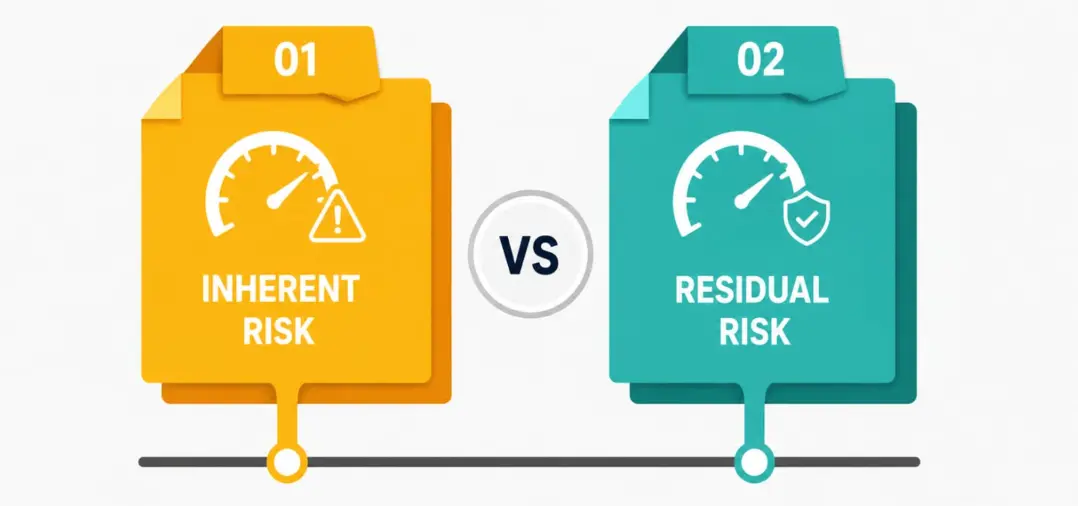
Here’s the distinction stripped down to its essentials: one figure answers, “How dangerous is this activity on its own?” The other answers, “How dangerous is this activity now that we’ve done something about it?” Everything else is really just an elaboration on that one comparison.
Getting this backwards is a surprisingly common mistake, even among people who’ve been in the field for years. Some teams report only the after-controls figure and quietly forget to document what the exposure looked like beforehand, which makes it impossible to prove those controls are actually earning their keep.
Others obsess over the pre-control score and never circle back to check whether real-world protections brought that number down at all. You genuinely need both halves of the picture, tracked side by side, for risk reporting to mean anything.
Here’s a side-by-side snapshot of inherent vs. residual risk:
|
Aspect |
Inherent Risk |
Residual Risk |
|
Definition |
Raw exposure before any safeguards exist |
Exposure that remains after controls are applied |
|
When it’s measured |
At the design or planning stage, before treatment |
After implementation, ongoing and reviewed periodically |
|
What it ignores |
Existing policies, technology, and training |
Nothing—it accounts for everything currently in place |
|
Primary use |
Deciding where controls are most urgently needed |
Deciding whether current protection is good enough |
|
Compared against |
The scale of the activity or process itself |
The organization’s Risk Appetite |
|
Typical owner |
Risk analyst or process owner scoping the activity |
Senior management, audit committee, or the board |
|
Changes when |
The activity, market, or regulation itself changes |
Controls are added, removed, tested, or fail |
The Role of the Control Environment and Risk Mitigation
None of this shrinking from the raw, pre-control figure down to the post-control figure happens by accident—it happens because of deliberate risk mitigation, sitting inside what auditors call the control environment.
The control environment is the overall culture and infrastructure a company builds around managing risk: its policies, its reporting lines, its tone from the top, and its willingness to actually enforce rules rather than just publish them in a handbook nobody reads.
The COSO Enterprise Risk Management framework, one of the most widely used models in corporate governance, treats a strong version of this culture as the foundation everything else is built on—because even brilliant risk-reduction tactics fail if the surrounding organization doesn’t take them seriously.
Risk mitigation itself usually falls into a handful of buckets: you can avoid the risky activity altogether, reduce its likelihood or impact through controls, transfer part of it (insurance is the classic example), or simply accept it because the cost of doing more outweighs the benefit.
Whichever route an organization picks, the goal is the same — pull the leftover exposure down to something the business can live with, without spending so much on safeguards that the control setup itself becomes a drag on getting anything done.
A well-documented explainer from ThinkCloudly walks through how ISO 31000 expects organizations to keep reassessing this balance rather than treating it as a one-time project.
How Does Risk Appetite Connect Inherent and Residual Risk?
Here’s where that acceptable-exposure threshold comes in, and honestly, it’s the piece students tend to skip past even though it’s what makes the whole exercise practical rather than academic.
Risk appetite is the amount of risk an organization has explicitly decided it’s willing to accept in pursuit of its goals. A hospital’s tolerance for patient-safety failures is close to zero. A venture-backed startup’s tolerance for a failed product launch might be fairly high, because swinging big is part of the strategy. Neither is wrong—they’re just calibrated to different objectives.
Once you know that threshold, the whole point of tracking inherent vs. residual risk becomes obvious: you measure the raw exposure to understand what you’re up against, you apply risk mitigation to bring it down, and then you check whether what’s left actually falls inside your stated boundary.
If it doesn’t, you either add more controls or you formally accept the gap — but you don’t get to just ignore it. The COSO framework, as summarized for students by ACCA, is explicit that risk tolerance for individual objectives should always trace back to this board-approved appetite, not to whatever feels comfortable at the moment.
A Real-World Example You Can Picture
Let’s walk through inherent vs. residual risk with a concrete example instead of an abstract one.
Say you drive a car worth $10,000. If it gets totaled in an accident and you’re carrying zero insurance, you’re on the hook for the full repair or replacement cost. That $10,000 exposure, with no protection in place, is your inherent risk.
Now you buy motor insurance with a policy that covers 90% of repair costs. You haven’t made accidents less likely to happen—the inherent risk of driving hasn’t changed at all—but you’ve transferred most of the financial damage elsewhere.
If an accident does happen, you’re now only responsible for the remaining 10%, or roughly $1,000. That $1,000 is your residual risk: the exposure you’re still personally carrying after your risk mitigation (the insurance policy) has done its job.
Swap the car for a company’s customer database and the insurance for firewalls, encryption, staff training, and access controls, and you’ve got the exact same logic running through a cybersecurity risk register. The dollar figures change. The underlying mechanics don’t.
Why This Matters if You’re Studying Risk, Audit, or Compliance?
If you’re working toward a career in internal audit, GRC (governance, risk, and compliance), or information security, understanding this distinction isn’t optional trivia for an exam — it’s the lens you’ll use on nearly every engagement you’re ever assigned to.
Auditors are routinely asked to assess whether a company’s protective efforts are proportionate to its actual exposure. You can’t answer that question without first knowing the baseline exposure you started with.
Compliance officers building a control environment from scratch need to know which processes carry the highest raw exposure so they can prioritize limited budgets sensibly, rather than spreading controls evenly across everything.
And nearly every regulatory framework—from financial reporting standards to data-protection law—expects organizations to document both figures, not just the comfortable one.
Get comfortable walking through both sides of this equation out loud, with a real example, and you’ll stand out in interviews far more than someone who can only recite the textbook definitions.
Common Mistakes to Avoid
A few patterns around inherent vs. residual risk show up again and again in classrooms and in actual risk committees:
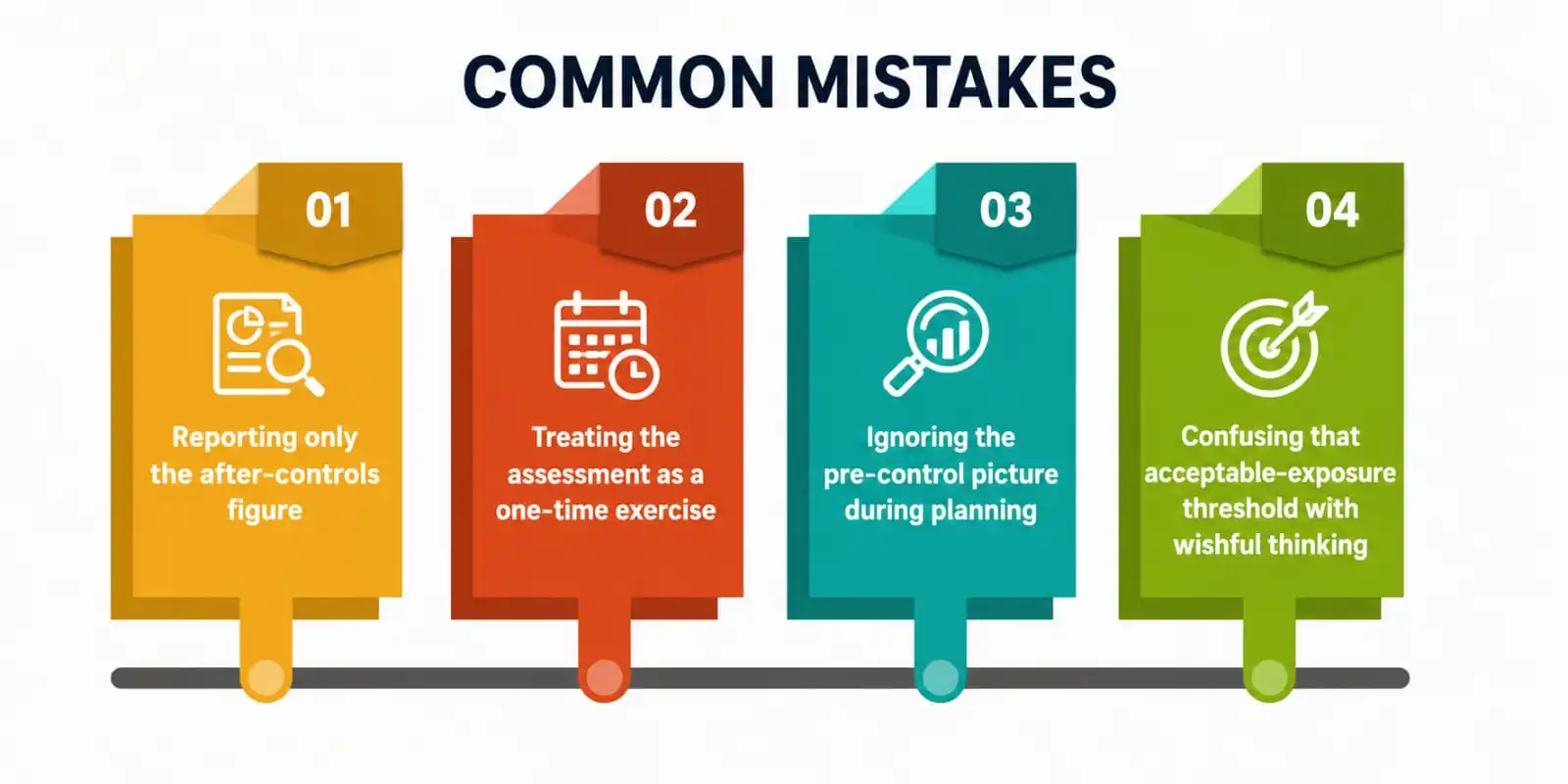
- Reporting only the after-controls figure. Without the starting exposure documented alongside it, nobody can judge whether your controls are pulling their weight.
- Treating the assessment as a one-time exercise. New systems, new vendors, new regulations, and new incidents all reset the calculation—a control setup isn’t a plaque you hang on the wall once and forget.
- Ignoring the pre-control picture during planning. If you jump straight to designing controls without scoring the underlying danger, you’ll end up over-controlling low-risk activities and under-controlling the genuinely dangerous ones.
- Confusing that acceptable-exposure threshold with wishful thinking. It has to be set deliberately by leadership, not inferred from whatever risk level the organization happens to be carrying at the moment. A detailed guide from CoreStream GRC makes the point well: if you only track one side of this equation, you’re either understating your exposure or overstating how effective your controls really are.
Conclusion
Inherent vs. residual risk isn’t academic trivia—it’s the backbone of how organizations decide where to spend money, what to insure against, and what keeps a board member up at night. One figure tells you what you’re up against in the absence of any protection.
The other tells you what’s actually left once your control environment, your risk-reduction efforts, and your day-to-day discipline have all had their say. Compare that number to your acceptable-exposure threshold, and you’ve got the core of every serious risk management conversation, whether it’s happening in a hospital boardroom, a bank’s compliance office, or a five-person startup deciding whether to buy cyber insurance.
A Personal Note
I’ll be honest with you: the first time I sat in on a risk committee meeting as a student intern, I nodded along to that term for a solid twenty minutes before I actually understood it meant “what’s left over,” not some separate, unrelated category of danger.
Nobody stopped to explain it simply — everyone just assumed you already knew. If this article did nothing else, I hope it saved you that twenty minutes. The concept really is straightforward once someone walks you through it with an example instead of a definition alone.