
Every business, whether it’s a five-person startup or a listed multinational, runs on decisions made under uncertainty. Markets shift, competitors move faster than expected, suppliers fail, and sometimes a single bad headline undoes years of brand-building.
This is exactly where business risk analysis earns its place—not as a compliance checkbox, but as the discipline that separates companies that survive shocks from companies that get blindsided by them.
If you’re a student trying to understand this subject for the first time or a young professional trying to make sense of it beyond the textbook definition, this guide walks through what this process actually means, why it matters, and how organizations use it in the real world.
What Is Business Risk Analysis?
Business risk analysis is fundamentally the formal process of identifying, assessing, and prioritizing uncertainties that could impact an organization’s ability to achieve its objectives. It’s not about being able to predict the future with certainty—nobody can do that; it’s about having a clear-eyed picture of what could go wrong, how badly it could hurt the business, and how likely it is to happen.
According to a detailed breakdown from Eastern Washington University’s MBA program, the basics of this process typically have four stages: identifying potential risks, assessing their likelihood and severity, developing mitigation plans, and continuously monitoring how the risk landscape changes over time.
That four-stage rhythm — identify, assess, mitigate, monitor — is the backbone of almost every serious approach to risk management used by companies today. It’s worth being clear about something students often confuse: business risk analysis is not the same as a SWOT analysis.
Modern risk analysis techniques state that SWOT is helpful as a first step for identifying weaknesses and threats but doesn’t provide enough detail. Proper risk analysis involves evaluating probability, impact, and specific mitigation measures, not simply listing problems on a matrix.
Why Should This Process Matter to Any Organization?
“If you don’t go through that process, the risk doesn’t go away; it just means the business finds out about problems after they’ve already done damage.” A company that does not formally assess its exposure is by default reacting to crises rather than preparing for them.
When properly implemented, this process supports leadership:
- Make informed choices about expansion, investment and resource allocation
- Understand which risk factors are truly threatening the business vs. noise
- Instead of chasing short-term wins that create hidden exposure, protect long-term business resilience
- Build investor and stakeholder confidence by demonstrating risks are being actively managed, not ignored
- Meet regulatory expectations, particularly in finance, healthcare and data-heavy industries
That’s why formal risk assessment is central to almost every serious strategic planning process, not an afterthought on the sidelines.
Common Risk Factors Businesses Must Evaluate
Before you can manage risk, you need to know where to look. The risk factors that most commonly threaten organizations tend to fall into a handful of recurring categories.
A risk assessment framework overview by CaseBasix groups the most common categories of business risk into financial, operational, market, and regulatory buckets, noting that understanding these categories is what gives an organization a complete view of its potential exposure rather than a partial one.
Here’s a closer look at the risk factors students and professionals should be able to identify:
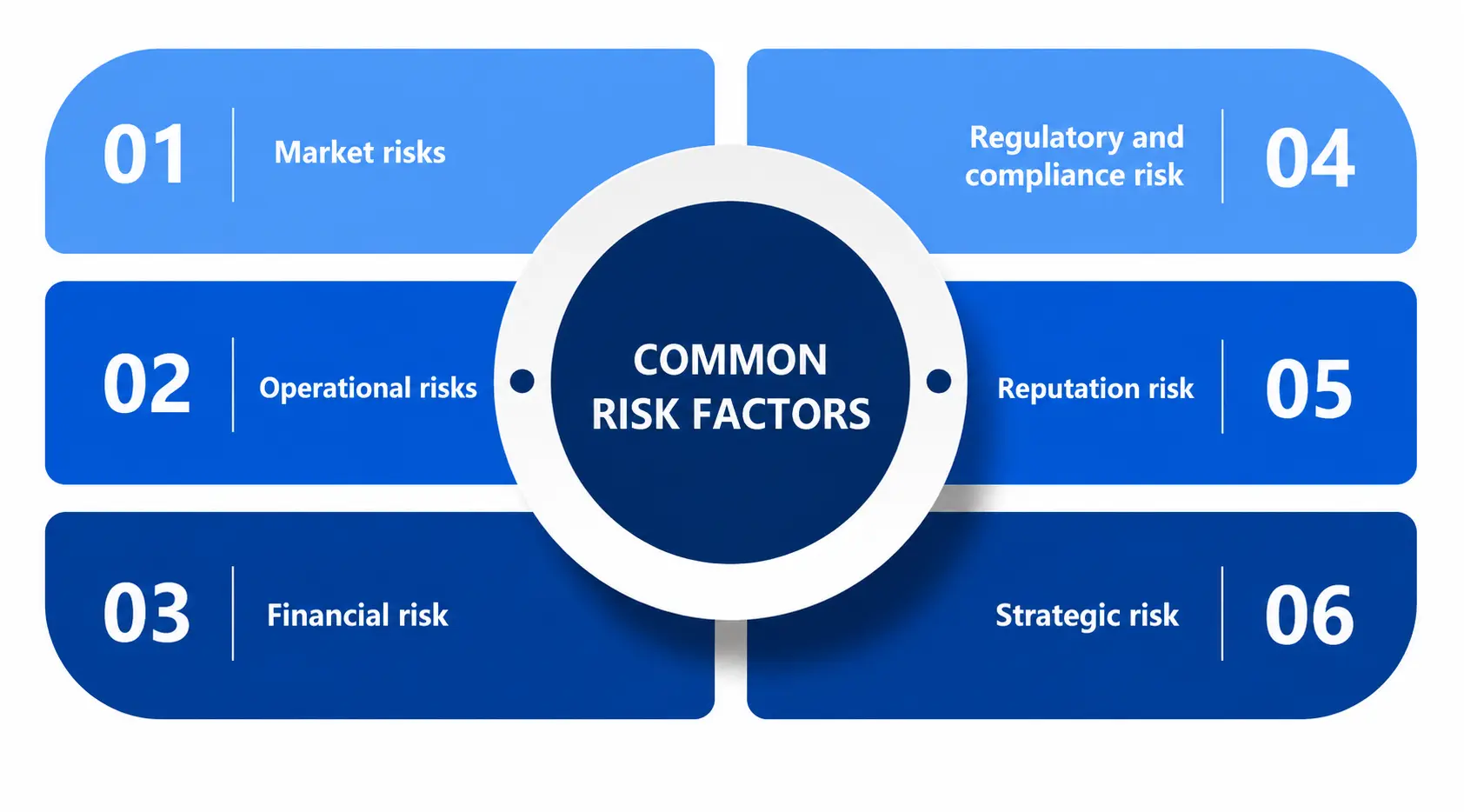
1. Risk of market This accounts for uncertainty arising from external market forces—shifting customer demand, competitor pricing, interest rate changes, currency fluctuations, and broader economic crises. Market risk is usually the most difficult to control since it is external to the organization and therefore needs to be closely monitored rather than simply reviewed on an occasional basis.
2. Operational risks That includes internal breakdowns—supply chain disruptions, system failures, human error, or process inefficiencies that prevent the business from running smoothly.
3. Financial risk Cash flow problems, debt exposure, credit risk, and the likelihood that a company will be unable to meet its financial obligations.
4. regulatory and compliance risk The potential for penalties, legal action, or operational restrictions that may result from non-compliance with industry regulations or government requirements.
5. Reputation risk Special mention deserves this one, for it is often undervalued. Reputational risk is the risk that a negative public perception—whether from a scandal, a data breach, poor customer service, or even a viral social media complaint—damages the brand’s standing and, in turn, its revenue. Unlike financial risk, reputational risk can spiral rapidly and is significantly more difficult to reverse once trust is lost.
6. Strategic risk This arises from poor decision-making at the top — entering the wrong market, misjudging a competitor, or building a business model that doesn’t hold up over time.
A thorough risk review doesn’t treat all of these the same way. As the Monday.com guide notes, different risk categories call for genuinely different evaluation techniques, and treating them identically tends to blur dependencies and distort how big the actual impact really is.
Business Impact: Measuring What a Risk Would Actually Cost
Identifying a risk is only half the job. The other half is understanding its business impact — in plain terms, what would actually happen to the organization if that risk materialized.
This is where most beginner-level risk discussions fall short. It’s easy to list “cyberattack” or “supplier failure” as a risk. It’s harder—and far more useful—to work out the business impact in concrete terms: How many days of downtime? What percentage of revenue is at stake? Which customer relationships would be damaged? Would it trigger regulatory penalties on top of operational losses?
A risk assessment methodology guide from Secureframe explains that a risk matrix is one of the most common tools used here—it assigns each identified risk a likelihood score and a business impact score (typically high, medium, or low), which allows teams to prioritize the risks that are both probable and damaging over ones that are unlikely or minor.
This is a crucial mindset shift for students to grasp: business risk analysis isn’t about eliminating every possible risk (that’s neither realistic nor efficient). It’s about ranking risks by business impact so the organization spends its limited time and money on the threats that matter most.
Risk Appetite vs. Risk Tolerance: A Distinction Students Often Get Wrong
Two terms come up constantly in risk management coursework and in the field—risk appetite and risk tolerance—and they are frequently used as if they mean the same thing. They don’t, and understanding the difference is genuinely useful, not just academic trivia.
Risk tolerance refers to the level of risk an organization can accept for an individual, specific risk, while risk appetite refers to the total amount of risk the organization is willing to bear across its entire risk profile—usually described in aggregate rather than case by case.
Put more simply, using the analogy from Risk Companion’s breakdown of the two concepts, risk appetite functions like a speed limit—a broad, strategic statement of how fast the organization is willing to move in pursuit of its goals—while risk tolerance is the tighter, tactical boundary set around specific risks or decisions.
It’s also worth knowing that the two major global standards don’t fully agree on definitions. COSO and ISO 31000 define risk appetite and risk tolerance slightly differently, which is precisely why organizations are advised to explicitly document which definitions they’re using rather than assuming everyone means the same thing.
Why does this distinction matter in practice? Because risk appetite sets the direction from the top (the board deciding “we’re comfortable pursuing moderate risk to grow market share”), while risk tolerance turns that into something operational teams can actually act on (for example, “no single-event loss above a defined financial threshold in this business unit”).
Without both, a company either has a vision nobody can execute or day-to-day limits that were never actually agreed upon at a strategic level.
Business Resilience: The End Goal of Business Risk Analysis
All of this — identifying risk factors, calculating business impact, setting risk appetite and risk tolerance — exists to serve one larger purpose: business resilience. Resilience is an organization’s capacity to absorb shocks, adapt, and keep functioning even when something goes wrong.
A company with strong business resilience doesn’t avoid every crisis; that’s not realistic. Instead, it recovers faster, loses less money, and retains customer trust more effectively than a competitor that never bothered to plan. This is the practical payoff of doing business risk analysis properly—it’s not about paranoia; it’s about building an organization that can take a hit and keep moving.
Table: Key Elements at a Glance
|
Element |
What It Means |
Why It Matters |
|
Risk Identification |
Recognizing potential threats—market shifts, cyber incidents, supplier failure |
Forms the foundation of the entire process |
|
Risk Factors |
Categories such as market risk, operational, financial, reputational, compliance |
Ensures no major exposure is overlooked |
|
Business Impact |
The measurable consequence if a risk occurs (revenue loss, downtime, legal cost) |
Helps prioritize which risks need urgent attention |
|
Risk Appetite |
The overall amount of risk the organization is willing to pursue |
Sets strategic direction from leadership |
|
Risk Tolerance |
The acceptable variation for a specific, individual risk |
Makes the appetite operational and actionable |
|
Reputational Risk |
Damage to brand trust and public perception |
Can cause losses that outlast financial damage |
|
Business Resilience |
The organization’s ability to absorb and recover from shocks |
The ultimate goal of doing risk analysis well |
How to Actually Conduct One: A Step-by-Step Approach
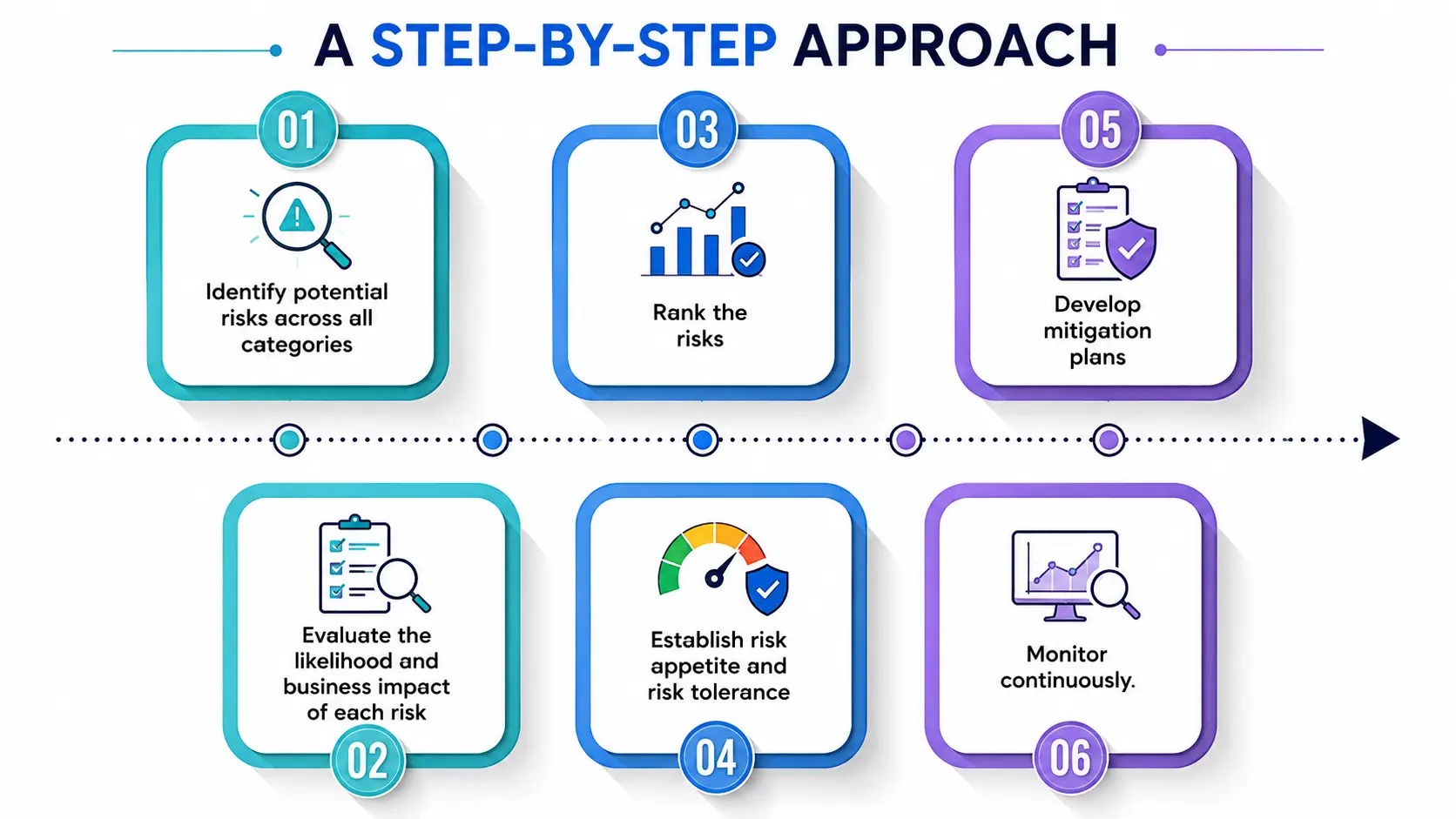
- Identify potential risks across all categories – market, operational, financial, reputational, compliance, and strategic. Don’t pick the easy ones.”
- Evaluate the likelihood and business impact of each risk. A simple qualitative scale (high/medium/low) is fine for starters, but a numerical scoring approach can also be used for a more advanced quantitative approach.
- Rank the risks from most likely to least likely in terms of likelihood and impact.
- Establish risk appetite and risk tolerance to know what risks are acceptable and what needs to be mitigated immediately.
- Develop mitigation plans for high-priority risks—this could include insurance, process redundancy, contract renegotiation, or contingency funding.
- Monitor continuously. Markets change, regulations change, and yesterday’s low-priority risk factor can become tomorrow’s emergency.
As the SafetyCulture guide to risk analysis notes, this is genuinely a multi-step process that blends assessment, active management, and ongoing communication—it isn’t a one-time report that gets filed away and forgotten.
A personal note
I’ve noticed that most people, students especially, treat risk analysis as something dry and bureaucratic—a report to be filed and forgotten. In my experience, it’s one of the more honest exercises a business can do, because it forces you to say out loud what could actually break the thing you’ve built. The organizations that do this well aren’t the ones with the fewest problems; they’re the ones that aren’t surprised when problems show up. That’s the real value of business risk analysis—not prediction, but preparation.