

If you have done any research into info security, you have probably come across this question: should your organization follow ISO 27001, or should you build your program around NIST?
One of the most common points of confusion for students, IT teams, and business owners looking to figure out where they should start is cybersecurity framework adoption. Truth is, there’s no one “right” answer—what’s right depends on your industry, your customers, and where you do business.
This guide compares ISO 27001 vs. NIST in plain English, without all the jargon you usually find in compliance manuals. By the end, you’ll know what each framework actually does, how they differ, and which one is likely to be a better fit for your organization’s approach to compliance standards and data protection.
What Is ISO 27001?
ISO/IEC 27001, an international standard for information security management systems, is often abbreviated to ISMS. It was first published in 2005 and has been updated twice since then, most recently in October 2022.
ISO/IEC 27001 is the result of a joint effort by the International Organization for Standardization and the International Electrotechnical Commission, which is why you will see it called ISO/IEC 27001 instead of ISO 27001.
At its heart, ISO 27001 provides organizations with a framework for identifying, evaluating, and controlling risks to their information assets. It’s not a technical checklist to work through; it’s a management framework. It means it includes how a company puts its people, policies, and technology around protecting data, not just telling IT what firewall rules to set.
One thing that makes ISO 27001 distinct is that it’s certifiable. A business can hire an accredited external auditor, go through a formal audit process, and walk away with an ISO 27001 certificate that it can show to clients, partners, and regulators.
This certification carries real weight internationally, particularly in Europe, the Middle East, and Asia, where clients often ask vendors directly whether they hold ISO 27001 certification before signing a contract.
The standard includes a set of security controls — 93 of them, organized into four categories: organizational, people, physical, and technological. These controls aren’t all mandatory. Instead, a company runs a risk assessment first, decides which controls actually apply to its situation, and documents why any control was left out.
This risk-based selection process is central to how ISO 27001 works, and it’s part of why the framework is often praised for being both flexible and thorough.
What Is NIST?
NIST, the National Institute of Standards and Technology, is a U.S. federal agency, and the term “NIST” in a cybersecurity context usually refers to the NIST Cybersecurity Framework, or CSF. The most current version, CSF 2.0, was released in February 2024 and represents the first major update since the framework’s original 2014 launch.
You don’t get “certified” in NIST CSF like you do in ISO 27001. Unlike an ISO certification, there is no official badge or audit process associated with it. Rather, NIST provides a voluntary set of guidelines, best practices, and outcomes for organizations to use to build or strengthen their cybersecurity posture.
It’s less about demonstrating compliance to an outside party and more about providing organizations with a common language and framework to discuss cyber risk internally and with partners.
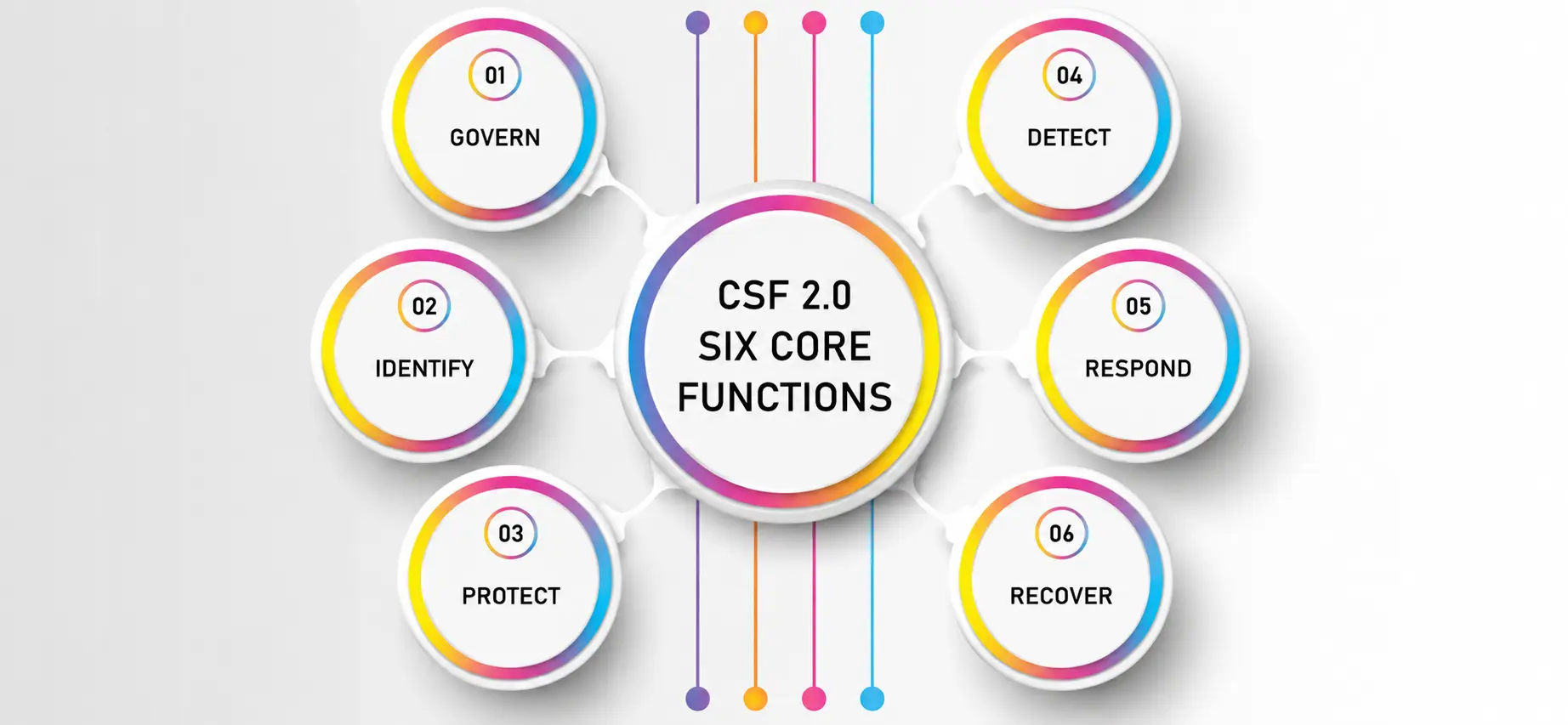
CSF 2.0 is organized around six core functions: Govern; Identify; Protect; Detect; Respond; and Recover. Introducing “Govern” as a standalone function in the 2.0 update was a big change—it signals an increasing awareness that cybersecurity is not just a technical problem but also a leadership and governance problem.
Each function breaks down into categories and subcategories that describe specific outcomes an organization should be working toward. Because NIST is a U.S. government body, its framework tends to be the default reference point for U.S. federal contractors, defense suppliers, and companies operating under U.S. regulatory expectations.
Many American businesses adopt NIST not because a client demanded it explicitly but because it’s the framework their regulators, insurers, or federal partners already speak in terms of.
ISO 27001 vs NIST: The Core Differences
When people ask about ISO 27001 vs. NIST, what they’re usually really asking is, “Which one does my business actually need?” The honest answer is that these two frameworks aren’t strict competitors—they’re built with different purposes in mind, and plenty of organizations end up using both together.
Here’s a side-by-side breakdown to make the ISO 27001 vs NIST comparison easier to digest. This table is the fastest way to see the ISO 27001 vs. NIST distinction at a glance:
|
Aspect |
ISO 27001 |
NIST CSF |
|
Origin |
International standard (ISO/IEC) |
U.S. federal agency (NIST) |
|
Certifiable? |
Yes, via accredited third-party audit |
No, it’s a voluntary self-assessment framework |
|
Structure |
ISMS with 93 controls across 4 categories |
Six functions: Govern, Identify, Protect, Detect, Respond, Recover |
|
Best suited for |
Businesses working internationally or with EU/Asia clients |
U.S.-based companies, federal contractors, defense suppliers |
|
Approach |
Prescriptive risk management framework requiring documentation |
Flexible, outcome-based guidance, adaptable to any maturity level |
|
Cost involvement |
Certification audits, ongoing surveillance audits |
No mandatory certification cost, but implementation still needs resources |
|
Recognition |
Globally recognized compliance standard |
Widely recognized in the U.S., growing global influence |
Neither framework is objectively “better.” ISO 27001 tends to appeal to organizations that need something formal and auditable — a certificate they can hand to a prospective client as proof of their security posture. NIST tends to appeal to organizations that want a flexible risk management framework they can adapt over time without committing to a formal audit cycle.
Information Security vs Cybersecurity Framework: Why the Distinction Matters
There is often a lot of confusion among many students about what exactly “information security” is as a broader discipline versus a specific cybersecurity framework like ISO 27001 or NIST CSF. Information security refers to the protection of all data, whether it is in the form of physical documents, digital files, verbal communication, or anything else.
A cybersecurity framework, however, is a systematic method that helps an organization to deploy information security in a uniform and repeatable manner. ISO 27001 is more on the “information security” side of that spectrum, since its scope explicitly includes people, physical assets, and organizational processes, not just digital systems.
NIST’s CSF is also broad but has a more technology- and infrastructure-focused origin, specifically around protecting critical infrastructure sectors in the U.S. such as energy, finance, and healthcare.
Knowing this difference is helpful when you are trying to determine which framework best fits your company’s actual risk profile. If your biggest exposure is around dealing with physical records, contractor access, and vendor relationships, then ISO27001’s wider approach of an ISMS may map more naturally.
If your biggest exposure is technical—cloud infrastructure, network segmentation, incident detection—the function-based structure of NIST might feel more immediately actionable.
How do security controls actually work in each framework?
Both frameworks rely heavily on security controls, but they organize and apply them differently. In ISO 27001, controls are drawn from Annex A and detailed further in the companion standard ISO/IEC 27002.
A company performs a risk assessment, decides which of the 93 controls are relevant, implements them, and documents the rationale for any exclusions. This creates a clear audit trail that assessors can review during certification.
NIST doesn’t have a single fixed control list in the same way. Instead, CSF 2.0 links out to other NIST publications—like SP 800-53—for organizations that want detailed technical control guidance. This layered approach means NIST CSF functions more like an umbrella framework, with more granular security controls living in separate, more technical documents that organizations can pull from as needed.
For someone new to compliance work, this is one of the clearest practical differences: ISO 27001 keeps its controls contained within one document family, while NIST spreads its guidance across multiple interconnected publications.
Risk Management: The Shared Foundation
Regardless of which framework a business adopts, risk management sits at the center of both. ISO 27001 requires a formal risk assessment methodology as a mandatory part of certification — you cannot get certified without demonstrating that you’ve identified risks, evaluated their likelihood and impact, and selected controls accordingly.
NIST’s approach to a risk management framework is somewhat different in tone. NIST actually has a separate publication specifically called the Risk Management Framework (RMF, described in SP 800-37), which is distinct from the CSF but often used alongside it, particularly by U.S. federal agencies.
The CSF itself references risk management as a guiding principle throughout its six functions, especially within “Govern” and “Identify,” but it doesn’t mandate one specific risk assessment methodology the way ISO 27001 does.
Smaller businesses are often won or lost on the difference in rigidity. NIST’s more flexible approach might be easier to begin with for a young company not yet ready to embrace a fully documented, auditable risk management framework. A company that needs to prove its security posture to regulators or enterprise clients often has no choice but to work toward ISO 27001 certification.
Standards of Compliance and Data Protection Duties
Organizations are frequently forced to choose between ISO 27001 and NIST not because they prefer one over the other but because of external compliance standards they are legally or contractually required to satisfy.
If data processing is part of your business for European clients, expectations on GDPR often match nicely with the structured way of thinking about data protection in ISO 27001.
If your company works with the U.S. federal government or its supply chain, NIST alignment is frequently a contractual requirement, sometimes made explicit through frameworks like CMMC, which itself is built on NIST SP 800-171.
It’s also worth noting that these frameworks aren’t mutually exclusive from a data protection standpoint. Plenty of organizations map their NIST CSF outcomes to ISO 27001 controls (or vice versa) to avoid duplicating work when they need to satisfy multiple sets of compliance standards at once.
NIST itself publishes mapping resources that show where CSF functions align with ISO 27001 controls, which makes running both frameworks in parallel far less painful than it sounds.
Which One Should You Choose?
If you’re a student trying to understand this for academic purposes, the honest takeaway is that ISO 27001 vs NIST isn’t really an “either/or” competition in practice—it’s more about which framework matches your organization’s geography, industry, and client expectations.
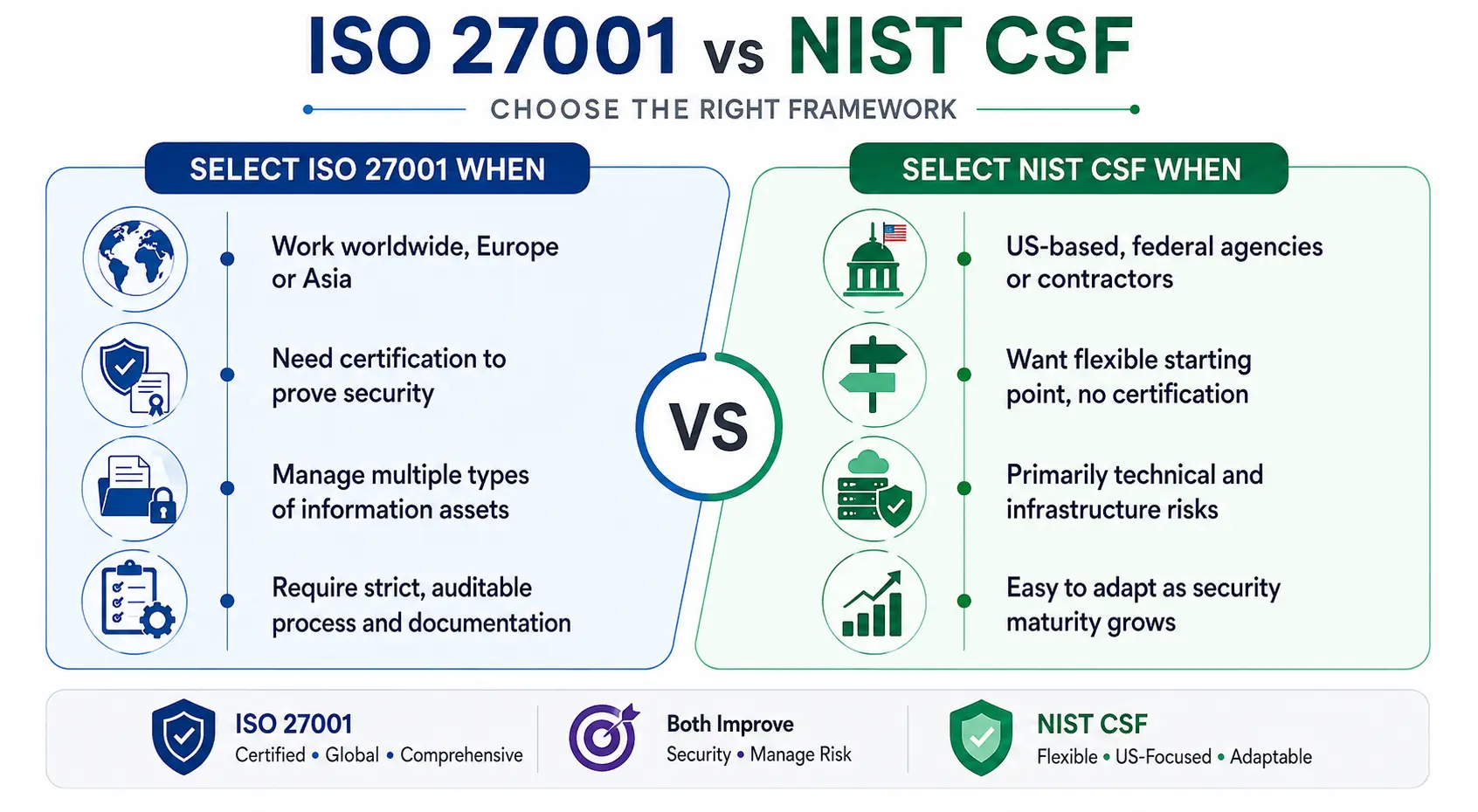
Select ISO 27001 when:
- You work worldwide, particularly with customers in Europe or Asia
- You want a certificate to demonstrate your security posture to customers or regulators
- Your business manages a variety of information assets, including physical, organizational, and electronic assets
- You want a strict, auditable process with clear documentation requirements
Select NIST CSF if:
- You are a business based in the United States, particularly if you work with federal agencies or contractors
- You want a flexible starting point and don’t want the commitment of formal certification
- Your main risk exposure is technical and infrastructure-related
- You want a framework that’s easy to adapt as your security maturity grows
Many mature organizations end up using both: NIST for internal guidance and continuous improvement and ISO 27001 for external certification and client assurance. Although more resource-intensive, this combination often provides the most comprehensive coverage across both the information security and cybersecurity framework requirements and keeps your security controls and compliance standards aligned as your business grows.
Ultimately, the ISO 27001 vs. NIST decision is one you should revisit periodically, not treat as a one-time choice. Your risk profile and client base will likely change over time.
A Personal Note
I’ve noticed that a lot of the confusion around ISO 27001 vs. NIST doesn’t come from the frameworks themselves—it comes from people trying to find a single “winner” when the honest answer is “it depends on your context.” When I researched this topic, what stood out most was how much overlap actually exists between the two once you get past the surface-level differences in certification and origin.
If you’re a student or early-career professional trying to learn this material, my honest suggestion is to stop treating it as a competition and start treating it as two different tools in the same toolbox. Understanding both well will serve you far better in a real compliance role than picking a “side” ever will.