If you’ve spent any time researching cybersecurity careers, auditing, or how tech companies prove they’re trustworthy with customer data, you’ve probably run into two acronyms that seem to mean the same thing but never quite explain how they’re different: SOC 2 and ISO 27001.
Students studying information security often assume these are interchangeable certificates you can pick based on which one sounds more impressive. They’re not. Understanding SOC 2 vs ISO 27001 properly means understanding two very different systems for proving the same underlying thing — that an organization takes data seriously.
This guide breaks down what each framework actually is, how they’re built, where they overlap, and where they genuinely diverge. Whether you’re a student prepping for a compliance career, an early professional trying to understand audit reports, or just someone curious about how companies get to say “we’re compliant,” this is the plain-language explanation nobody gave you in your first cybersecurity class.
What Is SOC 2?
SOC 2 (System and Organization Controls 2) is an attestation report, not a certification. That distinction matters more than most people realize. It’s issued by a licensed CPA firm after auditing a company’s controls against the Trust Services Criteria published by the American Institute of Certified Public Accountants (AICPA).
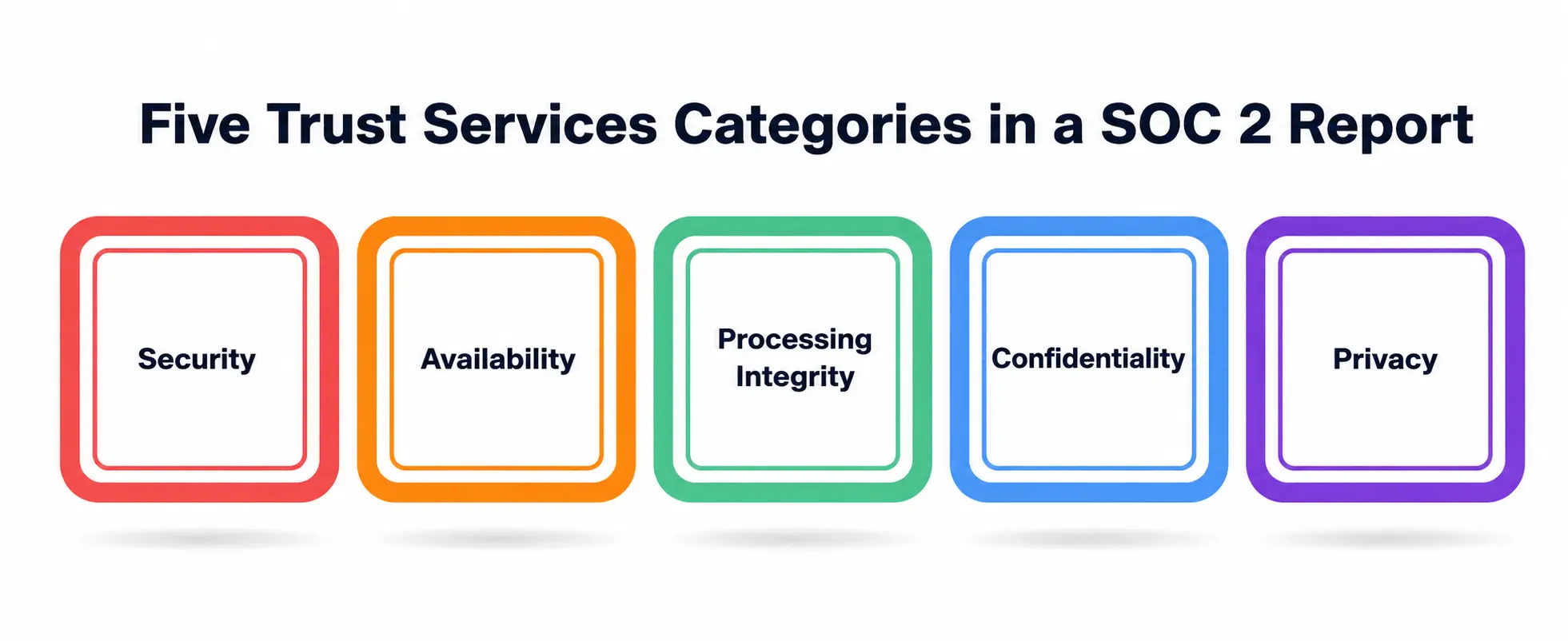
There are five trust services categories in a SOC 2 report: Security, Availability, Processing Integrity, Confidentiality, and Privacy. Security is mandatory for every SOC 2 report; the other four are optional depending on what the organization promises its customers.
A company that just stores files might only need Security and Confidentiality, while a payments platform might also need Processing Integrity. SOC 2 reports come in two flavors. A Type I report checks whether controls are designed properly at a single point in time.
A Type II report goes further, checking whether those controls actually operated effectively over a period of months — usually somewhere between three and twelve months. Type II is what most enterprise customers actually want to see, because it proves ongoing discipline rather than a one-day snapshot.
SOC 2 is primarily an American framework, built around US audit standards, but it has become the default request from SaaS buyers and enterprise procurement teams across the world, especially in North America.
What Is ISO 27001?
ISO 27001 is an internationally recognized standard, published jointly by the International Organization for Standardization and the International Electrotechnical Commission, for building and running an Information Security Management System, or ISMS. Unlike SOC 2, which evaluates specific controls, ISO 27001 evaluates an entire management system — the policies, processes, risk assessments, and continual improvement cycle a company uses to protect information.
The current version, ISO 27001:2022, is built around Annex A, a reference list of 93 controls grouped into four themes: Organizational, People, Physical, and Technological. Companies don’t have to implement all 93. Instead, they run a risk assessment, decide which controls actually apply to their business, and document their reasoning in a Statement of Applicability.
That risk-driven, document-everything approach is a hallmark of how ISO 27001 treats data protection — it’s less about a fixed checklist and more about proving you’ve thought carefully about your own risk landscape.
ISO 27001 results in an actual certification, issued by an accredited certification body, and it’s valid for three years with annual surveillance audits in between. Because it comes from an international standards body rather than a US accounting institute, it’s the framework most commonly requested by customers, regulators, and partners across Europe, Asia, and the Middle East.
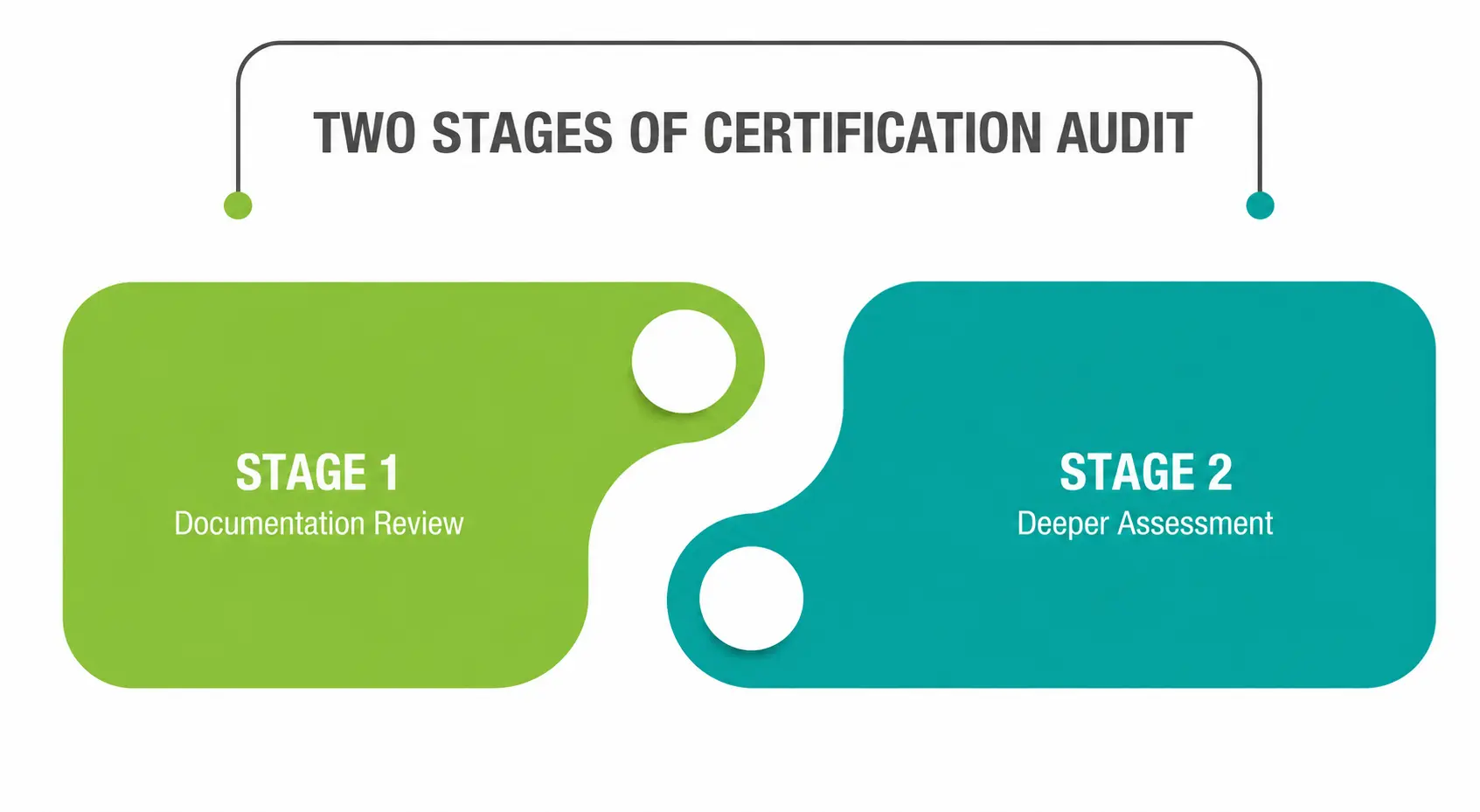
The certification audit itself runs in two stages. Stage 1 is a documentation review, where the certification body checks that your ISMS, policies, and Statement of Applicability are complete and consistent with each other.
Stage 2 is a deeper assessment, often on-site, that tests whether those documented processes are actually being followed day to day rather than just written down. Passing both stages is what earns the ISO/IEC 27001:2022 certificate — policies alone are never enough.
SOC 2 vs ISO 27001: A Side-by-Side Comparison
Here’s where the differences between SOC 2 and ISO 27001 become easiest to see:
|
Factor |
SOC 2 |
ISO 27001 |
|
Issued by |
Licensed CPA firm |
Accredited certification body |
|
Output |
Attestation report |
Formal certification |
|
Origin |
AICPA (United States) |
ISO/IEC (international) |
|
Structure |
5 Trust Services Criteria |
93 Annex A controls, 4 themes |
|
Focus |
Point-in-time or period controls testing |
Full management system (ISMS) |
|
Typical timeline |
2–3 months (Type I); 6–12 months (Type II) |
6–12 months to first certification |
|
Renewal cycle |
New report needed annually |
3-year cycle with annual surveillance audits |
|
Strongest region |
North America |
Europe, Asia-Pacific, globally recognized |
|
Best suited for |
SaaS and service companies selling to US enterprises |
Companies needing global, cross-border recognition |
Key Differences That Actually Matter
Reading the table is useful, but the real substance of SOC 2 vs ISO 27001 shows up in how each framework treats evidence and structure.
SOC 2 is criteria-based. Auditors test your controls against the trust services categories you’ve chosen and write a narrative report describing what they found. There’s no fixed control list you must satisfy — flexibility is the point, but it also means two companies’ SOC 2 reports can look quite different from each other even if both pass.
ISO 27001 is system-based. It doesn’t just ask “do you have good controls,” it asks “do you have a functioning system for managing and improving information security over time.” That includes leadership commitment, defined roles, a documented risk assessment methodology, and a formal management review process.
This is why people who’ve gone through both often say ISO 27001 feels more like building an operational habit, while SOC 2 feels more like passing an exam on a fixed syllabus. Neither framework is objectively “harder.” They test different things, which is exactly why so many growing companies eventually pursue both rather than choosing one over the other.
Around two-thirds of the underlying controls tend to overlap, so once you’ve built strong information security practices for one framework, extending them to the other is usually incremental work rather than starting from scratch.
Why Does Security Assurance Matters to Buyers and Regulators?
Neither of these frameworks exists to satisfy auditors for the sake of paperwork. They exist because buyers, investors, and regulators need some form of security assurance before trusting a vendor with sensitive data.
A signed contract promising “we take security seriously” means very little on its own. An independent report or certification, produced by a party with no financial interest in the outcome, means a great deal more.
This is also where compliance standards intersect with sales cycles. Enterprise procurement teams routinely request a SOC 2 report or ISO 27001 certificate before signing a vendor contract, particularly in industries like fintech, healthcare, and B2B SaaS. Skipping this step doesn’t just create legal risk — it can close off entire categories of customers who simply won’t buy from an unaudited vendor.
For students entering the field, this is the practical takeaway: security compliance isn’t a side function bolted onto engineering teams. It’s often a revenue enabler, directly tied to which deals a company can close and which markets it can enter.
How Security Assurance Turns Into Compliance Standards?
Security assurance isn’t an abstract idea — it’s a documented trail that a third party can verify. When a company earns a favorable SOC 2 report or an ISO 27001 certificate, it’s converting internal security work into external, checkable proof.
That’s the real function both frameworks serve: turning private security compliance effort into public compliance standards that a customer’s legal or procurement team can point to and trust, without having to audit the vendor themselves.
This matters more once you notice how many compliance standards now sit stacked on top of each other for a single business. A company might need to satisfy SOC 2 vs ISO 27001 requirements from enterprise customers, GDPR-style data protection obligations from European regulators, and industry-specific rules from healthcare or finance partners — all at the same time.
Frameworks like SOC 2 and ISO 27001 don’t replace those legal obligations, but they give auditors, regulators, and customers a shared vocabulary for evaluating data protection practices, which is exactly why security compliance teams treat them as a baseline rather than a finish line.
Which One Should You Choose First?
If your customer base is mostly US-based SaaS buyers, SOC 2 is usually the faster win and the one prospects will ask for by name. If you’re selling internationally, working with government contracts, or operating in regions where ISO standards carry more weight, ISO 27001 tends to open more doors.
Deciding between SOC 2 vs ISO 27001 as a starting point really comes down to where your customers and regulators sit, not which framework is “better” in the abstract. A few practical signals worth weighing:
- Customer requests: If prospects are already asking for a specific report by name, that’s your clearest signal.
- Geography: North American buyers lean SOC 2; European, Middle Eastern, and Asia-Pacific buyers often expect ISO 27001.
- Internal maturity: Companies with an existing quality-management culture (think ISO 9001 experience) often find the ISO 27001 documentation lift more familiar.
- Speed to market: SOC 2 Type I can be the fastest path to something concrete if you need proof of progress quickly.
Can a Company Have Both?
Yes, and it’s increasingly common rather than exceptional. Many mid-sized and enterprise-focused companies eventually pursue SOC 2 and ISO 27001 together, because their customer bases span multiple regions and procurement teams with different expectations.
Because so much of the underlying work overlaps — access control policies, incident response plans, vendor risk management, employee security training — building for one compliance standard rarely means starting over for the other.
The practical order most organizations follow is to build a strong information security foundation first, map it to whichever framework their most urgent customer needs, and then layer the second framework on top using shared evidence and shared policies.
Trying to run both audits as completely separate projects wastes time and money that a coordinated approach avoids.
Common Mistakes Students and Early Professionals Make
A few misunderstandings come up constantly when people are first learning about SOC 2 vs ISO 27001:
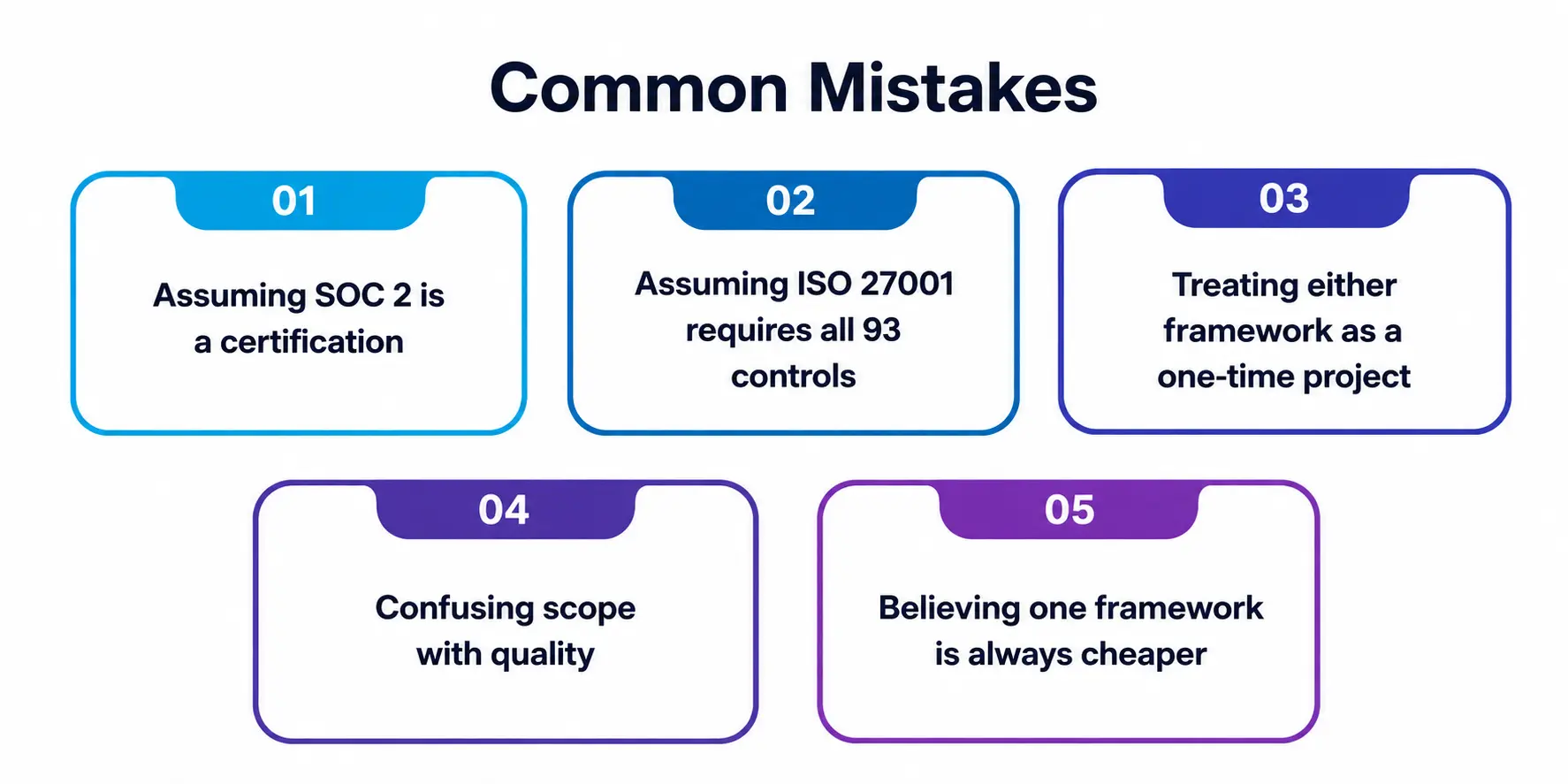
- Assuming SOC 2 is a certification. It isn’t. It’s an attestation report, and using “certified” language about it is technically inaccurate.
- Assuming ISO 27001 requires all 93 controls. It doesn’t. Companies select applicable controls through a risk assessment and document exclusions in a Statement of Applicability.
- Treating either framework as a one-time project. Both require ongoing maintenance — annual reports for SOC 2, surveillance audits for ISO 27001 — because data protection is a continuous responsibility, not a milestone you check off once.
- Confusing scope with quality. A narrow-scope SOC 2 report covering one product line isn’t automatically weaker than a broad one; scope should match what customers actually need to know about.
- Believing one framework is always cheaper. Pricing depends heavily on company size, the audit firm, and how much internal preparation work is needed — not simply on which framework you pick. Budgeting time for gap remediation matters more than chasing the cheaper-sounding option.
Final Thoughts
There’s no universal winner in the SOC 2 vs ISO 27001 debate, and treating it like a contest misses the point. Both exist to give buyers real security assurance, both feed into the broader compliance standards a business has to meet, and both push a company toward stronger security compliance habits long after the audit ends.
Whichever framework you study first, focus on the underlying data protection principles rather than the paperwork — that’s the knowledge that actually holds up once you’re the one being asked SOC 2 vs ISO 27001 questions in an interview or a client meeting.
A Personal Note
I’ve noticed that a lot of guides on this topic are written for people who already work in compliance, which makes the subject feel more intimidating than it needs to be. If you’re a student trying to break into cybersecurity, IT audit, or GRC (governance, risk, and compliance) work, my honest advice is this: don’t try to memorize every control number in Annex A or every trust services criterion.
Learn the reasoning behind each framework instead — why an auditor asks the questions they ask, and what risk each control is actually trying to reduce. That understanding transfers across frameworks far better than memorized checklists ever will, and it’s what actually gets noticed in interviews and on the job.