
I still remember the first time a senior manager asked me to “map our controls before the auditors land next month.” I had no idea where to even begin. Three years and a dozen audit cycles later, I can tell you this with confidence: understanding the benefits of GRC early in your career (or your business journey) saves you from that exact panic.
This blog is written for students, early-career professionals, and business owners who keep hearing the term “GRC” thrown around in meetings and want a plain-English explanation of why it actually matters.
By the end of this post, you’ll understand what GRC is, why organizations of every size are investing in it, and how the benefits of GRC translate into real, measurable outcomes like stronger business resilience, smarter risk mitigation, and better audit readiness.
What Exactly Is GRC?
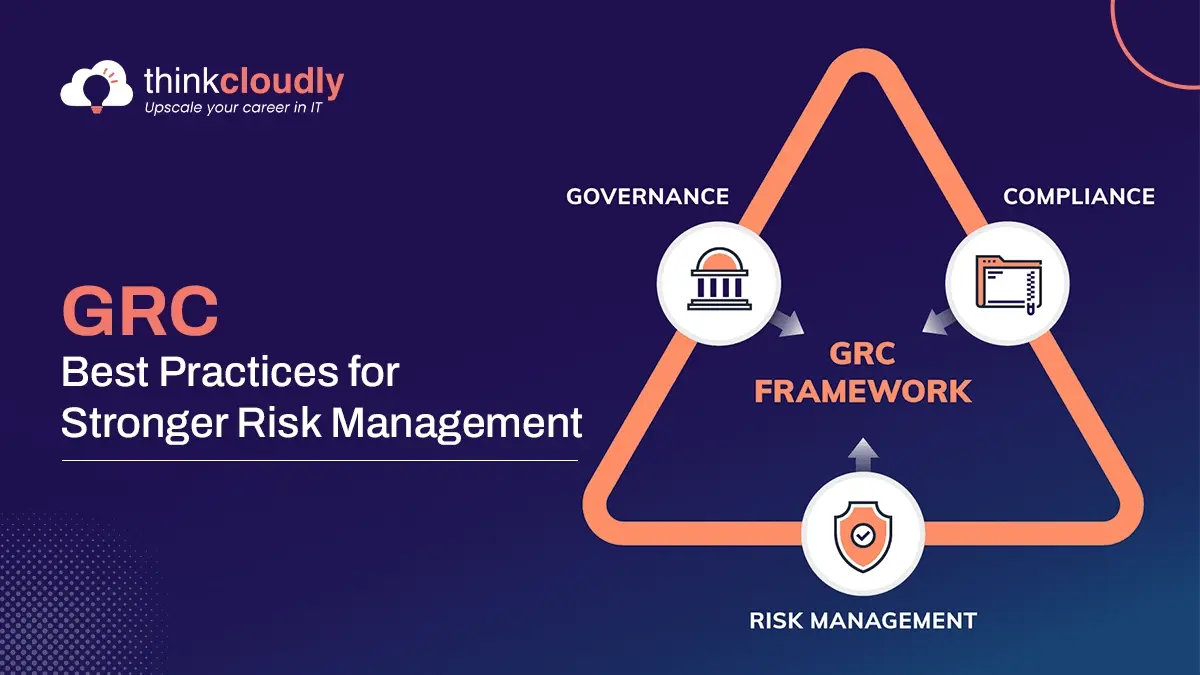
GRC stands for Governance, Risk, and Compliance. It’s a framework that helps organizations align their business goals with ethical practices, manage uncertainty, and stay within the boundaries of laws and regulations. Put simply, it’s a structured way of asking three questions at once:
Are we being run properly? Are we aware of what could go wrong? And are we following the rules we’re supposed to follow?
Rather than treating governance, risk management, and compliance as three separate departments doing their own thing, GRC brings them together under one roof. According to Diligent’s guide on GRC, the concept is meant to unify an organization’s approach to risk management and regulatory compliance, which in turn strengthens decision-making within corporate boards.
Once you understand this foundation, the benefits of GRC start to make a lot more sense — because you’re no longer looking at governance, risk, and compliance as three headaches. You’re looking at one connected system that protects the business from multiple angles at once.
Why the Benefits of GRC Go Beyond Just “Ticking Boxes”?
A lot of students assume GRC is just paperwork — checklists, policies, and boring audits. I used to think the same thing until I saw what happens without it. A company I once worked with had no centralized way of tracking who approved what, which meant the same risk was being reviewed by three different teams, none of whom knew the other two existed. That’s the opposite of what GRC is meant to achieve.
The real benefits of GRC show up when departments stop working in silos. An integrated GRC program strengthens decision-making, improves operational performance, and enhances organizational trust, helping teams respond quickly to risks while supporting strategic goals with confidence.
This is one of the clearest benefits of GRC: it turns compliance from a defensive, last-minute scramble into a proactive, everyday habit. And once that habit is built into daily operations, the organization naturally becomes more transparent and more accountable—two things every stakeholder, from investors to regulators, actively looks for.
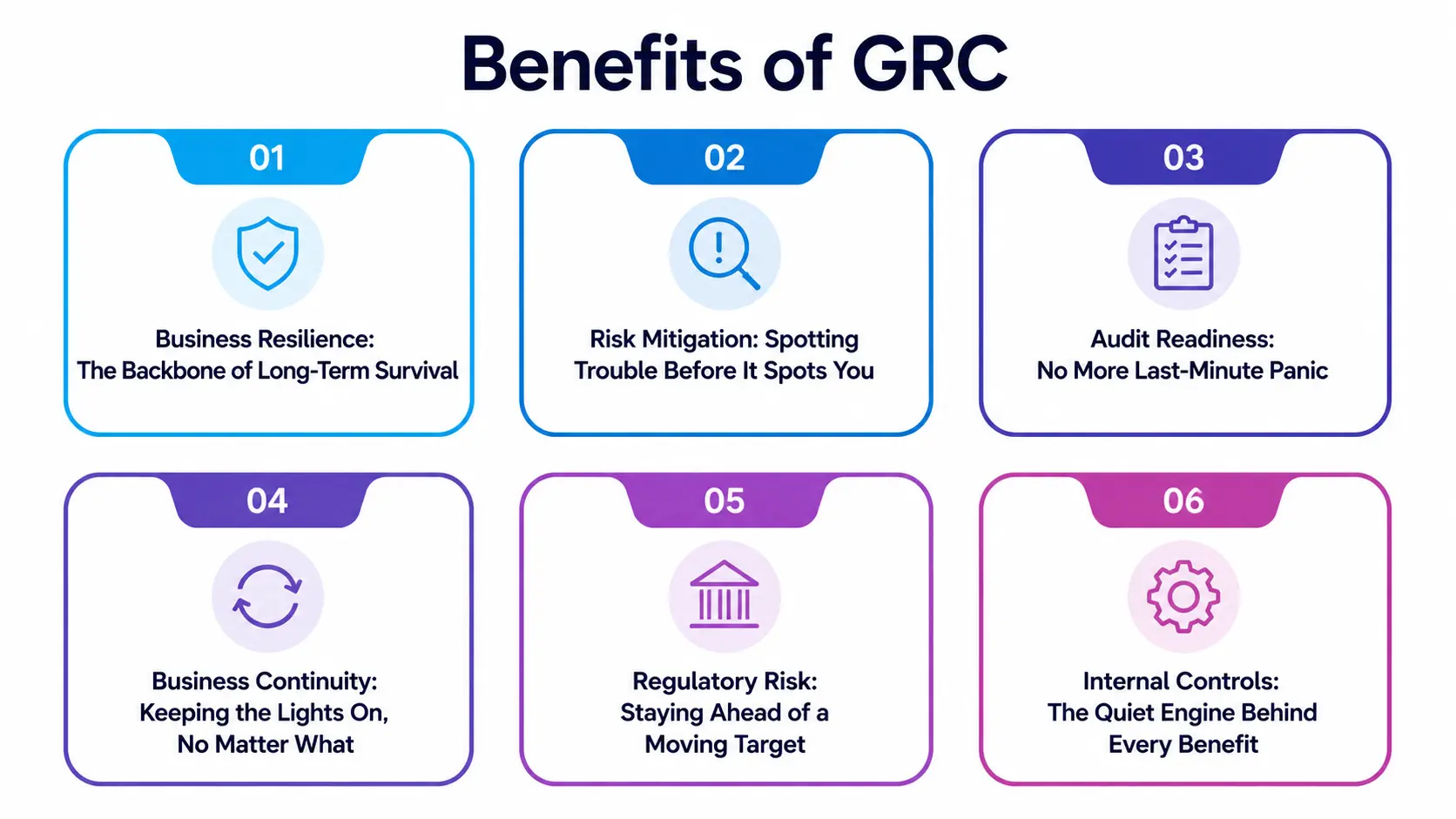
Business Resilience: The Backbone of Long-Term Survival
If there’s one word that comes up again and again when GRC professionals talk about outcomes, it’s business resilience. This means the ability of a company to absorb shocks — whether that’s a cyberattack, a regulatory change, a supply chain disruption, or an economic downturn — and keep functioning.
Business resilience doesn’t happen by accident. It’s built through consistent risk assessments, strong internal policies, and a culture where employees know what to do when something goes wrong. Organizations that treat GRC as a strategic function, rather than a compliance formality, tend to recover faster from disruptions because they’ve already mapped out their vulnerabilities in advance.
UnderDefense’s 2026 GRC report points out that effective GRC in 2026 combines automated evidence collection, continuous control monitoring, and predictive risk scoring—creating what they call a “living GRC posture” rather than a one-time snapshot. This kind of continuous monitoring is exactly what strengthens business resilience over time, because risks are caught early instead of being discovered during a crisis.
For students studying business or compliance, this is a good real-world lesson: resilience isn’t about avoiding every problem. It’s about building systems that let you bounce back quickly when problems inevitably happen. That’s precisely why business resilience is treated as a core outcome, not a side effect, of a well-run GRC program.
Risk Mitigation: Spotting Trouble Before It Spots You
Risk mitigation is probably the most talked-about benefit of GRC, and for good reason. Every business — big or small — carries risk. Financial risk, operational risk, cybersecurity risk, and reputational risk. The question was never whether risk exists but whether you’re managing it before it manages you.
A structured GRC framework gives organizations a repeatable process for identifying, assessing, and responding to risks. One of the primary advantages of GRC integration is a unified approach to identifying, assessing, and mitigating risks across the organization, breaking down silos between departments so no potential threat slips through unnoticed.
This is where risk mitigation stops being theoretical and becomes practical. Instead of each department guessing at what could go wrong, GRC creates a shared risk register, shared terminology, and shared accountability. When risk mitigation is handled this way, leadership gets a real-time, honest picture of where the organization stands—not a filtered version pieced together from five different spreadsheets.
For students entering fields like finance, IT, or operations, understanding risk mitigation early will make you significantly more valuable because almost every serious employer today wants people who can think in terms of “What could go wrong, and what’s our plan if it does?”
Audit Readiness: No More Last-Minute Panic
Ask anyone who has been through an audit unprepared, and they’ll tell you it’s one of the most stressful experiences in corporate life. Documents scattered across different systems, no clear ownership of controls, and a mad scramble to prove that policies were actually followed. This is exactly what strong audit readiness prevents.
Audit readiness simply means your organization is always in a state where it could pass an audit without extraordinary last-minute effort. GRC platforms and frameworks help maintain this state by continuously tracking evidence, control performance, and compliance metrics rather than assembling them only when an auditor is at the door.
MetricStream’s 2026 GRC tools highlight that organizations using integrated GRC platforms report better insights on compliance through a single source of truth, along with improved compliance efficiency through automated, standardized workflows—both of which are central to sustained audit readiness.
When audit readiness is built into daily operations instead of treated as an annual fire drill, teams save enormous amounts of time and stress. It also builds trust with regulators and external stakeholders, because consistent audit performance signals a mature, well-governed organization rather than one that’s just getting lucky each cycle.
Business Continuity: Keeping the Lights On, No Matter What
Closely related to resilience is business continuity — the specific plans and processes that keep essential operations running during and after a disruptive event. Think of resilience as the mindset, and business continuity as the concrete plan that gets executed when disaster actually strikes.
GRC frameworks require organizations to document continuity plans, test them regularly, and update them as the business evolves. This isn’t just a nice-to-have; it’s often a regulatory expectation, especially in sectors like banking, healthcare, and energy where downtime can have serious real-world consequences.
According to StandardFusion’s 2026 compliance regulations overview, integrated compliance programs eliminate duplication, reduce costs, and allow teams to move faster—all of which directly support stronger business continuity, because a leaner, better-coordinated organization can pivot and recover more efficiently when something breaks.
Business continuity planning is one of those things students often overlook until they see it fail in the real world. A company without a continuity plan doesn’t just lose time during a crisis—it can lose customers, contracts, and credibility permanently. GRC exists, in part, to make sure that never has to happen.
Regulatory Risk: Staying Ahead of a Moving Target
If you’ve followed the news around regulatory risk lately, you’ll know the compliance landscape barely stands still. New data privacy laws, financial reporting requirements, cybersecurity mandates, and industry-specific rules keep emerging, and businesses that fail to keep up face real financial and reputational consequences.
The 2025–2026 regulatory acceleration has been significant, referencing regulations like DORA reaching full enforcement for EU financial entities and NIS2 penalties now being actively enforced with fines reaching millions of euros for non-compliance. This is a clear signal that regulatory risk isn’t a distant, abstract concern—it’s an active, evolving threat that businesses must monitor continuously.
GRC frameworks help organizations track regulatory changes as they happen, rather than discovering new obligations after a violation has already occurred. This proactive monitoring of regulatory risk protects businesses from fines, lawsuits, and the kind of reputational damage that can take years to repair.
For anyone studying law, business, or compliance, understanding how regulatory risk is managed inside a GRC framework gives you a genuine edge — because regulators worldwide are only getting stricter, not more lenient.
Internal Controls: The Quiet Engine Behind Every Benefit
And none of the above benefits – resilience, risk mitigation, audit readiness – would be possible without strong internal controls. These are the very policies, procedures, and checks that ensure business processes are performed correctly and consistently every single time.
“Internal controls” may sound like a boring technical phrase, but think of them as the guard rails on a mountain road. On a bright sunny day you don’t notice them, but when something goes wrong, they are the difference between a minor inconvenience and a major catastrophe.
A strong GRC program means internal controls are documented, tested, and updated periodically, not left to gather dust in a policy binder nobody reads. Here, too, automation has really made a difference. “AI-driven monitoring and workflow automation is helping to boost GRC speed, accuracy, and scalability and cut compliance costs, so today, internal controls are checked continuously instead of once a quarter,” says Diligent’s 2026 GRC guide.
Internal controls are not just about avoiding fraud or mistakes but about establishing a culture of accountability. Employees feel their work is being monitored fairly and consistently, establishing confidence across the organization.
A Quick Look: Core Benefits of GRC at a Glance
Here’s a simple breakdown of how each supporting pillar connects back to the overall benefits of GRC:
|
GRC Pillar |
What It Focuses On |
Real-World Impact |
|
Business Resilience |
Preparing for shocks and disruptions |
Faster recovery from crises |
|
Risk Mitigation |
Identifying and reducing potential threats |
Fewer surprises, better planning |
|
Audit Readiness |
Maintaining continuous compliance evidence |
Smoother, less stressful audits |
|
Business Continuity |
Keeping core operations running during disruptions |
Reduced downtime and lost revenue |
|
Regulatory Risk |
Tracking and adapting to changing laws |
Avoiding fines and legal trouble |
|
Internal Controls |
Enforcing consistent processes and checks |
Higher accuracy, less fraud, more trust |
This table is a good reference point if you’re studying for an exam, preparing for an interview, or simply trying to explain GRC to someone in under a minute.
Why Should Students Actually Care About This?
I get it – GRC is not the sexiest subject compared to marketing or product design. The truth is, almost every industry today—from tech startups to hospitals to banks—needs people who understand governance, risk, and compliance. The benefits of GRC are not theoretical knowledge you learn for an exam but skills that immediately translate into job readiness.
Employers want graduates who understand how to mitigate risk, who know what those internal controls look like in practice and can speak intelligently about regulatory risk. If you walk into an interview and can describe how GRC supports business continuity and audit readiness, you are ahead of most candidates who only know the textbook definition.
Conclusion
As we’ve seen throughout this series, the benefits of GRC are not really about paperwork or bureaucracy at all. They are about building organizations that can think straight under pressure, recover quickly from setbacks, and gain the trust of all those who depend on them—employees, customers, investors, and regulators alike.
Whether you’re a student trying to understand where this fits into your future career or a business owner wondering if it’s worth investing in a proper GRC framework, the answer keeps pointing the same direction: organizations with strong governance, proactive risk management, and consistent compliance simply perform better over time. That’s really what the benefits of GRC come down to—not avoiding trouble entirely, but being ready for it when it comes.
Personal Note
Writing this blog took me back to my own early confusion about what GRC even meant. I used to think it was just a fancy term for “following rules.” It took real experience — sitting through audits, watching risk registers get built from scratch, and seeing how a single overlooked control could snowball into a genuine crisis — to understand that GRC is really about protecting the people and purpose behind a business.
If you’re a student reading this, my honest advice is don’t wait for a crisis to teach you why GRC matters. Learn it now, and it’ll serve you in whatever career path you choose.