
If you’re a student trying to break into cybersecurity, you’ve probably run into the same wall. I did years ago: every job board is flooded with Security Operations Center jobs, but nobody actually explains how a SOC Analyst role is different from a Security Engineer role. The titles get thrown around like they’re interchangeable. They’re not. And picking the wrong starting point can cost you a year or two of career momentum.
This guide breaks down both roles in plain language—what you’ll actually do day to day, what skills matter, what you’ll get paid, and which path fits your personality. No jargon for the sake of sounding smart. Just what you need to make a decision.
Why Are Security Operations Center Jobs Booming Right Now?
Before comparing roles, it helps to understand why Security Operations Center jobs are one of the fastest-growing categories in tech hiring in 2026. The math is simple: attacks are increasing faster than the workforce can keep up.
Globally, the shortage of qualified cybersecurity professionals sits at roughly 4.8 million unfilled positions, according to ISC2’s most recent workforce study. In the United States alone, there were over 514,000 open cybersecurity roles in the twelve months ending March 2026—a 12% jump from the year before, based on CyberSeek and CompTIA data.
The U.S. Bureau of Labor Statistics projects 29% growth for information security analysts between 2024 and 2034, which is roughly seven times faster than the average occupation.
On top of that, the global market for security operations infrastructure itself is expanding. It was valued at over $46 billion in 2025 and is projected to cross $100 billion by 2035, growing at more than 8% a year.

Every one of those dollars translates into more Security Operations Center jobs—both on the analyst side watching the alerts and on the engineering side building the systems that generate them.
If you’re a student weighing your options, this is genuinely one of the safer long-term bets in tech right now.
Geography matters too. North America currently accounts for roughly 43% of the global cybersecurity market, and North America together with Western Europe makes up more than 70% of worldwide security spending.
That means students in the US, UK, Canada, and across Europe are sitting in the middle of where hiring budgets are actually concentrated. Healthcare, finance, and government consistently rank among the sectors with the widest skill gaps, which is good news if you’re trying to figure out which industries to target once you start applying for Security Operations Center jobs.
What Does a SOC Analyst Actually Do?
A SOC analyst is the person sitting inside the security operations center, watching dashboards, reviewing alerts, and figuring out whether something is a real attack or just noise. Most Security Operations Center jobs at the entry level fall into this category, and the work is organized into tiers.
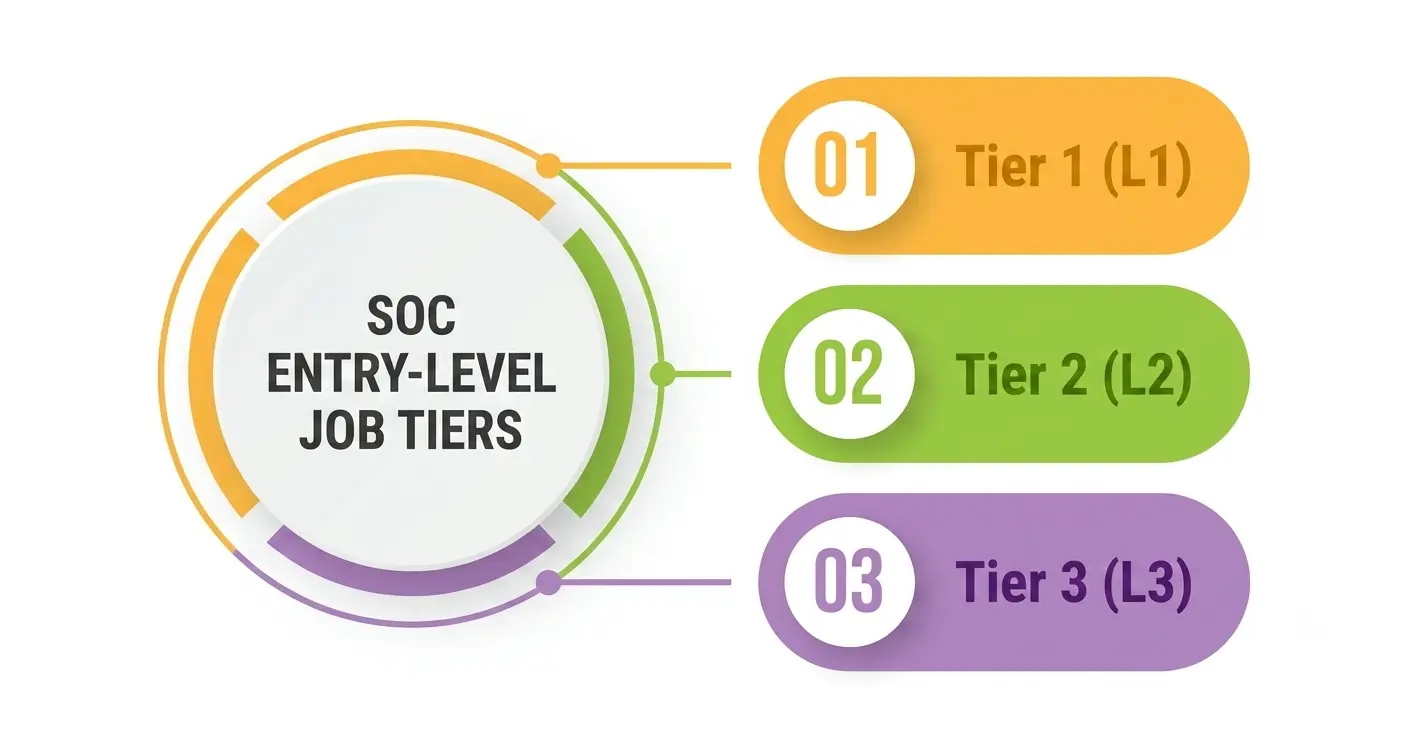
- Tier 1 (L1): This is where almost everyone starts. Your job is triage—reviewing alerts from the SIEM, doing basic log analysis, and deciding what gets escalated. You’ll spend your shift watching for patterns across endpoints, network traffic, and identity systems.
- Tier 2 (L2): You go deeper. This is real incident management—investigating confirmed threats, tracing how an attacker moved through a network, and coordinating the response with other teams.
- Tier 3 (L3): This is threat hunting territory. Instead of waiting for alerts, you proactively search for hidden threats that automated tools missed, and you often help develop new threat detection rules for the tools below you.
One thing worth knowing before you commit: SOC work runs on shifts. Organizations need 24/7 coverage, so nights, weekends, and holiday rotations are part of the deal—especially early in your career.
As one security operations manager put it on Reddit, it’s a busy job that’s rarely a clean 8-hour day. Some people thrive on the adrenaline of pattern-spotting under pressure. Others burn out within a year. It’s worth being honest with yourself about which type you are.
What Does a Security Engineer Actually Do?
A security engineer is a different animal entirely. Where the analyst reacts to alerts, the security engineer builds the systems that generate—and prevent—those alerts in the first place.
Security engineers are primarily responsible for designing, implementing, and maintaining an organization’s security infrastructure. That means configuring and tuning firewalls, intrusion detection systems, and security software—not just watching what those tools output.
This role demands deep technical expertise in scripting, automation, cloud architecture, and system design. You’re not just reading logs; you’re deciding what gets logged, how it’s collected, and how detection rules are built. A lot of the log analysis capability that analysts rely on exists because an engineer built the pipeline that makes it possible.
Security engineers also tend to have more predictable schedules. Unlike SOC analysts, who often work rotating shifts, engineers typically work standard business hours with more remote flexibility, though they still get pulled into incident response during major security events.
A Day in the Life: Analyst vs. Engineer
It helps to picture what a normal Tuesday actually looks like in each role, because the job descriptions alone don’t capture the difference.
A SOC analyst’s shift usually starts with a queue of overnight alerts waiting for triage. You’ll spend the first hour doing log analysis across the SIEM dashboard, sorting real signals from noise.
By mid-morning you might be deep into an incident management workflow—pulling timelines, checking which endpoints were touched, and looping in the right team before the issue escalates. The afternoon often means writing up documentation on a closed case and reviewing new threat detection rules that came down from the Tier 3 team.
A security engineer’s day looks almost nothing like that. You might start by reviewing the latest vulnerability scan results and prioritizing which systems need urgent patching. A chunk of the day goes into scripting or tuning detection logic—the same rules the SOC Analyst relies on to catch real threat detection hits instead of false positives.
You’ll likely sit in on an architecture review, evaluate a new security tool before rollout, and spend very little time actually watching a live alert queue. The rhythm is project-based rather than shift-based, which is one of the biggest quality-of-life differences between the two Security Operations Center jobs.
SOC Analyst vs Security Engineer: Side-by-Side Comparison
|
Factor |
SOC Analyst |
Security Engineer |
|
Primary focus |
Monitoring, alert triage, incident management |
Designing and building security infrastructure |
|
Typical entry point |
Tier 1, minimal prior experience needed |
Usually requires 4–6 years of prior IT/dev experience |
|
Core skill |
Log analysis, pattern recognition, SIEM tools |
Scripting, automation, system architecture |
|
Work schedule |
Rotating shifts, 24/7 coverage |
Standard business hours, more remote flexibility |
|
Key certifications |
CompTIA Security+, CySA+ |
CySA+, GIAC GSEC/GCIH, cloud security certs |
|
Salary range (US) |
Roughly $50,000–$130,000 depending on tier |
Roughly $75,000–$200,000+ with seniority |
|
Career trajectory |
Escalates through L1 → L2 → L3, then often moves into engineering |
Progresses into staff/architect or CISO-track roles |
These figures come from a combined breakdown by Unihackers and salary data reported through ZipRecruiter via Zero To Mastery, which found the average SOC Analyst salary sits around $99,000, with L2 and L3 analysts often clearing $125,000+.
The Skills That Actually Matter for Both Roles
Regardless of which of these Security Operations Center jobs you’re chasing, a few core competencies show up in nearly every job posting.
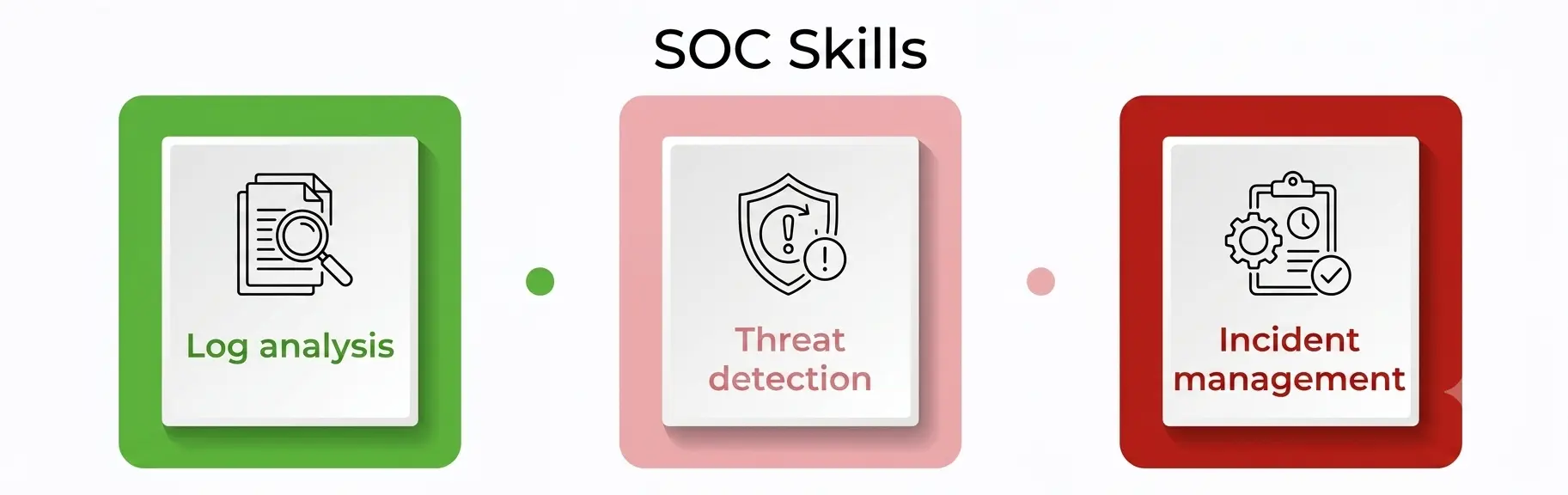
- Log analysis is non-negotiable. Whether you’re an analyst reviewing alerts or an engineer designing what gets logged, you need to be comfortable reading raw data from tools like Splunk, Microsoft Sentinel, and IBM QRadar and spotting what’s abnormal.
- Threat detection knowledge is equally important. This covers understanding attacker techniques (many teams reference the MITRE ATT&CK framework), recognizing indicators of compromise, and knowing how modern malware behaves.
- Incident management shows up constantly—not just responding to a breach, but documenting it, communicating with stakeholders, and running the post-incident review so it doesn’t happen again.
And increasingly, technical expertise in scripting (Python, PowerShell) and basic cloud security concepts separates candidates who get stuck at Tier 1 from those who get promoted quickly.
ISC2’s 2025 workforce data identifies AI/ML and cloud security as the two most in-demand skill areas going into 2026, which tells you where the industry is heading regardless of your job title.
Certifications Worth Getting in 2026
You don’t need a stack of certifications to land your first role, but the right ones accelerate things considerably.
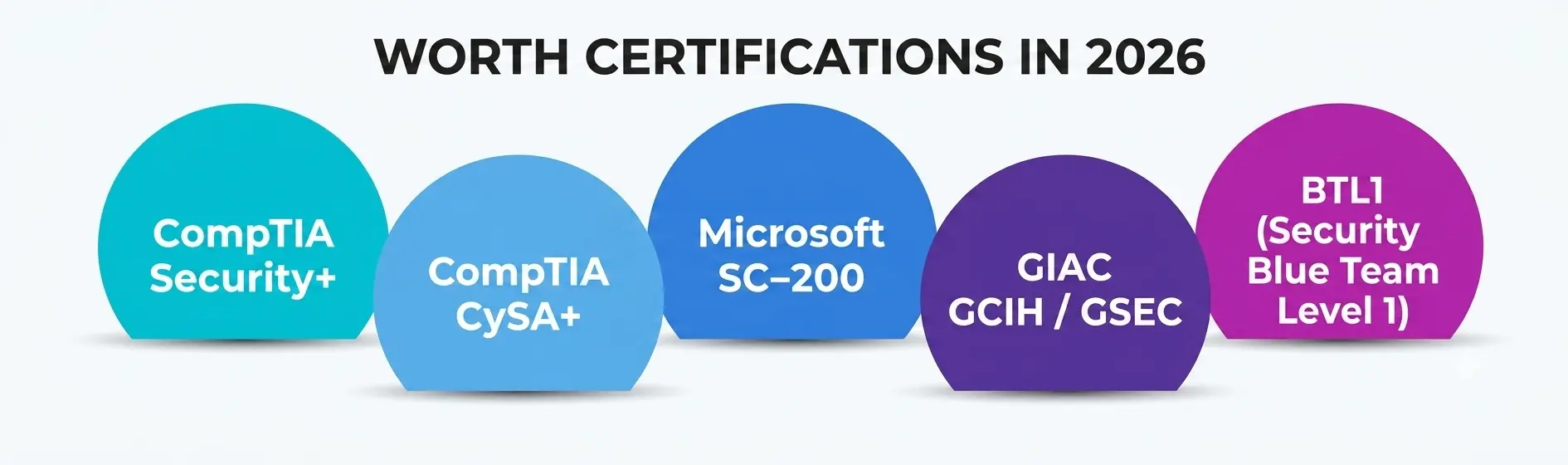
- CompTIA Security+—the standard starting point for nearly all Security Operations Center jobs. It’s affordable, vendor-neutral, and covers foundational concepts employers expect you to know.
- CompTIA CySA+—the natural next step, focused specifically on threat detection, data analysis, and incident management. This is the certification most closely aligned with actual SOC analyst work.
- Microsoft SC-200—increasingly valuable if you’re targeting organizations running Microsoft Sentinel or Defender XDR, which describes a large share of enterprise environments today.
- GIAC GCIH / GSEC—respected, practical certifications for those aiming at incident response or engineering-track roles, though the SANS training that often accompanies them is expensive unless your employer sponsors it, per CyberSecurityElite’s 2026 guide.
- BTL1 (Security Blue Team Level 1)—a genuinely hands-on option that proves practical skill through a lab-based exam rather than multiple-choice questions, which some hiring managers now value more than knowledge-only certs.
One honest note from an industry breakdown: no certification replaces hands-on investigation practice. Certifications open interview doors. Labs, home projects, and capture-the-flag exercises are what get you through them.
How Is AI Changing These Roles?
If you’re a student planning a multi-decade career, this matters more than any certification. AI is now automating a large share of routine Tier 1 work—enrichment, categorization, and initial alert triage that used to consume most of a junior analyst’s shift. Investigation tools can now run hundreds of queries across multiple data sources in minutes, work that previously took a senior analyst hours.
This doesn’t mean Security Operations Center jobs are disappearing. It means the entry-level role is shifting from “alert processor” to something closer to “AI supervisor and threat hunter.” Novel attack patterns, business context, and judgment calls under ambiguity still require a human.
If anything, this trend rewards people who build real technical expertise early rather than those who plan to coast on repetitive alert triage forever—which is exactly why understanding the analyst-to-engineer pipeline matters for your long-term planning.
Mistakes Students Make When Chasing Security Operations Center Jobs
A few patterns show up again and again among students trying to break in, and avoiding them will put you ahead of most applicants.
- Collecting certifications instead of building proof of skill. A resume with five acronyms and zero hands-on projects doesn’t demonstrate real technical expertise. Hiring managers increasingly want to see a home lab, a capture-the-flag writeup, or a documented investigation you ran yourself.
- Underestimating how much soft skill matters in incident management. Technical ability gets you the interview, but clear writing and calm communication under pressure are what get you promoted out of Tier 1. Every serious incident management process depends on someone documenting what happened in a way a non-technical stakeholder can understand.
- Assuming the SOC Analyst role is “easier” than Security Engineer. It’s a different kind of hard. Sustained shift work and constant context-switching between alerts take a real toll, and plenty of people underestimate it going in.
- Ignoring scripting until it’s too late. Even basic Python or PowerShell knowledge dramatically shortens the runway from SOC Analyst to Security Engineer, because so much of the transition is about proving you can build automation, not just follow a runbook.
Which Path Should Students Choose?
If you’re starting from zero, a SOC analyst role is almost always the better entry point. It requires less prior experience, the certifications are cheaper and faster to obtain, and you’ll be exposed to real incidents from day one—which is invaluable context you can’t get from a classroom. A common and well-documented career path looks like this: SOC Analyst (1–2 years) → Senior/Tier 2 Analyst (1–2 years) → Security Engineer.
If you already have programming or IT infrastructure experience—say, you’ve built things, deployed servers, or written meaningful automation scripts—you might be able to skip toward engineering-adjacent roles faster. But even then, spending a year or two inside a SOC gives you something no bootcamp can: firsthand pattern recognition of how real attacks actually unfold.
Either way, don’t treat the choice as permanent. The two roles feed each other, and most experienced security professionals have touched both sides of the fence at some point in their careers.
A Personal Note
I’ve watched a lot of students agonize over “SOC Analyst or Security Engineer” as if it’s a life sentence. It isn’t. Almost nobody I know who works in security today is doing the exact job they started in.
Pick the door that’s open to you right now, learn everything you can while you’re behind it, and let your curiosity pull you toward the next one. The industry needs people badly enough that it will meet you halfway if you show up and keep learning