
If you asked a security team in 2020 what kept them up at night, most would have said “a breach.” Ask the same question in 2026, and the answer is more specific: encryption spreading across the network before anyone notices.
That shift is exactly why ransomware detection has moved from being a line item in a security budget to being the single most important control a modern organization can invest in.
This guide walks through what that actually looks like in practice, how modern attacks unfold, and how it connects to the practical work of analyzing malware, planning for backups, isolating networks, and preventing phishing—written in plain language for students and early-career defenders who want to understand the field, not just memorize buzzwords.
What Ransomware Actually Does
Ransomware is malicious software built to deny you access to your own systems, usually through file encryption, and then demand payment for the key that reverses it. Modern crews rarely stop at encryption. Most now steal data first and threaten to publish it, a tactic security researchers call double extortion.
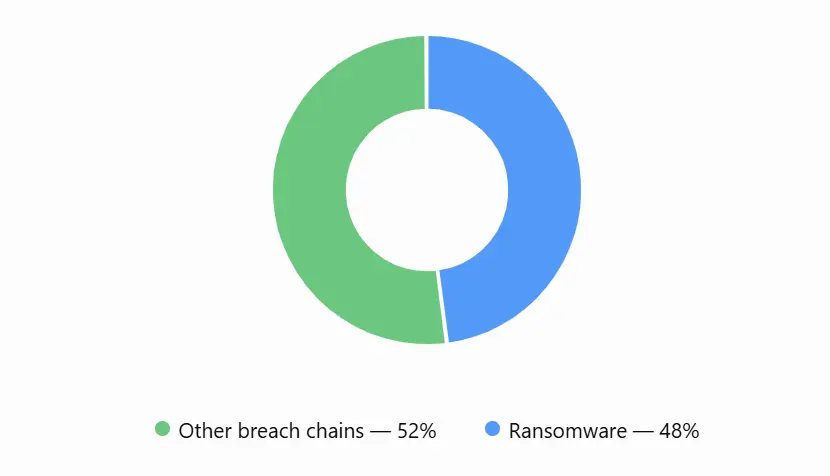
According to the Verizon 2026 Data Breach Investigations Report, ransomware now appears somewhere in roughly 48% of all breach chains analyzed, which tells you this is not a niche threat aimed at a handful of unlucky companies—it is a default outcome attackers plan for from the first click.
Why Ransomware Detection Matters More in 2026 Than Ever
The numbers from this year are not subtle. The report tracked 7,551 publicly disclosed victims between April 2025 and March 2026, a 24.9% jump over the previous period, with the number of active threat groups climbing to 146 by June 2026.
Growth was not steady either—disclosures accelerated 60% in the second half of that window, closing with the single highest monthly victim count Black Kite has ever recorded.
The economics behind this growth explain why detection has become so urgent. The Sophos 2026 State of Ransomware report surveyed over 2,100 IT and security leaders across 17 countries and found ransom demands and recovery costs both continuing to climb, even as a growing share of victims refuse to pay. Attackers have responded by compressing their timelines.
Google Cloud’s Mandiant M-Trends research found that the handoff between an initial access broker and a ransomware crew, which used to take around eight hours, has fallen to roughly 22 seconds in observed 2025–2026 intrusions.
When the gap between “attacker gets in” and “attacker starts encrypting” shrinks that fast, a detection strategy built around catching the ransom note is already too late. The only strategy that works is one built around catching the behavior that precedes it.
How a Modern Ransomware Attack Actually Unfolds?
Understanding how these attacks unfold starts with understanding the chain they’re built on, one link at a time.

- Initial access. The 2026 data found phishing accounted for over half of observed intrusions that quarter, edging out exploited public-facing applications and valid account abuse. This is why phishing prevention sits so close to the top of any serious defense plan—it’s the door attackers try first.
- Credential theft and reconnaissance. Attackers harvest logins and quietly map the network, often specifically hunting for backup repositories before touching production systems.
- Lateral movement. Without network isolation between segments, a single compromised laptop can often reach servers, file shares, and domain controllers with little resistance. Research found 80% of enterprise servers reachable from anywhere inside the network it studied.
- Backup sabotage. Modern crews try to delete, encrypt, or disable backups before the main event, because working, untouched backups are the single biggest reason a victim can refuse to pay.
- File encryption and extortion. The payload runs, locking files and often exfiltrating data first, followed by a ransom note and a countdown timer.
Every one of those five stages is a place where defenders can interrupt the chain—but only if they’re watching for behavior, not just known malware signatures.
Core Ransomware Detection Methods You Should Know
Effective ransomware detection is layered. No single tool catches everything, which is why security teams combine several approaches rather than betting on one.
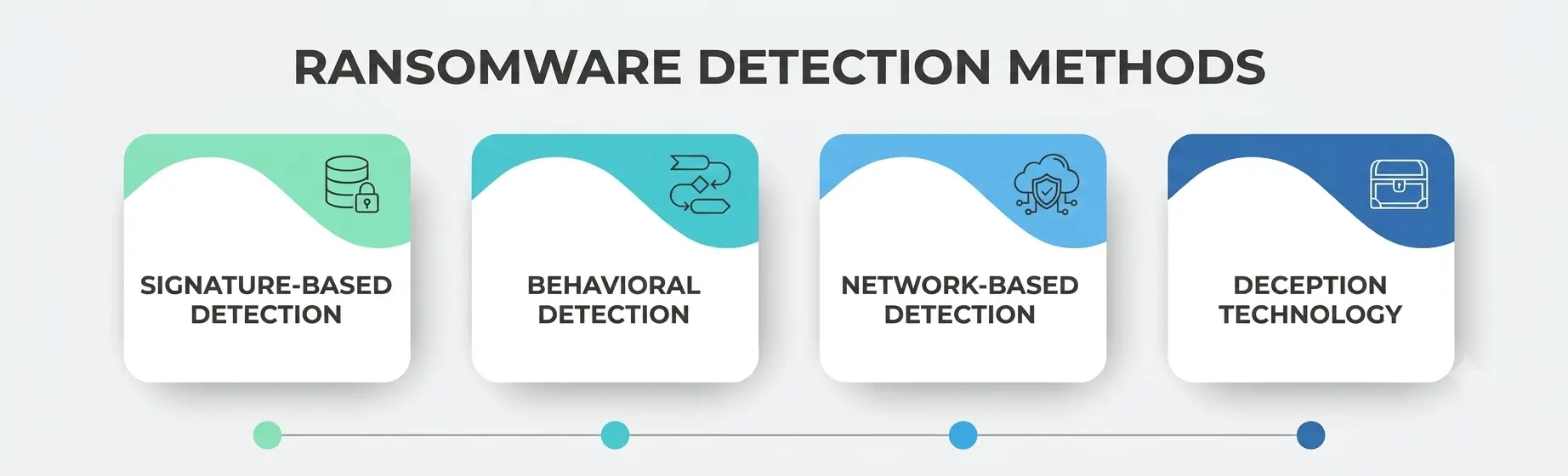
- Signature-based detection compares files against a database of known malicious hashes. It’s fast and cheap but useless against a variant nobody has seen before, since attackers routinely repack and obfuscate their code to dodge exact matches.
- Behavioral detection watches what a process actually does—mass file renames, rapid file encryption across folders, shadow copy deletion—rather than what it looks like. Microsoft’s March 2026 disclosure of a predictive-shielding case showed behavioral telemetry stopping encryption across roughly 700 devices, blocking about 97% of attempted file encryption within three hours of the first suspicious signal.
- Network-based detection looks at traffic instead of endpoints: command-and-control beaconing, unusual SMB or RDP spikes, and large outbound transfers. This matters because network signals persist even when an attacker disables the endpoint agent—you can’t hide packets the same way you can hide a process.
- Deception technology plants decoy files and fake credentials that no legitimate user would ever touch, so any interaction is an instant, high-confidence alert.
Layering these methods, combined with routinely analyzing anything suspicious that does get through, is what closes the gap that any single method leaves open.
Comparing the Main Detection Approaches
|
Detection Method |
What It Watches | Best For |
Main Weakness |
|
Signature-based |
File hashes, known code patterns | Catching known, unmodified malware quickly |
Blind to new or repacked variants |
|
Behavioral analysis |
Process actions (mass file changes, encryption speed) | Catching zero-day and fileless ransomware |
Needs tuning to avoid false alarms |
|
Network detection (NDR) |
Traffic patterns, lateral movement, beaconing | Spotting attackers even after endpoint tools are disabled |
Requires visibility across the whole network |
|
Deception / honeypots |
Interaction with decoy files or credentials | High-confidence, near-zero false-positive alerts |
Only works if attackers touch the decoys |
Building a Backup Strategy That Can Actually Survive an Attack
A backup strategy sounds like the most basic control in security, and yet it’s the one attackers now go after first. Research found that in incidents studied by Sophos, 94% of victims had attackers attempt to compromise their backups, and 57% of those attempts succeeded.
That statistic alone explains why the old three-copies, two-media-types, one-offsite-copy rule has evolved into the “3-2-1-1-0” model: three copies, two media types, one offsite, one immutable or air-gapped copy that can’t be altered even with stolen admin credentials, and zero recovery errors confirmed through regular restore testing.
A backup strategy only counts if it’s tested and if it’s isolated enough that active file encryption spreading through production systems can’t reach it too. CISA’s StopRansomware Guide recommends organizations verify they can restore at least seven days of operations, and security teams generally treat quarterly restore drills as the minimum acceptable cadence.
It’s also worth separating backup credentials completely from production logins—if the same account that runs your servers can also touch your backups, a single phishing click can wipe both. A setup built on shared credentials is really just one copy of your data with extra steps.
Network Isolation: Containing the Blast Radius
If detection is about noticing an attack, network isolation is about making sure that attack can’t go anywhere once it’s noticed. Flat networks—where any device can talk to any other device—are exactly what let a single infected laptop become a company-wide incident.
The 2024 Change Healthcare ransomware attack is the case study most often cited here: one stolen login gave attackers a path across the entire internal network, and analysts who reviewed the incident concluded that proper segmentation would have contained the damage to a single zone instead of the estimated $22 billion cleanup that followed.
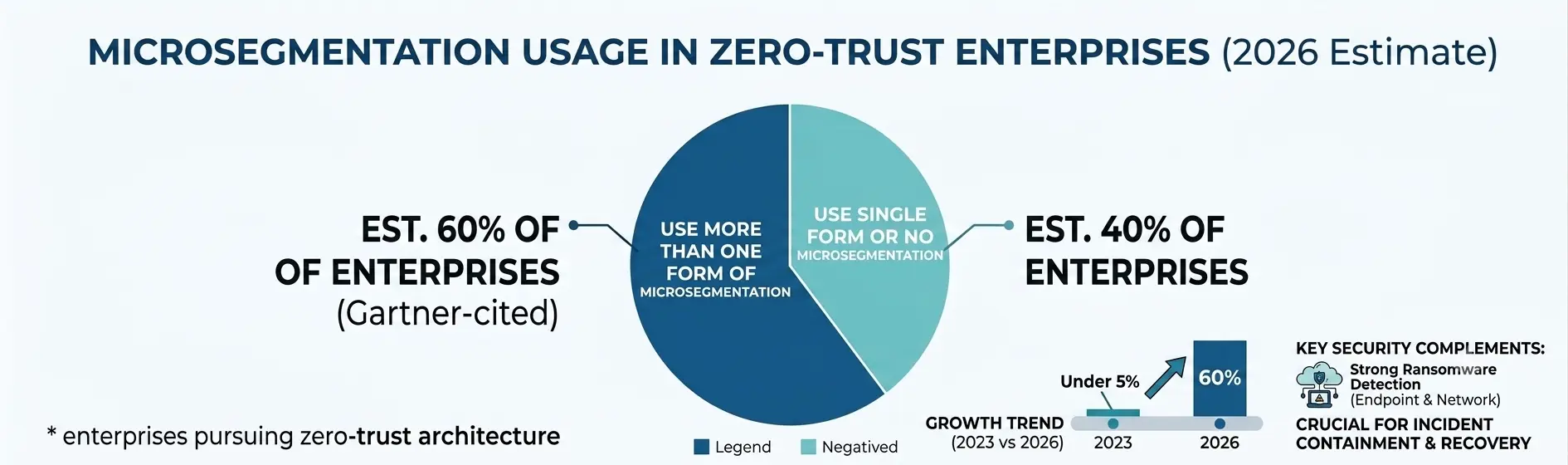
Modern network isolation goes beyond old-style VLANs. Microsegmentation applies access rules at the level of individual workloads, so a compromised web server can’t simply reach an internal database just because they share the same physical network.
Gartner-cited research estimates 60% of enterprises pursuing zero-trust architecture in 2026 will use more than one form of microsegmentation, up from under 5% just three years earlier. Combined with strong ransomware detection at the endpoint and network layer, this kind of isolation turns a potential enterprise-wide catastrophe into a contained, recoverable incident.
Phishing Prevention: Closing the Human Entry Point
Every technical control in this article exists downstream of one simple fact: most ransomware incidents still start with a person clicking something they shouldn’t. Phishing prevention, therefore, isn’t a “soft” HR-training topic—it’s a frontline technical control.
Research on AI-generated spear-phishing found that AI-written phishing emails now achieve click rates of up to 54%, compared with roughly 12% for traditional phishing attempts, and voice-based phishing (“vishing”) rose sharply through 2025 as attackers diversified beyond email.
Effective phishing prevention combines several layers: email authentication standards like DMARC to stop domain spoofing, URL sandboxing that detonates links before a user ever reaches them, phishing-resistant multi-factor authentication (hardware keys or passkeys rather than SMS codes), and realistic phishing simulations that teach staff to recognize the newer, more convincing lures.
None of these measures alone stops every attempt, but together they shrink the window attackers rely on—research on reporting delays found roughly 27 minutes typically pass between a user’s first click and the first report to security teams, which is more than enough time for credential theft and lateral movement to begin.
Malware Analysis: Turning an Incident into Intelligence
When a suspicious file does make it through, malware analysis is how defenders figure out what it is, what it does, and how to stop the next one like it. Analysts generally work in two modes. Static malware analysis examines the file without running it—inspecting code structure, strings, and packing—which is fast but easily defeated by obfuscation.
Dynamic malware analysis, by contrast, detonates the sample inside an isolated sandbox and records exactly what it does: which files it touches, what registry keys it modifies, and where it tries to communicate on the network.
This is where modern detection work increasingly overlaps with machine learning. Recent academic work on behavior-based detection frameworks shows sandbox-generated behavioral traces feeding directly into models that can flag ransomware families the system has never seen before, based on how they act rather than what they look like.
Every completed malware analysis also produces indicators of compromise—file hashes, IP addresses, registry changes—that get fed back into detection tools and shared threat-intelligence feeds, which is how one organization’s bad day becomes protection for everyone else’s next day.
Building a Complete Ransomware Detection Strategy
Pulling all of this together, a workable ransomware detection strategy for 2026 looks less like a single product and more like a stack of overlapping habits:
- Deploy layered detection (signature, behavioral, and network) rather than relying on one tool
- Maintain a tested backup strategy built on the 3-2-1-1-0 model, with credentials fully separated from production
- Apply network isolation and microsegmentation so a single compromised device can’t reach everything else
- Invest in phishing prevention as a technical control, not just a training checkbox
- Analyze anything suspicious that gets through, and feed the findings back into detection rules
- Rehearse the incident response plan before you need it, so the first real alert isn’t also the first time anyone has run the playbook
A Personal Note
I’ve spent enough time reading incident write-ups to notice a pattern: almost none of them describe an unstoppable, unprecedented attack. Most describe a normal, tired employee clicking a well-crafted email, a network where segments blur into one big flat space, and a backup nobody had actually tested since it was set up.
The technology behind this work keeps getting more sophisticated, and it should—but the organizations that actually come out of an incident intact are usually the ones that got the boring fundamentals right long before the alert fired. If you’re a student heading into this field, learn the fundamentals first. The advanced tooling makes a lot more sense once you understand exactly what it’s trying to catch.