A few years ago, learning Amazon Web Services (AWS) was enough to land a great cloud job. You could put “AWS Certified” on your resume and get calls within days.
But 2026 is different.
Companies are not using just one cloud platform anymore. They are spreading their work across AWS, Microsoft Azure, and Google Cloud — all at the same time. This approach is called multi-cloud, and it has quietly become the new standard in the tech industry.
The professionals who understand how all three work? They are getting hired faster, earning higher salaries, and becoming the go-to experts that companies cannot afford to lose.
This blog breaks down exactly what multi-cloud is, why it matters for your career in 2026, what the real data says — and how you can start building this advantage today.
What Is Multi-Cloud?
Think of it like this.
Imagine a restaurant that buys vegetables from one farm, meat from a butcher, and imported spices from a specialty store. They do not rely on just one supplier, because if one supplier has a problem, the restaurant can still operate.
Multi-cloud works the same way for companies. Instead of putting all their data and software on one cloud platform (like only AWS), businesses use two or three platforms together — picking the best services from each one.
For example:
- Run core business operations on AWS
- Manage Microsoft Office tools and enterprise apps on Azure
- Handle AI and data analytics workloads on Google Cloud
This is not a new idea. But in 2026, it has gone from an “advanced strategy” to simply the way most large companies now operate.
The Data Is Clear: Multi-Cloud Is the New Normal
Let’s look at what is actually happening in the industry right now.
92% of enterprises worldwide now use a multi-cloud strategy. The average organisation uses 3.4 different cloud providers. 68% of IT leaders say multi-cloud improves risk resilience.
Companies are not choosing one platform. They are mixing and matching based on what each cloud does best.
If one cloud provider has an outage, your business does not go down because you are spread across multiple platforms.
The global public cloud services market reached approximately $670–700 billion in 2025 and is projected to surpass $1 trillion by 2028.
By 2026, cloud will account for over 45% of all enterprise IT spending — up from just 17% in 2021.
These numbers tell one clear story: cloud is everywhere, multi-cloud is the standard, and the people who understand it are sitting in a very strong position.
The Career Advantage: What Multi-Cloud Does to Your Salary
Here is the part that matters most to most people reading this — the money.
Cloud engineer salaries are already high. According to leading job market data, cloud engineers in the US earn between $115,000 and $160,000 per year, with specialists and architects earning significantly more. But here is the hidden advantage that most people miss: Multi-cloud knowledge adds 15–25% to your base salary.
According to LinkedIn Economic Graph data from 2025–26, professionals with certifications across two or more cloud platforms earn, on average, 15–25% more than engineers who know only one platform — a premium that reflects the genuine scarcity of cross-cloud expertise in the talent market.
And at the senior level? Cloud Solutions Architects, Cloud Security Specialists, and Multi-Cloud Engineers are among the highest-paid tech roles today — often exceeding $230,000 per year at top companies.
The numbers are not subtle. Learning multi-cloud is one of the clearest ways to increase your earning potential in the tech industry right now.
Why Companies Need Multi-Cloud Professionals
You might wonder — if companies are already using multi-cloud, do they not already have the people to manage it?
Not even close.
47% of companies say a lack of cloud expertise is a top challenge when implementing multi-cloud strategies. (Source: Scoop Market US, 2026)
Companies are adopting multi-cloud faster than they can find and train the right people to manage it. This gap between what businesses need and what is available in the job market is a major opportunity for anyone willing to learn.
Here is why companies specifically need people who know multiple clouds:
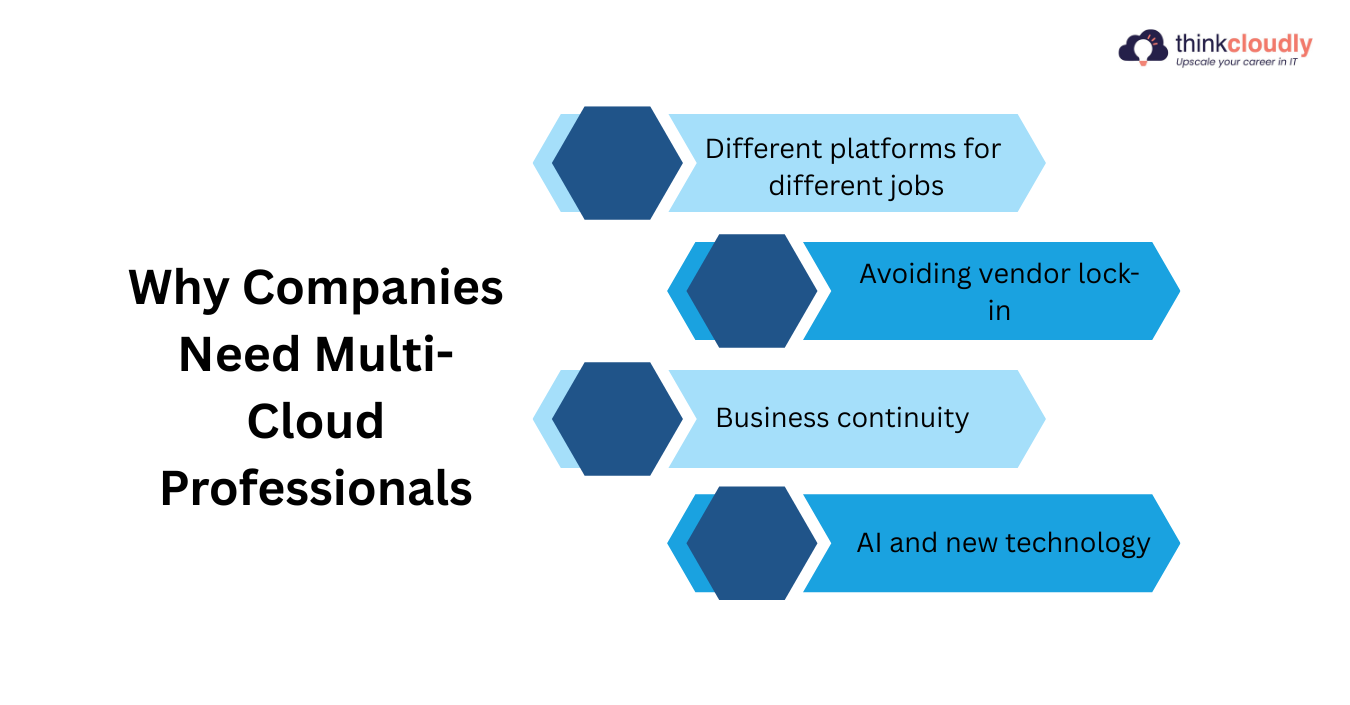
- Different platforms for different jobs: Google Cloud leads in AI and data analytics — for example, its BigQuery and Vertex AI services are widely used for large-scale machine learning pipelines. AWS has the widest range of services and the largest global infrastructure footprint. Azure connects best with Microsoft tools, making it the default choice for enterprises already running Microsoft 365 or Active Directory.
- Avoiding vendor lock-in: Companies do not want to be completely dependent on one provider and its pricing. 37% of firms moved to multi-cloud specifically to avoid this.
- Business continuity: If AWS has a major outage — and yes, this has happened — a company running only on AWS could lose millions of dollars per hour. Multi-cloud means one provider failing does not bring the whole business down. 58% of CIOs report fewer service disruptions after moving to multi-cloud.
- AI and new technology: With generative AI now used by nearly every major organization, companies need cloud professionals who understand AI services across all three platforms. This is a fast-growing specialization within cloud that pays exceptionally well.
Real-Life Example: How Multi-Cloud Knowledge Changed One Career
The following example is a composite based on real career paths we have observed among working professionals.
Meet Joe — a mid-level IT professional who had been working in IT support for three years.
In early 2024, he decided to get his AWS Cloud Practitioner certification. It took him about two months of studying after work. He passed on his first attempt.
The result? He moved into a junior cloud role with a 30% salary bump. But here is where it gets interesting.
A year into his new job, Joe noticed that his company was migrating some workloads to Microsoft Azure and exploring Google Cloud for their data science team. He started learning Azure on the side — spending about an hour a day — and earned his Azure Administrator Associate certification within four months.
Six months later, his company needed someone to manage cross-platform deployments. No one else on the team had Azure experience. Joe stepped up, led a successful migration project, and within three months was promoted to Senior Cloud Engineer with another 25% salary increase.
By mid-2025, he had also added a Google Cloud fundamentals badge and was being consulted on AI workload decisions — something completely outside his original job description.
What changed? Not his years of experience. Not a new degree. Just structured, platform-by-platform learning combined with applying it in real-world scenarios.
What Multi-Cloud Actually Means for Your Learning Path
Multi-cloud does not mean you must learn everything at once. That is the biggest misconception.
Here is a practical way to think about it:
- Start with one cloud. Get certified. Get a job: Most people start with AWS because it has the most job openings globally. Azure is also a strong starting point, especially if you want to work in enterprise companies that use Microsoft products. Google Cloud is ideal if you are interested in AI, data, or machine learning.
- Then add a second cloud after 1–2 years of experience: Once you have hands-on experience with your first platform, adding a second becomes much easier. The core concepts of cloud computing — networking, storage, security, and compute — are similar across platforms. You are learning the differences, not starting from zero.
- That is where the salary premium really starts: According to market data, the biggest salary jump for cloud professionals happens not at the entry level, but when they demonstrate the ability to work confidently across two or more platforms.
Industries Driving Multi-Cloud Demand
All four industries are actively hiring cloud professionals with cross-platform expertise as their infrastructure spans multiple cloud providers.
|
Industry |
Cloud adoption |
Why multi-cloud matters |
|
Financial Services |
88% |
Heavy compliance requirements — different clouds for different regulatory needs |
|
Healthcare |
72% (fastest-growing sector, +41% YoY) |
Fastest growing sector — patient data privacy laws drive multi-cloud compliance strategies |
|
Retail & E-Commerce |
79% |
Rapid scaling needs during peak sales — multi-cloud prevents outages on high-traffic days |
|
Telecommunications |
86% |
Core services are fully cloud-dependent — multiple providers ensure zero downtime for millions of users |
Sources: Flexera State of the Cloud Report 2026, IDC Cloud Adoption Survey 2026
Common Mistakes to Avoid
Learning Cloud is a great investment. But there are a few mistakes that can slow you down.
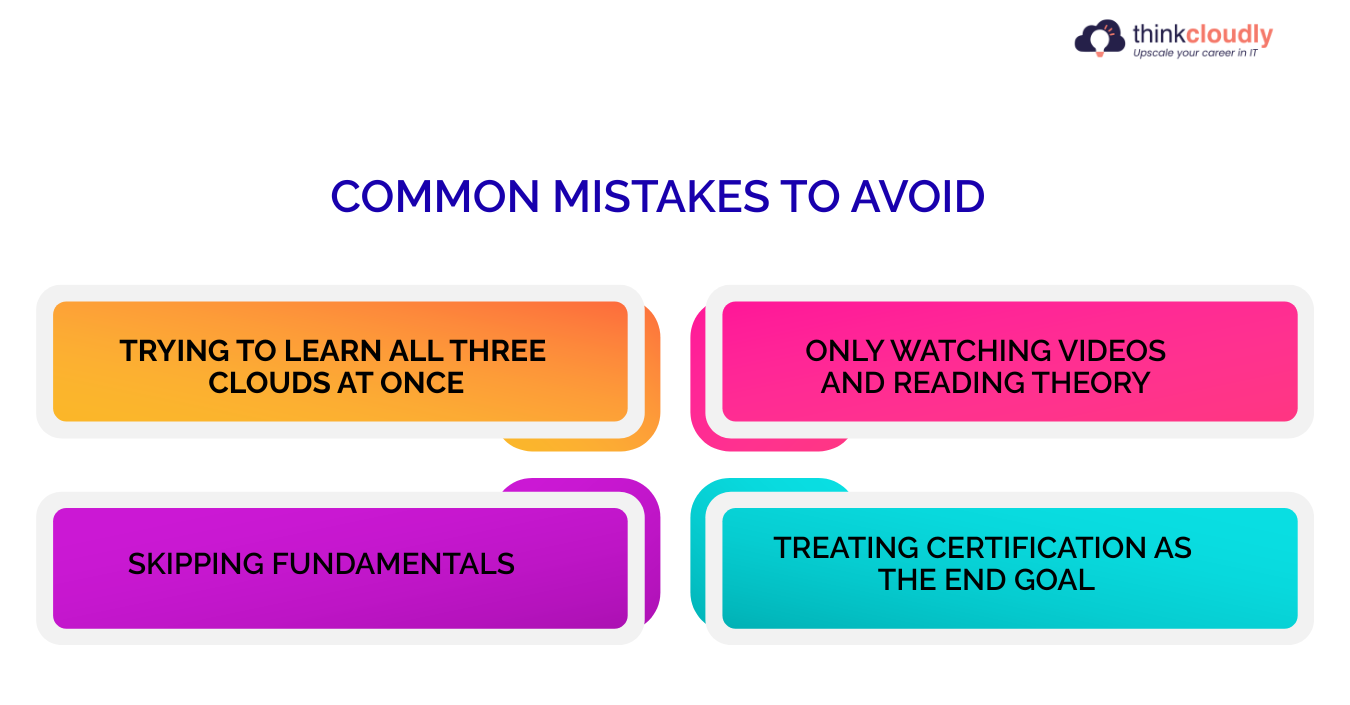
Mistake 1: Trying to learn all three clouds at once: This leads to surface-level knowledge and no real depth anywhere. Pick one. Get certified. Then expand.
Mistake 2: Only watching videos and reading theory: Cloud is a hands-on skill. Companies want engineers who can actually build and deploy — not just those who can explain concepts. Look for learning platforms that include labs and real project experience.
Mistake 3: Skipping fundamentals: Many learners jump straight into specific services (like AWS Lambda or Azure Kubernetes) without understanding the foundational concepts. This creates gaps that come up in interviews and on the job.
Mistake 4: Treating certification as the end goal: Certification is a starting point — a credential that opens doors. The real value comes from applying what you know in real environments.
Conclusion: The Advantage Is Real — and Available to You
Multi-cloud is not a buzzword or a distant future concept. It is how the majority of companies around the world run their technology right now.
The professionals who understand it are being hired faster, paid more, and promoted into senior roles with greater influence. The gap between what companies need and what is available in the talent market is a real opportunity — one that is available to anyone willing to learn in a structured, practical way.
You do not need to start by learning everything. You need to start somewhere.
The hidden advantage of multi-cloud in 2026 is not that it is complicated. It is that most people have not bothered to learn it yet.
Ready to start? Look for structured cloud learning programs that combine certification preparation with hands-on lab experience — the combination that gets professionals hired fastest.
Ready to start? Explore ThinkCloudly’s AWS, Azure, and Google Cloud learning paths — structured courses with hands-on labs designed for working professionals.
Sources and References
- Flexera — State of the Cloud Report 2026
- Gartner — Public Cloud Services Forecast 2026
- Synergy Research Group — Cloud Market Share Data 2026
- IDC — Worldwide Public Cloud Services Tracker 2026
- LinkedIn Economic Graph — Cloud Skills & Salary Premium Data
- ZipRecruiter — Cloud Engineer Salary Data 2026
- U.S. Bureau of Labor Statistics — Computer and IT Occupations Outlook
- Softjourn — Cloud Computing Statistics 2026
- Spacelift — 55 Cloud Computing Statistics 2026
- Finout — Cloud Computing Statistics 2026
- Market.us / Scoop — Cloud Computing Statistics 2026