
Imagine spending months learning to code, polishing your resume, and applying to hundreds of jobs, only to hear nothing. No reply. No rejection. Just silence. This is happening to millions right now. And the reason isn’t what most people think.
Here is the surprising truth: there are more IT job openings in 2026 than ever before. The U.S. Bureau of Labour Statistics projects 317,700 new tech job openings every year through 2034. Companies are desperately searching for skilled talent, and yet most IT job seekers are failing to land a role.
How? Because a dangerous gap has opened between what companies need and what most applicants actually bring. This blog breaks down every reason, in plain language, with real data, and tells you exactly what to do about it.
| Statistic | Insight |
|---|---|
| 75% | Resumes never seen by a human |
| 87% | Tech leaders struggle to find skilled talent |
| 2–3% | Applications that result in an interview |
| 2.5 years | Half-life of a tech skill today |
A Robot Reads Your Resume First — and It’s Unforgiving
Before any human sees your application, a tool called an Applicant Tracking System (ATS) scans it. Think of it as a very picky bouncer. Wrong format, missing keywords, fancy columns — and you’re out in 0.3 seconds. And 98% of Fortune 500 companies use these systems.
A former Google Product Manager faced 87 rejections. An ATS simulator revealed his resume lacked key term connections. After restructuring with measurable results, his ATS score jumped from 41 to 89 — and he got six interview invitations in two weeks.
The fix: Use a clean, single-column resume. No graphics. Mirror the exact job-ad language. Always include a “Skills” section listing the specific tools mentioned in the posting.
The Skills They Want Are Not the Skills You Have
According to Harvard Business Review, the half-life of a tech skill is now just 2.5 years. Skills you learned in 2022 may already be considered stale. Meanwhile, 78% of IT roles now require AI skills, and generative AI job postings grew 170% in a single year (LinkedIn, 2025).
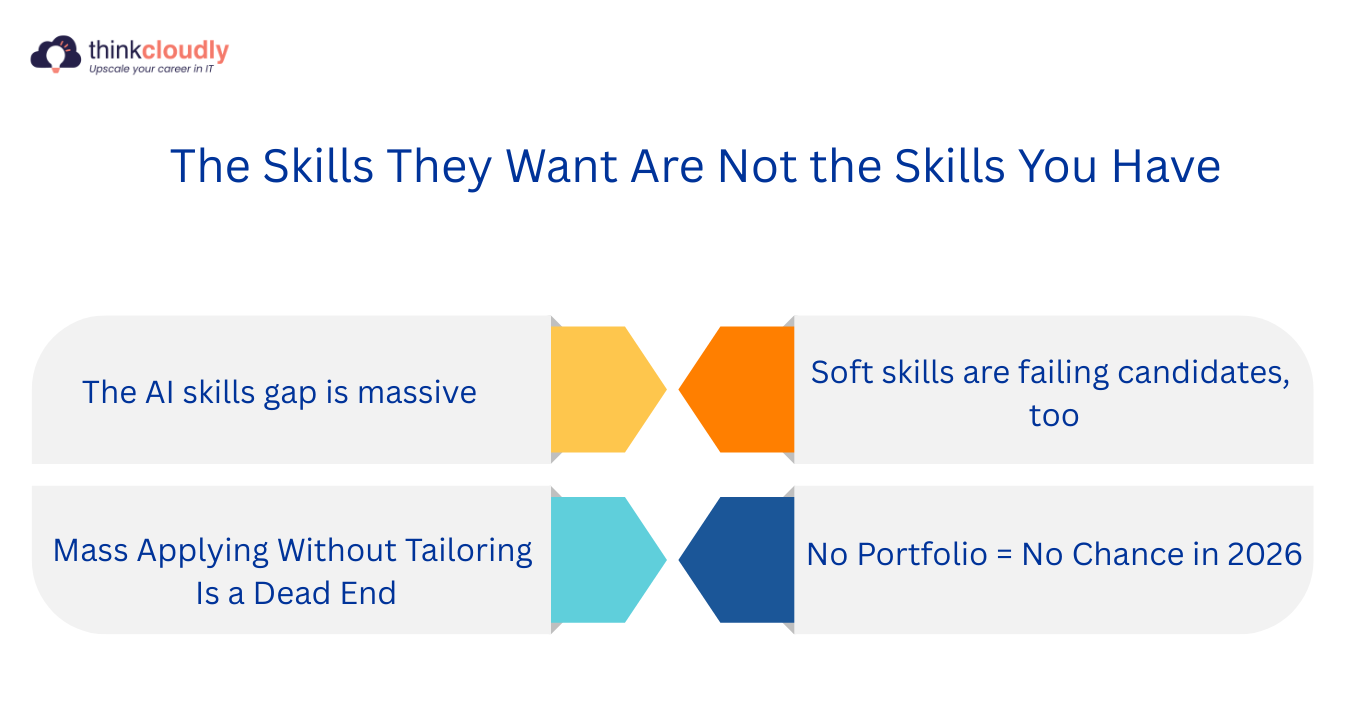
The AI skills gap is massive
Globally, there are 1.6 million open AI roles but only 518,000 qualified candidates — a 3:1 shortage. AI and machine learning were cited by 45% of tech leaders as their biggest hiring challenge.
Soft skills are failing candidates, too
89% of hiring failures are linked to soft skill gaps, not technical ones. A LinkedIn survey found that 57% of senior leaders value soft skills more than hard skills. Communication and adaptability now separate average candidates from hired ones.
Mass Applying Without Tailoring Is a Dead End
Sending 200 identical applications and waiting is no longer a strategy — it’s a trap. Roughly 3% of applications lead to an interview—about 5 in every 180. AI screening tools now detect generic submissions and rank them lower.
Job seekers who win spend 45 minutes on one targeted application rather than two minutes on 150 generic ones. Referred candidates are 8x more likely to get hired and often bypass ATS entirely.
No Portfolio = No Chance in 2026
Hiring has shifted to skills-based evaluation — 85% of employers now use it globally (WEF, 2025). That means proof of what you can actually do matters more than where you studied.
Two-thirds of managers say the biggest gap in recent hires was not technical knowledge — it was the inability to demonstrate skills in real-world contexts. Anyone can claim “cloud computing.” The candidate with a deployed AWS project wins.
Real-Life Scenario: The Qualified Candidate Who Kept Getting Rejected
Disclaimer: Name and identifying details changed for privacy. This scenario reflects documented patterns from multiple real candidate case studies—not a single individual’s story.
Alex is a 26-year-old Computer Science graduate who spent 18 months sending over 240 applications. He received four interview calls and zero job offers.
A career advisor identified three core problems: his two-column resume template was being scrambled by ATS systems; his listed skills—basic Python, HTML, and SQL — were relevant in 2021 but stale by 2025; and he had no portfolio, no GitHub, and nothing to show for his abilities.
After switching to an ATS-compliant resume, earning an AWS Cloud Practitioner certification, and building two GitHub projects, Alex received three interview invitations in six weeks and accepted a junior cloud support role. Nothing about his intelligence changed. Only his approach did.
Why IT Job Seekers Fail: The Data at a Glance
|
Failure Reason |
Who It Affects Most |
Impact |
Data Source |
Effort to Fix? |
|
ATS Resume Rejection |
All applicants to medium/large companies |
Critical |
98% Fortune 500 use ATS (Jobscan, 2025) |
Low effort |
|
Outdated Skill Set |
Graduates 2021–2023, career changers |
Critical |
Skills half-life = 2.5 yrs (HBR) |
High effort |
|
No AI / Cloud Skills |
Traditional IT pros, freshers |
Critical |
78% ICT roles need AI skills (AI Workforce Consortium, 2025) |
Medium effort |
|
Mass Generic Application |
High-volume applicants |
High |
Interview rate: 3% (CareerPlug, 2025) |
Low effort |
|
No Portfolio / Proof of Work |
Freshers, bootcamp graduates |
High |
85% employers: skills-based hiring (WEF, 2025) |
Medium effort |
|
Soft Skills Gap |
Technical-only candidates |
Moderate-high |
89% of hiring failures = soft skill gaps (2026) |
High effort |
|
Competition from Laid-Off Seniors |
Entry-level, new graduates |
Moderate |
178,000+ tech layoffs in 2025 (TechTarget) |
Medium effort
|
What Actually Works in 2026
Here is what actually works in 2026:
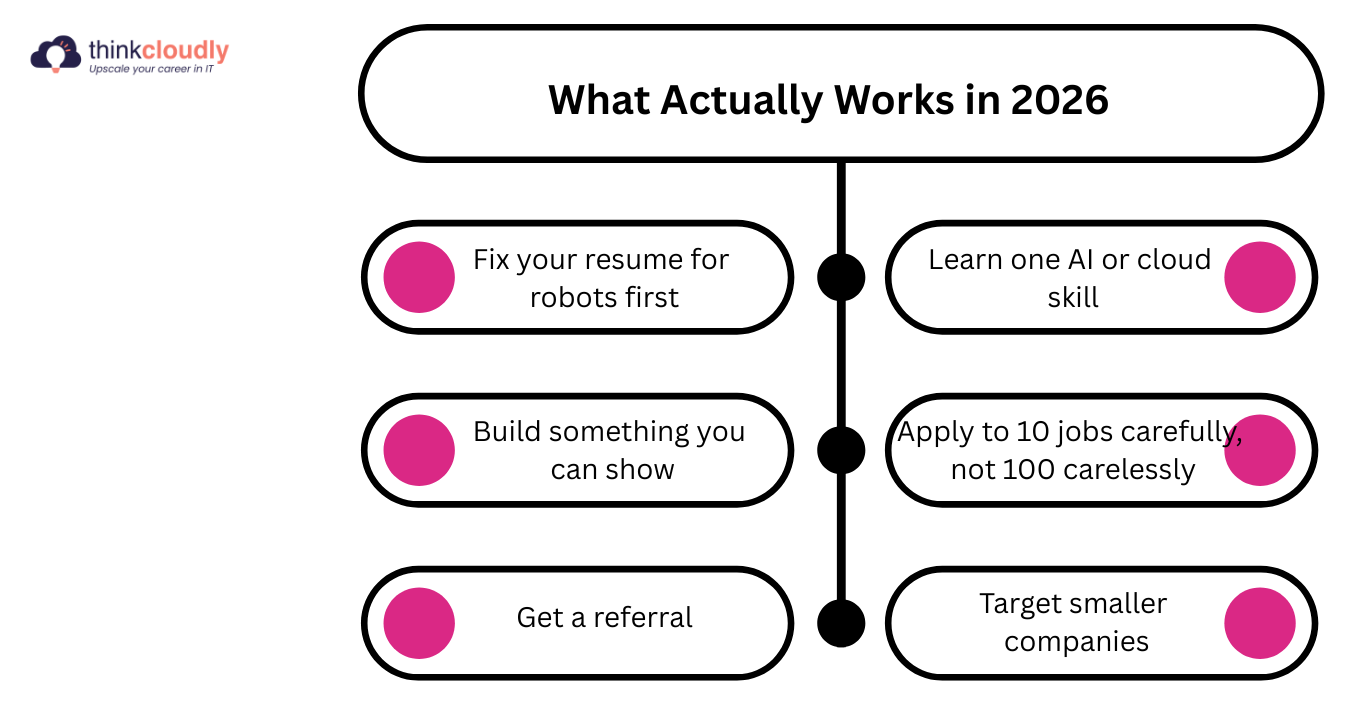
Fix your resume for robots first
Single-column, no graphics, clean DOCX or PDF. Mirror exact keywords from each job posting and include a clear “Skills” section.
Learn one AI or cloud skill
AWS Cloud Practitioner, Google Associate Cloud Engineer, or Azure Fundamentals — available free or low-cost on Coursera and LinkedIn Learning.
Build something you can show
Two or three GitHub projects—a website, a dashboard, and a small automation. Employers want proof of work, not just a list of skills.
Apply to 10 jobs carefully, not 100 carelessly
Tailor every application. A short, specific cover letter referencing something real about the company goes a long way.
Get a referral
Referred candidates are 8x more likely to be hired. Build genuine LinkedIn connections in your field—not spam, but real relationships.
Target smaller companies
Less competition, more human review. CompTIA data shows major tech hiring in Dallas, Atlanta, and Raleigh — not just Silicon Valley.
Conclusion
The IT job market in 2026 is not broken. It’s just different — and most job seekers haven’t updated their approach to match the new reality.
You’re not being rejected because companies don’t need people. You’re being rejected because a robot never showed your resume to a human, or your skills no longer match what the job requires, or you sent 200 identical applications and expected magic.
Every single one of these problems has a practical solution. A cleaner resume. One certification. Two GitHub projects. Ten tailored applications instead of a hundred generic ones.
The IT job market rewards people who understand how it works. Now you do. So, what’s the one thing you’ll change this week?
Sources & References
- Robert Half — Demand for Skilled Talent Report (2026) — 87% of technology leaders feel confident about their business outlook for 2026; 65% say it’s harder to find skilled professionals than a year ago.
- CompTIA — State of the Tech Workforce (2026) — The U.S. Bureau of Labour Statistics projects 317,700 new tech job openings every year through 2034.
- TechTarget — 2026 Tech Job Market Statistics and Outlook — The half-life of a tech skill is as short as 2.5 years (citing Harvard Business Review).
- CareerPlug — 2025 Recruiting Metrics Report (via CoverSentry) — Only 3% of applications lead to an interview; for every 180 applicants, roughly five get a call. —
- CIO.com — State of IT Jobs: AI Sparks Rapidly Changing Market (Feb 2026) — 78% of IT roles now require AI skills; generative AI job postings grew 170% from Jan 2024 to Jan 2025.
- Scale.jobs—Why Perfect Resumes Still Don’t Get Interviews (2026) — 90% of employers use automated ATS systems; ATS rejects 75% of resumes instantly due to keyword mismatches or formatting errors.
- The Interview Guys — The 2% Rule: Why 98% of 2026 Applications Fail (Jan 2026) — Referred candidates are 8x more likely to get hired and often bypass ATS entirely.
- Second Talent — Global AI Talent Shortage Statistics (2026)—Globally, there are 1.6 million open AI roles but only 518,000 qualified candidates—a 3:1 shortage.
- AnitaB.org — Tech Job Market 2026: Trends, Skills, and Opportunities (Feb 2026) — Professionals with AI and machine learning expertise earn 15–25% higher salaries than generalist counterparts.
- Fast Company — Key Workforce Trends to Watch in 2026 (Dec 2025) — 45% of employers rate the 2026 graduate job market as “fair”; 65% have adopted skills-based hiring for entry-level roles.
- Harvard Business Review — Skills Half-Life in Technology — The half-life of a technology skill is as short as 2.5 years.
- World Economic Forum — Future of Jobs Report (2025) — 63% of employers identify skills gaps as the biggest barrier to business transformation.