
You spent hours building your resume. You checked it twice. You have applied to dozens of jobs. And then nothing. No call. No email. Just silence.
If this sounds familiar, you are not alone. Most IT professionals who struggle to get interviews are not bad at their jobs. They just do not know what is quietly killing their chances before a single human even reads their name.
Here is the uncomfortable truth: recruiters spend an average of just 6 to 8 seconds scanning a resume before deciding to move on or move forward. In many cases, an automated system filters it out even faster — sometimes in as little as 0.3 seconds. Your resume does not get a fair read; it gets a glance.
This post breaks down exactly why IT resumes get rejected so fast — and more importantly, what you can do to fix it.
The Numbers Are More Brutal Than You Think
Before we get into the why, let us look at what the data actually says.
The average corporate job posting receives around 250 applications; for entry-level or remote IT roles, that number can reach 400–600 or more. Out of all those applicants, only 2 to 3 percent ever make it to the interview stage.
That means 97 out of every 100 resumes get rejected before anyone has a proper conversation with the candidate.
Here is a quick look at the most common reasons resumes get filtered out:
|
Rejection Reason |
% of Hiring Managers Who Cite It |
|
Missing required skills or poor role alignment |
81% |
|
Spelling mistakes, bad grammar, or typos |
78% |
|
No quantifiable achievements listed |
75% |
|
Unprofessional email address |
30-35% |
|
Poor formatting or low readability |
26% |
|
Resume longer than 4 pages |
Nearly 100% |
The scary part is that most of these issues are completely fixable. They are not about your experience level. They are about how you present yourself on paper.
Why Your IT Resume Keeps Getting Ignored — And How to Fix It
Most of these mistakes take less than five minutes to fix — once you know what they are.
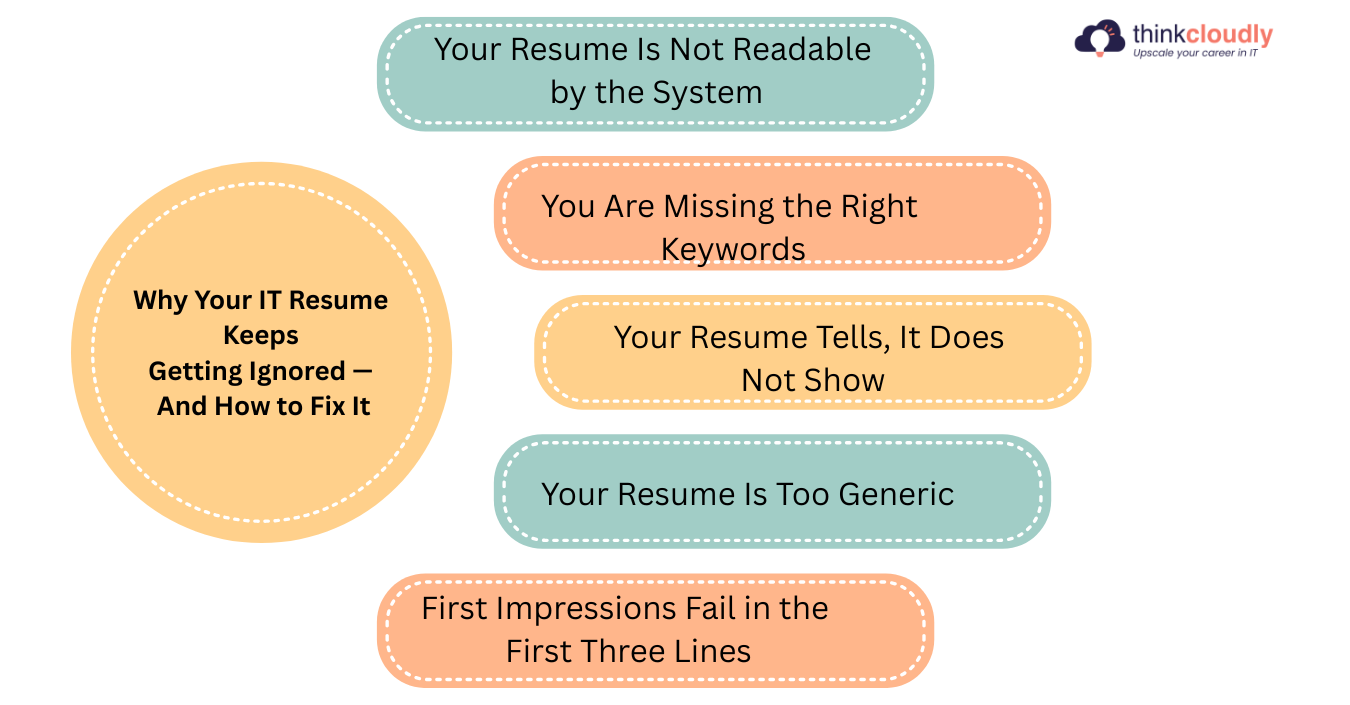
Reason 1 — Your Resume Is Not Readable by the System
Most companies, especially larger ones, use an Applicant Tracking System — commonly called an ATS. This is software that reads your resume before any human does. It pulls out your skills, job titles, years of experience, and qualifications to decide if you are worth passing to a recruiter.
The problem is that ATS software struggles with certain resume formats. If your resume has columns, graphics, tables inside the document, or unusual fonts, the system may not be able to read it correctly. Around 23 percent of resume rejections happen because of parsing errors — the system simply cannot extract the information properly.
This does not mean your resume looks bad. It means it is invisible to the machine that decides whether a human ever sees it.
The fix: Use a clean, single-column format. Save your resume as a PDF or Word document depending on what the job posting specifies. Avoid text boxes, logos, and fancy design elements unless you are applying for a design role.
Reason 2 — You Are Missing the Right Keywords
Here is something most people do not realise. ATS systems do not just read your resume — they score it. They look for specific words and phrases that match the job description. If those words are missing, your score drops. A low score means a recruiter may never see your application.
This is not about keyword stuffing. It is about alignment. If the job description says “cloud infrastructure management” and your resume says “managing servers,” those mean the same thing to a human — but not to a machine.
The fix: Read every job description carefully before applying. Mirror the exact language used for key skills, tools, and responsibilities. You do not need to copy entire sentences — just make sure the important terms appear naturally in your resume.
Reason 3 — Your Resume Tells, It Does Not Show
Recruiters see hundreds of resumes that say things like “responsible for managing a team” or “worked on cloud migration projects.” These sentences say very little. They do not tell the recruiter whether you were good at what you did.
According to LinkedIn data, 75 percent of hiring managers specifically look for quantifiable achievements — real numbers that show the impact of your work. Resumes with measurable outcomes consistently outperform vague, responsibility-based descriptions.
The fix: Replace soft descriptions with hard results. Instead of “managed a team,” write “managed a team of 6 engineers and reduced deployment time by 30 percent.” Instead of “worked on cloud migration,” write “migrated 40 on-premise servers to AWS, cutting infrastructure costs by 22 percent.” Numbers make you memorable.
Reason 4 — Your Resume Is Too Generic
One of the biggest mistakes IT professionals make is sending the same resume to every job. It feels efficient. It is actually one of the fastest ways to get rejected.
Hiring managers can tell when a resume has not been customized. It reads like a job description rather than a story about what you have actually done and what you can specifically bring to their team.
In a market where 81 percent of employers are now screening for demonstrated skills rather than just credentials, a generic resume signals that you did not do your homework.
The fix: Spend 10 to 15 minutes tailoring your resume for each application. Move the most relevant experience to the top. Adjust your summary to speak directly to what that specific role needs. It sounds like a lot, but it is the single most effective change you can make.
Reason 5 — First Impressions Fail in the First Three Lines
When a recruiter does pick up your resume, the first thing they look at is the top section — your name, contact details, and professional summary. If that section is weak, unclear, or missing entirely, you have already lost them.
Resume Genius data shows that 90 percent of hiring managers say a clear resume summary helps them evaluate candidates faster. Yet many IT professionals skip the summary altogether or write something so generic it might as well not be there.
The fix: Write a 2 to 3-line summary at the top that answers three questions — who you are, what you specialize in, and what value you bring. Example: “Cloud engineer with 5 years of experience in AWS and Azure. Specialized in infrastructure automation and cost optimization. Helped three companies reduce cloud spending by an average of 25 percent.”
That is specific. That is memorable. That gets read.
A Real Story: How One Small Change Made All the Difference
Marcus had been working in IT support for four years. He had solid skills — networking, basic cloud knowledge, and troubleshooting across Windows and Linux environments. But he had applied to over 60 jobs over three months and heard back from exactly two.
His resume was two pages, neatly designed with two columns and some icons next to his contact details. It looked great on screen. The problem was that his ATS parsing score was terrible — the two-column layout was scrambling the information completely.
On top of that, his experience section read like a list of duties. “Handled ticket resolution.” “Managed user accounts.” Nothing with numbers. Nothing that showed what he was actually capable of.
He made three changes: switched to a single-column format, added measurable outcomes to each role, and rewrote his summary to target cloud support roles specifically. Within three weeks, he had five interview calls — from companies that had previously been ignoring him entirely.
The resume did not change his experience. It changed how his experience was seen.
What Hiring Managers Want to See in 2026
At its core, a strong IT resume answers one question for the recruiter: Can this person do the job, and can I prove it?
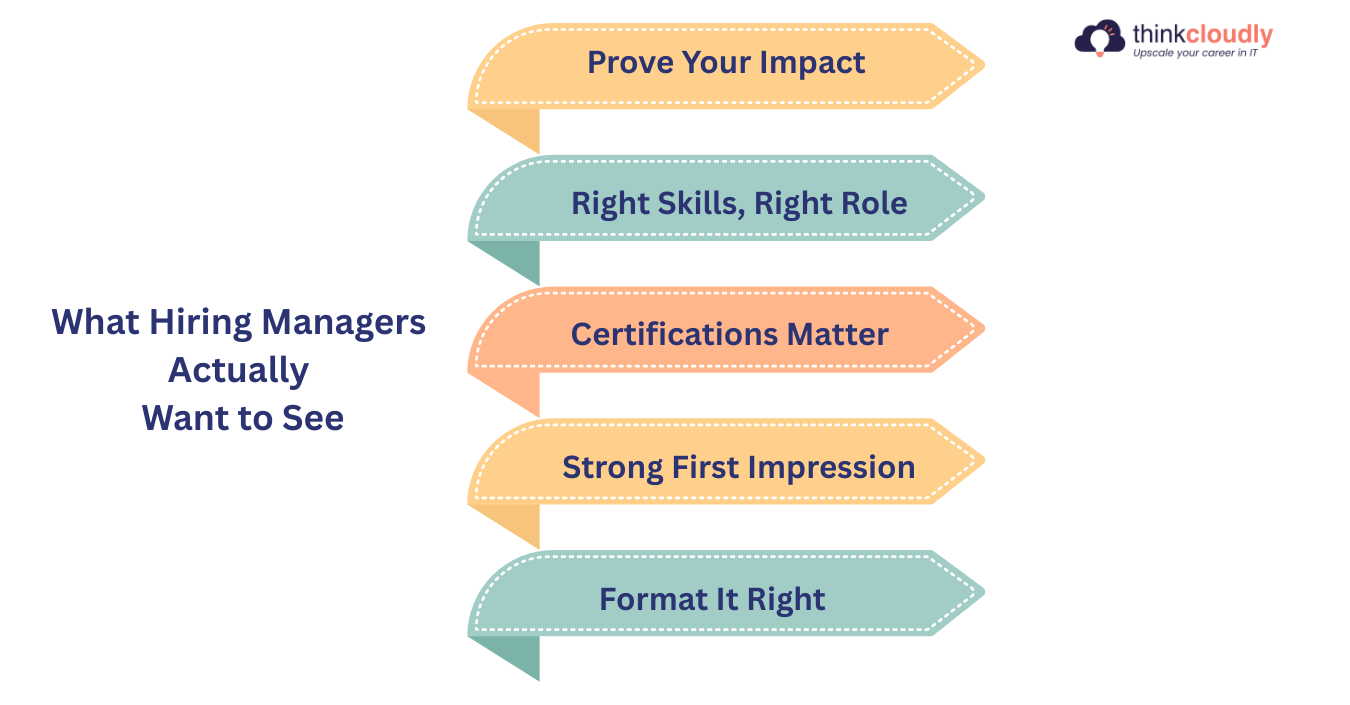
Here is what matters most to hiring managers in 2026, based on current data:
- Work experience with clear, measurable outcomes
- Skills that match the role (not a generic list of every tool you have ever touched)
- Certifications relevant to the position — 82 percent of hiring managers say certifications can be as valuable as a formal degree
- A professional summary that frames your story in under 30 seconds
- Clean formatting that any system can read without errors
What does not matter as much as most people think: the design of your resume, the font you choose, or whether you include a photo (in most Western markets, photos are not expected and sometimes discouraged).
The AI Resume Trap
One more thing worth mentioning. With AI tools becoming more accessible, many candidates are now using them to write entire resumes. This is creating a new problem.
According to Resume Genius data, 80 percent of hiring managers say they can often tell when a resume has been written by AI. And 72 percent say AI-written resumes make it harder to tell who is actually qualified. Relying too heavily on AI makes you look less capable, not more.
Use AI to refine and sharpen your resume — not to write your experience for you. Your experience is real. Your resume should sound like it.
Conclusion
Your resume is not just a document. It is the first impression you make on every company you apply to — and in most cases, you have less than 10 seconds to make it count.
The good news is that the reasons most IT resumes get rejected have nothing to do with how good you are at your job. They come down to format, keywords, clarity, and specificity — all things you can fix.
Start with one change. Fix your format so the system can read it. Add one number to each bullet point. Rewrite your summary. These small shifts can completely change your results without changing anything about your actual skills or experience.
The IT job market is competitive, but it is not closed. The candidates who get interviews are not always the most experienced — they are the ones who have learned how to communicate their value clearly and quickly. Now you know how to do the same.
Sources and References
“Recruiters spend an average of 6 to 8 seconds on an initial resume scan” — HiroCV — Resume Statistics 2026
“These systems can reject a resume in as little as 0.3 seconds, and 75 percent of resumes are now discarded without any human review” — HiringThing — 2026 Job Application Statistics
“The average corporate job posting receives approximately 250 applications; for entry-level positions, that number climbs to 400–600” — HiroCV — Resume Statistics 2026
“Only 2 to 3 percent of applicants reach the interview stage” — HiringThing — 2026 Job Application Statistics
“23 percent of rejections were caused by parsing errors — the ATS could not read the resume correctly due to tables, columns, graphics, or unusual file formats” — HiroCV — Resume Statistics 2026
“75 percent of hiring managers specifically look for quantifiable achievements in the work experience section” — HiroCV — Resume Statistics 2026
“81 percent of employers have adopted skills-based hiring methods, evaluating candidates on demonstrated capabilities rather than credentials alone” — Select Software Reviews — Recruitment Statistics 2026
“90 percent of hiring managers say a clear resume summary helps them evaluate candidates faster” — Resume Genius — Resume Statistics 2026
“82 percent of hiring managers say certifications can be as valuable as a formal degree” — Resume Genius — Resume Statistics 2026
“80 percent of hiring managers say they can often tell when a resume has been written by AI; 72 percent say AI-written resumes make it harder to tell who is qualified” — Resume Genius — Resume Statistics 2026
“Almost 8 in 10 resumes are rejected by hiring managers due to spelling mistakes, bad grammar, or typos” — StandOut CV — Resume Statistics USA