
Nobody told Marcus he needed a degree to fix broken systems, write code that thousands of people use, or earn a six-figure salary before he turned 30. He figured that out on his own — at 2 a.m., hunched over a laptop in a one-bedroom apartment, watching YouTube tutorials while his college friends were studying for finals. Three years later, he was a cloud engineer. No diploma on the wall. Just skills, a few certifications, and a lot of stubborn curiosity.
That’s not a fairy tale. That’s 2026.
The idea that you need a four-year computer science degree to work in tech is one of the most persistent myths still floating around. Employers used to treat degrees as the gold standard. But the tech industry — more than almost any other field—has quietly moved on. What companies actually need are people who can do the work. And in a world where you can learn almost anything online, the question is no longer “Do you have a degree?” but “Can you prove what you know?”
This guide is for anyone who’s ever thought about getting into IT but felt like the door was closed because they didn’t follow the traditional route. It isn’t. The door is open. This is what it looks like on the other side.
Why the IT Industry Stopped Caring About Degrees
In the early 2000s, a computer science degree was almost a requirement to get hired at a tech company. But the industry grew faster than universities could keep up. According to CompTIA’s 2025–26 IT Industry Outlook, the global shortage of skilled IT workers is severe and ongoing — and hiring managers know that a diploma doesn’t automatically mean someone can solve a real problem on day one.
Major tech employers started removing degree requirements from job postings over the past few years. Google, IBM, Apple, and many others announced publicly that they would assess candidates based on demonstrated ability, not educational background. This wasn’t charity — it was strategy. They needed people who could actually do the job, and they broadened the pool to find them.
Meanwhile, the rise of remote work has pushed this even further. When you can hire from anywhere in the world, and when skills can be verified through practical tests and portfolios, the piece of paper becomes less relevant. The tech industry now runs on proof of work, not proof of attendance.
Five Real Paths People Are Taking in 2026
There is no single road into IT without a degree. There are several, and people mix and match them depending on their situation, budget, and timeline. Here are the most common ones working right now.
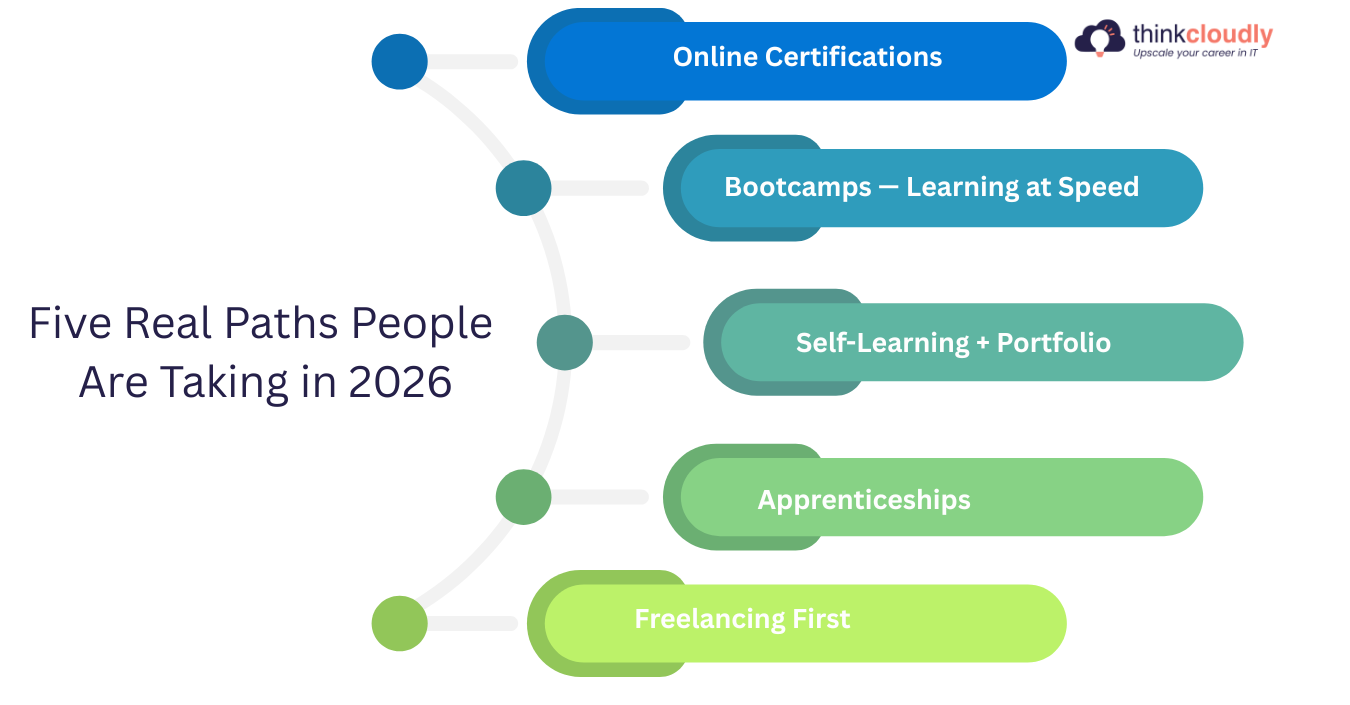
Path 1: Certifications — The Fastest Credibility Builder
Certifications are the single most direct way to signal skills to an employer. They are structured, respected, and often tied directly to specific job roles. In 2026, the most in-demand entry-level certifications include CompTIA A+ (for IT support), CompTIA Security+ (for cybersecurity), Google’s IT Support and Cloud certifications, AWS Cloud Practitioner, and Microsoft Azure Fundamentals.
The beauty of certifications is that they are modular. You don’t have to commit to years of study. You pick one, focus on it for a few weeks or months, pass the exam, and add it to your resume. Then you do the next one. Many IT professionals stack certifications over time as their careers develop.
Path 2: Bootcamps — Learning at Speed
Bootcamps were built specifically for people who want to move fast. A good bootcamp compresses what might take two years of self-study into a few months of focused, structured work. They are particularly popular for web development, data analytics, UX design, and cybersecurity. Many online bootcamps now offer flexible schedules, so you can keep working while you study. Some offer income-share agreements, meaning you pay nothing until you land a job.
Path 3: Self-Learning + a Strong Portfolio
This path takes more discipline but costs the least. Platforms like freeCodeCamp, The Odin Project, Coursera, and others offer high-quality curricula that rival what universities teach. The key difference here is the portfolio — a collection of real projects you’ve built that demonstrates your ability to employers. A developer who can show three functional apps they’ve made from scratch is far more interesting to a recruiter than a candidate with a degree but nothing to show.
Path 4: Apprenticeships — Getting Paid to Learn
Apprenticeship programs in IT are expanding rapidly in many countries. Companies sponsor your training in exchange for a work commitment. You learn on the job from experienced professionals, earn a wage, and graduate with real experience rather than just a certificate. This is particularly powerful because you’re building your professional network from day one.
Path 5: Freelancing as a Launchpad
Some people don’t wait for permission. They start small — helping a local business set up a network, manage ads, or sort out a broken website — and build from there. These gigs might seem small, but they add up to a portfolio, a network, and real-world problem-solving experience that no classroom can replicate.
Quick Comparison: Entry Paths Into IT Without a Degree
|
Path |
Time to job-ready |
Avg. Cost |
Best For |
Difficulty |
|
Certifications |
2-6 months per cert |
$150–$400 per exam |
IT support, cloud, security |
Moderate |
|
Coding Bootcamp |
3–6 months |
$2,000–$15,000 |
Web dev, data, UX |
Intensive |
|
Self-Learning |
6–18 months |
$0–$500/year |
Motivated self-starters |
High Discipline |
|
Apprenticeship |
12–24 months |
Free to low cost |
Hands-on learners |
Moderate |
|
Freelancing |
Varies widely |
Near zero |
Self-driven entrepreneurs |
Variable |
From Restaurant to Cybersecurity: A True Story
One person we spoke to had been working as a restaurant manager for six years. She felt stuck. At 29, with no savings to go back to university, she spent her lunch breaks watching free tutorials on cybersecurity. Over eight months, she completed two certifications — all self-funded, all online. She landed her first IT role as a junior security analyst at a financial services firm. She now manages her own team.
Her turning point? She stopped waiting for the “right time” and started treating learning like a part-time job she was already hired for.
Note: Names and specific details have been changed to protect the privacy of the individual. The story reflects real experiences shared with us during research.
What IT Roles Are Most Accessible Without a Degree?
Not all IT roles are equally accessible to career changers. Some require deep academic knowledge built over years. Others are very much open to anyone with the right skills and the right attitude. Here are the roles that people without degrees most commonly break into.
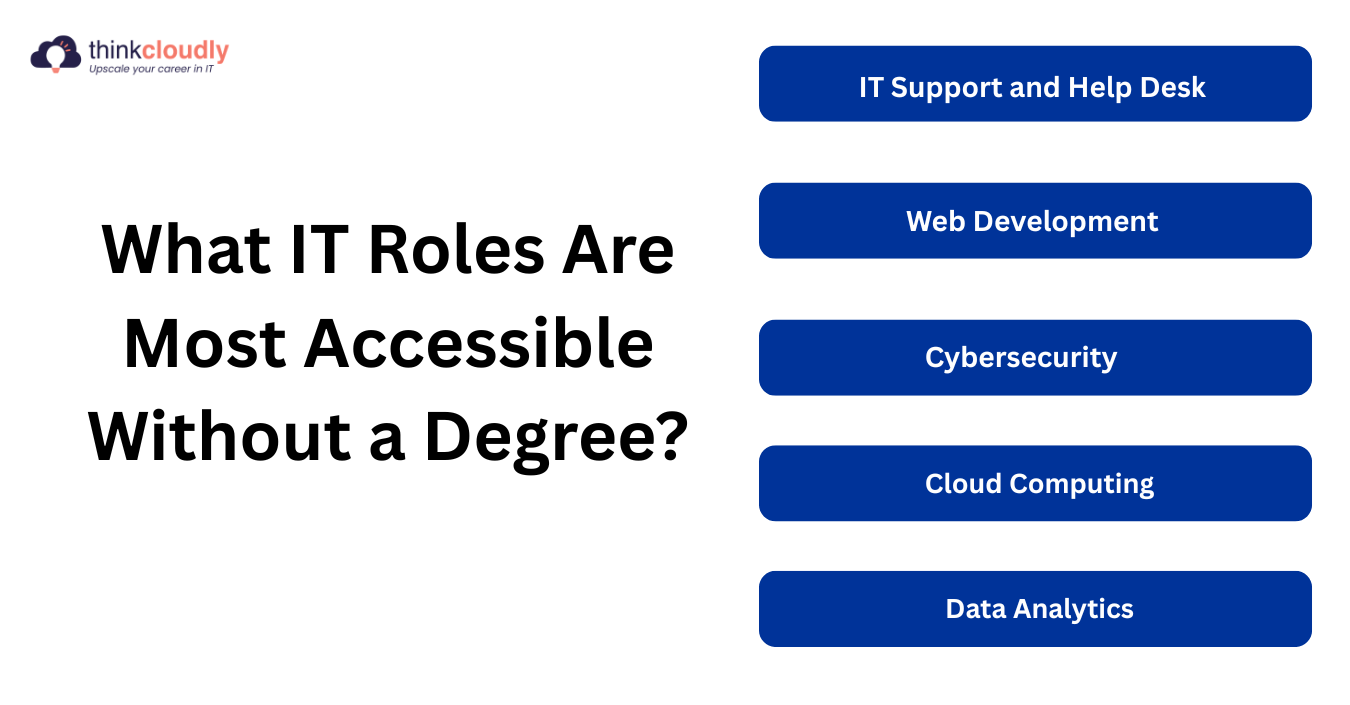
IT Support and Help Desk are often the first step. It’s the entry point of the IT world — helping people troubleshoot problems with computers, software, and networks. It teaches you the fundamentals and gives you exposure to how businesses actually use technology.
Web Development — particularly front-end development, which is about building the visual side of websites — is one of the most portfolio-driven fields in tech. If you can show you’ve built functional, attractive websites, many employers will hire you regardless of your educational background.
Cybersecurity has become one of the fastest-growing fields in the entire economy. The shortage of security professionals is so severe that companies are actively lowering the barrier to entry. Entry-level roles like security analyst or SOC analyst are attainable with the right certifications and some practical experience.
Cloud Computing is another area where certifications speak louder than degrees. As companies move their infrastructure to platforms like AWS and Microsoft Azure, they need people who understand those platforms — and vendors have built robust certification programs to prove exactly that. Cloud engineers with two to four years of experience commonly earn between $90,000 and $130,000 annually, according to BLS and LinkedIn salary data.
Data Analytics is increasingly accessible, too. With tools like Excel, Python, SQL, and business intelligence platforms becoming standard in every industry, analysts who can pull insights from data are in high demand — and many of these skills can be learned from scratch in under a year.
The Skills That Matter More Than Your Resume
Technical skills get you the interview. Soft skills get you the job — and keep you in it. This is something experienced IT professionals will tell you over and over again, and it’s especially true when you don’t have a degree to lean on.
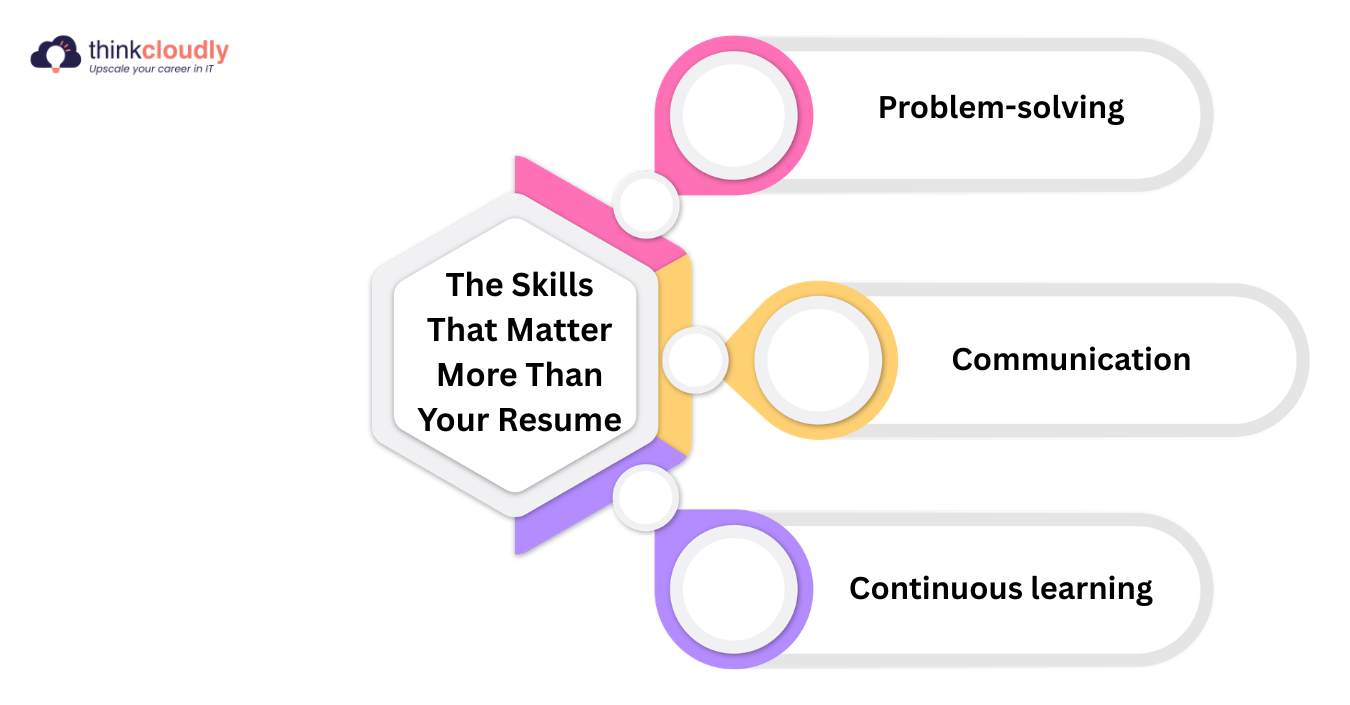
Problem-solving is the core of every IT role. Technology breaks. Systems fail. Code behaves unexpectedly. The ability to stay calm, think logically, and work through a problem step by step is more valuable than any qualification.
Communication is often overlooked. IT professionals work with non-technical people constantly — explaining what went wrong, what needs to happen, and why it matters. Being able to explain technical concepts in plain language is a genuine superpower.
Continuous learning isn’t optional in tech — it’s a survival skill. The landscape changes fast. The person who stays curious, keeps updating their skills, and embraces new tools will always have a place in this industry, degree or not.
Common Mistakes to Avoid When Starting Out
The path into IT without a degree is real, but it isn’t without pitfalls. Here are the mistakes that slow people down the most.
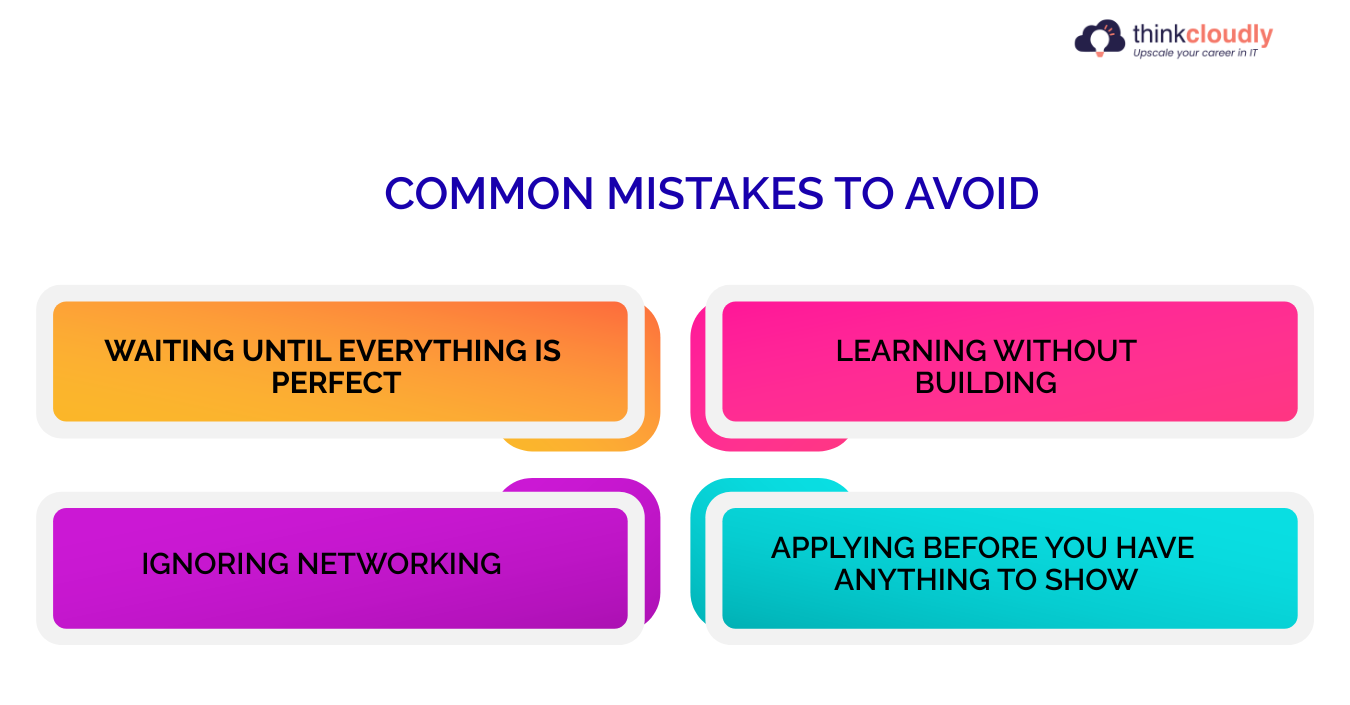
Waiting until everything is perfect
Many people spend months researching the “best” path, the “best” course, the “best” certification — and never actually start. Progress beats perfection every time. Pick one path and begin.
Learning without building
Watching tutorials is comfortable. Actually building something is uncomfortable and messy and slow. But it’s the only way to really learn. Employers want to see what you’ve made, not what videos you’ve watched.
Ignoring networking
This word makes some people cringe, but it simply means connecting with people in the field. LinkedIn, online communities, local meetups — these are where opportunities often come from. Many IT jobs are filled before they’re publicly posted.
Applying before you have anything to show
A resume with no experience and no portfolio is a tough sell. Build something first. Even a small project demonstrates initiative, and initiative is exactly what employers hiring from non-traditional backgrounds are looking for.
Conclusion
The tech industry doesn’t care how you learned — it cares that you can do the work. In 2026, the path from zero to your first IT job is more accessible than it has ever been. The tools are available. The certifications are recognized. The demand for talent is enormous.
What it requires is a decision. Not a degree application. Not thousands of dollars in tuition. Just a decision to start, to stay consistent, and to keep building until your skills do the talking for you.
Every expert in IT was once a complete beginner who decided to keep going. The only real difference between them and you right now is time — and that’s something you can control.
Sources & References
- CompTIA IT Industry Outlook 2025–2026 — Referenced for the ongoing global shortage of IT professionals and the rising value of certifications.
- Google Career Certificates Program — Referenced as an example of industry-led, degree-free pathways into IT support and cloud computing.
- IBM Skills Build — Degree-Free Hiring Statement — Referenced in the context of major employers removing degree requirements from job listings.
- U.S. Bureau of Labor Statistics — Information Security Analysts Outlook — Referenced for employment growth projections in cybersecurity and related IT fields through 2030.
- AWS Training and Certification — Referenced as an example of a vendor-led certification program recognized globally for cloud computing roles.
- LinkedIn Workplace Learning Report 2024 — Referenced for the emphasis on skills-based hiring and the growing employer focus on demonstrable ability over credentials.