
Sarah had been studying IT for seven months.
She watched hours of tutorials every evening after her shift at a retail store. She took notes. She rewatched confusing parts. She even paid for an online subscription to get access to more courses.
But when she finally sat down to apply for her first IT support role, she froze. Her resume was blank. She had no projects to show. No examples of anything she had actually done. Just a list of courses—and a growing fear that none of it had actually prepared her for a real job.
She didn’t have a skills problem. She had a building problem. And in 2026, that is the single biggest mistake IT beginners are making.
What’s Actually Going On
The internet has made learning easier than ever. You can find free tutorials on almost any IT topic—networking, cybersecurity, cloud computing, coding—without spending a single dollar or pound.
That’s wonderful. But it has created a new trap.
People get comfortable watching. They feel like they’re making progress because they’re busy. But watching someone else fix a computer or set up a server is not the same as doing it yourself. And employers know the difference immediately.
According to CompTIA’s 2025–26 IT Industry Outlook, there is a severe and ongoing global shortage of skilled IT workers. Companies are desperate to hire. But “skilled” is the key word. They don’t need people who have watched 200 hours of content. They need people who can actually sit down and solve a problem.
The gap between watching and doing is where most beginners get stuck — sometimes for over a year.
Why This Mistake Is So Easy to Make
Here’s the honest reason this happens: building something feels scary. Watching feels safe.
When you watch a tutorial, you can always pause, rewind, and follow along. There’s no pressure. Nothing breaks permanently. You feel like you understand because, in the moment, you do.
But the moment you try to build something on your own, without anyone guiding you, everything gets harder. You get stuck. You don’t know what to search for. Things don’t work the way the tutorial made them look.
That uncomfortable feeling is not a sign that you’re failing. It’s the actual learning happening.
Most beginners mistake that discomfort for a signal to go back and watch more tutorials. So they do. And the cycle repeats.
What Employers Actually Look For
Let’s be direct about what gets someone hired in IT without a degree in 2026.
|
What Employers Check |
What Most Beginners Prepare |
|
Portfolio of real projects |
List of completed courses |
|
Certifications with practical labs |
Certificates of course completion |
|
Problem-solving in an interview |
Theoretical knowledge from videos |
|
GitHub, personal projects, or freelance work |
Notes and bookmarked tutorials |
|
Evidence of independent thinking |
Proof of following instructions |
A hiring manager at a mid-sized company once put it this way: “Show me something you broke and then fixed.” That tells me more than any certificate.”
A Real Story: From Watching to Building
James had spent nearly nine months watching IT tutorials in his spare time. He worked in a warehouse and had no technical background at all. He could explain how a network worked. He could describe what a firewall does. But he had never actually set one up.
One evening, frustrated with yet another rejection email, he made a decision. He stopped watching for 30 days. Instead, he set up a small home lab using an old laptop and free software. He broke things. He fixed them. He documented what he learned in a simple blog.
Within three months of that decision, he had a portfolio. Within five months, he had his first IT support role.
The tutorials didn’t get him the job. The building did.
Note: The name and identifying details have been changed to protect the individual’s privacy. This story is based on real experiences gathered during editorial research in early 2026.
The Fix: What You Should Do Instead
The good news is that this mistake is entirely fixable. Here’s what actually works.
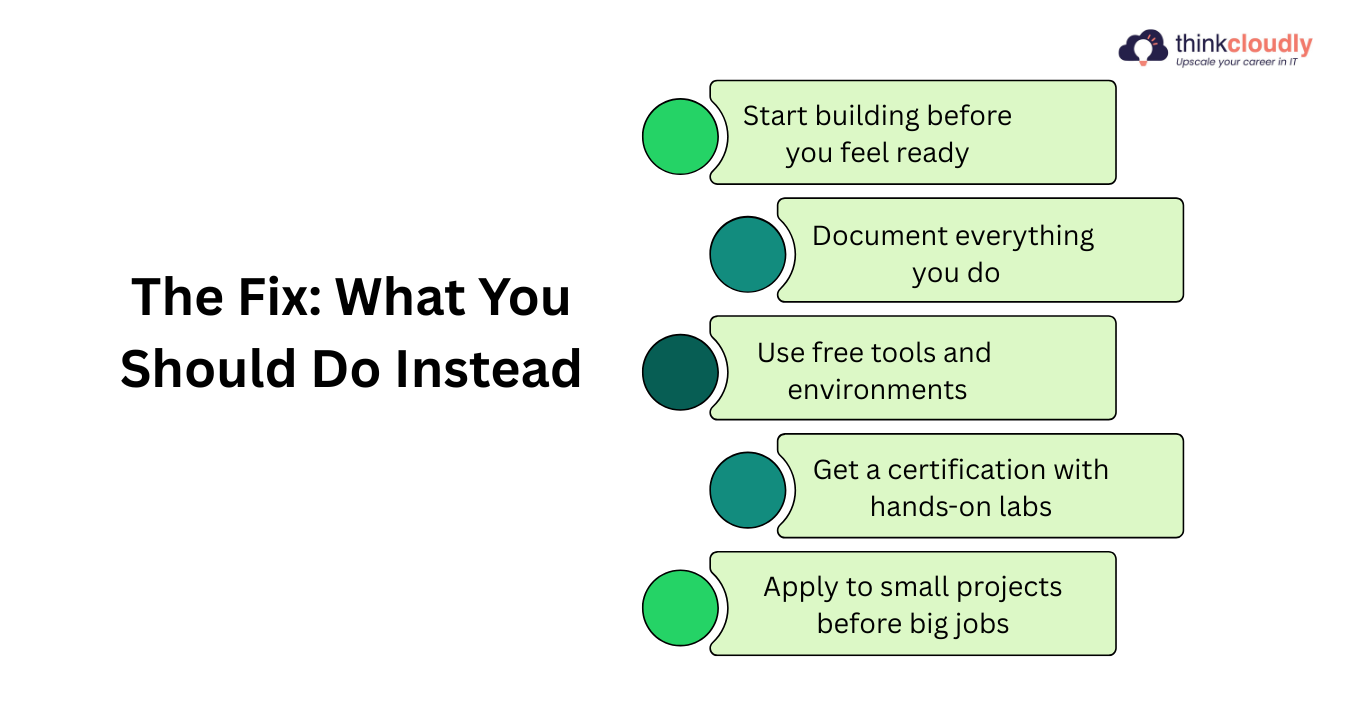
Start building before you feel ready
You will never feel fully ready. Start anyway. Set up a home lab on an old device. Create a small project. Break something and figure out how to fix it.
Document everything you do
Keep a simple log or write short posts about what you built and what you learned. This becomes your portfolio. It proves to employers that you can think, not just follow.
Use free tools and environments
You do not need expensive equipment. Free platforms offer practice environments at no cost. Old laptops, free virtualization software, and open-source tools are enough to start.
Get a certification with hands-on labs
Certifications like CompTIA A+ include practical components that force you to apply knowledge, not just remember it. This bridges the gap between theory and real work.
Apply to small projects before big jobs
Offer to help a local business, a family member’s shop, or a community group with their tech setup. These small, informal experiences count as real experience—and they build confidence.
The One-Line Rule Worth Remembering
For every hour you spend watching or reading, spend at least one hour doing something with what you just learned.
That balance alone will separate you from the majority of beginners who stay stuck.
Conclusion: The Door Is Open — But You Have to Walk Through It
The IT industry in 2026 is one of the most accessible it has ever been for people without degrees or formal qualifications. The demand for skilled workers is enormous. The barriers to entry are lower than they have ever been. Hiring managers at major companies have publicly moved away from requiring degrees.
But none of that matters if you never build anything.
The tutorials are a starting point, not the destination. The destination is a portfolio. A project. A problem you solved on your own, documented, and can talk about confidently in an interview.
You don’t need more content. You need to start creating.
Pick one thing today. Build it. Break it. Fix it. Write it down.
That is how careers in IT actually begin.
Sources & References
- CompTIA IT Industry Outlook 2025–26 — Referenced for the global shortage of skilled IT workers and the ongoing demand for demonstrable, practical skills.
- CompTIA A+ Certification Overview — Referenced for its inclusion of hands-on, practical labs that go beyond theoretical knowledge.
- U.S. Bureau of Labour Statistics—Computer Support Specialists Outlook—Referenced for employment growth projections in IT support and related entry-level roles.
- AWS Free Tier — Referenced as an example of a no-cost cloud practice environment available to beginners.
- LinkedIn Workplace Learning Report 2024 — Referenced for employer focus on skills-based hiring and the growing value of demonstrated ability over credentials.