
There’s a career hiding in plain sight inside thousands of companies right now. It doesn’t require a computer science degree. It doesn’t ask you to write code all day. And it sits at the intersection of two things that every business cares deeply about: technology and money.
It’s called FinOps. And most people have never heard of it.
That’s actually good news for you.
Let’s Start With a Problem Every Company Has
Imagine you run a mid-sized business. A few years ago, you moved all your software and data to the cloud because everyone said it would save money and make things more flexible. And it did, for a while.
But then the bills started creeping up. Then they started climbing. Then one day your finance director walked into a meeting holding a cloud invoice that made the room go quiet.
This is not a hypothetical. It happens constantly. In fact, according to Gartner, organizations waste an estimated 30 to 35 percent of their cloud spend every year. For a company spending $10 million annually on cloud services, that’s up to $3.5 million quietly disappearing.
Nobody set out to waste that money. It just happened because cloud costs are genuinely complicated, move fast, and don’t behave like traditional expenses. You can’t manage them the same way you manage office rent or payroll.
That’s the problem FinOps was built to solve.
So What Exactly Is FinOps?
FinOps stands for Financial Operations, applied specifically to cloud technology spending.
Think of it this way. In a traditional company, the finance team manages money and the tech team manages technology. Those two groups often barely talk to each other. FinOps is the practice, and increasingly the professional discipline, of getting those two worlds to work together in real time.
A FinOps practitioner helps organizations understand exactly what they’re spending on cloud services, why they’re spending it, whether it’s necessary, and how to make smarter decisions going forward. They translate technical cloud usage into financial language that business leaders can actually understand and act on.
It’s not about cutting costs blindly. It’s about spending intentionally. There’s a significant difference between those two things, and companies are learning to value that difference a great deal.
The FinOps Foundation, the nonprofit organization that defines and governs the discipline, describes it as “a cultural practice and an operational framework.” That’s a fancy way of saying it’s both a set of skills and a way of working that brings people together around a shared goal.
Why Is This Career Taking Off Right Now?
Cloud spending has exploded globally. According to IDC, worldwide spending on cloud services is expected to surpass $1.3 trillion by 2025. That’s an enormous amount of money moving through systems that most finance teams were never trained to understand.
At the same time, economic pressures in recent years have pushed companies to scrutinize every dollar they spend. The era of “we’ll figure out the costs later” is over. Boards and CFOs are asking hard questions about cloud budgets, and many companies simply don’t have anyone qualified to answer them.
Enter the FinOps professional.
The FinOps Foundation reported that FinOps job postings increased by over 200 percent between 2021 and 2024. And the role continues to grow because it solves a pain point that shows no sign of going away.
What Does a FinOps Professional Actually Do Day to Day?
This is where it gets interesting, especially if you’re coming from a non-technical background.
A FinOps practitioner’s daily work typically includes reviewing cloud usage dashboards and spending reports, meeting with engineering teams to understand upcoming projects and their likely costs, presenting financial summaries to leadership, identifying areas where the company is paying for cloud resources it doesn’t actually use, and building processes that help teams make cost-aware decisions from the start rather than cleaning up expensive messes afterward.
Notice what’s not on that list. Writing software. Managing servers. Building infrastructure.
The technical knowledge required is more about understanding. You need to know enough about how cloud services work to have intelligent conversations with the people who manage them, but you don’t need to be an engineer yourself.
Many successful FinOps practitioners come from backgrounds in finance, accounting, project management, procurement, or business analysis. The skill set is genuinely more cross-functional than almost any other cloud role.
What Does the Pay Actually Look Like?
|
Role Level |
Typical Job Titles | Average Annual Salary (US) |
|
Entry Level |
FinOps Analyst, Cloud Cost Analyst |
$75,000 to $95,000 |
|
Mid-level |
FinOps Engineer, Cloud Financial Analyst |
$95,000 to $130,000 |
|
Senior Level |
Senior FinOps Practitioner, Cloud Economist |
$130,000 to $160,000 |
|
Lead / Manager |
FinOps Manager, Head of Cloud FinOps |
$160,000 to $200,000+ |
| Principal / Director |
Director of Cloud Financial Management |
$200,000+ |
These figures reflect US market data primarily, but salaries in the UK, Australia, Canada, and Germany are also strong and growing. The global demand means remote and hybrid roles are widely available, which broadens the opportunity further.
Beyond base salary, many FinOps roles sit within finance or technology leadership structures that include bonuses tied to cost savings achieved, which can add meaningful additional income.
The Certification That Opens the Door
The FinOps Foundation offers a structured certification called the FinOps Certified Practitioner (FOCP). It has become the recognized credential for this field in a way that’s similar to how the AWS Cloud Practitioner certification works for general cloud knowledge.
The FOCP exam covers the core principles of FinOps, the three phases of FinOps practice (Inform, Optimize, and Operate), and how to apply the framework across different team structures and cloud environments.
It doesn’t require prior cloud or finance experience to sit the exam, though having some familiarity with either will help. Many candidates prepare in four to eight weeks of part-time study using the FinOps Foundation’s official training materials, many of which are freely available.
Holding the certification signals to employers that you understand the discipline at a foundational level and that you’re serious about the field. For career changers, it’s one of the most efficient investments of time available in the cloud space.
Who Is Best Placed to Move Into FinOps?
Honestly, a wider range of people than you might expect.
Finance professionals who want to work in tech without becoming engineers find FinOps to be an exceptionally natural fit. Their existing skills in budgeting, forecasting, and variance analysis translate directly into cloud financial management.
Business analysts who are comfortable working with data, spotting patterns in spending reports, and presenting findings to leadership will find the day-to-day work familiar in structure, just applied to a new domain.
Even procurement professionals who understand vendor contracts and negotiation find relevant footing in FinOps, since managing cloud vendor commitments and reserved capacity purchases is a significant part of the role at senior levels.
The Biggest Misconception About FinOps
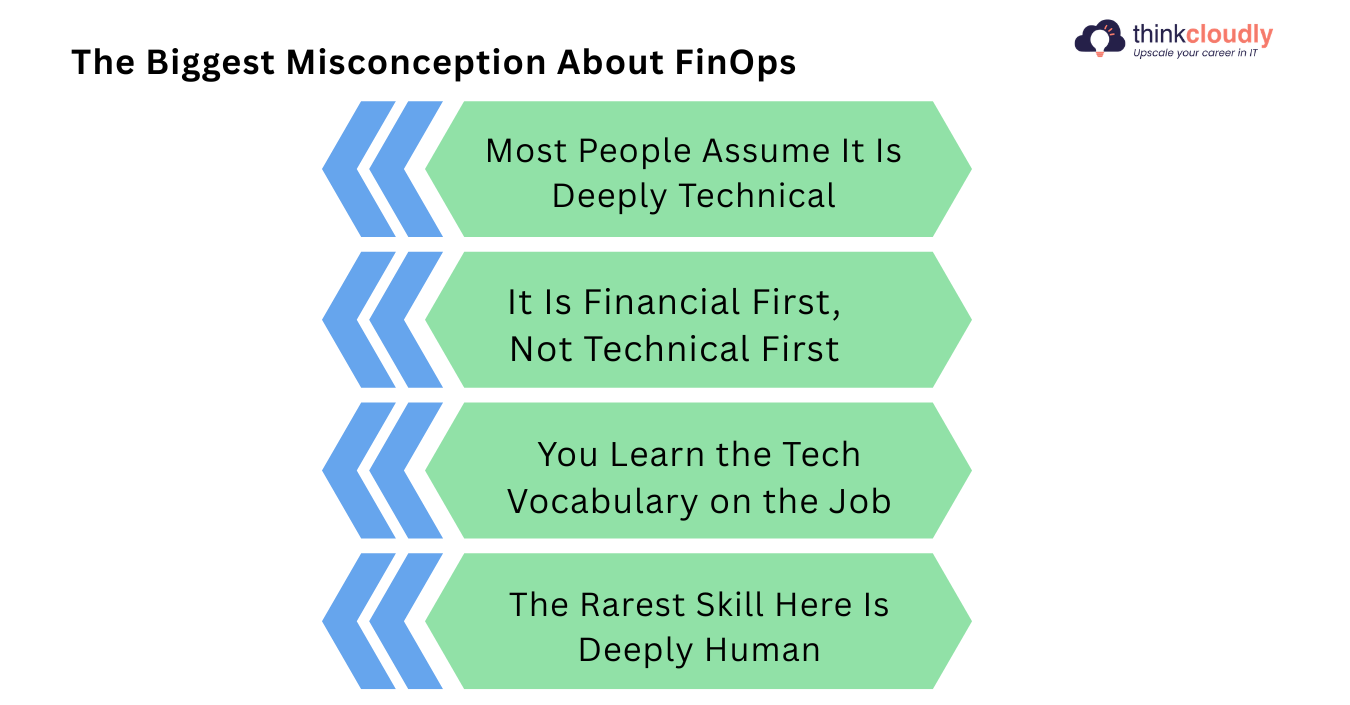
Most people assume it is deeply technical.
Many qualified people avoid FinOps, thinking it requires heavy technical skills. It does not. The role lives closer to finance and operations than to engineering.
It Is Financial First, Not Technical First
FinOps is not a technical role that happens to touch finance. It is a financial and operational role that happens to work in a cloud context. The emphasis matters.
You Learn the Tech Vocabulary on the Job
Yes, you will learn cloud terminology. You will need to understand the difference between reserved instances and on-demand pricing, or why rightsizing a virtual machine can save a company tens of thousands of dollars. But you learn those things on the job and through certification study. You do not need to arrive already knowing them.
The Rarest Skill Here Is Deeply Human
The most valued ability in FinOps is communicating clearly between the tech team and the business team. That is a human skill. And it is one that no amount of engineering training automatically provides.
The Bottom Line
FinOps is one of those rare career opportunities that sits at the exact intersection of an urgent business problem and a genuine shortage of qualified people. Companies are spending more on cloud than ever before. Most of them are managing that spending poorly. And the professionals who can help them do it better are in short supply and well compensated for it.
You don’t need to be a software engineer. You don’t need a computer science degree. You need an interest in how technology and money intersect, a willingness to learn a new framework, and the kind of communication skills that help different teams understand each other.
If that sounds like something you could do, it probably is.
Sources & Further Reading
The data and statistics in this article are drawn from the following sources:
- FinOps Foundation — FinOps Certified Practitioner Certification and Official Framework — Certification structure, exam requirements, and the official FinOps discipline framework
- Gartner Research — Cloud Cost Waste and Optimization Report — Cloud spending waste estimates and organizational cost optimization benchmarks
- IDC Research — Worldwide Cloud Services Spending Forecast 2025 — Global cloud market size projections and spending growth forecasts
- LinkedIn Talent Insights — FinOps Job Posting Growth and Demand Trends 2024 — FinOps role posting growth data and hiring demand trends across industries
- FinOps Foundation — State of FinOps Report 2024 — Practitioner survey data, adoption rates, and cloud financial management maturity benchmarks
- Glassdoor — FinOps Practitioner and Cloud Financial Analyst Salary Data — Salary ranges by role level and seniority for FinOps professionals in the US market
- Levels.fyi — Cloud and FinOps Compensation Data by Role and Seniority—Verified compensation data across cloud financial management roles at technology companies
- Amazon Web Services — Cloud Economics and Cost Optimization Resources — AWS cost optimization principles, reserved instance pricing, and rightsizing guidance
- Microsoft Azure — Cost Management and Billing Documentation — Azure cloud cost management tools, billing structures, and financial governance documentation
- Forbes Technology Council — The Rise of FinOps as an Enterprise Discipline — Expert analysis on enterprise FinOps adoption and the growing demand for cloud financial practitioners
- Forrester Research — Cloud Financial Management and FinOps Market Analysis — Market sizing, vendor landscape, and enterprise adoption trends in cloud financial management
- CompTIA — IT Industry Outlook and Cloud Workforce Trends 2025—Cloud workforce hiring trends, skills demand, and technology industry employment projections
All salary figures, job demand statistics, and market data referenced in this article reflect global and US cloud industry conditions as reported for 2024 and 2025.