
Did you know that 80% of software teams experience significant sprint rollover—meaning they regularly carry unfinished work from one sprint into the next?
That figure comes straight from Easy Agile’s State of Team Alignment 2026 report, which surveyed 419 engineers and product managers across the US, UK, Germany, Canada, and Australia. For teams relying on Agile project management to deliver real results, that number is not just a statistic—it is a week-by-week productivity drain. In 2026, the teams finding a way out of that cycle are the ones leaning into AI sprint planning—not as a gimmick, but as a genuine operating upgrade. This blog breaks down what is actually working, what the data says, and why the smartest agile software teams are doing things differently right now.
What Is AI Sprint Planning — and Why Does It Matter in 2026?
AI Sprint Planning is the practice of using machine learning, predictive analytics, and large language models to make sprint cycles faster, more accurate, and far less reliant on gut instinct. Rather than spending an entire afternoon in a room debating story points, teams feed their historical sprint velocity data and backlog into an AI tools, which surfaces calibrated estimates, flags hidden dependencies, and highlights capacity risks—all before the meeting even begins.
This is not a future concept. According to Scrum.org’s AI4Agile Practitioners Report 2026, 83% of Agile practitioners now use AI tools in some capacity. The same report found that 67% of organizations have already provided formal access to AI tools, and 45% have active strategic AI initiatives underway. The challenge is not access — it is integration. A striking 54.3% of practitioners say their biggest barrier is not knowing where AI fits inside their Scrum ceremonies. AI sprint planning solves that by giving practitioners a clear, ceremony-level entry point: start with estimation, capacity, and backlog prioritization.
The Real Cost of Sprint Failures — What 2026 Data Reveals
Before we get into solutions, it is worth understanding exactly what is going wrong. Poor sprint planning is not just an inconvenience—it is measurable and expensive.
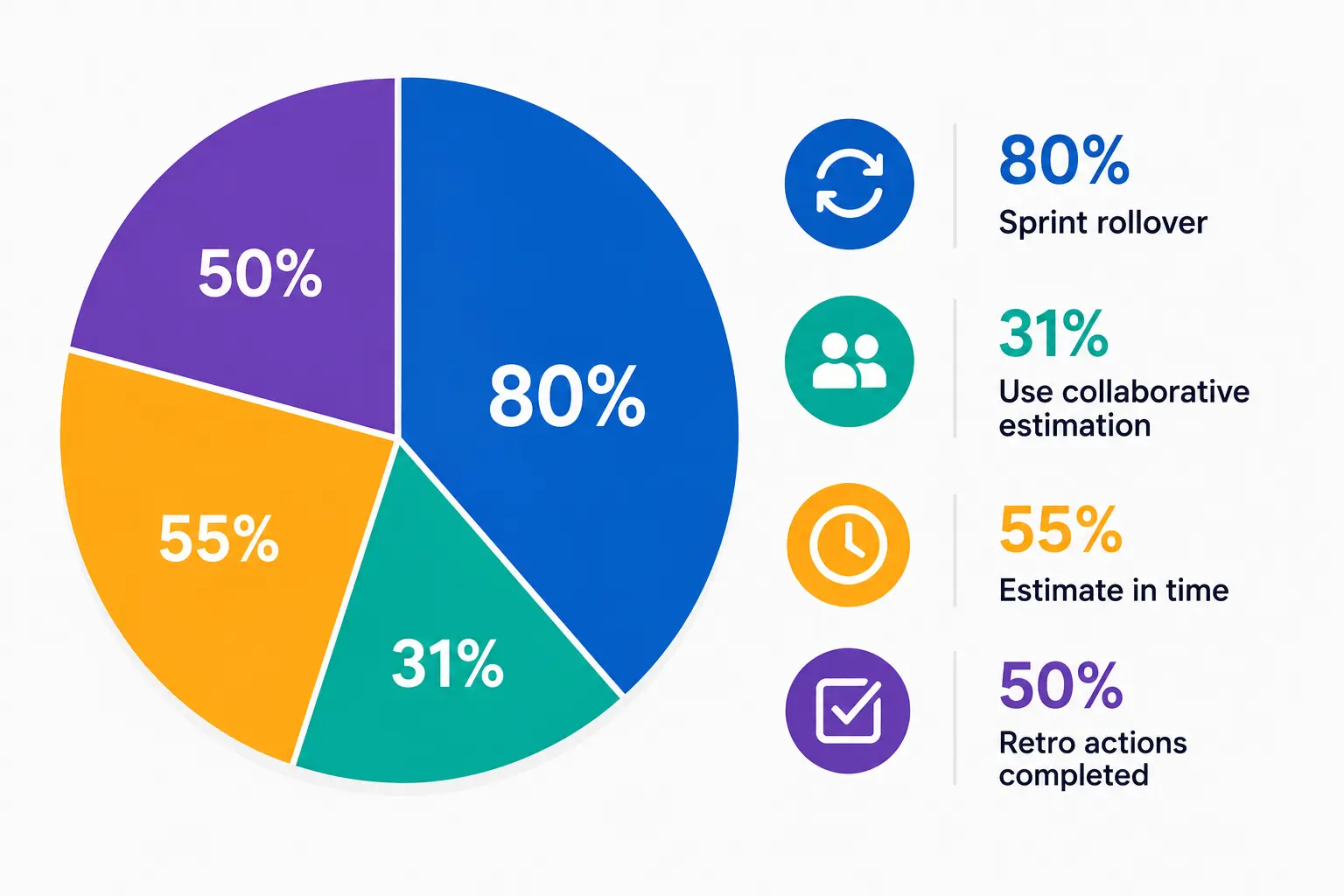
Easy Agile’s 2026 research reveals:
-
80% of teams experience significant sprint rollover regularly
-
Only 31% of teams use collaborative estimation techniques, meaning most miss the hidden complexity surfaced by group discussion
-
55% of teams estimate in time rather than story complexity, which papers over uncertainty
-
Only half of retrospective action items ever get completed and implemented
Zenhub’s 2026 research adds another layer: teams lose up to 10% of their sprint capacity to administrative work in planning sessions alone. That is nearly half a day per sprint, per team member — doing tasks an AI could handle in minutes.
The problem compounds when you factor in DORA Metrics. According to Zylos Research’s 2026 Developer Productivity report, while AI tools now write 41% of all code, delivery stability has actually decreased by 7.2% at many organizations. More output, but flatter — and sometimes worse — delivery. That is the signature of teams that added AI to their workflow without fixing the planning layer first. Fast execution of the wrong priorities is still a sprint failure, just a more expensive one.
How AI Sprint Planning Is Fixing These Problems
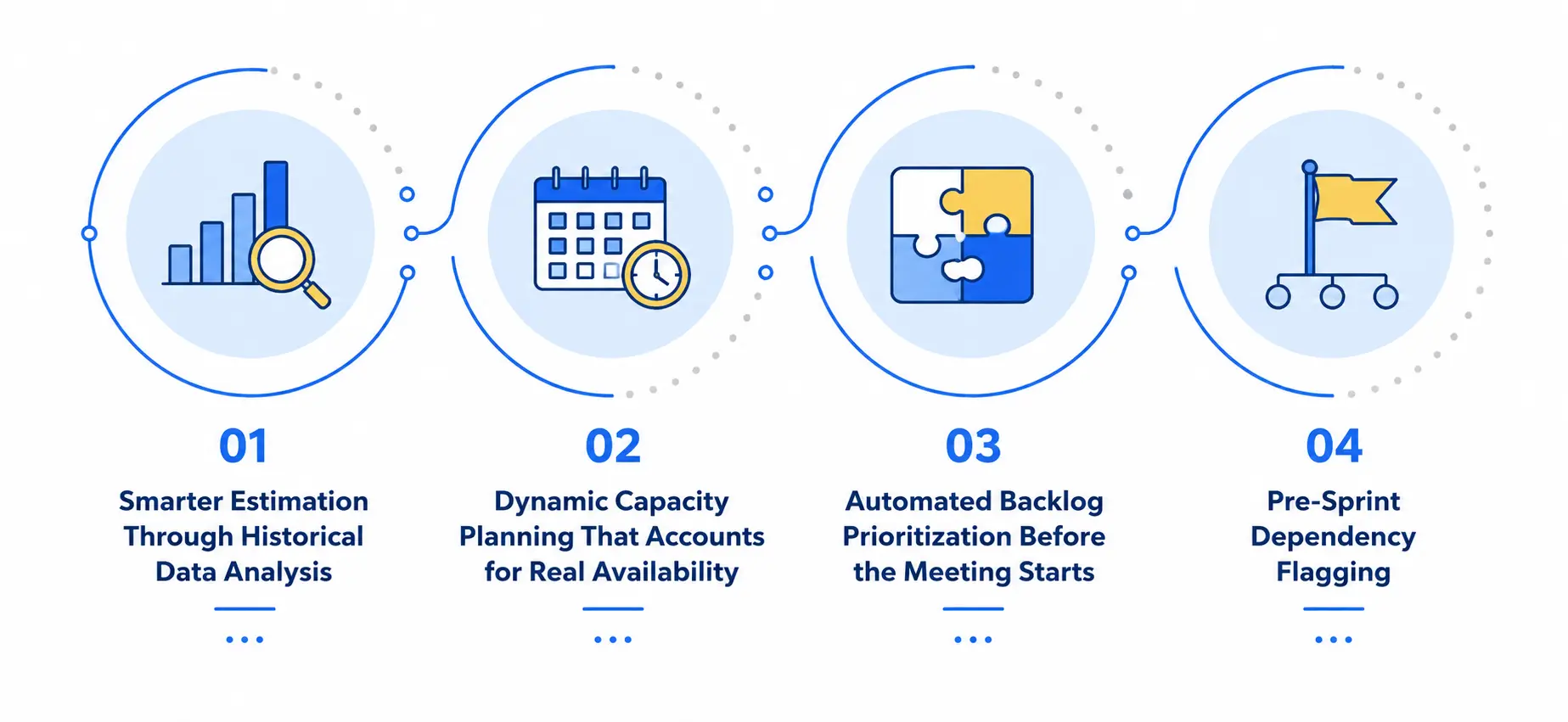
1. Smarter Estimation Through Historical Data Analysis
The single biggest reason Sprint Planning sessions drag on is that estimation relies on individual memory and subjective experience. One senior developer’s estimate rarely accounts for a junior colleague’s ramp-up time, existing technical debt, or sprint-to-sprint variance.
AI sprint planning tools like Baseliner AI and Zenhub’s AI features change this by analyzing past estimate-versus-actual variance across dozens or hundreds of sprints. They generate calibrated story point baselines for new backlog items based on similarity to previously completed work. According to Baseliner.ai’s 2026 data, teams using this approach reduce sprint overcommitment by 20 to 35% within the first six months of consistent use. For agile project management leads, that is the difference between a sprint that ships and one that spills.
2. Dynamic Capacity Planning That Accounts for Real Availability
One of the most persistent myths in sprint planning is that capacity equals headcount multiplied by available hours. Cadence’s 2026 sprint planning analysis calculated that a realistic five-person team in a two-week sprint has roughly 200 hours of actual focused engineering work — not the 400 hours a naive calculation suggests. That 50% gap is where sprint failures are born.
AI capacity planning tools ingest real data—leave schedules, meeting loads, on-call rotations, and historical sprint velocity patterns per individual—then produce a capacity forecast grounded in reality, not optimism. This alone materially reduces the number of teams that walk into software delivery commitments they cannot keep.
3. Automated Backlog Prioritization Before the Meeting Starts
Backlog prioritization is where AI delivers perhaps its most obvious ROI. Modern agile project management platforms—including Jira Intelligence (Atlassian Rovo), ClickUp Brain, and Asana’s AI integrations—now read historical sprint data, identify dependency chains, and suggest priority reordering before a single human opens the planning meeting. Modern AI tools can save product owners up to 10 hours per week in backlog refinement overhead alone.
The result is that teams walk into sprint planning with a pre-organized, AI-vetted backlog—not a chaotic pile of items ranked by whoever shouted loudest in the last stakeholder meeting. Backlog prioritization done well is the foundation of predictable software delivery.
4. Pre-Sprint Dependency Flagging
One of the quietest causes of sprint failure is the dependency nobody spotted until Wednesday of sprint week, when two teams discover they are building on top of each other’s unfinished work. AI tools now scan backlogs and sprint boards to surface these conflicts before the sprint begins. NextAgile’s 2026 review of AI sprint tools found that teams using dependency-aware AI planning tools reported a measurable reduction in mid-sprint scope changes — one of the top three causes of sprint failure in Easy Agile’s survey.
AI Sprint Planning and DORA Metrics: What the Numbers Say
DORA Metrics—Deployment Frequency, Lead Time for Changes, Mean Time to Restore, and Change Failure Rate—are the industry’s four most trusted signals of software delivery health. They were developed by Google’s research team and have become the benchmark for engineering performance across every major enterprise.
Here is the uncomfortable truth: according to GitKraken’s 2026 DORA and AI guide, individual developers may feel more productive with AI, yet organizational DORA metrics often stay flat—or decline. The reason is structural. If you improve code generation speed but leave sprint planning broken, your DORA metrics will not improve—because the bottleneck was never the typing. Teams that improve their DORA Metrics with AI are the ones who fix the planning layer first, then accelerate execution. AI Sprint Planning is that planning layer.
AI Sprint Planning Tools Compared: A 2026 Snapshot
|
Tool |
Primary Function | Key AI Feature | Best For |
DORA Metrics Impact |
|
Baseliner AI |
Sprint estimation | Historical variance analysis | Multi-team Agile orgs |
Lead Time, Deployment Frequency |
|
Jira Intelligence (Rovo) |
Backlog Prioritization & sprint planning | Dependency mapping, user story generation | Enterprise Agile teams |
All four DORA metrics |
|
Zenhub AI |
GitHub-native sprint planning | Auto story point suggestions | Dev-first Agile Software teams |
Deployment Frequency |
|
ClickUp Brain |
All-in-one Agile Project Management | Context-aware task prioritization | Cross-functional teams |
Lead Time |
|
Dart AI |
Multi-team forecasting | Predictive sprint models | Scaling Agile orgs |
Sprint Velocity, MTTR |
|
Microsoft Copilot (ADO) |
Backlog creation from stakeholder inputs | Converts emails/meetings to backlog items | Microsoft ecosystem teams |
Change Failure Rate |
|
Asana AI |
OKR-aligned Backlog Prioritization | Strategic goal matching | Product-led teams |
Lead Time, Software Delivery |
Sources: NextAgile 2026, Baseliner.ai 2026, Agile Leadership Day India 2026, The Digital Project Manager 2026
What do smart teams know about sprint velocity and AI?
Sprint Velocity—the amount of work a team completes per sprint, measured in story points—is often cited as the primary success metric in Agile. But in 2026, Sprint Velocity alone is telling less and less of the story.
Faros AI’s engineering report found that 75% of engineers use AI tools, yet most organizations see no measurable performance gains at the organizational level. Teams that simply use AI to write more code—without fixing how that code is planned, prioritized, and reviewed—end up with inflated Sprint velocity numbers and declining code quality. Zylos Research’s 2026 analysis confirmed this: code churn is expected to double in 2026 for teams that optimize only for output speed. The teams using AI sprint planning well are tracking sprint velocity alongside DORA metrics, not instead of them. They use AI estimates as a calibrated starting point, not a final commitment — and they ensure that human judgment always validates the output before a sprint begins.
The Risk Side: What to Watch for in AI Sprint Planning
Honest coverage of AI sprint planning has to include the risks. A 2026 survey of Scrum practitioners published on Medium found that while AI-generated sprint goals were useful as drafts, 81% reported “almost correct” outputs, 59% reported hallucinations, and 63% flagged confidentiality concerns when pasting sensitive backlog content into public AI tools.
Modall’s 2026 software development statistics report adds another warning: developer trust in AI tools dropped from 70% positive in 2023 to just 29% in 2025. The reason? Teams that used AI tools longer understood their failure modes better. AI-generated code contains more errors when it lacks sufficient context, and the same is true of AI-generated sprint plans. The practical takeaway: AI sprint planning works best as a starting layer—one that saves two hours of prep work and surfaces patterns no human would catch—while keeping human judgment in the driver’s seat for every final commitment.
Conclusion: AI Sprint Planning Is the Edge Teams Can’t Ignore in 2026
Sprint failures are not a Scrum problem. They are a planning problem—and planning is exactly where AI is now most useful. The agile project management teams gaining ground in 2026 are the ones who have stopped treating AI sprint planning as a novelty and started treating it as infrastructure. They use AI to sharpen their backlog prioritization, build honest capacity plans, flag dependencies before the sprint begins, and track DORA metrics alongside sprint velocity to measure what actually matters in software delivery.
The data from various sites and sources tell a consistent story: organizations that fix the planning layer first see real gains in agile software delivery outcomes. Those that bolt AI onto a broken process just fail faster.
AI sprint planning is not a replacement for agile thinking. It is what makes Agile thinking finally as fast as it was always supposed to be.