
In the digital world, AI in cloud computing is used to transform how organizations operate and deliver their services. Companies can now automate tasks, improve efficiency, and provide better user experiences with the help of Generative AI and deep learning.
AI in cloud operations enables businesses to store data and run their applications online. It has become even stronger after combining with AI and deep learning. AI is helping organizations work faster and smarter, from chatbots and virtual assistants to fraud detection and proactive mitigation.
In this blog, you will learn how Generative AI and deep learning are working in cloud systems and software-as-a-service, what the benefits of AI are, and real-world applications, also regarding Proactive mitigation, chatbots, and virtual assistants.
What is AI in Cloud Computing?
AI in cloud operations uses AI tools and technologies within cloud platforms such as AWS, Azure, and Google Cloud. These platforms help to provide services like software-as-a-service (SaaS), which allows users to access their applications over the internet without installing them.
What AI does in a cloud system:
- It helps to analyze large amounts of data
- It is used to automate tasks by using deep learning models
- Helps in improving decision-making
- With the help of AI and deep learning, cloud security can be improved by using proactive mitigation
When AI is united with cloud services, software-as-a-service creates smarter and more efficient systems.
Key Technologies Behind AI in Cloud Computing
If you want to understand how generative AI in a cloud system actually works, it is first important to know the main technologies behind the whole process. These three components of cloud operations help AI systems run smoothly, with the help of deep learning to process data efficiently and deliver smart output faster.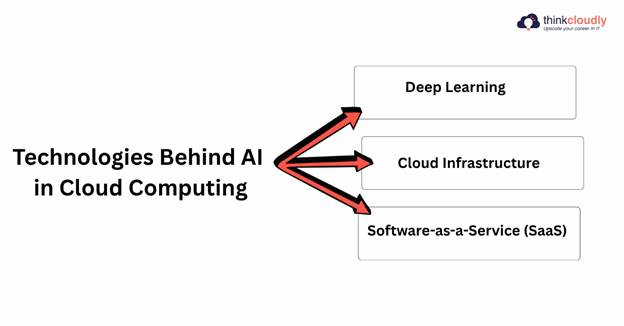
1. Deep Learning
Deep learning in cloud systems is the most important part of intelligent automation, as it uses neural network training to learn from large datasets.
It helps systems to understand complex patterns such as text, images, and code.
- It uses multi-layer neural networks in a deep learning system to process complex data
- It learns from large datasets without the help of manual rules
- It maintains the accuracy of the output through continuous training and feedback
- Majorly used in fraud detection, chatbots and virtual assistants
- It helps to support advanced Generative AI models to create content using deep learning
2. Cloud Infrastructure
Cloud infrastructure is the main part of the cloud, as it is the collection of hardware and software. It offers storage, computing power, and networking resources, which help them to handle large-scale AI workloads.
- It provides flexible computing power, such as servers and GPUs, for running AI models
- It is used to store large datasets that are required for training and testing AI systems
- It allows faster processing and real-time data analysis
- It supports the benefits of AI in cloud operations to work smoothly and improve system performance
- Helps in proactive mitigation by monitoring systems and predicting the causes of failures
3. Software-as-a-Service (SaaS)
Software-as-a-service (SaaS) allows users to access AI tools directly through the internet without installing or locally managing software.
- Software-as-a-Service provides automatic AI applications on cloud platforms
- Helps in reducing the need for technical maintenance and setup
- Software-as-a-Service helps to make AI in Saas based AI solutions available to non-technical users
- Supports intelligent automation by combining AI into daily business tools
- Software-as-a-service is commonly used in tools like CRM systems, AI writing assistants, and analytics dashboards
What do you understand by Generative AI in Cloud Computing?
Generative AI is a very powerful part of AI in intelligent automation that is used in content creation to create new content, such as images, text, or code. When it is merged with generative AI in cloud systems, it helps to improve cloud operations, automate complex processes, and generate output faster and more smartly.
For example:
- It generates automated reports and summaries of businesses.
- It helps in creating codes for software development
- Using chatbots and virtual assistants to respond instantly
Generative AI helps to make cloud services work more intelligently and user-friendly.
Applications of AI in Cloud Computing
|
Applications |
Role of AI in cloud computing |
|
Chatbots & virtual assistants |
It is the best benefits of AI to provide customer support instantly. |
|
Fraud detection |
It helps to identify the threats early before they occur. |
|
Cloud operations |
It is used to automate management and to monitor the system |
|
Intelligent automation |
Because of this, intelligent automation decreases manual tasks and improves efficiency |
|
Proactive mitigation |
It is used to predict the failure and then helps in preventing the occurrence of failure |
Benefits of AI in cloud computing
Organizations are able to improve their efficiency, reduce manual efforts, and work more smartly by using the benefits of AI in cloud computing. It also allows intelligent automation and flexibility in the system and strong cloud systems.
Here are some of the benefits of AI: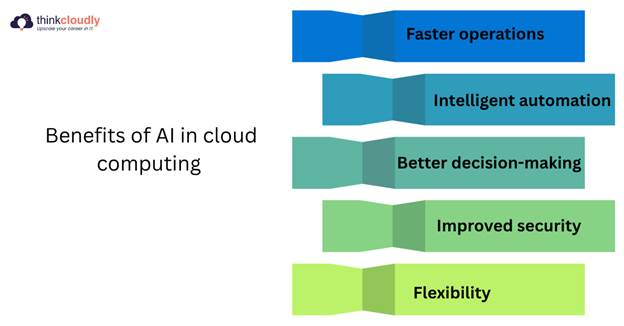
Faster operations
The benefits of AI help in speeding up the process by automating daily tasks and by reducing manual workload. Generative AI helps to handle large datasets efficiently and provide output quickly. It has improved the overall performance in cloud operations.
Intelligent automation
Organizations can easily automate repetitive tasks like queries of customers, data entry, and reporting with the help of intelligent automation. It helps to minimize the mistakes in routine tasks and reduces the efforts of humans. Because of the reduction of manual work, it improves the productivity of the team to focus on high-priority tasks.
Better decision-making
This benefit of AI helps in better decision-making using proactive mitigation by analyzing large datasets in real time. It allows organizations to understand patterns, customer behaviour, and trends easily. This will lead to making business strategies informed and smart.
Improved security
Nowadays, cyber threats are increasing, so the benefits of AI helps in improving security by monitoring systems and detecting cyber threats by proactively mitigating them. It plays a very important role in identifying risk early, before it occurs, by fraud detection. This will allow you to protect your sensitive data and information to ensure a safe cloud environment.
Flexibility
Cloud platforms perform chatbots and virtual assistants easily to adapt AI solutions based on your business requirements. Organizations are able to increase or decrease resources whenever needed without making major changes in the system. This will provide flexibility to businesses in growing smoothly and managing work without delay.
Challenges of AI in Cloud Computing
However, AI in cloud computing has many AI benefits, like intelligent automation, speed, and better decision-making, but as part of its benefits, it has various challenges as well.
High Implementation Cost
Implementing AI in cloud computing requires strong infrastructure, advanced tools, and, obviously, continuous maintenance. Because of this, the cost of businesses increases, which is mostly affects the small and medium-sized companies. Expenses increase more because of the investment in various AI platforms, GPUs, and storage.
Data Privacy Concerns
AI systems are used to handle large amounts of sensitive and personal information in the cloud. These steps increase the risks of data security, unauthorized access, and privacy breaches. To overcome this challenge, there is a need to implement strong security measures in the system.
Need for Skilled Professionals
As with the increase in technology, there is a need for skilled professionals who can work with AI in cloud computing and are able to understand both AI models and cloud systems. There is a lack of several skilled professionals who know how to manage, deploy, and work on these tools and technologies. This gap in skills slows down the implementation process in many organizations.
Dependence on Data Quality
AI systems totally depend on the quality of the input data we are providing. If the input data is incomplete, biased, or incorrect, it can affect the performance of AI models. The quality of data should be structured to maintain the accuracy of predictions and output.
Conclusion
In the final verdict, I would say AI in cloud computing is changing the way businesses work and operate. It helps organizations automate their tasks, work on cloud operations, and deliver accurate output with the help of Generative AI and deep learning strategies.
AI is an important part of chatbots and virtual assistants for fraud detection and proactive mitigation. While the technology is growing, the combination of AI and software-as-a-service-based AI solutions will be able to provide new opportunities for businesses and individuals alike.

