
If you are starting your job preparation journey, mastering AI interview questions is important to have an understanding of gen AI and its fundamentals, with the right interview tips. Companies are actively hiring candidates for these new roles in AI platforms and tools who can understand both traditional AI and techniques in generative AI.
To crack your first job, you need strong interview preparation and interview tips, a basic understanding of traditional AI and techniques in generative AI, and the ability to answer most commonly asked AI interview questions with confidence.
This blog will cover the most frequently asked AI interview questions with useful interview tips and answers for job preparation, which will help you in your interview preparation and to understand various AI platform topics like attention mechanisms, Generative adversarial networks (GANs), large language models, neural network training, and traditional AI, among many more.
Gen AI Interview Questions and Answers for Job Preparation
A generative AI platform is one of the fastest-growing areas in the field of tech interview preparation. In comparison to traditional AI, which works on predictions and classifications, generative AI works on providing you with content like images, text, and audio in milliseconds through techniques in generative AI. It is very important to know the difference while doing your job preparation.
Here are the most asked gen AI interview questions on AI platform, which will help you in your job preparation with the interview tips.
Q1. What are Generative AI Models?
Answer: For job preparation,this is one of the most asked AI interview questions during interview preparation. Gen AI models can create new data like text, images, and audio. These AI platforms understand structure and patterns from large datasets using techniques in generative AI.
They can create real and creative content such as text, images, and audio
-
They use a deep learning architecture that includes GANs, diffusion models, and transformers.
Follow proper interview tips to answer it confidently.
Q2. Differentiate between traditional AI and generative AI?
Answer: You should know the difference between traditional AI and generative AI for interview preparation of AI interview questions with the right interview tips.
|
Aspect |
Traditional AI |
Generative AI (Gen AI) |
|
Definition |
Traditional AI works on analyzing existing data, making predictions, and identifying patterns. |
Generative AI works on creating new data, such as text, images, and audio, by learning patterns from existing data. |
|
Purpose |
Traditional AI main purpose is to analyze data to help in decision-making or the automation of specific tasks. |
It works to generate content from the existing data that mimics human-like creativity. |
|
Data usage |
Data is used to train models that help to give accurate predictions. |
Data is used to learn the structure of the existing text and generate output from the given examples. |
|
Technologies used |
Traditional AI uses rule-based systems, machine learning, and regression models. |
Diffusion models, Generative adversarial networks (GANs), transformers, and deep learning models. |
|
Examples |
Credit scoring, medical diagnosis, and spam detection. |
AI platform, ChatGPT, Gemini, Midjourney, DALL-E, GitHub Copilot. |
Q3. Explain GANs (Generative Adversarial Networks).
Answer: Generative adversarial networks are the most frequently asked question for job preparation.Generative adversarial networks (GANs) are basically a type of neural network training that is used for generative tasks.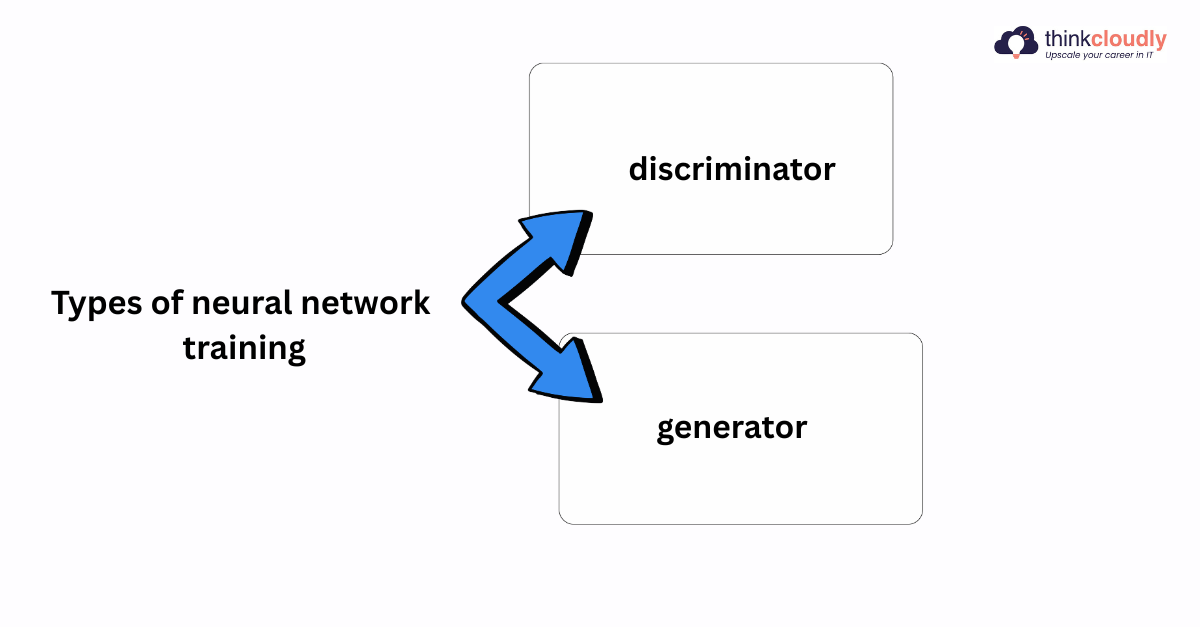
There are two types of neural network training: the discriminator and the generator. The discriminator identifies the real and fake data, whereas the generator generates fake data. There are variants available, such as DCGAN, StyleGAN, and CycleGAN, to improve the performance and quality of the data.
Generative adversarial networks are the most asked in AI interview questions for interview preparation. With good interview tips, you can crack it confidently.
Q4. What do you understand by Neural Network Training?
Answer: Neural network training is the process by which the model learns from data to generate accurate output. In this learning process, a large amount of data is given to the model, and it learns the patterns by adjusting weights step-by-step.
In simple terms, it is an important topic for job preparation. To crack this, you need to go through proper interview tips and AI interview questions.
Q5. What is the attention mechanism?
Answer: The attention mechanism is the most important part of an AI model architecture. This will highlight the important words in a sentence. Instead of treating all words equally, it highlights the importance of relevant and important words. Gen AI models help in understanding the input context and improve the accuracy of the content in AI platform.
Let’s take an example to understand it clearly. “The dog sat on the mat to relax because it was tired.” In this example, the model understands that “it” stands for “dog” here, using the attention mechanism.
Q6. What is a transformer model?
Answer: Transformer models are one of the neural network architectures in job preparation that are used in modern AI systems. They use an attention mechanism to understand the context of data input and improve the quality of the given output. If you are doing job preparation, then this can be the most asked AI interview question about AI platforms.
Q7. What are large language models?
Answer: Large language models are trained AI platform that work on large amounts of data to understand the context and generate human-like output. Large language models are very important in job preparation, used to generate content, chatbots, and automation tools.
Large language models are a very important topic in interview preparation for AI interview questions.
Q8. What is a Variational Autoencoder (VAE)?
Answer: A variational autoencoder (VAE) is a type of autoencoder in the techniques of generative AI that converts input data into an uncertain latent space instead of a fixed point. It allows the Variational Autoencoder to generate new data by sampling from this latent distribution. A Variational Autoencoder combines probabilistic modeling with neural networks and generates tasks like text, creating images, and other complex data.
Q9. What do you understand by latent space?
Answer: Latent space is a process where an AI model stores important data used in techniques in generative AI instead of keeping all the records. For example, it doesn’t cover all the points; instead, the latent space will highlight the most important points like size, name, and shape. The latent space helps to make the complex task easier.
- Latent space is very useful in generative AI techniques like variational autoencoders and generative adversarial networks.
- latent space helps the model to generate new data by making changes in stored features.
- Latent space only learns important patterns to generate new and similar data.
Q10. What are the techniques in Generative AI?
Answer: The techniques used in generative AI to generate new data include: generative adversarial networks, latent space, variational autoencoders, and transformer models.
Q11. What is memory in a large language models?
Answer: Memory in a large language models helps to retain data from the past beyond the new input. It allows you to get the previous conversations into your AI platform.
Q12. What is a token in generative AI?
Answer: Knowing the token is very important for job preparation, especially if you are preparing for an AI interview question. Tokenization is basically breaking the text into small units of sentences that are easy for the large language models to understand and provide you with a meaningful output on AI platform.
Let’s take an example to understand the context of a token:
“Artificial intelligence is powerful.”
In this example, tokens are Artificial| intelligence| is |powerful. As we know, AI doesn’t read the whole sentence in once; instead, it breaks it into smaller parts that are known as tokens.
Q13. Key concept of Gen AI Interview for job preparation?
Answer: While doing interview preparation for an AI interview, you should focus on various important points:
- You should have a basic understanding of AI and large language models
- Have a proper understanding of neural network training and its types
- What is the difference between generative AI and traditional AI
- You should have a good understanding of latent space, variational autoencoder, and techniques in generative AI
- Have hands-on experience with AI platforms
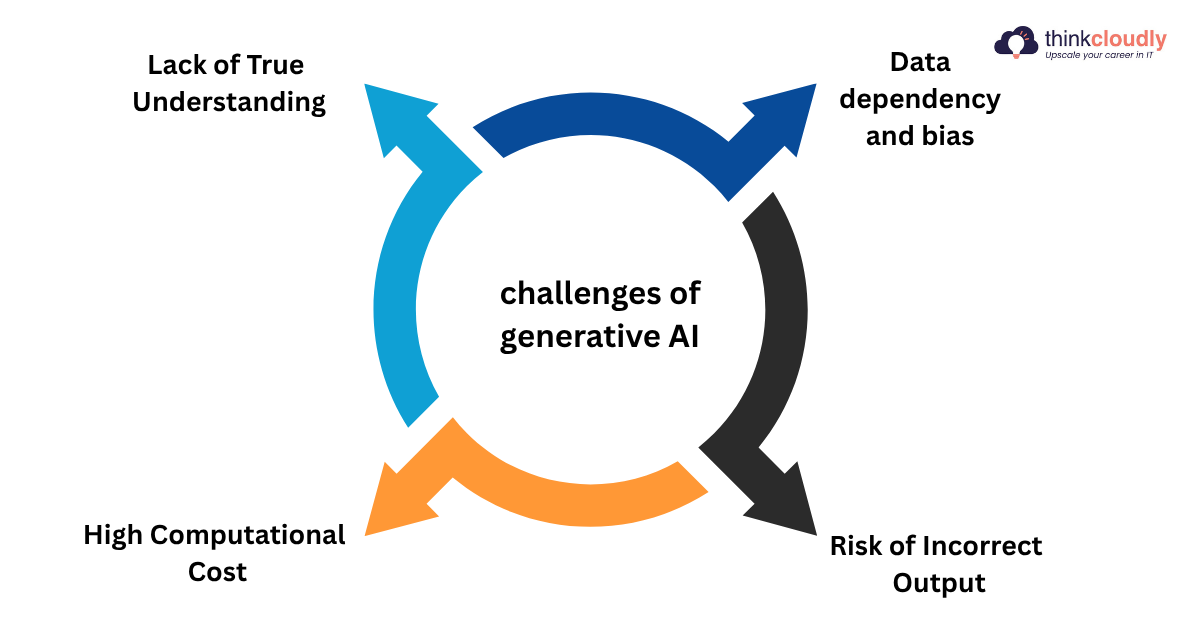
Q14. What are the challenges of generative AI?
Answer: Learning these challenges can be interview tips to answer them confidently:
- Lack of True Understanding: AI language models and Gen AI models don’t generate text based on real understanding; instead, they generate text based on patterns. They usually don’t understand the content as humans do. Sometimes this can’t give you accurate human-based content as per your requirement.
- Data dependency and bias: Large language models’ performance is based on the data they are trained on. If the information is incorrect and biased, then the AI text generation process can build misleading and biased output.
- High Computational Cost: Because of its high computing power, which is used as a transformer model, it can be costly. This is the common challenge which usually every organization face like it can be expensive to run and train these models.
- Risk of Incorrect Output: As gen AI can make mistakes too, the AI word generator works on probability, so it can also provide you with wrong information. Human review is needed for accuracy to deal with challenges in the AI word generator.
Q.15 What is Prompt Engineeringin AI Platforms?
Answer: Prompt engineering is important to understand for job preparation as it is used to design the input to get meaningful output by using AI platforms, and helps to improve the results in AI text generation.
Conclusion
These mostly asked AI interview questions will help you in interview preparation. So it’s important to understand latent space, large language models, Variational Autoencoder techniques in generative AI, and have a strong knowledge of AI platforms. This guide of questions will help you in your job preparation for AI and neural network training.
Use these interview tips to clear your interview round and improve your skills to stay focused on your job preparation and goals.

