
In modern technology, An AI language model is a core element of artificial intelligence that allows machines to understand and generate human text. Nowadays, developers and businesses rely on both small language models (SLMs) and Large Language Models (LLMs) to build intelligent applications with rapid advancements in AI models.
While both types of AI language models have almost similar services and purposes, They have different scalability, performance, and efficiency. So, let’s discuss what makes a language model large or small. It’s important to understand which model is suitable in your case. In this blog, we will explore the key differences, benefits, LLM workflow, challenges, and AI model optimization strategies.
What is an AI Language Model?
An AI language model is a system that has been trained to process and generate natural language using deep learning and machine learning techniques. These models help to examine the trends in large datasets to predict and generate meaningful text outputs.
In simple terms we can say that:
- It understands the context and processes the input text.
- It uses training data to learn linguistic patterns in scalable AI models.
- It generates human-based output
AI language models are widely used in translation systems, chatbots, and content generation tools.
Small Language Models (SLMs)
Small language models are used as intelligent systems designed for efficiency and speed. They are trained on smaller datasets and provide concise and consumable knowledge to the users for specific tasks. They are best for those organizations looking for efficient language models. In comparison to LLMs, they are smaller in size which makes them lightweight and less resource intensive. It includes various key features: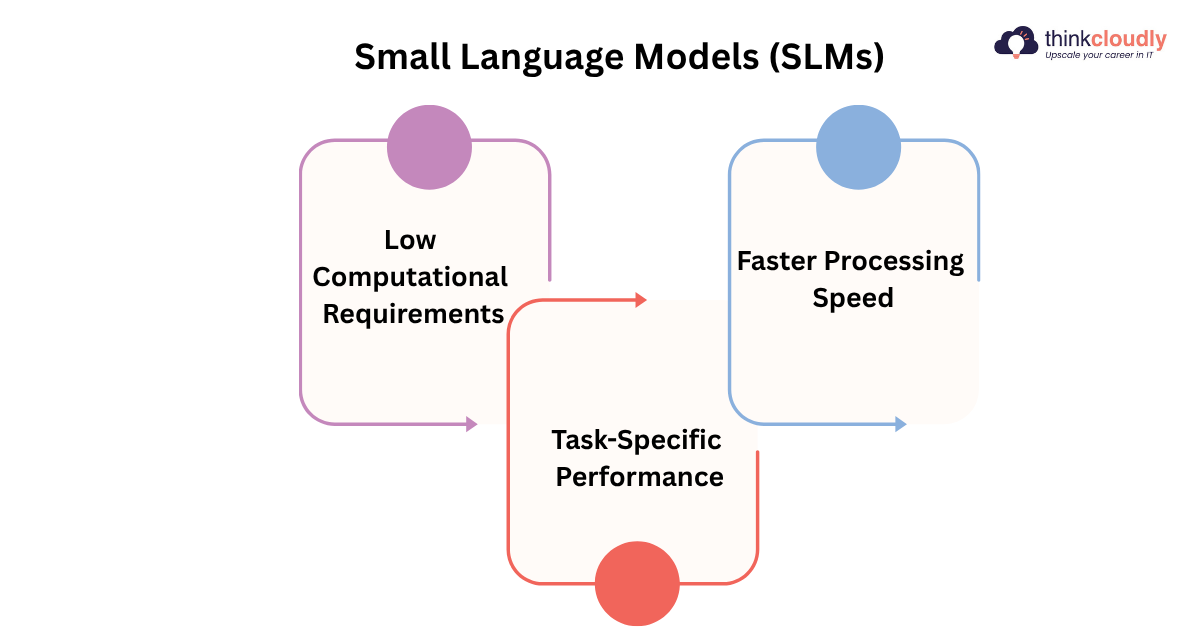
Low Computational Requirements
Due to their small size, SLMs need less hardware resources like memory and power, which make them suitable for edge devices and real-time applications. They are best for those organizations looking for efficient language models with lower infrastructure costs.
Faster Processing Speed
SLMs generally have fewer layers and parameters, these models provide faster output in comparison to LLMs. This makes them suitable for applications that require high speed, quick decision-making, and faster responses.
Task-Specific Performance
Small language models are trained on smaller datasets that are modified to perform well in focused tasks such as classification or keyword extraction. They are optimized for specific use cases rather than general-purpose or vast tasks which are used for LLMs.
Large Language Models (LLMs)
Many users are already familiar with LLMs such as ChatGPT, it is the first consumer facing case of LLMs which were previously limited to Google’s BERT technology and OpenAI’s GPT. Currently, this model is used as an intelligent AI model to provide consumable and concise knowledge to carry out the challenging tasks. Advanced AI language models are usually trained on large datasets to perform complex tasks. There are a few features listed below:
High Accuracy and Context Understanding
In comparison to SLMs, LLMs have the capability to understand complex language trends and provide extremely accurate output. They can manage the contextual thinking and complex data.
Versatility Across Applications
These models help organizations to support multiple use cases such as coding, content creation, and translation. They are widely used in creating scalable AI models for enterprise solutions.
High Resource Consumption
LLMs need strong, powerful GPUs and large memory for training and deployment. They provide superior performance as compared to small models but also increase the cost.
SLM vs LLM: Key Differences in AI Language Model
|
Features |
Small Language Models (SLMs) |
Large Language Models (LLMs) |
|
Size |
This model has a smaller size and lightweight architecture, which makes it easier to deploy on limited hardware. |
This model has large datasets, which make them resource-intensive and highly complex. |
|
Performance |
They work well in specific and well-defined tasks with limited complexity and provide moderate accuracy. |
They are efficient language models and provide high-accuracy output with an understanding of the context, which makes them suitable to solve the complex tasks. |
|
Speed |
Due to their smaller size, they provide faster processing. |
Because of their large computations, they provide slower responses as compared to SLMs. |
|
Cost |
As they require less computational power and infrastructure, they are cost-friendly for development. |
Development and deployment are costly because of their powerful GPUs, large datasets, and high maintenance. |
|
Use |
It is used to perform focused tasks such as keyword extraction, text classification, and simple automation workflows. |
It is used to perform complex tasks like coding and conversational AI and generate content. |
AI Language Model Workflow: SLM vs LLM Process
As we have discussed the difference and uses, now it’s important to know the process of how models transform input into meaningful output: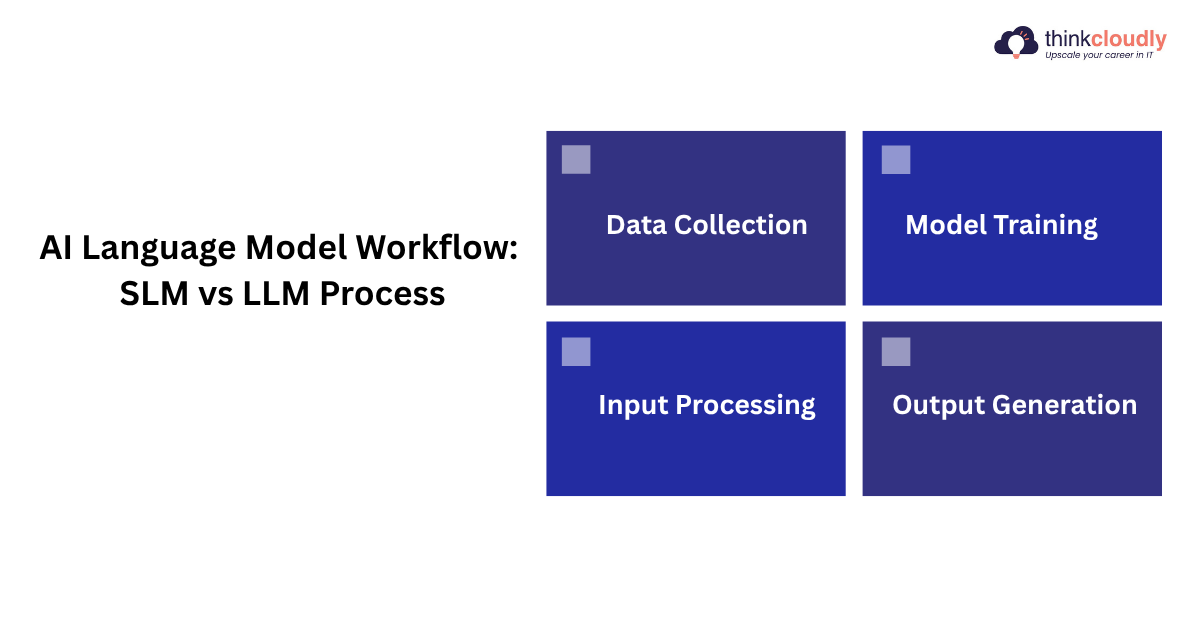
Data Collection
The First step is to collect large datasets from various sources such as blogs, books, reference websites, and articles. This gives an idea about the context and helps the AI language model to understand the language patterns and context of the input to generate accurate output.
Model Training
After collecting data, it is important to train the model using deep learning techniques to learn relationships between the words. It adjusts parameters to provide accurate data and high performance of AI models.
Input Processing
In this step, input from the user is analyzed using trained patterns and contextual understanding. The model helps to identify the context and meaning behind the input text.
Output Generation
The Last step of the LLM workflow is to provide the meaningful output after analyzing the input. This step ensures high-quality output in scalable AI models.
Challenges of SLM vs LLM
However, Both the models have various benefits, but there are also some challenges that can majorly impact performance and accuracy. Understanding these challenges may help you to choose the right model based on specific resource availability and use cases.
Limitations of Small Language Models
They often struggle to handle complex tasks because of their smaller size, as it requires deep contextual understanding or advanced thinking. Due to their limited training capacity, they also struggle to provide more accurate data than larger models.
Limitations of Large Language Models
No doubt this model provides various benefits and provides high-accuracy output, but they are expensive to deploy due to high computational requirements, advanced GPUs, and infrastructure. Their size can lead to slowing down the responses.
Conclusion
The comparison between small language models and Large Language Models highlights the importance of choosing the right AI language model for specific use cases. While SLMs offer efficiency and speed, LLMs provide advanced capabilities and scalability.
Organizations can create powerful and scalable AI models modified according to their needs with the help of AI model optimization. Understanding SLM vs LLM workflow is essential for using efficient language models effectively.

