
In recent years, generative AI has completely transformed businesses by facilitating efficiency, creativity, innovation, and automation. But with its advantages, both individuals and businesses are now very concerned about the emergence of AI security threats and generative AI risks. AI is increasingly being misused for fraud and misleading actions ranging from internet frauds to fake news.
In today’s digital environment, it’s critical to understand how AI threats for common users function for online fraud and learn how to avoid AI fraud. In this blog, we will examine the practical dangers, How AI scams targeting users online and approaches to digital safety and generative AI risk management, with a main focus on AI threats for common users.
What Are AI Scams?
AI scams refer to fraudulent actions and operations that use artificial intelligence technologies to trick users. Some of the frequently used scams are deepfakes and automated phishing. Key features of generative AI scams are explained below:
- Highly realistic content generation AI can create realistic content, images, fake voices, and videos that look so real even you will not be able to recognize the fake ones. This makes it difficult to identify scammers as compared to traditional methods.
- Automation at scale AI allows scammers to target thousands of users at once. Online frauds have become more common and successful as a result. The AI threat for common users is increasing.
- Personalized attacks By using data analysis, AI scams that target users online can be customized. As a result, AI scams and AI threats for common users targeting users online are convincing and dangerous.
How Generative AI Is Used for Online Fraud
Nowadays, it has become difficult to identify online fraud because of Generative AI. AI scams targeting users online and increase their chances of success by using automation and realistic content generation. There are some of the most common ways that show how AI scams are executed in today’s digital environment: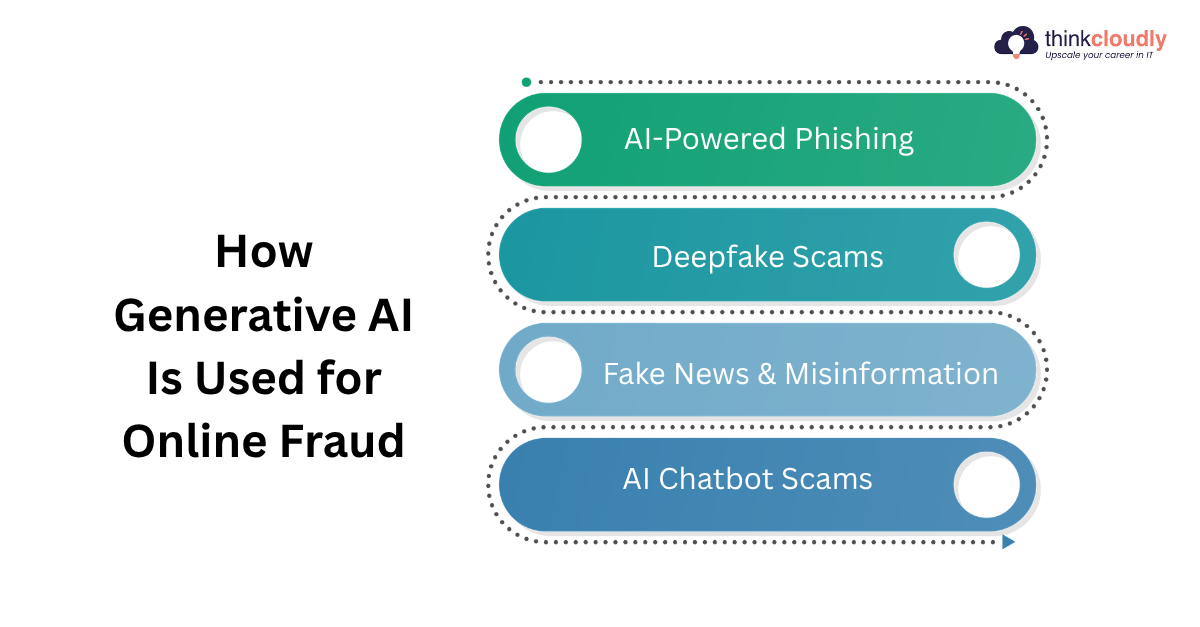
AI-Powered Phishing
AI models use natural language processing (NLP) to train on and generate from massive datasets to produce human-based communication in AI-driven phishing. It identifies user metadata in order to create messages to receive accurate results. This approach helps to boost click-through rates.
Deepfake Scams
Deepfake systems use diffusion models and generative adversarial networks (GANs) to create realistic human faces and voices. These models replicate people almost exactly by learning their biometric data. They use high impact fraud activities like CEO impersonation and real-time to identity spoofing which include tricking and fooling.
Fake News & Misinformation
At scale, language models produce logical, contextually relevant narratives that frequently contain false or misleading information. Their outputs can remove conventional detection because of their linguistic precision. This creates systemic risks that affect public opinion and lower the accuracy of the information.
AI Chatbot Scams These bots maintain context-aware interaction by utilizing reinforcement learning and conversational AI frameworks. To gain the trust of the users, they dynamically modify their responses in human-like response. Sensitive information is extracted once engagement is established, allowing in identity theft and financial crime.
AI Scams vs Traditional Online Scams
|
Features |
AI scams |
Traditional online scams |
|
Content quality |
The Quality of the content is highly realistic |
It often provides poorly written or generic content. |
|
Personalization |
Highly targeted using data |
Limited personalization |
|
Speed & scale |
Scalable and automated |
Slower and manual |
|
Detection difficulty |
Difficult to detect |
Easier to identify |
|
Risk level |
Risk level is high due to AI automation |
Risk level is moderate |
AI Content Verification: Why It Matters
According to analysis, AI scams targeting users online are rising day by day, so it’s become very important to verify the authenticity of digital content to protect your digital space. AI content verification helps to detect manipulated information, prevent misinformation, and build stronger trust in online platforms.
Detecting Fake or Manipulated Content
AI content verification systems are used to identify whether the content is real or AI-generated by analyzing their input data, metadata, and inconsistencies. These systems use machine learning models to detect anomalies in images, text, and videos that are not easily visible to humans. This helps to prevent the spreading of deepfakes and reduces the impact of AI security threats by targeting users online.
Building Trust in Digital Platforms
Make sure of the authentic and realistic content through verification mechanisms. Platforms can improve transparency and confidence for users in digital interactions by authenticating sources and results. This plays an important role in handling fake news and maintaining trustworthiness in an AI-driven environment.
Supporting AI Risk Management
AI content verification is a major component of AI risk management techniques in organizations. It allows you to monitor continuously and detect the suspicious or manipulated content present in your systems. This reduces the vulnerability to AI security threats and helps the organizations in maintaining data integrity, AI scams targeting users online and compliance effectively.
Improve Digital Safety for Users
There are various verification tools used to protect your digital safety by detecting harmful, misleading, or fraudulent AI-generated content such as fake images, videos, and voices. They are a security layer that helps users to avoid interacting with fraud information or malicious sources. This significantly improves the overall safety and reduces the risks related to online fraud.
Improve Scalable Content Moderation
These AI-powered verification systems are used to automate the monitoring process and filtering large amounts of content. These systems can detect and flag harmful or fake content in real time on multiple platforms. This minimizes the change of spreading risk into your system.
How to Protect Yourself from AI Threats
In today’s digital world, it’s important to identify the problems and provide solutions to protect yourself from AI threats. As AI scams become more advanced by adopting active and strong security practices and have the ability to reduce the risk of online fraud significantly and data threats.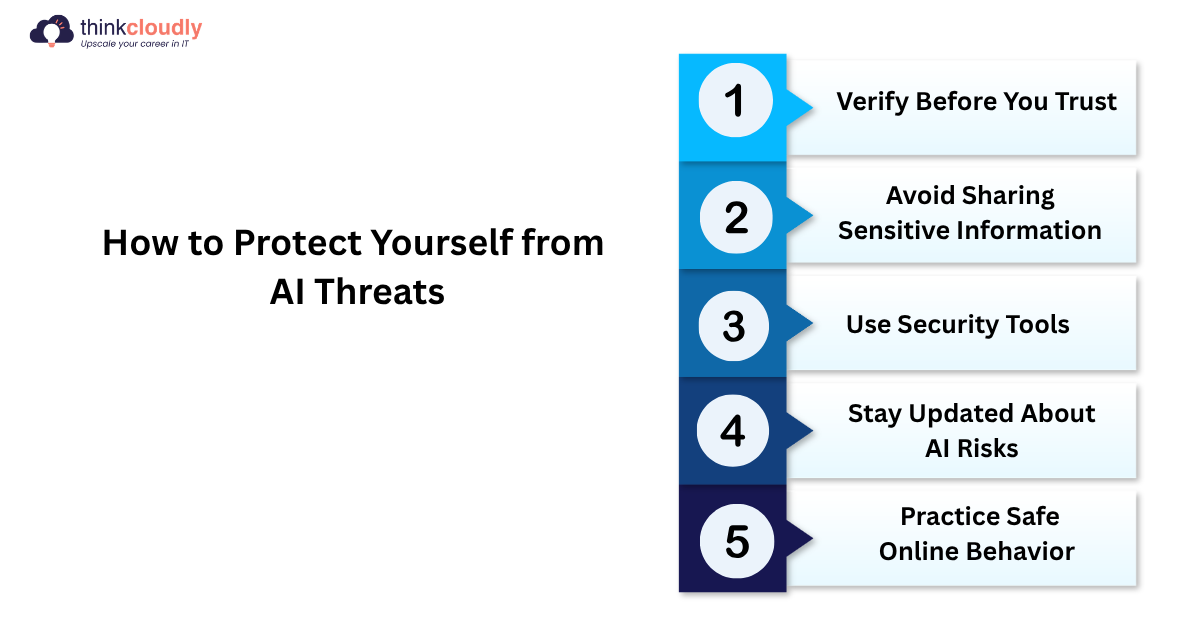
Verify Before You Trust
This is a crucial step in avoiding phishing and impersonation attacks. It’s essential to always double-check emails, messages, and links before taking any action. Do not rely solely on how authentic the content appears. AI-generated content can closely mimic your real communication by using advanced language models. Verifying the source, domain, and sender identifies and helps to detect the inconsistencies and prevents falling victim to AI scams by targeting users online.
Avoid Sharing Sensitive Information
This is the basic awareness to protect your digital safety by avoiding sharing your sensitive information. To keep your digital space safe, never share passwords, OTPs, or sensitive and personal data online. Be cautious while entering personal information on unknown platforms. AI-powered scams are designed to extract sensitive data through manipulation and social engineering techniques. Limiting the exposure of personal and financial information reduces the attack surface.
Use Security Tools
Install antivirus software and anti-phishing tools on your devices. It allows two-factor authentication (2FA) for all important accounts. There are security tools that provide an additional layer for protecting after detecting malicious links, suspicious activities and attempts to unauthorized access. Two-factor authentication includes an extra verification step, which makes it difficult for attackers to compromise accounts. This helps to reduce the AI security threats effectively.
Stay Updated About AI Risks
To prevent these threats, continuously learn about emerging generative AI risks and threats. Keep yourself updated about the cybersecurity news. AI-based fraud techniques change rapidly by making awareness a critical defense mechanism. Staying informed about new attack patterns and scam strategies helps users to identify threats early. This proactive approach reduces vulnerability to online scams and AI-driven attacks.
Practice Safe Online Behavior
You should avoid clicking on unknown links or downloading any suspicious files. Be careful while connecting on social media platforms. Many online scams start with simple actions by the user such as clicking unsafe links or connecting with unproven profiles. Practicing cautious behaviour reduces the vulnerability of the systems. This helps in preventing fraud attempts and ensures safe digital environments.
Conclusion
While generative AI offers powerful capabilities, it also introduces serious risks such as AI scams, fake news, and online scams. To protect your digital space from these AI scams targeting users online and threat it’s necessary for individuals as well as businesses to understand how generative AI is used for online fraud and how you can protect yourself from frauds, what are the preventive measures implementing digital safety practices can help users stay protected.
Individuals and organizations can reduce exposure to threats and ensure safer digital experiences by focusing on generative AI risk management and AI content verification and by following safety awareness.

