

The growing use of Agile methodologies in today’s businesses is changing the way they plan, carry out, and deliver projects. As businesses continue to shift towards using Agile frameworks in order to stay competitive, there has been a substantial increase in demand for individuals who have become proficient at utilizing Agile practices. With today’s many different types of certifications available, ASM certification is one of the few that will provide you with a true competitive advantage if you are looking to advance your career in an Agile work environment.
For project managers, team leaders, or developers currently working in an Agile environment, ASM certification can be essential to helping you build a successful and sustainable career. The purpose of this article is to discuss how obtaining ASM certification can assist in your growth, how to enhance your agile leadership, and how to prepare for the future scrum master role.
Understanding ASM Certification
The Agile Scrum Master (ASM) is a certification that demonstrates your ability to apply the principles and practices of Agile and Scrum in a professional manner. The ASM Certification is centred around the responsibilities, thought process, and skills needed to successfully help teams using scrums implement Agile.
Additionally, the ASM certification has an emphasis on the practical application of these concepts rather than just the theoretical concepts. This makes it very relevant for today’s workforce because the practical information provided regarding the roles and responsibilities of a scrum master, the scrum ceremonies and artifacts, as well as the values of Agile, is directly relayed to real-life work scenarios.
Why Is ASM Certification in High Demand?
Organizations from every industry have begun transitioning away from conventional project management methodologies and towards agile frameworks. As a result of this transition, there is now an increasing need for professionals who can lead teams in their transformation to the agile methodology. An individual with ASM certification will prove to be capable of identifying candidates who possess knowledge of agile methodologies as well as the ability to apply them effectively.
As competition continues to increase, having an ASM certification listed on your resume can give you an advantage over other candidates by demonstrating that you are committed to structured, appropriate, and meaningful learning to develop your skills in preparation for agile roles, along with your interest in helping teams and organizations achieve success in implementing agile leadership initiatives.
The Role of ASM Certification in Career Growth
More than simple work experience will help you advance your career in an agile environment; it should also consist of a combination of applied experience and proven knowledge. To provide formal proof to potential employers of your agile skills, obtaining ASM Certification will help you achieve this.
Many certified individuals achieve career growth much more quickly than expected, because companies do not hesitate to allow them access to important leadership positions, coordinate across different functional areas of their business, and implement process improvements. Ultimately, these experiences will result in your receiving a superior position with more visibility in the industry and more significant ongoing opportunities for advancement throughout your career.
Key Benefits of ASM Certification
Obtaining an ASM certification is a strategic step resulting in both immediate and long-term career benefits. Here are the main ways in which the certification contributes to overall career success:
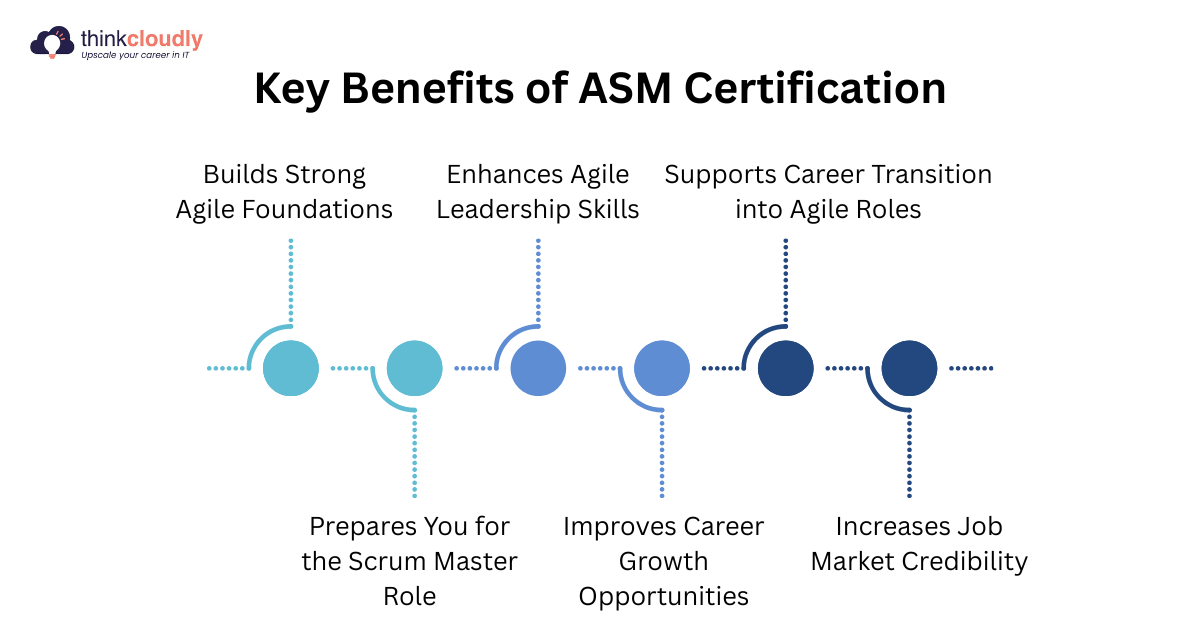
Builds Strong Agile Foundations
The primary benefit of holding an ASM certification is that it establishes a solid foundation in Agile and the fundamentals of scrum methodology. Many certification programs cover what the Agile Manifesto means for you, the different scrum roles that complete a scrum team, how to implement iterative processes, and they also provide you with various tools used within those processes.
Having this firm background will allow you to participate confidently as part of an agile team and engage in significant ways with your fellow agile teammates during team discussions, planning sessions, and retrospective meetings, which will be important for your long-term career growth.
Prepares You for the Scrum Master Role
Agile’s success hinges on the scrum master role. The scrum master serves as the team’s facilitator, coach, and servant leader. By learning practical techniques for managing impediments, building collaboration, and ensuring effective use of Scrum practices, ASM certification prepares you for this role.
Having ASM-certified professionals gives your team a significant advantage when working through real-world challenges such as conflicts between team members, delays in sprints, and issues regarding stakeholder communications.
Enhances Agile Leadership Skills
Leadership is quite critical in order to achieve success in an agile environment, but with an emphasis on servant-type leadership as opposed to authority-type leadership. The ASM certification program places great emphasis upon the development of agile leadership skills including facilitation, coaching, and mentoring.
All of these skills are beneficial for both scrum masters and managers or team leaders who wish to encourage collaboration and continuous improvement within their groups.
Improves Career Growth Opportunities
Individuals certified through an ASM certification routinely advance faster than their non-certified counterparts. Many organizations will seek out certified professionals for positions dealing with transformation initiatives, products, and team coaching.
As the rate of agile adoption increases, certified professionals will have a wider range of employment options available, including promotions and long-term career growth across all industries.
Increases Job Market Credibility
Certification is one of the criteria that recruiters may use to filter their candidates, meaning that if you include an ASM certification on your resume, it will increase both your credibility and visibility during the hiring process.
This also shows potential employers that you have knowledge about Agile concepts in addition to having the ability to implement them in your job; therefore, your certification would be an asset for employers looking at every candidate for the scrum master role.
Supports Career Transition into Agile Roles
The ASM certification is a structured path to Agile careers for professionals making the transition from project management or any position not utilizing Agile principles.
It also provides a way for you to assess your skill set and fill any gaps, which will help you gain the confidence you need to transition into a Scrum-type role. This represents a new stage of your career growth.
ASM Certification vs Traditional Project Management Certifications
 ASM Certification focuses on Agile, collaboration, and iterative delivery, making it ideal for fast-changing environments.
Traditional certifications like Project Management Professional (PMP) and PRINCE2 emphasize structured planning and fixed processes.
With rising Agile adoption, ASM aligns better with modern project needs.
|
Aspect |
ASM Certification |
Traditional Project Management Certifications |
|
Approach |
Adaptive and iterative, based on Agile and Scrum principles |
Predictive and sequential, based on fixed planning |
|
Focus |
Team collaboration, flexibility, and continuous improvement |
Detailed upfront planning and strict execution |
|
Leadership Style |
Servant leadership and coaching-oriented |
Command-and-control management style |
|
Change Management |
Embraces and adapts to change throughout the project |
Changes are minimized and tightly controlled |
|
Role Orientation |
Facilitator and enabler for Agile teams |
Project controller and decision-maker |
|
Team Structure |
Self-organizing, cross-functional teams |
Hierarchical and role-based teams |
|
Documentation |
Lightweight and just-enough documentation |
Extensive documentation and formal reporting |
|
Industry Relevance |
Highly relevant in IT, software, and digital transformation |
Common in construction, manufacturing, and compliance-driven industries |
|
Career Growth |
Strong long-term growth due to rising Agile adoption |
Stable growth in traditional project environments |
|
Job Market Demand |
High demand as organizations adopt Agile frameworks |
Moderate demand, limited to specific industries |
|
Learning Focus |
Practical application of Scrum and Agile values |
Process-driven and methodology-focused |
Who Should Pursue ASM Certification?
ASM certification is the perfect fit for many types of professionals, for example:
- Newer Scrum Masters
- Project Managers who are transitioning to an Agile methodology
- Team leads and managers
- Developers & Testers who are currently working in Agile teams
- Individuals in a leadership-oriented role, like a product owner
In all of these situations, ASM certification builds your ability in agile leadership, ultimately strengthening your ability to continue your career growth.
How ASM Certification Impacts Long-Term Career Success
The value of an ASM certification is in the relevance of being able to use agile practices. Although agile practice continues to evolve, the fundamental principles have not changed. Certified individuals create a baseline that can be built upon through additional learning and adaptation as they grow and gain experience.
As companies adopt and expand their use of agile frameworks, those certified in ASM will be well-suited to progress into senior positions, such as agile coach, product owner, or transformation lead, which expands on the influence of a scrum master role.
Conclusion
As an asset for building a successful future-ready career, certification in ASM is a sound investment for anyone interested in creating their future. ASM certification builds on your understanding of Agile and develops agile leadership with the knowledge and preparation needed to be a scrum master, ultimately accelerating your career growth.
Unlike hands-on Agile experience, certification does not stand in its own right to replace actual experience; however, when combined with real-world Agile practice, certification provides a significant boost to your professional profile. In this rapidly changing global economy, where change and collaboration truly define success, certification in ASM provides you with the necessary skills, credibility, and confidence to succeed in today’s workplace.

