
What if your organization could identify the upcoming risks before they turn into real threats and make sure that rules are being followed automatically with immediate response? That’s exactly the work done by GRC automation for transforming today’s business world into a more productive and modern digital environment.
As organizations are turning more complex with the development of their rules and regulations, the traditional process of Governance, Risk and Compliance (GRC) is not enough for them. The manual workflows and spreadsheets shared everywhere can result in a lack of productivity and increase the chances of errors. This is where automation comes into play.
Organizations can run their operations smoothly, improve accuracy, and get immediate visibility of risks and compliance by merging GRC automation tools into a modern GRC framework.
What is GRC Automation?
The use of modern technology to run the processes of governance, risk and compliance automatically is referred to as “automation in GRC.” In place of getting dependent on the manual work of tracking and reporting, organizations are using systems that can monitor and report continuously.
The things that automation enables in a modern GRC framework are:
- Continuous monitoring of risks
- Tracking of compliance automatically
- Immediate reporting
- Improvement in collaboration among the teams
By the coordination of risk and compliance frameworks, the automation makes sure that organizations are maintaining consistency and efficiency. There are some challenges in GRC automation, which we will talk about, but apart from these challenges, this is helpful in many ways.
Why Is Automation Important in Modern GRC Programs?
With the growing organization, managing risks and compliance manually becomes unsuitable and defective. Automation is used to deal with these challenges by introducing efficiency and consistency.
Key reasons for adopting automation in GRC are the following:
- Increasing demand for authority
- Complex business operations
- Need for immediate risk monitoring
- The demand for accurate reporting
By applying automation in GRC, organizations can deal with challenges in GRC automation and turn their approach from traditional to modern according to the real-time digital environment.
Key Roles of GRC Automation in Modern GRC Programs
In today’s modern digital environment, there is a need to introduce more automated processes for managing governance, risk and compliance effectively. Automation in GRC plays an important role in making complex workflows simpler and ensuring immediate visibility. By utilizing the advanced GRC automation tools, businesses can enhance efficiency and organize their operations with a modern GRC framework.
Some key roles of automation in GRC in modern GRC programs are: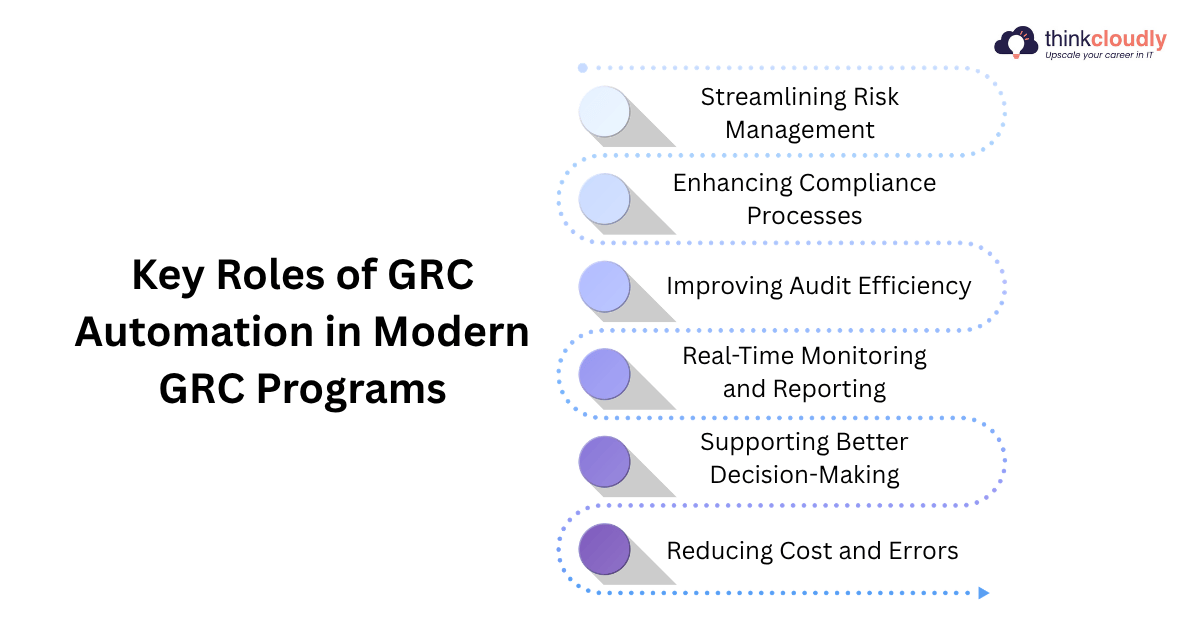
1. Streamlining Risk Management
One of the most important roles of automation in organizations is improving the process of managing risks. The automated systems help in continuously monitoring risks and provide useful information.
The benefits of risk management are:
- Identifies the risk automatically
- Analyse the identified risks
- Tracks the strategies for decreasing risks
- Provides the real-time risk dashboards
This works with risk and compliance management frameworks and ensures the structured management of risks.
2. Enhancing Compliance Processes
One of the crucial components of GRC is compliance, and automation helps in simplifying the management of compliance by running repetitive tasks automatically and ensuring that the regulations are being followed.
The benefits of compliance management are:
- Implementation of policy is done automatically
- Immediate alerts for violations of compliance
- Centralized documentation of compliance
- Requirements of compliance are fulfilled
Organizations are using GRC automation tools for reducing the manual efforts.
3. Improving Audit Efficiency
Audits require large documentation and proper coordination, and GRC automation tools help to make audits easier by collecting evidence and reporting automatically.
The main advantages of audit efficiency are:
- Faster preparation of audits
- Reduce manual efforts
- Improve the accuracy of audits
- Strengthen the overall effectiveness
It works according to the modern GRC framework.
4. Real-Time Monitoring and Reporting
Organizations are not dependent upon the scheduled reviews. One of the advantages of automation is the immediate visibility.
The core features are:
- Continuous monitoring of risks
- Dashboards and reports running automatically
- Issues are detected early
- Immediate response towards risks
This is the main capability for modern GRC frameworks.
5. Supporting Better Decision-Making
It is beneficial to make decisions based on data analysis for modern businesses, and GRC automation helps in providing accurate data for the decision-makers.
The impact of better decision-making is:
- Risk visibility is improving
- Faster decision-making
- Better strategic planning
- Utilizing information
GRC automation tools are used by the organizations for making decisions.
6. Reducing Cost and Errors
Doing everything manually can be very time-consuming and can cause human errors. GRC automation tools help to reduce these possibilities and save time.
The benefits of automation in GRC are:
- Operational costs are reduced
- Accuracy is increased
- Reduce manual work
- Turns out to be time-saving
This makes the modern GRC framework more reliable.
Popular GRC Automation Tools
The main part of implementing automation is the selection of the right tools. Modern organizations usually depend on advanced GRC automation tools for managing governance, risk and compliance.
Some commonly used GRC automation tools are the following: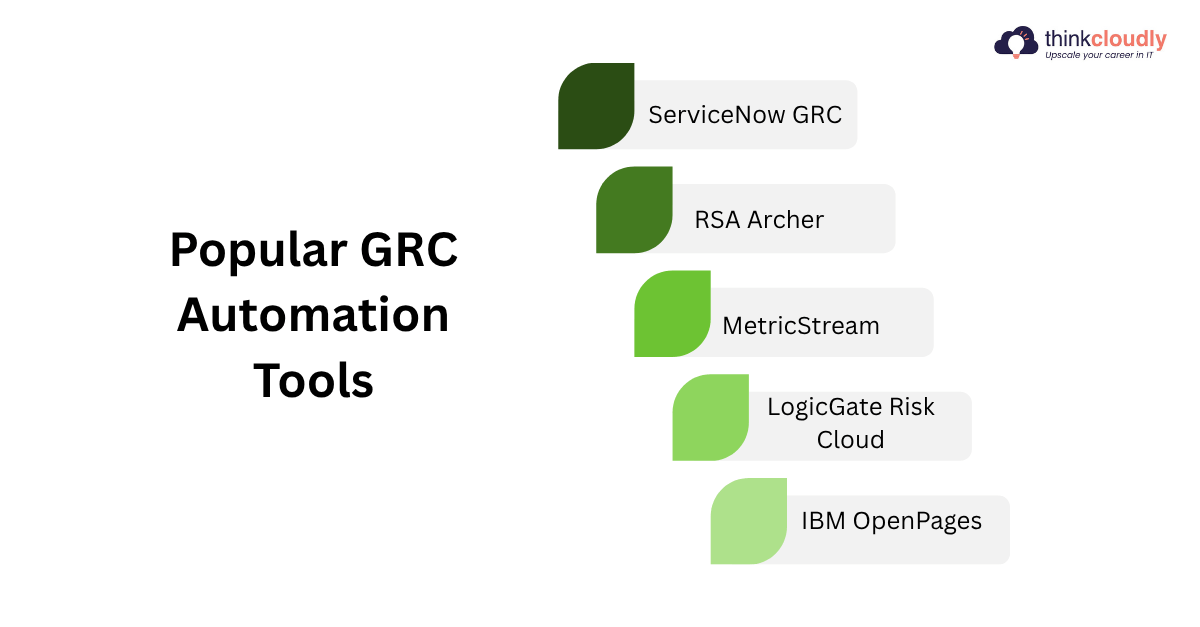
- ServiceNow GRC: This offers the merging of risk, compliance and audit management into one platform.
- RSA Archer: This is mostly used for enterprise risk management (ERM) and regulatory compliance.
- MetricStream: This gives end-to-end GRC solutions with strong capabilities of analytics.
- LogicGate Risk Cloud: This is the flexible and customizable platform for developing modern GRC frameworks.
- IBM OpenPages: This is the AI-powered tool used for managing the processes of risk and compliance.
Selection of the correct GRC automation tools is important for the development of a strong and scalable modern GRC framework.
Key Components of Automation in GRC
There are many components of automation that help in working and managing risk and compliance by dealing with challenges in GRC automation. The main components and their role in automation are:
| Component | Role in GRC Automation |
| Risk Management | Helps in identifying and managing risks |
| Compliance Management | Make sure that regulations are being followed |
| Audit Management | Makes the audit simpler |
| Reporting | Develops dashboards |
| Monitoring | Tracks the risks continuously |
These components together act as a backbone of the risk and compliance management frameworks.
Challenges in GRC Automation
We know that GRC automation tools are very beneficial for the purpose of making work easier and reducing manual efforts. But with that, automation comes with many challenges as well.
Some common challenges in GRC automation are:
- Merging with outdated systems
- Initial investment is high
- Does not support organizational change
- Lack of skilled professionals
The knowledge of these challenges is helpful in dealing with GRC automation tools and risk and compliance management frameworks.
Conclusion
GRC automation is an important topic for today’s complex digital environment, as organizations want to stay competitive and ready to do things in less time. By using GRC automation tools in the modern GRC framework, businesses can run their operations smoothly, reduce risks and improve decision-making.
As you know, there are challenges in GRC automation, but the long-term benefits make the investment worthwhile. Organizations are ready to work with the risk and compliance management frameworks, and it will help them to be prepared for the future demands of risks and regulations.
Automation helps in transforming GRC programs from working manually to taking the initiative to do work by itself. The systems will get intelligent and drive business success.

