
Mastering AWS Lambda interview questions is important for the preparation of cloud or DevOps roles. AWS Lambda (an AWS Serverless/Serverless computing service) is becoming one of the most essential services for developing scalable and cost-efficient applications with the rise of AWS Serverless architecture.
This blog covers the top AWS Lambda interview questions and answers, which will help you in understanding concepts like Serverless computing, Lambda functions and the real-world use cases.
AWS Lambda Interview Questions and Answers
AWS Lambda is one of the most important services in Serverless computing that helps developers run code without managing the servers. This concept is highly used inside the modern applications for automation, event-driven processing and micro-services.
Here are the most asked AWS Lambda interview questions, which will help you in cracking your interview.
1. What is AWS Lambda?
Answer: An Amazon Web Services Serverless service that gives you permission to run the Lambda functions without managing servers is AWS Lambda. The form of Serverless computing where the AWS Lambda function automatically runs after being triggered by events like API requests. An Amazon Web Services Serverless service helps in handling scaling and execution in the background.
2. What are Lambda functions?
Answer: The small and single piece of code that runs in AWS Lambda is called a lambda function. These lambda functions are part of AWS Serverless, which means the code will run automatically without managing servers. A lambda function works only after triggering and stops after the task is completed. You only have to pay for the time of execution in the Lambda cloud.
3. What is Serverless Computing?
Answer: The cloud model where the applications run without managing the servers is called Serverless computing. Services like an Amazon Web Services Serverless service can run lambda functions automatically in Amazon Web Services Serverless. Serverless computing allows you to pay only for the actual running time of your code and AWS Lambda function on the basis of demand in the Lambda cloud, which makes the development faster.
4. What triggers AWS Lambda?
Answer: AWS Lambda is an AWS Serverless service that runs Lambda functions when a specific event occurs.
Some common AWS Lambda triggers are:
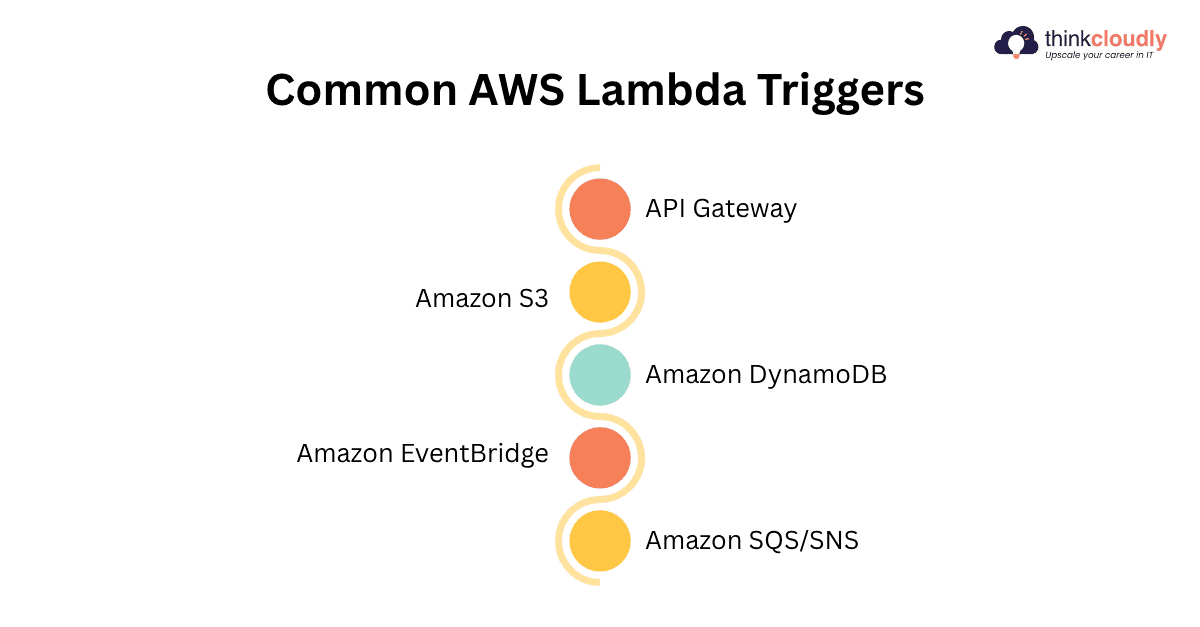
- API Gateway (HTTP Request): It triggers AWS Lambda when the endpoint of the API is called in AWS Serverless.
- Amazon S3 (File Upload): It helps the Lambda functions to run after a file is stored in the storage.
- Amazon DynamoDB (DB changes): AWS Lambda function is triggered by this after the data is uploaded or updated.
- Amazon EventBridge (schedule): It helps in the execution of a lambda function at fixed times inside Serverless computing.
- Amazon SQS/SNS (messages): It helps in calling Lambda functions after a message or notification arrives.
5. What is the difference between AWS Lambda and EC2?
Answer: Here is the basic difference table between AWS Lambda and EC2.
|
Feature |
AWS Lambda | Amazon EC2 |
|
Type |
It is an AWS Serverless type | It is a virtual server (IaaS) |
|
Server Management |
It does not contain any servers to manage | It has full control on the servers |
| Execution | The lambda functions are running on the basis of demand |
It runs automatically |
| Scaling | It helps in automatic scaling in the Lambda cloud |
It has a manual or auto-scaling setup |
|
Cost |
It has pay per execution of the AWS Lambda function |
It has pay according to the time of functioning |
| Setup | It has a quick setup |
It requires configuration |
6. What is a cold start in Lambda?
Answer: The starting delay that occurs after the execution of the lambda function code without being initialized before is known as a cold start in a Serverless computing service. AWS requires setting an environment in the Lambda cloud when an AWS Lambda function runs for the first time, and this takes some extra time. After this, the executions of the same lambda functions are faster.
7. What is the warm start?
Answer: When the previously used environment is used for the execution of a lambda function to avoid any delay or waste of time, it is known as a warm start in an AWS Serverless service. If the lambda functions in AWS Lambda are executed again within a short period, then the environment in the Lambda is already activated.
8. What is the execution time limit for AWS Lambda?
Answer: The maximum time limit in AWS Lambda for a single AWS Lambda function is 15 minutes or 900 seconds. You can arrange the break for your lambda function from 1 sec to 15 minutes inside the Lambda Cloud.
9. What is AWS Lambda pricing?
Answer: The AWS Lambda pricing is completely based upon a pay-as-you-go model, which means you only have to pay when your Lambda functions run.
The AWS Lambda pricing works on:
- Number of Requests: It is charged on the basis of the number of executions of an AWS Lambda function. The charge is around $0.20 per 1 million requests.
- Execution Time: It is based on the time, which means how long the code executes and the amount of memory used. It is measured in GB seconds.
10. What is the role of IAM in Lambda?
Answer: Identity and Access Management (IAM) in an AWS Serverless service works for controlling the permissions and security of your Lambda functions.
The main roles of IAM in AWS Lambda are:
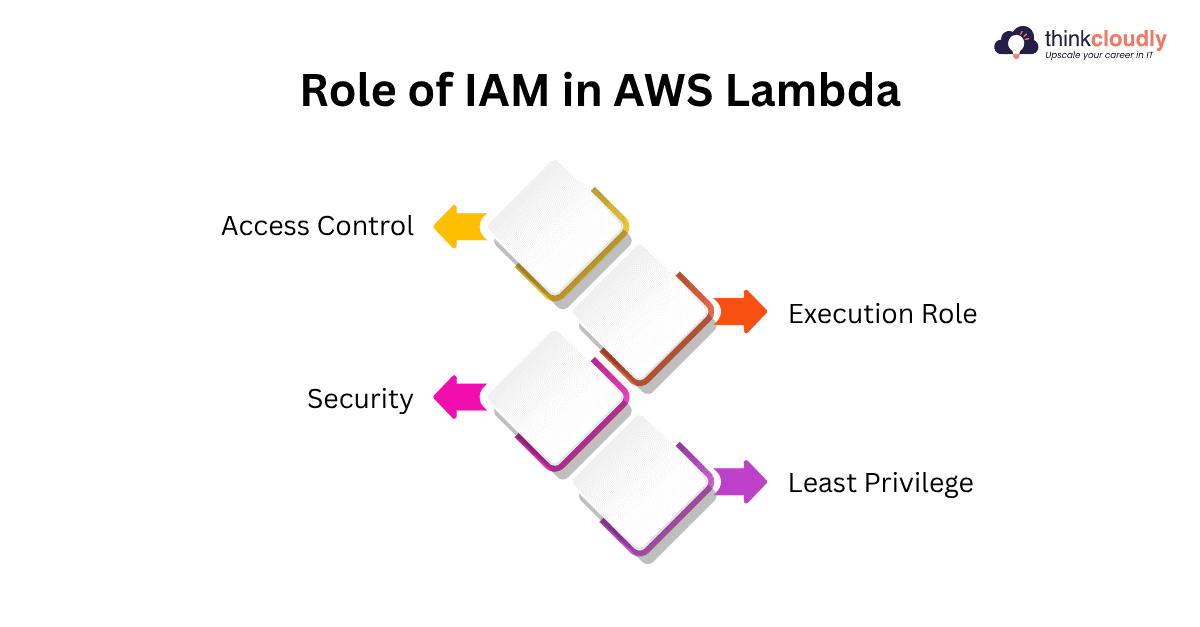
- Access Control: It defines what can be accessed by the AWS Lambda function.
- Execution Role: Each lambda function executes with an IAM role that gives the permissions that are required.
- Security: It makes sure that only the authorized users can call AWS Lambda, an Amazon Web Services Serverless service.
- Least Privilege: It allows giving the minimum permissions that are needed in the Lambda cloud.
11. What is concurrency in AWS Lambda?
Answer: The number of lambda functions that can run simultaneously at a particular time is known as concurrency in an Amazon Web Services Serverless service. A Serverless computing service can create multiple instances of your AWS Lambda function in the Lambda cloud if multiple requests occur. This can help with handling them in parallel.
12. What is provisioned concurrency?
Answer: Keeping a number of lambda functions that are pre-initialized and are ready to run at any time is called provisioned concurrency in a Serverless computing service. This makes sure that the AWS Lambda function will start without any cold start delays in lambda cloud.
13. What is a Lambda handler?
Answer: The entry point function in your code that is called by AWS Lambda to execute the Lambda functions in an AWS Serverless environment. It receives the input, processes it and returns a response from the lambda function in the lambda cloud.
14. What is the Lambda layer?
Answer: Lambda layer is a way to separate code, libraries or dependencies in multiple Lambda functions in an Amazon Web Services Serverless/Serverless computing service and reuse them. This helps you to create a shared code in a layer and attach it to multiple functions in the Lambda Cloud instead of keeping everything in each AWS Lambda function. The decreased duplication makes the lambda function easy to manage.
15. What are environment variables in Lambda?
Answer: The key-value pairs that are used to store configuration data for your lambda functions are environment variables in an AWS Serverless service. Allow your AWS Lambda function to access the values like URLs of the database, API keys or settings without putting them in the code. This makes you lambda cloud more secure and flexible.
16. What is the memory allocation concept in Lambda?
Answer: Giving a particular amount of memory to your AWS Lambda function is called memory allocation in AWS Lambda. You can structure memory from 128 MB to 10 GB in AWS Lambda, and higher memory gives better performance for your Lambda functions in the Lambda cloud.
17. What is AWS Lambda timeout?
Answer: The maximum amount of time that is required by an AWS Lambda function to run before it is stopped automatically is called AWS Lambda timeout. You can set the timeout from 1 second to 15 minutes for your Lambda functions in the Lambda Cloud.
18. What is AWS Lambda logging?
Answer: The process of recording logs and execution details of your AWS Lambda function is called AWS Lambda logging. Logs are automatically sent from Lambda functions to Amazon CloudWatch, where you can view anything from the Lambda cloud.
19. What is the difference between Synchronous and Asynchronous Invocation?
Answer: Invocation types in an Amazon Web Services Serverless service mean how requests are processed and how the responses are returned. Here is the tabular difference between synchronous and asynchronous invocation.
|
Feature |
Synchronous Invocation | Asynchronous Invocation |
|
Definition |
The caller waits for the response after sending a request |
The caller sends the request but does not wait for the response |
|
Response Handling |
Response is returned immediately from the AWS Lambda function |
There is no immediate response in this |
|
Trigger Services |
API Gateway and ALB |
S3, SNS and EventBridge |
|
Use Cases |
Real-time applications (Login, Payment, APIs) |
The background jobs (File processing or notifications) |
|
Latency Impact |
The user faces a delay until the response returns |
There is no delay for the user |
| Example Flow | User → API → Lambda → Response |
Event → Queue → Lambda → Process |
20. What are AWS Lambda limits?
Answer: The configuration restrictions applied to your AWS Lambda functions in AWS Lambda are called AWS Lambda limits.
Some important AWS Lambda limits are:
- Execution Time: It takes a maximum of 15 minutes per AWS Lambda function.
- Memory Allocation: The memory allocation is from 128 MB to 10 GB.
- Concurrency Limit: The default setting has ~1000 concurrent executions per account.
- Deployment Package Size:
- Zip: 50 MB (direct upload)
- Unzipped: 250 MB
- Payload Size:
- Sync: 6 MB
- Async: 256 KB
- Environment Variables: The total size is up to 4 KB
- Timeout: The maximum timeout is 900 seconds (15 minutes) in lambda cloud
21. What is AWS Lambda integration with API Gateway?
Answer: The AWS Lambda integration with API Gateway gives permission to HTTP requests for triggering Lambda functions in an Amazon Web Services Serverless service. The request is received by the API gateway and forwarded to an AWS Lambda function. The functions process it later in the lambda cloud and then return a response.
22. What is AWS Lambda VPC?
Answer: The connection of AWS Lambda to a virtual private cloud (VPC), which gives access to private resources to your Lambda functions. It allows an AWS Lambda function to interact with services in the Lambda cloud securely.
23. What is AWS Lambda monitoring?
Answer: AWS Lambda monitoring is the process of tracking the performance and usage of the AWS Lambda function. It uses Amazon CloudWatch to collect metrics like errors, durations and concurrency of lambda functions in AWS Lambda.
24. What are the advantages of AWS Lambda?
Answer: The advantages of AWS Lambda are:
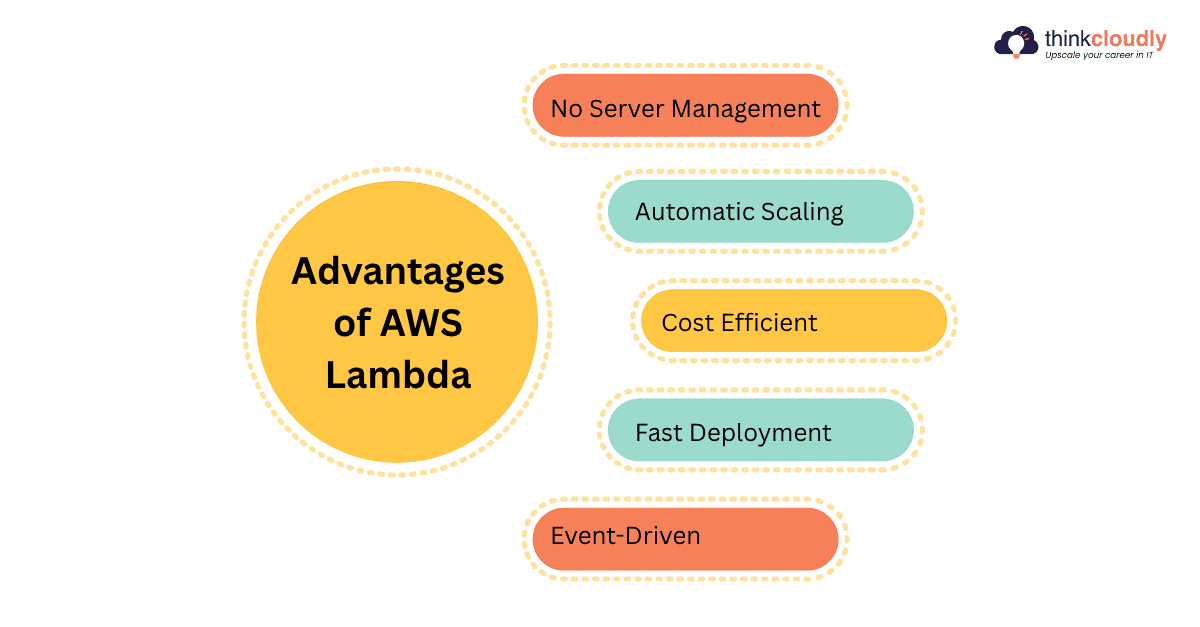
- No Server Management: It can run lambda functions without any arrangement or maintaining servers.
- Automatic Scaling: The scaling is done automatically in AWS lambda which is based on incoming requests in the Lambda cloud.
- Cost-efficient: The payment is done only for the execution time of each AWS Lambda function.
- Fast Deployment: It can quickly deploy and update the Lambda functions.
- Event-Driven: It can easily merge with AWS services like S3, API Gateway, etc.
25. What are the limitations of AWS Lambda?
Answer: The limitations of AWS Lambda are:
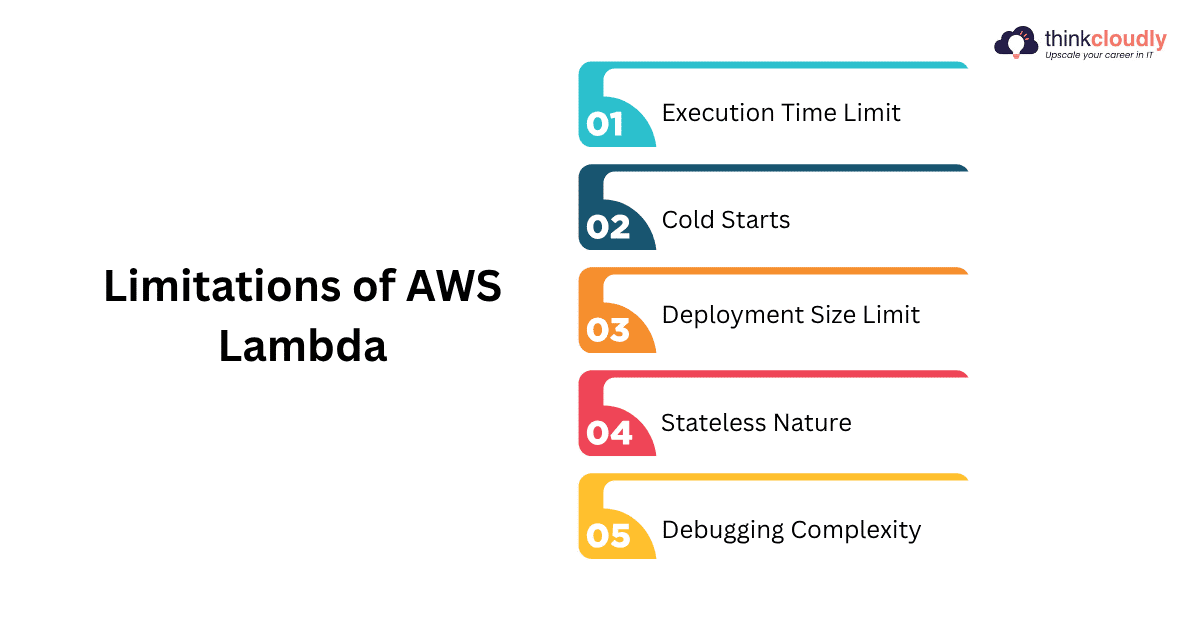
- Execution Time Limit: The running time of the AWS Lambda function is only up to 15 minutes.
- Cold Starts: There is a delay at the start of a Lambda function when it is executed after inactivity.
- Deployment Size Limit: AWS Lambda has a limited size for the package.
- Stateless Nature: There is no constant state between the executions.
- Debugging Complexity: It is hard to debug compared to other traditional servers.
Conclusion
If you want to create a strong career in cloud computing, then you should prepare for AWS Lambda interview questions. AWS Lambda plays an important role in the AWS Serverless environment.
If you understand the concepts like lambda functions and behavior of executions, you can answer these AWS Lambda interview questions and work on real-world applications of the Lambda cloud.

