

Quick gut check: have you noticed how many machine learning job posts this year ask for an AWS Machine Learning Certification instead of just preferring one? That’s not a coincidence. It is one of the loudest hiring signals in the cloud right now, and it didn’t happen overnight.
Having guided hundreds of learners through this exact path at Thinkcloudly, I’ve watched the AWS Machine Learning Certification shift from a “nice resume add-on” to a baseline expectation for data engineers, IT professionals pivoting into AI, and students and career changers alike.
This guide breaks down what the exam covers, what changed with the new MLA-C02 version, what the certification costs in 2027, how the broader AWS AI certification family compares, and how to prepare without wasting your weekends. No fluff, no recycled exam dumps: just what you need to make a confident decision.
Why the AWS Machine Learning Certification Matters More in 2027 Than Ever
By 2027, AI isn’t a side project for most companies; it is embedded in the product roadmap. Generative AI features, AI agents, recommendation engines, fraud detection, and demand forecasting all run on cloud infrastructure, and AWS still holds the largest share of it. That scale is exactly why the AWS Machine Learning Certification carries weight with employers: it signals that you understand how ML actually gets built, trained, and shipped on the platform powering a huge slice of the internet.
The certification landscape has also matured. AWS now offers a clearer ladder of AI-focused credentials, from a foundational AWS AI certification for people who use AI tools without building them, up to associate and professional credentials for engineers who design and deploy ML and generative AI workloads themselves. You’re no longer forced into a one-size-fits-all exam; you can choose the credential that matches your role.
There’s also a hard economic reason employers care. AWS points to outside research projecting that demand for AI and ML specialists will keep climbing sharply through the rest of the decade, while the supply of qualified candidates hasn’t kept pace. AWS cites a World Economic Forum projection suggesting demand for AI and ML specialists could grow by more than 80% by 2030. That gap is why a verified, vendor-specific credential like the AWS ML certification can move your resume to the top of the pile faster than a self-taught portfolio alone (though portfolios still matter, and we’ll get to that).
For career changers especially, this certification offers something rare: a structured, AWS-validated way to signal competence without needing five years of prior ML experience first.
AWS ML Certification Path: Which Credential Fits You?
AWS’s AI and ML credentials aren’t a single exam. They’re a small ecosystem, and picking the wrong one wastes both time and money. Here’s how the current AWS AI certification lineup breaks down.
At the foundational level sits the AWS Certified AI Practitioner. It targets people who interact with AI tools in their daily work (sales engineers, product managers, and business analysts) rather than the engineers building ML pipelines.
One level up is the AWS Certified Machine Learning Engineer – Associate, which is what most people mean when they say “AWS Machine Learning Certification.” AWS recommends at least a year of hands-on experience with Amazon SageMaker AI, Amazon Bedrock, and other AWS ML services, plus a year in a related technical role. This isn’t designed as a true beginner’s exam.
At the top sits the AWS Certified Generative AI Developer – Professional (AIP-C01), for experienced developers building production generative AI applications on Amazon Bedrock.
There used to be another option, the AWS Certified Machine Learning – Specialty. AWS retired it on March 31, 2027, and the associate-level credential has absorbed its role. If you already hold it, it stays active until its original expiry date.
|
Certification |
Level | Best For |
Hands-On Building Required? |
|---|---|---|---|
|
AWS Certified AI Practitioner |
Foundational | Sales, product, business roles, students starting out |
No |
|
AWS Certified Machine Learning Engineer – Associate (MLA-C02) |
Associate | Data engineers, ML engineers, MLOps engineers, developers |
Yes |
|
AWS Certified Generative AI Developer – Professional (AIP-C01) |
Professional | Experienced developers building GenAI apps |
Yes |
|
AWS Certified Machine Learning – Specialty |
Specialty | Retired March 31, 2027; existing holders only |
— |
If you’re a student or exploring careers in data and AI, the foundational AWS AI certification is a sensible entry point. If you’re already comfortable with Python, data pipelines, or cloud basics, go straight to the AWS Machine Learning Engineer Associate. There’s little benefit in starting below your actual skill level.
For a structured AWS training path that maps each of these certifications to a job-ready curriculum rather than isolated exam cramming, many learners start with a guided multi-cloud program, building fundamentals you can apply well beyond a single exam.
MLA-C01 vs MLA-C02: What Changed in the AWS Machine Learning Engineer Exam
AWS updated the Machine Learning Engineer Associate exam in 2027. The last day to take the old version (MLA-C01) in English was September 28, 2027, and the beta of the new version (MLA-C02) has been running since September 29, 2026. The standard MLA-C02 exam launches in all languages on January 14, 2027.
The four exam domains stay the same, but the content inside them has expanded. AWS’s reason: today’s ML engineers don’t just deploy traditional models; they also build generative AI solutions, work with large language models, and orchestrate AI agents.
|
MLA-C01 (old) |
MLA-C02 (new) |
|
|---|---|---|
|
Status in English |
Closed after Sept 28, 2026 |
Beta now; standard from Jan 14, 2027 |
|
Questions / time |
65 questions, 130 minutes |
85 questions, 170 minutes (beta) |
|
Fee |
$150 |
$75 (beta); $150 expected at standard launch |
|
Generative AI and RAG |
Limited |
Core content |
|
Agentic AI |
Not covered |
Covered |
|
Foundation models / LLMs |
Limited |
Selecting, customizing, and operationalizing LLMs |
|
Amazon Bedrock |
Some coverage |
Expanded coverage |
|
Responsible AI |
Basic |
Updated across both traditional ML and GenAI |
Should you take the beta or wait? If you’re ready now, the beta costs half price and earns the same certification. The trade-off is that beta results take longer to arrive. If you need more preparation time, target the standard MLA-C02 launch in January 2027. Either way, make sure any course or practice exam you buy is updated for MLA-C02.
AWS Machine Learning Certification Prerequisites: What You Actually Need First
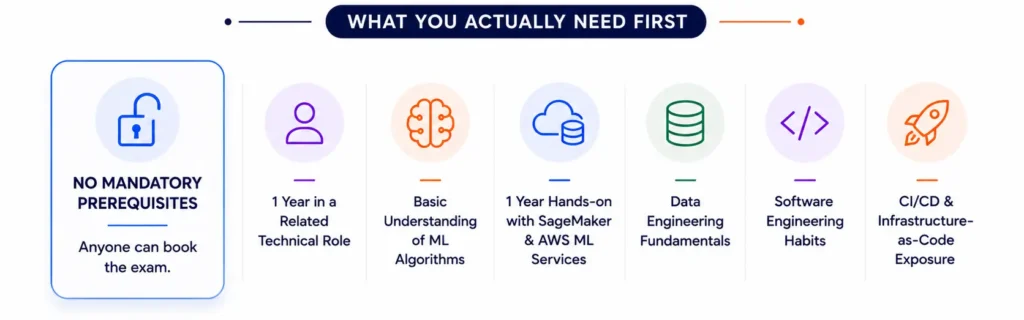
Here’s the good news up front: AWS doesn’t lock the door. There’s no mandatory prerequisite course, no required lower-level certification, and no formal eligibility check before you register for the AWS Certified Machine Learning Engineer – Associate exam. Anyone can book a seat.
That said, “no requirement” and “no expectation” are different things. AWS publishes a recommended background for the ideal candidate, and skipping it is how first-time candidates end up retaking the exam.
What AWS recommends before you sit the MLA-C02 exam
- About a year of hands-on experience with Amazon SageMaker AI and Amazon Bedrock, not just reading about them but having built something with them
- About a year in a related technical role: Backend developers, DevOps engineers, data engineers, and data scientists all count
- Experience with both traditional ML and generative AI, a new expectation in MLA-C02
- A basic understanding of common ML algorithms and when you’d reach for each one
- Data engineering fundamentals: common data formats, ingestion patterns, and how raw data becomes something a model can use
- Software engineering habits: modular code, version control, debugging
- Some CI/CD and infrastructure-as-code exposure, since the MLOps domain assumes you’ve seen a deployment pipeline before
Notice what’s missing: a computer science degree, a PhD in statistics, or years of pure research. This is a practitioner’s exam, not an academic one.
Starting from zero? Here’s your path.
If you’re starting from zero, you don’t need to wait. AWS Skill Builder offers free and paid courses, official practice question sets, and hands-on labs through AWS Builder Labs and AWS Cloud Quest, all built to take a candidate from no ML background to exam-ready. Pair that with the foundational AWS Certified AI Practitioner exam if you want a confidence-building stepping stone, though it isn’t required.
Who should wait before attempting this exam?
Pure researchers focused on algorithm theory rather than production systems, and engineers working only in Azure or GCP with no AWS exposure. Both groups have better-matched starting points before circling back to AWS.
The honest takeaway: prerequisites here are a recommendation, not a gate. But the further your real-world experience is from the recommended profile, the more weeks you should add to the study roadmap below.
What the AWS Machine Learning Engineer Exam Covers (and Why It Matters on the Job)
The exam blueprint is built on four domains: data preparation for ML, ML model development, deployment and orchestration of ML workflows, and ML solution monitoring, maintenance, and security. Across them, it tests Amazon SageMaker AI workflows, Amazon Bedrock’s generative AI capabilities, deep learning on AWS, and the MLOps discipline that ties it all together.
Amazon SageMaker AI: the backbone of the exam
If one service anchors the AWS Machine Learning Certification, it’s Amazon SageMaker AI. Some AWS-focused training guides go as far as calling the associate exam a dedicated SageMaker exam, given how much of the question bank centres on it.
SageMaker has grown from a single training tool into a full ML platform covering data preparation, model training, hyperparameter tuning, deployment endpoints, and monitoring. On the exam, expect scenario questions about choosing the right SageMaker feature for a business problem, not just naming the service. In production, most AWS-based ML teams build their entire pipeline inside it, from notebook to deployed endpoint, which is why employers trust this section of the exam so heavily.
Amazon Bedrock, generative AI and agentic AI on AWS
A few years ago, this certification barely touched generative AI. Not anymore, and MLA-C02 goes further than ever. Amazon Bedrock, AWS’s managed service for foundation models, is now central to both the AI Practitioner and Machine Learning Engineer Associate exams. You’re expected to understand how Bedrock differs from training a model from scratch in SageMaker, when retrieval-augmented generation (RAG) beats fine-tuning, how AI agents orchestrate multi-step workflows, and how to manage cost and latency when calling foundation models in production.
This matters beyond the exam. Generative AI features are now table stakes in product roadmaps, and engineers who can explain Bedrock’s trade-offs fluently are in a different hiring conversation from those who can only describe traditional supervised learning. If you’re pursuing the AWS ML certification to future-proof your resume, this domain is where that future-proofing lives.
Deep learning on AWS: beyond the basics
Deep learning questions trip up candidates from a traditional software background because the exam doesn’t just test whether you know what a neural network is. It tests which AWS service you’d reach for at each stage. Expect questions on distributed training across GPU instances, choosing between CPU- and GPU-backed SageMaker instance types, and managing training costs for large models.
If your experience leans toward web development or general IT rather than data science, budget extra study time here. Deep learning isn’t a separate certification; it’s woven through the associate exam, and it’s consistently one of the harder sections for first-time candidates.
MLOps: where certification meets real production skills
If SageMaker is the backbone of the exam, MLOps is its nervous system. Candidates are expected to show competence across back-end development, DevOps and data engineering as they relate to machine learning, not just modelling theory. MLA-C02 extends this to LLMOps: operationalizing foundation models the same way you would a traditional model.
In practice, MLOps covers CI/CD pipelines for model deployment, automated retraining triggers, model monitoring for drift, and rollback strategies when a new model underperforms. This is the domain employers care about most, because a model that works in a notebook but breaks in production is worthless.
If you take one thing from this section: MLOps competence is what separates a “passed the exam” candidate from a “ready for the job” hire.
AWS Machine Learning Certification Cost: What You’ll Actually Spend in 2027
Let’s talk numbers, since vague “it depends” answers don’t help anyone budgeting for a certification. AWS prices its certification exams by tier: $100 for foundational exams like AI Practitioner, $150 for associate-level exams including the Machine Learning Engineer Associate, and $300 for professional exams such as the Generative AI Developer Professional.
Right now there’s a discount window: the MLA-C02 beta exam costs $75, half the standard associate price, until the standard exam launches on January 14, 2027. In India, expect roughly ₹7,800 for the beta and ₹15,600 for the standard exam, including 18% GST.
The exam fee is only part of the real AWS Machine Learning Certification cost. Most candidates also spend money on training courses, practice exams and, if needed, a retake. Use the table below as a starting point.
| Cost Component | Typical Range (USD) | Notes |
|---|---|---|
| Exam fee: MLA-C02 beta | $75 | English only; until standard launch |
| Exam fee: MLA-C02 standard | $150 | From January 14, 2027 |
| Practice exams / question sets | $20–$50 | Make sure they’re updated for MLA-C02 |
| Structured training course | $100–$400 | Varies by depth and format |
| Retake (if needed) | $75–$150 | Full fee applies again |
| Total realistic budget | $200–$550 | Assuming a first-attempt pass |
One detail that catches people off guard: AWS gives everyone who passes a certification a 50% discount voucher toward their next exam, valid for one year. If you plan to stack the foundational AWS AI Practitioner before the associate-level AWS Machine Learning Certification, sit the cheaper exam first and use the voucher to offset the harder one.
A quick gut check before you book: don’t pay for a premium course you don’t need. If you already work daily with SageMaker and Python, a practice-exam-only approach might be all you need. If you’re starting from near zero, a structured course is worth it, but compare a few before committing, since quality varies widely and many older courses still teach only MLA-C01.
If you’d rather not piece together a study plan from scattered free resources, our Multi-Cloud Engineer (AWS, Azure & GCP) training course bundles AWS, Azure and Google Cloud skills, including AI and ML foundations, into one guided path. That is often more cost-effective than studying for one certification at a time. For the full breakdown across all AWS exams, see our AWS certification cost guide.
How to Prepare for the AWS Machine Learning Certification: A Realistic 8-Week Study Roadmap
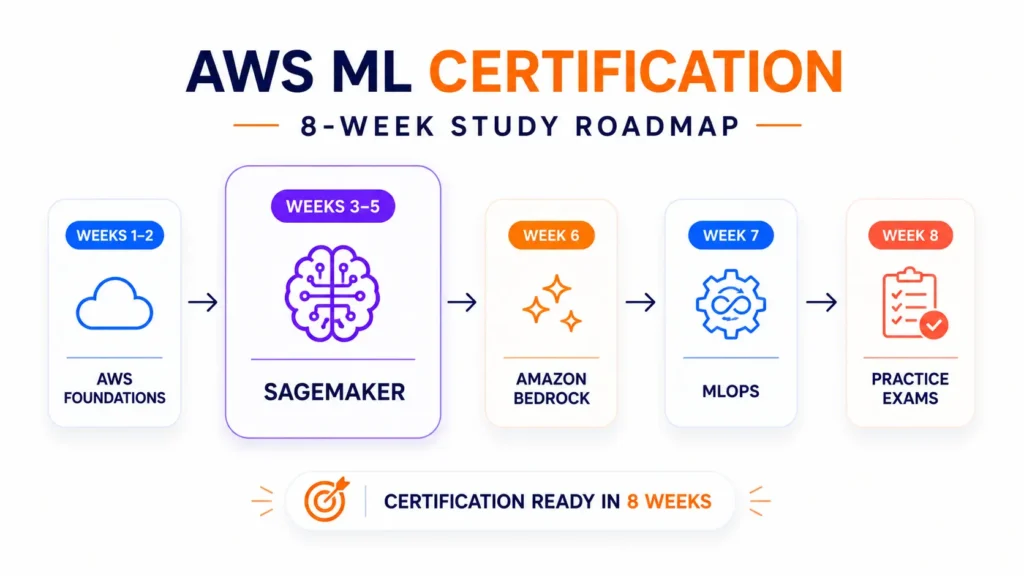
I’ve seen too many candidates try to cram for the AWS Machine Learning Certification in a single weekend and fail; it’s simply too scenario-heavy for that. Here’s the roadmap I recommend to working professionals who can’t disappear for two weeks straight.
Weeks 1–2: Foundations. Get comfortable with core AWS services outside ML: S3, IAM, Lambda and VPC basics. You can’t reason about a SageMaker pipeline if you don’t understand where your data lives and who can access it.
Weeks 3–5: SageMaker AI deep dive. This is the heaviest-weighted area, so give it the most time. Build at least one small end-to-end project: ingest data, train a model in SageMaker, deploy an endpoint, and tear it down. Reading about it isn’t the same as touching it.
Week 6: Amazon Bedrock, generative AI and agents. Make an Amazon Bedrock model call, compare prompt-based, RAG and fine-tuned approaches, build a simple agent workflow, and understand the cost model for foundation model inference. MLA-C02 tests this far more heavily than MLA-C01 did.
Week 7: MLOps and deep learning on AWS. Practice CI/CD concepts for model deployment and revisit distributed-training concepts. This is where most candidates feel rushed, so don’t skip it because it feels less exciting than building models.
Week 8: Practice exams and gap-filling. Take at least two full-length AWS practice exams under timed conditions (MLA-C02 gives you 170 minutes for 85 questions), then spend your remaining days only on your weakest domains.
For learners who want hands-on lab access and mentorship built into a guided, mentorship-backed program rather than assembling free resources solo, structured accountability tends to produce better results, especially if self-paced study hasn’t worked for you before.
The Multi-Cloud Advantage Nobody Talks About
Here’s something most AWS Machine Learning Certification guides won’t tell you: the certification’s value compounds when it’s not your only cloud credential.
In 2027, very few companies, especially mid-size and enterprise ones, run on a single cloud. Many teams use AWS for ML workloads alongside Azure for identity and Microsoft 365 integration, or Google Cloud for analytics. A candidate who holds an AWS ML certification and can also speak fluently about equivalent services on other platforms solves a hiring problem most single-cloud candidates can’t: reducing the company’s dependency on any one vendor’s specialists.
This is especially relevant for career changers and students, who don’t yet have years of platform-specific experience to fall back on. Building cross-cloud fluency early tends to open more doors faster, because you become the person who can work across whatever stack an employer has already committed to.
It’s also a practical hedge against certification churn. In 2027 alone, AWS retired the Machine Learning Specialty and replaced MLA-C01 with MLA-C02. Vendors change their exam lineups, but the underlying skills (data pipelines, model deployment and operational discipline) transfer regardless of which cloud badge is in fashion.
If that resonates, it’s worth exploring training that builds AWS, Azure and Google Cloud skills in parallel, which is exactly the gap our Multi-Cloud Engineer course was built to close.
Is the AWS Machine Learning Certification Worth It? Career Outlook and Salary in 2027
Let’s address the question everyone actually wants answered: is it worth it?
According to Glassdoor’s self-reported salary data from over 8,500 submissions as of June 2026, machine learning engineers in the United States average roughly $162,750 per year, with a typical range of about $130,800 to $205,000. Certification alone won’t guarantee the top of that range (experience, specialization and location matter enormously), but it consistently works as a tiebreaker in hiring and, for many candidates, a fast track past initial resume screening.
What’s shifted in 2026 is which skills push you toward the higher end. Generic model-training knowledge is increasingly table stakes. Production deployment experience, MLOps and LLMOps fluency, deep learning on AWS, and genuine comfort with Bedrock-based generative AI and agent workflows are what separate mid-range offers from senior ones. That is exactly why AWS rebuilt the exam as MLA-C02: it now tests the production skills employers screen for, not just theoretical ML knowledge.
For students and career changers without years of experience, pairing the certification with a visible project portfolio (a deployed SageMaker endpoint or a small Bedrock-powered app) does more for your credibility than the badge alone ever will.
Jobs you can land with the AWS Machine Learning Certification
The certification doesn’t lock you into one job title. In practice, it opens five overlapping career tracks, each drawing on the same exam domains with a different emphasis:
| Role | What They Actually Do | Typical Salary Range (2026, US) |
|---|---|---|
|
ML Engineer |
Builds, trains and tunes models; owns the SageMaker pipeline end to end | |
|
MLOps / LLMOps Engineer |
Keeps deployed models and LLMs running in production, monitors drift, automates retraining | |
|
AI Engineer |
Integrates Bedrock and other foundation models into real products and agents |
$140,000–$185,000 |
|
Data Engineer |
Builds the pipelines that feed clean, reliable data into ML systems | |
|
Cloud AI Specialist |
Advises on AI architecture, cost and governance across cloud platforms |
Tracks senior cloud engineer pay, generally $130,000+ |
A quick honest note on the last row: “Cloud AI Specialist” isn’t a standardized title tracked by major salary databases the way the others are. It’s an emerging, often blended role, and pay tends to track senior cloud engineer and architect bands.
If you’re a data engineer, the MLOps or ML Engineer track is usually the shortest hop. If you’re coming from a non-technical background, the AI engineer or cloud AI specialist path, leaning on Amazon Bedrock fluency rather than deep model-building, is often more realistic to break into first.
Common Mistakes That Sink First-Time Candidates
A few patterns show up again and again among candidates who fail the AWS Machine Learning Certification on their first attempt:
- Studying theory, skipping hands-on labs. In my experience reviewing first-attempt failures, this is the biggest culprit: candidates who’ve never deployed anything in SageMaker get punished hardest by scenario-based questions.
- Preparing with MLA-C01-only material. Many courses and practice tests haven’t caught up with MLA-C02’s generative AI and agentic AI content. Check the version before you buy.
- Ignoring deep learning on AWS until the last week. It’s not the biggest area, but it’s dense, and cramming it rarely works.
- Treating MLOps as an afterthought. It’s one of the most heavily tested practical areas, not a side topic.
- Skipping Amazon Bedrock because it feels “too new.” Generative AI questions are no longer optional extras; in MLA-C02 they’re core content.
- Booking the exam too early. Going in below 80% on practice exams and hoping the real thing will be easier is a common, and expensive, mistake.
Avoid these and you’ve cleared the biggest hurdles most candidates create for themselves. AWS refreshes exam content as Bedrock and SageMaker evolve, so skip outdated screenshot-based dumps and always cross-check against the current official exam guide.
Final Thoughts
The AWS Machine Learning Certification isn’t a magic ticket, but it is one of the most credible, efficient signals you can send employers in a crowded AI job market, especially when it’s backed by real SageMaker and Bedrock project work rather than exam memorization.
Whether you start with the foundational AWS AI Practitioner or aim straight for the MLA-C02 associate exam, the skills underneath (MLOps discipline, deep learning on AWS, generative AI fluency and genuine cloud experience) are what will carry your career forward.
If you want that fluency to extend beyond a single AWS badge, our Multi-Cloud Engineer (AWS, Azure & GCP) course is built to help you get there.