

A misconfigured permission line sat quietly inside a company’s AWS account for four months. Nobody noticed. Then one Tuesday morning, a stranger was reading customer records that were never meant to leave the building. No firewall was breached. No password was cracked. The door was simply left unlocked—and in the cloud, that unlocked door is almost always an identity problem.
That gap between “it works” and “it’s secure” is exactly where the AWS security engineer lives. As organizations push more of their business onto Amazon Web Services in 2026, the people who can lock those doors have quietly become some of the most sought-after professionals in tech. Whether you are an aspiring cloud professional, an IT pro looking to specialize, a student mapping your future, or a career changer hunting for a high-ceiling field, this guide was written for you.
By the end, you will understand exactly what an AWS security engineer does, the skills that separate a good cloud security specialist from a great one, what you can realistically earn, how the role compares to its counterparts on other clouds, and the clearest security engineer career path to get there. Let’s begin.
What Does an AWS Security Engineer Actually Do?
Forget the Hollywood image of a hoodie-clad hacker pounding a keyboard to “stop the hack.” The reality looks more like an architect, an inspector, and a detective rolled into one person.
An AWS security engineer designs and enforces the controls that keep data, applications, and infrastructure safe inside the AWS Cloud. That means deciding who can access what, encrypting sensitive information, watching for suspicious activity, and building automated responses so threats are contained in seconds instead of days. The same person is often called a cloud security specialist depending on the company, but the mission stays identical: reduce risk without slowing the business down.
A typical week might include reviewing access permissions, tightening IAM policy management across dozens of accounts, investigating a strange login flagged by Amazon GuardDuty, and sitting with developers to bake security into a new feature before it ships.
What makes the AWS security engineer role different from traditional cybersecurity is the shift in perimeter. In the old data centre world, you protected a building. In the cloud, identity is the perimeter. That single change is why employers now treat the aws security engineer as a strategic hire rather than a back-office cost.
A Day in the Life: What This Actually Looks Like
Most guides describe the job in the abstract, so here is a composite, anonymized scenario built from common patterns reported across mid-size companies — not a single real employer.
Picture a 60-person logistics startup running its entire stack on AWS. Their AWS security engineer starts the center with a GuardDuty alert: an EC2 instance is making unusual calls to an unfamiliar IP range. Within ten minutes, the engineer isolates the instance using a pre-built EventBridge-Lambda playbook, pulls the CloudTrail logs, and confirms it was a compromised dependency in a deployment pipeline — not an attacker who had stolen credentials.
By 11 a.m., the same cloud security specialist is in a design review with two developers who want a new microservice to read from a shared S3 bucket. Instead of granting broad access, they write a scoped IAM role with a permission boundary, satisfying the request without widening the blast radius. After lunch, they update a Security Hub finding, document the incident in a two-paragraph post-mortem, and spend the last hour of the day reviewing Bedrock guardrail logs for a new AI chatbot feature the product team shipped last week.
Nothing about that day involved a movie-style takedown. It involved judgment, documentation, and a dozen small decisions that quietly prevented a bigger problem later.
Why Demand for Cloud Security Talent Is Exploding in 2026
Three forces have collided to create a genuine shortage of qualified people.
First, cloud adoption is no longer optional. Nearly every meaningful company runs critical workloads on AWS, and each new workload widens the attack surface. Second, regulators have tightened the screws—frameworks like PCI-DSS 4.0, HIPAA, and FedRAMP now demand provable, auditable controls. Third, attackers have grown more sophisticated, increasingly targeting misconfigurations and over-permissive roles instead of brute-forcing their way in.
The result is a market where the qualified AWS security engineer is genuinely scarce. The U.S. Bureau of Labour Statistics projects information security roles to grow 29% between 2024 and 2034 — several times faster than the average occupation.
There is also a quieter trend worth naming: AI workloads. As companies deploy generative AI on AWS, securing model access, training data, and guardrails has become a brand-new responsibility. The cloud security specialist who understands both identity and AI security will be unusually valuable for the rest of this decade, and the aws security engineer who masters it early will set the pace for everyone else.
AWS Security Engineer vs. Azure and Google Cloud Security Roles
Readers comparing platforms often ask how this role stacks up against Microsoft’s Azure Security Engineer Associate (AZ-500) or Google’s Professional Cloud Security Engineer track. The honest answer: the underlying skills overlap heavily—identity, encryption, logging, and network controls matter on every cloud—but the tooling and hiring patterns differ.
Azure security roles lean toward enterprises already standardized on Microsoft 365 and Active Directory, so they reward familiarity with hybrid, on-premises-plus-cloud environments. Google’s security track leans toward data- and AI-heavy organizations, with deeper emphasis on BigQuery and Vertex AI access controls. The AWS security engineer path, by contrast, sits in the largest hiring pool of the three, since AWS still commands the broadest market share—which means more job postings, more mature tooling, and a faster route to a first offer for career changers. None of the three platforms is objectively “harder.” The smarter question is which cloud your target employers actually run, since that should decide where you specialize first.
The Core Cloud Security Engineer Skills That Get You Hired
Let’s get specific. Below are the cloud security engineer skills hiring managers actually screen for, grouped so you can self-assess honestly. The broader your coverage of these cloud security engineer skills, the more confidently you can call yourself a cloud security specialist rather than a generalist.
Identity and access. This is the heart of the job. Mastering IAM policy management — roles, policies, permission boundaries, service control policies, and temporary credentials via AWS STS — is non-negotiable. Most real breaches trace back to identity, so this is where you invest first.
Data protection. Be comfortable with AWS KMS key policies, encryption in transit and at rest, AWS Secrets Manager, and certificate management. Protecting the data is the second pillar after protecting the door.
Detection and response. Know how to wire up CloudTrail, AWS Config, Security Hub, GuardDuty, and Amazon Detective so a suspicious event triggers automated remediation through EventBridge and Lambda — this is what turns a junior into a senior.
Network and edge security. VPC design, security groups, network ACLs, AWS WAF, and AWS Shield round out the infrastructure layer.
Governance at scale. Managing security across many accounts with AWS Organizations, Control Tower, and Resource Control Policies is increasingly expected.
The strongest cloud security engineer skills aren’t memorized facts—they’re habits of thinking. Can you look at an architecture and instinctively ask, “What is the blast radius if this credential leaks?” That mindset, more than any single service, defines a great AWS security engineer.
Here’s something most guides skip: soft skills matter just as much. Explaining risk to a nervous executive, saying “no” to a developer kindly, and writing a clear post-incident report will accelerate your security engineer career path faster than another certification ever could.
A Unique Framework: The Threat-to-Skill Map
Most articles hand you a skills list and wish you luck. Here is an original way to connect what goes wrong with what you must learn.
|
Common Real-World Failure |
Root Cause |
The Skill That Prevents It |
|
A public S3 bucket leaks customer data |
Over-permissive access policy |
IAM policy management & least privilege |
|
Leaked access key mines crypto for weeks |
No anomaly detection |
GuardDuty + automated response |
|
Ransomware spreads across accounts |
Flat, unsegmented architecture |
Multi-account governance & SCPs |
|
Sensitive data readable in transit |
Missing encryption configuration |
KMS, TLS, and data protection |
|
Auditors can’t prove compliance |
No centralized logging |
CloudTrail, Config, Security Hub |
|
AI chatbot leaks a customer’s private prompt |
No guardrails on Bedrock access |
GenAI security & IAM scoping |
Notice how often the first column traces back to identity. That is exactly why IAM policy management sits at the top of every serious cloud security specialist’s priority list.
Securing AI on AWS: What GenAI Security Actually Involves
Most guides mention “AI security” once and move on. That’s not enough, because it’s the fastest-growing part of the job. Here’s what it actually means in practice.
Guardrails, not just access control. Amazon Bedrock Guardrails let you configure layered safeguards—content filters that block denied topics, automatic redaction of PII before it reaches a model, and detection of prompt-injection attempts where a user tries to manipulate the model into ignoring its instructions. A proactive cloud security specialist applies these centrally across accounts rather than reconfiguring them per application.
Model access control. Foundation models on Bedrock are governed the same way any other AWS resource is—through IAM. That means scoping exactly which roles can invoke a model, which can fine-tune one, and which can touch the underlying training data. A common mistake is granting broad bedrock:* permissions because a deadline is looming; a disciplined aws security engineer scopes that down to specific model IDs and actions from day one.
Data poisoning risk. If a model is fine-tuned on internal data, that training set becomes an attack surface. Anyone who can write to the training data — even indirectly through an ingestion pipeline — can quietly bias or corrupt the model’s outputs. Protecting against this looks like access control and integrity checks on the data pipeline itself, not just the model endpoint.
This is genuinely new territory, and it’s why the updated security specialty certification now tests it directly, alongside the identity and encryption fundamentals that have always defined the job.
The Certification That Validates Your Expertise
Skills get you in the room; proof gets you the offer. The security specialty certification from AWS—officially AWS Certified Security – Specialty—is the credential employers recognize instantly. It tells a hiring manager you can secure real workloads, not just talk about them, and it’s the clearest external signal that you can perform as an AWS security engineer from day one.
A crucial 2026 update: AWS retired the older SCS-C02 version of this security specialty certification on December 1, 2025, and the current exam is SCS-C03. If you’re studying outdated material, you risk preparing for an exam that no longer exists. The new version raises Identity and Access Management to 20% of scored content, restructures detection and incident response into two cleaner domains, and adds dedicated coverage of generative AI security.
Here are the essentials as they stand in 2026: the exam code is SCS-C03; it costs $300 USD plus local taxes; you’ll answer 65 questions (multiple choice, multiple response, plus the newer ordering and matching formats) in 170 minutes; and the passing score is 750 out of 1,000. AWS recommends five years of general IT security experience with at least two of those years securing AWS workloads specifically, and if you already hold any active AWS certification, you qualify for a 50% discount voucher on your next attempt.
The exam rewards people who’ve done the work. Cold-studying without hands-on identity experience is the single most common reason candidates fail, because an AWS security engineer is expected to apply controls, not recite them. That’s why a structured program pairing theory with labs—like this AWS security specialty certification course—tends to outperform passive video-watching for a serious cloud security specialist.
There are no formal prerequisites, so you can sit the exam directly. But the security specialty certification is best attempted after six to twelve months in a real AWS environment, where IAM, KMS, and logging stop being abstractions and start being muscle memory.
How Much Can You Earn? A Realistic 2026 Salary Picture
Let’s talk numbers, because the cloud security engineer salary is one of the biggest reasons people enter this field. The cloud security engineer salary in the United States is genuinely strong, though your exact cloud security engineer salary varies by source, location, and experience.
Verified 2026 data puts the average cloud security engineer salary at roughly $168,700 nationally, with a typical range between about $134,000 and $214,000 and top earners clearing $264,000. AWS-specific expertise tends to command a premium over generalist security roles, which is why pay for a certified cloud security specialist clusters at the higher end of that band.
|
Career Stage |
Experience | Typical Base (US, 2026) |
What You’re Paid For |
|
Entry / Junior |
0–2 years | $95,000 – $125,000 |
Executing controls, monitoring, basic IAM |
|
Mid-level |
3–5 years | $130,000 – $165,000 |
Designing controls, incident response, automation |
|
Senior |
6–9 years | $165,000 – $215,000 |
Architecture, governance, mentoring |
|
Architect / Lead |
10+ years | $215,000 – $265,000+ |
Strategy, multi-account design, risk ownership |
A few honest caveats: these are base figures, and stock or bonuses can push total cloud security engineer salary packages meaningfully higher at large employers. Geography matters too — a cloud security engineer salary in a major tech hub will outpace the same role in a lower-cost region, though remote work has narrowed that gap. And certifications genuinely move the needle: holding the AWS security credential correlates with a measurably higher cloud security engineer salary across multiple industry surveys.
The Security Engineer Career Path: From Curious to In-Demand
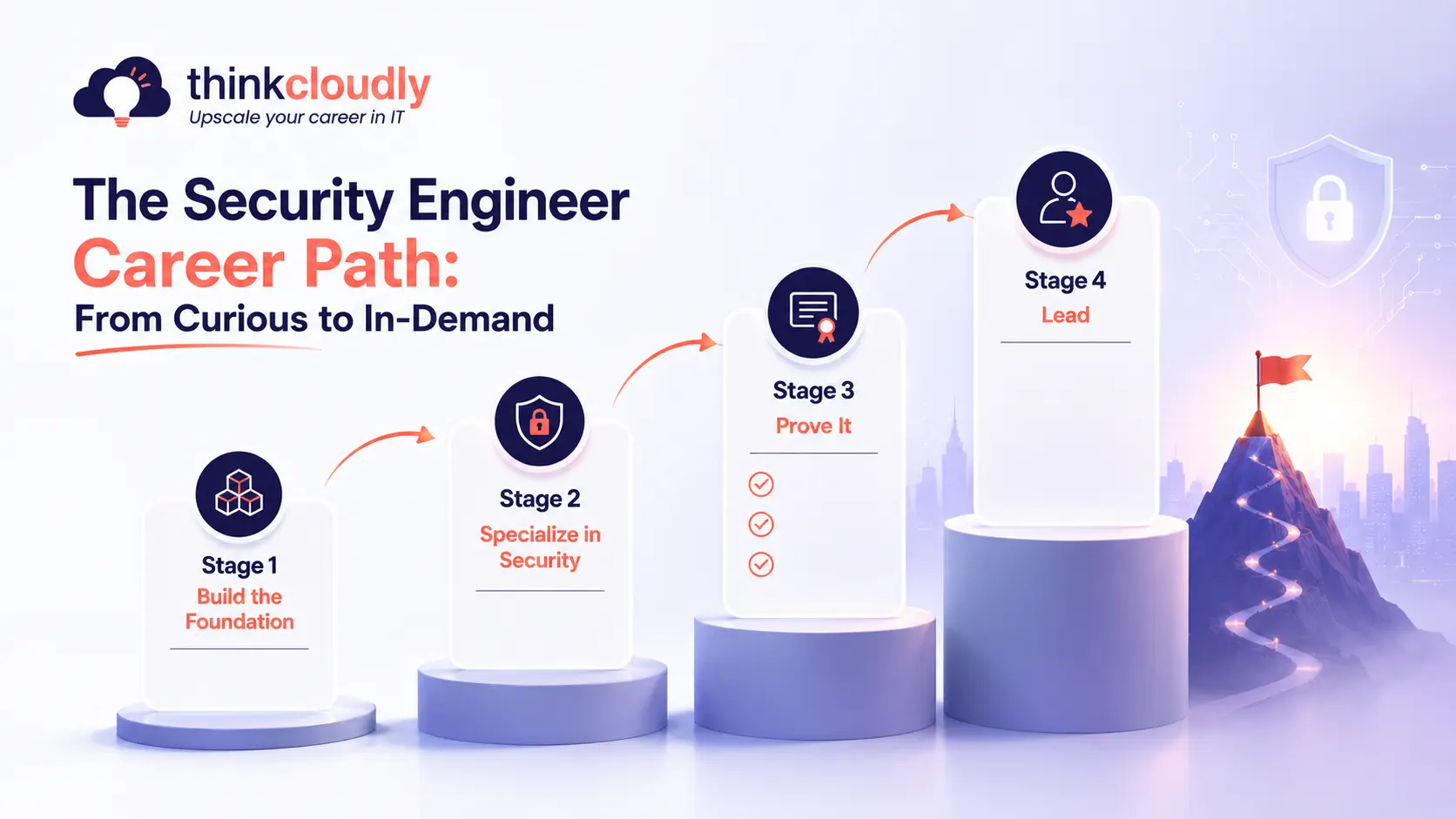
There’s no single road into this field, but there is a reliable sequence. Here is the security engineer career path mapped as a practical progression.
Stage 1 — Build the foundation. Learn core AWS services and basic networking. Many a successful AWS security engineer starts as a cloud administrator, developer, or support analyst. If you’re a career changer, this is your on-ramp.
Stage 2 — Specialize in security. Go deep on identity, encryption, and logging. This is where you transition from “works with AWS” to “secures AWS” and where the title “cloud security specialist” starts to fit.
Stage 3 — Prove it. Earn the security specialty certification and build a portfolio of hands-on projects: a multi-account setup with guardrails, an automated GuardDuty remediation pipeline, and a least-privilege IAM redesign.
Stage 4 — Lead. Move toward security architecture, where you shape strategy across the whole organization.
The beauty of this security engineer career path is that each stage pays well on its own, so you’re never stuck waiting years for a payoff. The AWS security engineer who commits to continuous learning rarely worries about job security—demand simply outpaces supply.
For students and career changers, the most encouraging truth is this: you don’t need a computer science degree to walk this security engineer career path. You need curiosity, hands-on practice, and the discipline to turn concepts into working controls.
A Unique 12-Week Sprint to Job-Ready
Here’s a second original tool—a focused study sprint balancing theory with the lab work hiring managers actually care about. Spend weeks 1–3 on a deep IAM dive (roles, policies, boundaries, and STS) until your IAM policy management is genuinely confident. Use weeks 4–6 for data protection with KMS, Secrets Manager, and encryption; then use weeks 7–8 to stand up a detection-and-response lab with CloudTrail, GuardDuty, and Security Hub. Spend weeks 9–10 on network and governance work across WAF, organizations, and SCPs; reserve week 11 for AI/ML security and the new exam question formats; use week 12 for full practice exams and weak-spot review.
Treat the early weeks as the most important. If your IAM policy management is rock-solid, everything downstream gets easier — both on the exam and on the job.
Common Mistakes That Slow People Down
A short, candid list. Many an aspiring AWS security engineer chases certifications before building hands-on skills, then freezes when handed a real console. Some neglect IAM policy management entirely, treating it as boring plumbing — only to discover it’s the single most tested and most exploited area in the cloud. Many underestimate the communication side, forgetting that a cloud security specialist who can’t explain risk clearly will always be overruled by louder voices.
Avoid these traps and you’ll move through the security engineer career path noticeably faster than your peers.
Final Thoughts
The unlocked-door story we opened with plays out somewhere in the world every single day. Behind every prevented version of that story is a skilled AWS security engineer who saw the risk first. This is a field where your work genuinely protects people, where demand outstrips supply, and where the cloud security engineer salary rewards expertise generously.
The path is clearer than it looks: build real cloud security engineer skills, master IAM policy management, earn the security specialty certification, and keep learning.
When you’re ready to take the next concrete step, enroll in a structured AWS security course that compresses months of trial and error into a focused, guided journey toward becoming a confident AWS security engineer. Your future as an AWS security engineer starts with the very next thing you choose to learn.