

Cloud computing is a core component of today’s digital infrastructure. The vast majority of organizations are leveraging cloud technology for both their applications and their data, therefore, when an organization considers a cloud provider, security is now arguably the most important criterion because of the increased reliance on the internet to access this information remotely. Consequently, the discussion around azure security vs AWS security is also continuing to grow.
Two of the three largest players in the cloud computing marketplace are Amazon Web Services (AWS) and Microsoft Azure. Both these providers offer excellent security features; however, they have very different security architectures, security solutions, and security management processes.
In this document we will highlight the major cloud security comparison between the two CSP’s provided security capabilities so you will be able to make an educated decision as to which cloud environment is best suited for meeting your organization’s security requirements. This guide will help you clearly understand azure security vs aws security so you can choose the right platform confidently.
Understanding Responsibilities of Azure Security vs AWS Security
The first step in comparing azure security vs AWS security is to understand the concept of a shared responsibility model. Both companies provide secure cloud infrastructure, but customers are responsible for securing what they put in that infrastructure.
This includes:
- Application configuration
- Access permissions
- Data protection policies
- Identity management controls
Although both companies use the same model to define responsibilities for their users, there are very different ways in which each of these companies helps its customers perform their assigned responsibilities. Understanding the responsibility model is the foundation of comparing azure security vs aws security effectively.
Methods to Compare Azure Security vs AWS Security
There are few ways in which we can make the comparison of Azure Security vs AWS Security. Some of them are mentioned below in detail.
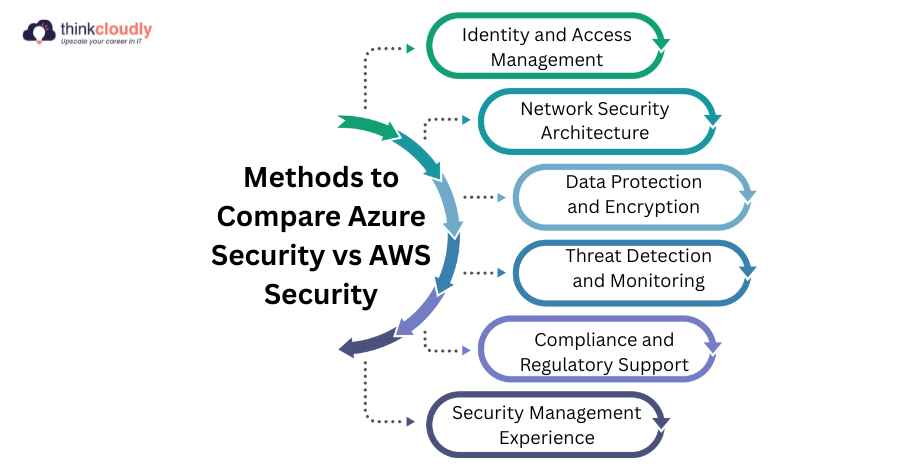
Identity and Access Management
Identity is integrated deeply into Cloud protection. The most significant difference between azure security vs AWS security can be found in how each platform handles Authentication Architecture.
Azure Approach
Azure’s approach to authentication is tightly integrated with an organization’s Enterprise Directory because of its Identity Management capability, enabling organizations to use Microsoft systems as a part of their existing corporate login environment. This is one of the most important areas in the azure security vs aws security comparison because identity controls overall access protection.
AWS Approach
On the other hand, when logging into AWS, the use of highly granular permission controls gives administrators the ability to create highly detailed policies. This provides significant flexibility but requires manual configuration of users and groups. Organizations often start evaluating azure security vs aws security from identity architecture differences.
Key Difference
The key difference here is that Azure focuses on providing a seamless integration of Identity Management into an Enterprise-friendly structure, while AWS focuses on the ability to customize every permission policy to the level of detail an administrator wants.
To summarize, in a cloud security comparison Azure tends to feel easier to use, whereas AWS provides very granular degrees of control to experienced systems.
Network Security Architecture
What role does network security play in the decisions made regarding Azure security vs AWS security? The following outlines the key aspects of network security for both cloud providers.
Azure Network Security
With Azure’s centralized policy structure and simpler configuration layers, administrators have the option of creating security rules at multiple levels, which can help simplify governance.
AWS Network Security
AWS focuses heavily on segmenting their networks into subnets and having fine-grained network control. They provide very flexible configuration options, but this requires a solid knowledge of how to design the architecture.
Key Difference
The major difference is that Azure focuses on ease of governance, while AWS focuses on flexibility of the architecture.
Network design philosophy plays a critical role when analyzing azure security vs aws security in enterprise environments.
Data Protection and Encryption
Data security is one of the most important parts of a cloud security comparison. So it plays an important role in Azure Security vs AWS Security.
Both services offer:
- Data encryption while stored
- Data encryption while moving
- Key management service
But, how they are implemented is different. Encryption strategy is frequently a deciding factor in azure security vs aws security selection.
Azure Encryption
A major part of how Azure encrypts data is their focus on automated security through both policies that are built into the system as well as integration into the enterprise, so a lot of the security features are automatically enabled.
AWS Encryption
AWS focuses more on allowing for individual users to control aspects of encryption, so you have many different options and ways to configure how to protect your data.
Key Difference
When comparing Azure security vs AWS security, the main difference is Azure is much easier and has more automated solutions than AWS, while AWS provides you with the ability to customize your solution.
Threat Detection and Monitoring
Threat detection instruments help organizations quickly identify and counter-attack. This has its own way to compare Azure security vs AWS security.
Azure Monitoring
Azure’s main priority is for its management service to provide its customers with comprehensive view. All security alerts and recommendations are made available via unified dashboards that are designed for quick comprehension.
AWS Monitoring
While AWS’s various monitoring tools are extremely powerful, they are provided via multiple different advertisements. This offers users great flexibility but greatly increases the administrative workload.
Key Difference
In general, Azure focuses upon a consolidated monitoring approach and AWS focuses upon a modular monitoring orientation.
The significant differences between both company’s clouds considerably affect operational efficiencies and many other practical aspects of real-life examples of cloud security comparisons. Monitoring capability differences strongly influence real-world azure security vs aws security adoption decisions.
Compliance and Regulatory Support
Compliance requirements often drive organizations toward researching azure security vs aws security in detail. Organizations that work in regulated industries rely on the capabilities of cloud compliance and consists a vital role in both azure security vs AWS security
Both platforms have built-in capabilities for supporting common international compliance standards such as:
- ISO
- SOC
- HIPAA
- GDPR
The two platforms differ in usability with regard to cloud compliance.
Azure Compliance
Microsoft Azure provides built-in compliance framework guidance as part of the platform, allowing users to apply and manage policies directly from within Microsoft Azure.
AWS Compliance
On the other hand, AWS has extensive downloadable compliance documentation and customizable configuration templates, but much of this will require manual implementation by the user.
Key Difference
In primary comparison of Azure security vs AWS security, Azure is often preferred over AWS for organizations with built-in monitoring tools, while AWS is normally preferred for custom compliance monitoring.
Ultimately, regulatory needs significantly shape azure security vs aws security preferences.
Security Management Experience
When comparing, overall user experience is part of that cloud security comparison of azure security vs AWS security.
Azure Experience
Azure is built to centralize the enterprise management solutions associated with the Microsoft ecosystem and to be easier to manage by IT teams who are familiar with Windows platform management.
AWS Experience
AWS focuses on providing greater flexibility in your architecture and DevOps-driven environment, which gives engineers more direct control.
Key Difference
Azure emphasizes guided management and AWS emphasizes engineering control.
Cost and Operational Overhead
Although security is often viewed as a technical challenge, it is equally as much an operational one. When comparing Azure security vs AWS security, the operational complexity involved in maintaining security infrastructure will influence overall cost of ownership.
While Azure provides capabilities to lower your administrative burden via automation and built-in governance tools, AWS offers you extensive flexibility through numerous options to customize your security experience. However, customization of AWS often requires higher levels of effort and expertise for configuration.
This means that, in order for organizations for cloud security comparison costs, they must take into account the required maintenance burden associated with each provider’s solutions. Operational complexity is a hidden factor when comparing azure security vs aws security long-term costs.
When to Choose Azure Security?
When dealing with security in the cloud, Azure security features are typically recommended when:
- Organizations utilize enterprise directory services
- Teams want a centralized view of their security posture
- Simplified compliance is critical for their business model
- There is a need for built-in identity management services
In these examples, when comparing Azure security vs AWS security solutions, the result frequently favors azure due to the ability to more easily integrate and govern.
When to Choose AWS Security?
AWS security is often preferred when:
- Organizations need deep customization
- Teams have strong cloud engineering expertise
- Architecture flexibility is critical
- Advanced segmentation is required
Here, azure security vs AWS security discussions often favor AWS due to configurability and granular control.
Azure Security vs AWS Security: Overview of Key Differences
The table below summarizes the key differences in azure security vs aws security for quick decision-making.
|
Security Area |
Azure Security |
AWS Security |
|
Identity Management |
Integrated with enterprise directory systems and centralized access control |
Highly granular policies with detailed permission customization |
|
Access Control Approach |
Role-based access designed for enterprise environments |
Policy-based access offering deep configuration flexibility |
|
Network Security |
Simplified network rules and centralized governance |
Advanced segmentation and fine-grained network configuration |
|
Encryption |
Automatic encryption enabled by default in many services |
Customizable encryption settings controlled manually |
|
Key Management |
Easier integration with platform services |
Greater control over encryption keys and lifecycle |
|
Threat Detection |
Unified dashboards and centralized alerts |
Distributed monitoring across multiple services |
|
Monitoring & Logging |
Built-in consolidated monitoring experience |
Modular monitoring tools requiring configuration |
|
Cloud Compliance |
Built-in compliance recommendations and guided setup |
Extensive compliance controls with manual implementation |
|
Security Management Style |
Automation-driven and enterprise-friendly |
Engineering-driven and highly customizable |
|
Operational Complexity |
Easier to manage and maintain |
More flexible but requires deeper expertise |
|
Best Suited For |
Enterprises seeking simplified governance |
Organizations needing maximum customization |
Conclusion
The decision between azure security vs aws security depends on organizational priorities and technical expertise. When it comes to choosing between Azure security vs AWS security there isn’t only one answer as the difference in capabilities cannot be easily categorized as being “better.” Instead, the answer depends upon which platform meets your organization’s requirements for infrastructure.
As Azure emphasizes integration, automation and compliance with governance, it provides organizations with a solution that enables them to simplify their cloud compliance efforts through the extended use of identity management and access control.
On the other hand, while AWS puts the emphasis on the ability to offer customers flexibility, customize their resource configurations to meet their requirements, and have the ability for engineering control over their resource composition, it does not provide the same level of automation or governance that Azure does.
A detailed cloud security comparison of azure security vs AWS security is offering from each provider will ensure that you have selected a solution which will help protect both your organization’s infrastructure and provide for continued business operations. A careful evaluation of azure security vs aws security ensures long-term security and operational efficiency.

