

A GRC framework is essential for any business that wants to grow while managing risk, meeting regulatory requirements, and maintaining operational transparency. A flexible GRC framework is important for businesses, as it helps them to follow rules, reduce risks, and become more resilient.
Creating a GRC framework from scratch ensures that your work processes are well structured, risks are controlled, and compliance is well maintained, whether it’s a startup or an enterprise. This blog will guide you through the practical GRC timeline from the initial assessment and creation of policies to risk management, conducting internal audits, and achieving certifications.
Learn how to manage GRC software and practices such as penetration testing, managing third-party vendors, and continuous monitoring.
What is a GRC framework?
A governance risk and compliance (GRC) is a defined approach used to combine governance, risk management, and compliance into a single system.
- Accountability, policies, and procedures are guaranteed by the governance.
- Risk management identifies and eliminates all the potential threats.
- Compliance guarantees that rules and laws are followed to avoid legal issues.
- It is an organized method that unifies compliance, risk management, and governance into a single system.
- When we combine them, these elements provide a solid basis for organizational growth and resilience.
Why your business needs a GRC framework
A flexible risk management system allows organizations to grow without losing control over risks and compliance obligations. There are several reasons to use a governance, risk, and compliance framework.
Firstly, it helps organizations identify potential risks before they become critical issues. Organizations are able to control damage and avoid costly disruptions by actively managing risks.
Secondly, the governance risk and compliance ensure that the organizations remain compliant with regulatory requirements by avoiding legal penalties and safeguarding their reputation. A framework drives trust among stakeholders, including investors, employees, and customers.
There are various key benefits of a GRC framework, which include the following:
- It increases the effectiveness of operations.
- Uses real-time data insights for better decision-making
- This improves the cybersecurity risk management system.
- Reduces regulatory fines
- Build confidence among stakeholders
Steps to Build an Effective GRC Framework
There are several steps included to create an effective GRC framework to ensure that governance, compliance, and risk management systems are smoothly combined into the organization’s operations.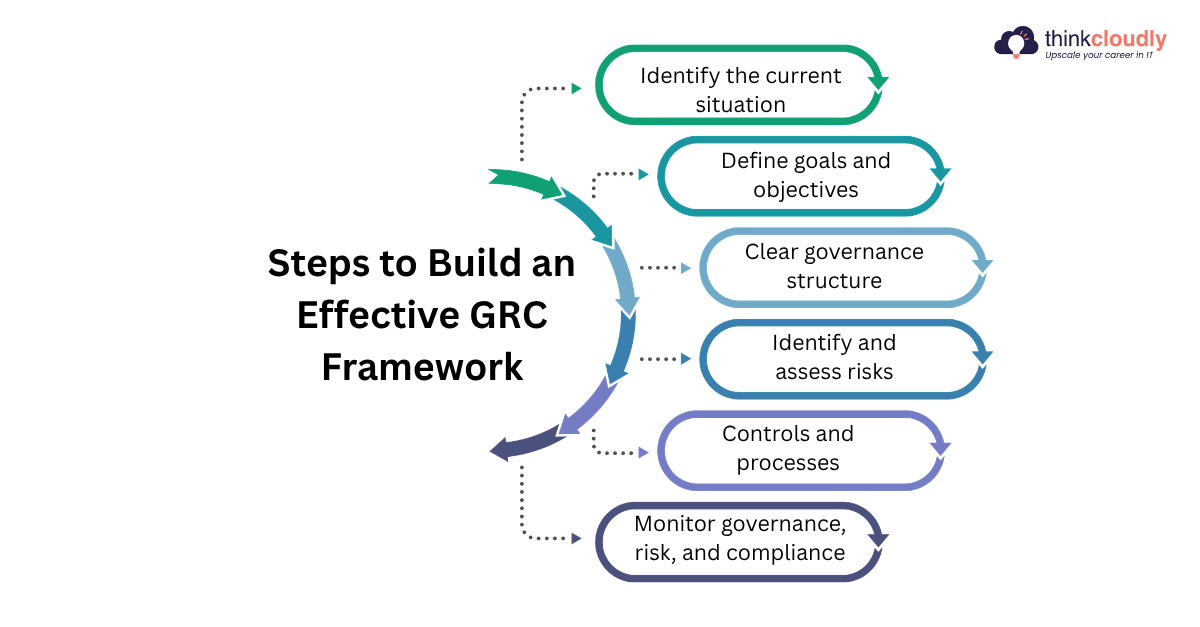
Step 1: Identify the current situation
The first step is to identify the current situation of the organization’s processes, data, technology, and people. This helps to identify the gaps and areas that need improvement. It’s important to understand the existing scenario is key for designing a governance risk and compliance that aligns with the organization’s specific needs and responsibilities.
Step 2: Define goals and objectives
The next step is to clearly define the goals and scope to ensure GRC implementation aligns with business goals. You can make sure of risk management, governance, and compliance by aligning the framework with organizational goals.
Step 3: Clear governance structure
After alignment, the next step is to structure governance, involving outlining roles, decision-making processes, and responsibilities. A proper governance structure checks that everyone in the organization must understand their roles and responsibilities in risk and compliance, managing governance, and leading.
Step 4: Identify and assess risks
For better results, actively monitor and identify risks across the organization. Understanding potential threats and vulnerabilities that could impact the organizations. Organizations can prioritize risk based on their severity and likelihood by conducting thorough risk assessments.
Step 5: Controls and processes
This step is important as it involves developing policies, technologies, and procedures to mitigate risks and maintain compliance. Controls may include data protection policies, access control mechanisms, and incident response plans. These controls help you to strengthen your cybersecurity risk management and ensure compliance.
Step 6: Monitor governance, risk, and compliance
The last step is to continuously monitor, improve, and maintain the governance, risk, and compliance to adapt to risk and regulatory requirements. Regularly update and review to ensure that the framework remains relevant and effective.
Tools and key components of a GRC framework
There are some essential components and GRC tools to support risk management, governance, and compliance. It helps organizations to manage risk, structure, and meet regulatory requirements easily.
|
Tools |
Description |
Roles in GRC framework |
|
Board Portal Software
|
Allow secure collaboration and communication among board members |
Improves governance and compliance management efficiency |
|
Integrated Risk & Audit Systems |
Combines business processes, risk management systems, and auditing into a single system. |
Aligns GRC implementation and reduces operational gaps |
|
SIEM Tools |
Monitors and analyzes security events in real time |
Strengthens cybersecurity risk management and threat detection |
|
Virtual CISO Services |
Provides expert security leadership and strategic guidance |
Enhances overall security posture and compliance readiness |
Challenges in GRC implementation
Organizations face several challenges while implementing a GRC framework:
Lack of clear strategy
Organizations usually struggle to align their framework with business goals, which leads to confusion and creates inefficiency. This happens without a defined plan.
Poor inclusion of GRC tools
This challenge usually occurs when GRC tools are not properly connected with your existing systems, and it makes the data weak and reduces overall performance and effectiveness.
Addressing the clash between the new GRC framework and existing practices
Transitioning to a GRC framework may often involve changing established practices, which can lead to resistance. To address this challenge, clear communication and stakeholder engagement are important.
Adapting to new GRC software
Sometimes employees may face problems adapting to new processes, which can lead to a slowdown of GRC implementation and impact your governance, risk, and compliance.
Benefits of Using Governance Risk and Compliance Framework
With these several GRC implementation challenges, there are numerous benefits of risk assessment: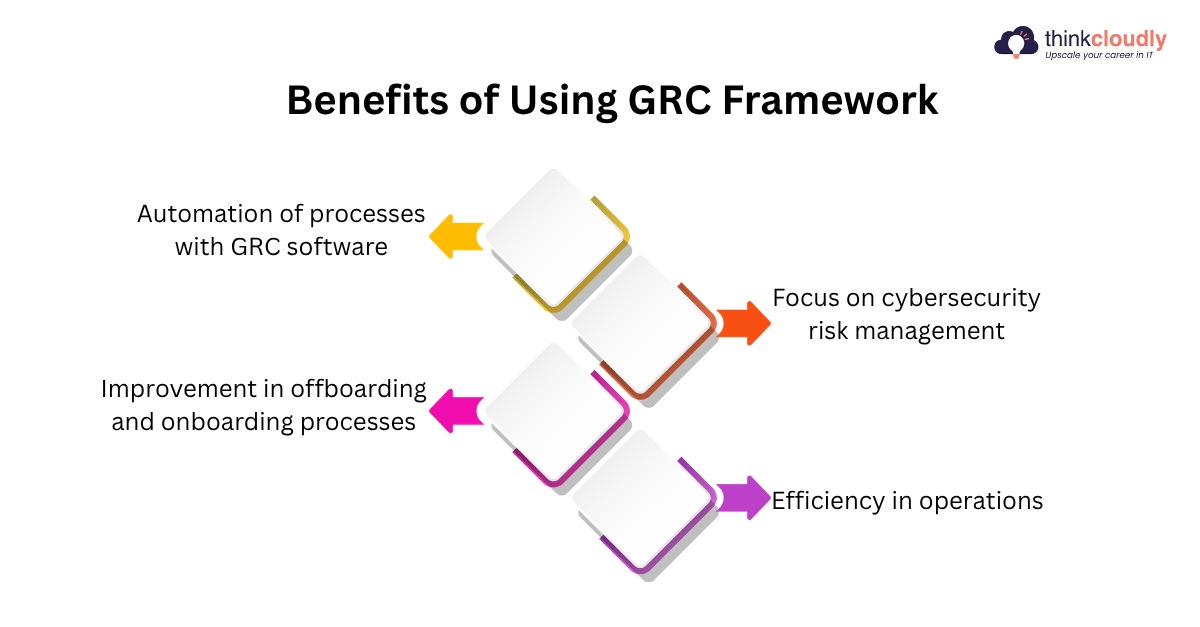
Automation of processes with GRC software
Automating compliance and risk management processes reduces the burden of manual risk management and compliance by allowing more accurate processes and more efficiency. Automated systems can simplify monitoring, reporting, and auditing activities to improve overall compliance and risk management effectiveness.
Focus on cybersecurity risk management
The GRC framework protects your cybersecurity risk management systems and data by identifying, assessing, and mitigating risks. This can improve management and reduces the likelihood of security incidents and helps to protect the reputation and assets.
Improvement in offboarding and onboarding processes
Building a proper GRC framework improves offboarding and onboarding processes by making sure that all the necessary risk and compliance activities are completed. This makes sure that new employees are adequately trained and departing do not pose compliance risks or cybersecurity risk management.
Efficiency in operations
A GRC framework improves operational efficiency by reducing redundancies and streamlining processes. This not only saves time and resources but also improves the organization’s ability to respond to regulatory changes and risk management.
Conclusion
For building a flexible GRC framework from scratch, careful planning is required. Continuous improvement and the GRC tools are needed. Organizations can improve efficiency, security and transparency by integrating risk management, governance, and compliance into a single system.
At Thinkcloudly, we understand the importance of having a strong GRC framework. Organizations can create a strong system that supports long-term business growth by focusing on conducting a strong risk assessment, governance, and modern GRC tools.
A well-implemented governance, risk and compliance strategy not only reduces risk but also helps to build trust, compliance, and operational excellence.

