

In this growing environment, especially in tech, organizations must carefully balance both growth and potential risk. While maintaining strong governance, risk, and compliance practices, it is essential to align risk appetite with business strategy to ensure success.
A well-structured GRC framework helps organizations integrate risk considerations into their business goals, ensuring that every decision aligns with defined risk tolerance levels and internal business policies. In this blog, you will learn how to align risk appetite with risk management strategy using a structured GRC framework to support business goals by applying business policy and managing risks within defined risk tolerance levels for strong governance, risk, and compliance.
What is risk appetite in business strategy?
Risk appetite is the type of risk an organization is willing to take to achieve its business goals. It helps to shape the business strategy. The organization uses it to decide how to pursue opportunities. It is typically about the amount of risk an organization is willing to accept. It guides the organization in making business decisions.
Basically, it is made up of four factors:
- Industry context
- Company culture
- Leadership
- Organizational objective
For example, A company’s strategy is to expand into new markets quickly to achieve its business goals. Its risk appetite allows for moderate financial risk but very low compliance risk. The company is willing to invest in new products and accept possible losses, but it strictly follows every business policy and regulatory requirement. By defining clear risk tolerance levels within its GRC framework, the company ensures of its strong governance, risk and compliance while supporting growth through effective GRC risk management and its enterprise risk framework.
Why Aligning Risk Appetite with Business Strategy is Important
While maintaining control over uncertainties, organizations can grow by aligning risk appetite with business strategy, ensuring that organizations can grow confidently. Here’s why aligning risk appetite is essential:
- Aligns risk-taking with business strategy: Risk-taking decisions are positioned with the organization’s strategic goals by preventing unnecessary risk-taking or excessive risk aversion.
- Improve decision-making: It provides a clear framework for evaluating risks and making informed decisions aligned with the overall enterprise risk planning and also reduces the likelihood of costly mistakes.
- Improve communication: It promotes a shared understanding of risk across the organization and improves communication and collaboration between departments and lines of defence.
- Strengthens integrated risk management: It helps organizations to identify and prioritize risks and allocate resources effectively and develop appropriate risk-mitigation business strategies that are flexible to evolving needs.
- Supports compliance: It can help organizations to demonstrate compliance with regulatory requirements and industry standards, including promoting audit readiness and improving public company readiness.
Steps for setting the organization’s risk appetite
Now that we know what risk appetite is and why it matters, let’s look at how to establish it practically: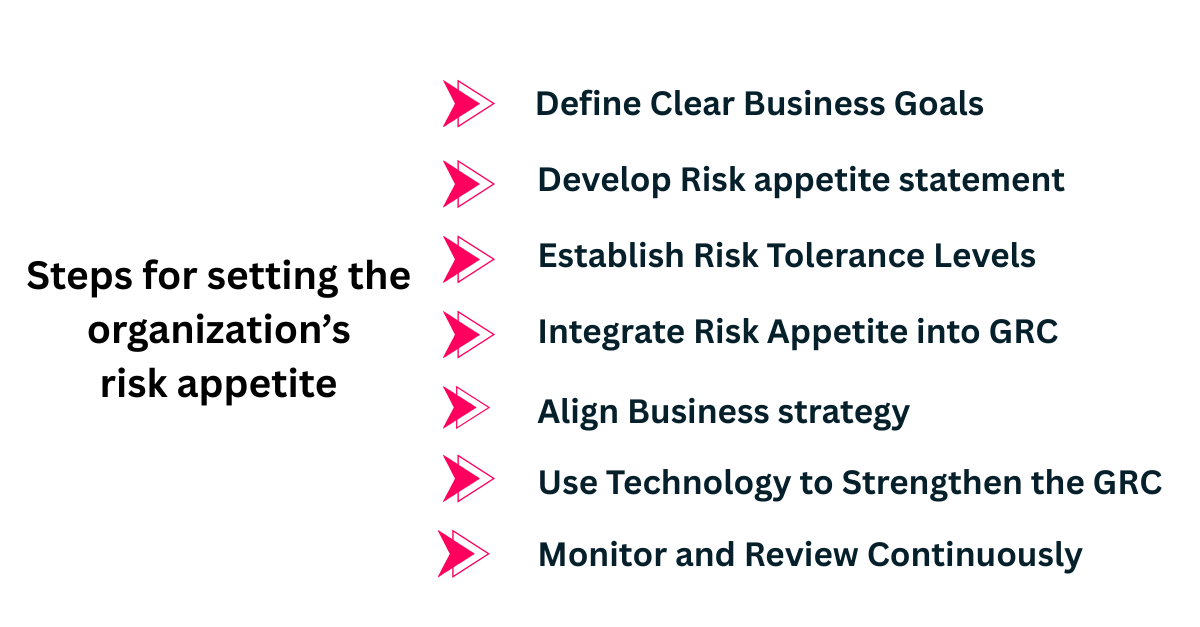
Step 1: Define Clear Business Goals
The first step is to start by identifying your organization’s goals. These goals should align with your long-term business strategy and guide risk-taking decisions.
Step 2: Develop Risk Appetite Statements
These statements outline the risk levels in key domains, including operational, financial, and compliance risks. Provide the formal declarations about your risk appetite within your enterprise risk framework.
Step 3: Establish Risk Tolerance Levels
Define measurable risk tolerance levels that translate risk appetite into actionable limits. These thresholds make sure about the consistency across operations.
Step 4: Integrate Risk Appetite into GRC Risk Management
Place risk appetite into GRC risk management processes to make sure about the alignment with business strategy. It includes updating the risk assessments and aligning them with business goals.
Step 5: Align Business Strategy
Ensure that your business policy reflects the defined risk appetite and supports governance, risk and compliance objectives.
Step 6: Use Technology to Strengthen the GRC Framework
Modern tools can improve the GRC framework by automating risk monitoring and improving the reporting accuracy.
Step 7: Monitor and Review Continuously
Regularly update about your enterprise risk framework and review risk tolerance levels to make sure about alignment with evolving business goals.
Key Components of a GRC Framework
|
Component |
Description |
Role in business strategy |
|
Governance |
Defines leadership roles and accountability for risk management and compliance |
Ensure clear oversight aligned with business strategy. |
|
Risk Management |
Includes GRC risk management processes such as risk identification, assessment, mitigation, and monitoring. |
Helps to manage risks while achieving business goals |
|
Compliance |
Ensures adherence to laws, regulations, and internal business policy, strengthening governance risk and compliance |
Protects the organization from legal and regulatory risks |
|
Reporting |
Provides transparency and supports informed decision-making aligned with the business goals |
Allows data-driven strategic decisions |
Challenges in Aligning Risk Appetite with Business Strategy
Aligning risk management strategy faces several challenges, which are mostly due to communication gaps, inconsistent risk practices and change resistance. Some challenges are listed below:
1. Communication Gaps
Independent organizational structures and a lack of integrated GRC risk management systems prevent effective dissemination of risk appetite across business units. This results in misalignment between business strategy, operational execution, and defined risk tolerance levels.
2. Inconsistent Risk Management
GRC risk management methodologies create fragmentation in risk assessment, including inconsistent risk taxonomies and scoring models. It makes it complex to combine risks across the organization and weakens alignment with the enterprise risk framework.
3. Difficulty in Defining Risk Tolerance Levels
Organizations usually struggle to quantify risk tolerance levels due to the limited use of key risk indicators and advanced risk modelling techniques. These lead to subjective thresholds that fail to align with business goals and the overall business.
4. Resistance to Change
Lack of risk-aware culture and misaligned performance metrics hinder the adoption of risk-integrated decision-making processes. This reduces the effectiveness of the GRC framework and impacts overall governance risk and compliance.
The Best Ways to Align Effectively
In order to effectively match company strategy with risk appetite, companies must: 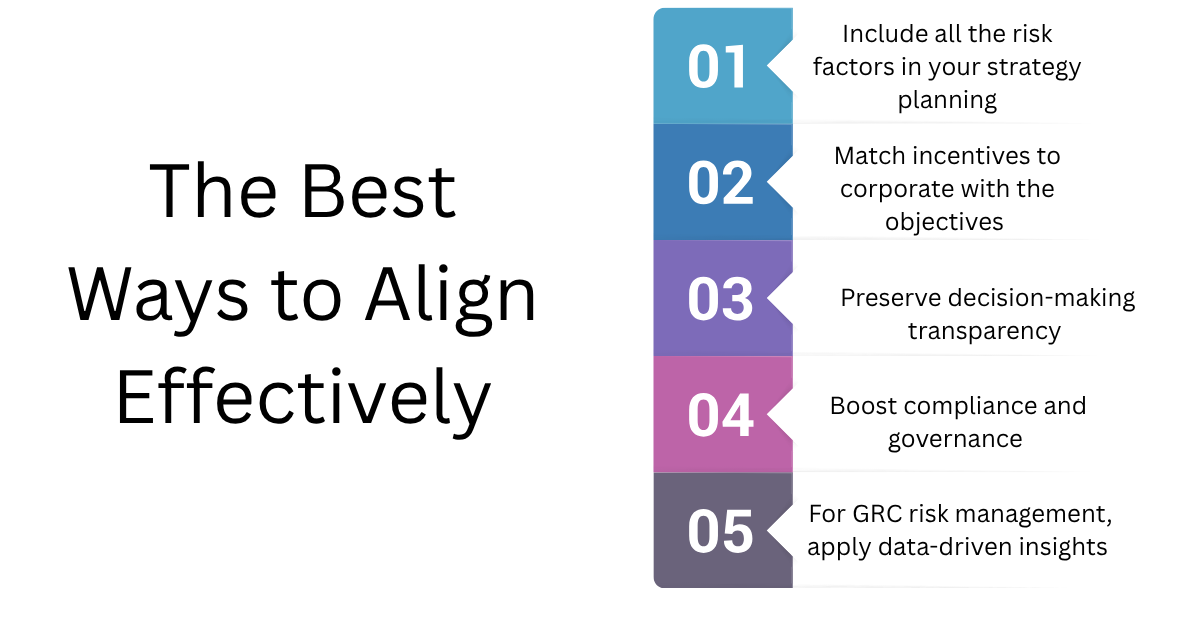
- Include all the risk factors in your strategy planning.
- Match incentives to corporate with the objectives
- Preserve decision-making transparency
- Boost compliance and governance
- For GRC risk management, apply data-driven insights
In conclusion
Businesses can confidently pursue their objectives by including risk appetite in the GRC framework by utilizing efficient GRC risk management and upholding a strong enterprise risk framework. Risk appetite must be in line with the business strategy for the business to achieve resilience and sustained growth. Organizations stay compliant while making strategic decisions thanks to well-defined risk tolerance levels and coordinated business policies. In the end, powerful governance risk and compliance procedures allow companies to manage uncertainty and accomplish long-term corporate objectives.

