
Cloud computing stopped being a niche skill a long time ago. Today, it runs everything—from small startups to Fortune 500 companies. And right now, in 2026, cloud engineers with the right skills and a solid portfolio are quietly pulling in an extra $3,000 to $5,000 every single month outside of their regular jobs.
This is not clickbait. This is what is happening across freelance platforms, LinkedIn job boards, and private client referrals every week.
If you are wondering how they do it — or how you can get started — this blog breaks it down in plain, honest terms.
Why Cloud Skills Are Printing Money Right Now
The demand for cloud talent has not slowed down. In fact, it has spread wider. Companies that once needed only one or two cloud professionals are now building entire teams. And smaller businesses—the ones that cannot afford full-time staff—are turning to freelancers and part-time consultants.
That gap between demand and available talent is exactly where cloud engineers are stepping in and getting paid very well for it.
The three major platforms—AWS, Microsoft Azure, and Google Cloud—all reported continued growth in 2025 and heading into 2026. Businesses are migrating old systems, building new ones in the cloud, and trying to cut infrastructure costs. Every single one of those projects needs someone who knows what they are doing.
What Kind of Side Work Are They Actually Doing?
Here is the honest breakdown of where the money is coming from for cloud professionals in 2026:
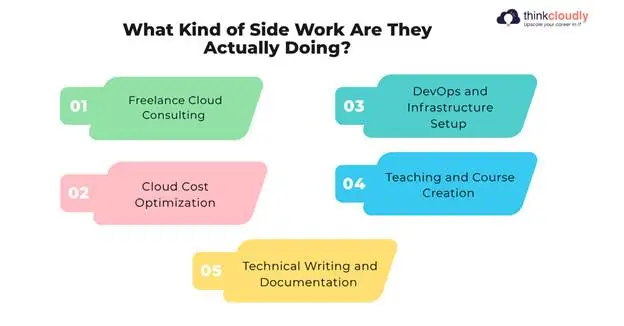
Freelance Cloud Consulting
Small and mid-sized businesses hire cloud consultants to help them move their data and applications from old servers to the cloud. A single migration project can pay anywhere from $2,000 to $8,000, depending on the size and complexity.
DevOps and Infrastructure Setup
Here is something a lot of businesses deal with — they hired developers, but nobody actually knows how to build the pipelines, manage containers, or wire up a deployment system. That is where cloud engineers walk in. If you know Terraform, Kubernetes, and how CI/CD pipelines work, you are looking at $75 to $150 an hour for contract work. Good projects are not hard to find once you have even one solid example to show.
Cloud Cost Optimization
Businesses moved quickly to the cloud, and many are now realizing they have no idea what they are actually paying for. Wasted resources, forgotten instances, bloated storage — it adds up fast. Engineers who can go in, look at the mess, and bring the monthly bill down by 30% to 50% are getting paid $1,500 to $4,000 per engagement. Some companies keep them on a monthly retainer just to stay on top of it.
Teaching and Course Creation
Cloud professionals with a few years of experience are building their own courses and communities online. Some are making an extra $1,000 to $3,000 a month passively from content they created once.
Technical Writing and Documentation
Cloud companies and SaaS tools are always looking for technical writers who actually understand the product. If you can write clearly and know cloud architecture, you can pick up writing contracts that pay $500 to $1,500 per piece.
The Skills That Actually Get You Hired or Booked in 2026
Not all cloud skills pay the same. The ones with the highest demand right now are:
- AWS and Azure certifications (especially Solutions Architect and DevOps Engineer levels)
- Infrastructure as Code (Terraform and Pulumi are in demand)
- Kubernetes and container management
- Cloud security basics (this is now expected, not optional)
- Serverless architecture
- Python or Bash scripting for automation
The engineers making $3K to $5K on the side are not necessarily the most experienced. They are the ones who picked a clear niche, built proof of their skills, and made themselves easy to find and hire.
How to Build a Cloud Portfolio That Actually Gets Attention
A portfolio is what turns your skills into income. Without one, you are just another person claiming to know things. With one, you are someone worth paying.
Here is a simple framework to build a portfolio that works:
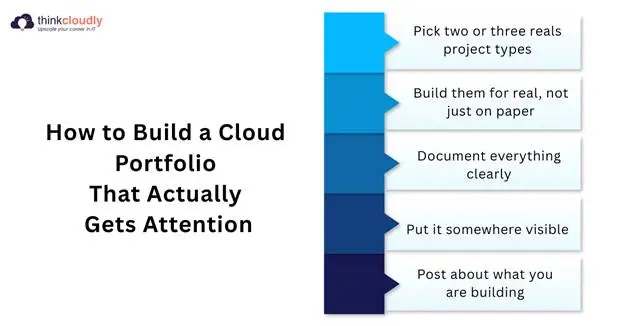
Step 1: Pick two or three real project types.
Do not try to show everything. Pick two or three project types that reflect the work you want to get paid for. If you want cloud migration work, show a migration project. If you want DevOps work, show a working CI/CD pipeline.
Step 2: Build them for real, not just on paper.
Use AWS Free Tier, Azure free credits, or Google Cloud’s free tier to actually build and deploy projects. Screenshots of live infrastructure are far more convincing than slides.
Step 3: Document everything clearly.
Write up what you built, why you made certain decisions, and what problems it solves. A GitHub repository with clean documentation is one of the best portfolio assets you can have right now.
Step 4: Put it somewhere visible.
A simple personal website or a well-organized GitHub profile is enough. Include a short bio, your certifications, and links to your projects. Keep it clean and direct.
Step 5: Post about what you are building.
LinkedIn continues to be the single best platform for cloud professionals to get noticed. Posting weekly about what you are working on — a project, a lesson learned, a certification passed — builds an audience that leads to opportunities.
A Quick Look at Cloud-Side Income by Skill Area
|
Skill Area |
Type of Work |
Estimated Monthly Side Income |
|
Cloud Migration |
Freelance Projects |
$2,000 – $5,000 |
|
DevOps / Infrastructure |
Hourly Consulting |
$1,500 – $4,000 |
|
Cloud Cost Optimization |
Audit & Retainer |
$1,000 – $3,500 |
|
Cloud Security |
Contract Work |
$2,000 – $5,000 |
|
Teaching / Course Creation |
Passive Income |
$500 – $3,000 |
|
Technical Writing |
Per-Article Contracts |
$500 – $1,500 |
Getting Hired Full-Time in 2026: What Employers Are Actually Looking For
Whether you want a full-time cloud role or just want better-paying clients, the bar has shifted a little since 2024. Here is what matters now:
Certifications still help, but they are not enough alone
An AWS Certified Solutions Architect or Azure Administrator certification opens doors. But employers now also want to see that you have used those skills in real scenarios. A certification plus a portfolio beats a certification alone every time.
Soft skills around communication and clarity
Cloud engineers who can explain complex setups to non-technical stakeholders—product managers, finance teams, and founders—are in extremely high demand. The ability to translate tech into plain business language is rare and valued.
Understanding of cloud security basics
Security used to be something you could learn later. Not anymore. Open almost any cloud job posting in 2026, and it is mentioned somewhere—sometimes as a requirement, sometimes just as an expectation. You do not have to become a security engineer, but if you cannot talk about IAM policies, network security groups, and basic encryption practices, you are going to lose out to someone who can.
Experience with multi-cloud or hybrid setups
A lot of companies in 2026 are not on just one cloud. They might run most things on AWS but have a few services sitting in Azure, or they have old systems on-premise that they are slowly moving over. Engineers who know how to work across both setups—and do not get thrown off by the messiness of a hybrid environment—are genuinely easier to hire and easier to keep.
How to Start if You Are Brand New to Cloud
If you are starting from scratch, the good news is that the cloud is genuinely one of the most accessible tech fields to enter. Free resources are everywhere. Certification paths are clear. And entry-level roles exist at many companies.
A realistic starting path looks like this:
Begin with AWS Cloud Practitioner or Microsoft Azure Fundamentals—both take about four to eight weeks to prepare for. Then move into a hands-on role-based certification. Build two to three portfolio projects while studying. Start posting on LinkedIn before you finish your first certification—the audience you build now is the one that will send you job leads later.
From the first study session to the first cloud job, most people who stay consistent are landing roles or picking up their first freelance client within six to nine months.
Final Thoughts
Cloud computing is not a trend that is going away. The infrastructure of the internet runs on it. Businesses of every size depend on it. And the people who know how to build and manage it are getting paid very well—not just in full-time salaries, but in the side income that comes from a world that always needs more cloud expertise than it has.
The $3K to $5K a month that cloud engineers are making on the side in 2026 is not magic. It is the result of clear skills, a portfolio that proves it, and the consistency to stay visible in a market that keeps growing.
If you are already in tech and thinking about adding cloud to your skill set, right now is still a very good time to start.
Sources & Further Reading
The data and statistics in this article are drawn from the following sources:
- AWS — Global Infrastructure Growth Reports — Context on cloud demand growth continuing into 2026.
- Microsoft Azure — Cloud Adoption Framework Reports — Enterprise cloud migration trends and multi-cloud adoption patterns.
- Upwork — Freelance Market Report 2025 — Freelance cloud consulting rate benchmarks and demand data.
- LinkedIn — Jobs & Skills Report 2025 — Cloud job posting trends, in-demand skills, and hiring patterns heading into 2026.
- Stack Overflow — Developer Survey 2025 — Fastest-growing tech skill categories and developer outcomes in cloud computing.
- Toptal — Cloud Developer Rates Overview — Hourly rate benchmarks for cloud DevOps and infrastructure work.
- Google Cloud — Free Tier Documentation—Free learning resources referenced in the portfolio-building section.
- AWS — Free Tier Overview — Hands-on practice resource for beginners building portfolio projects.
All data and statistics referenced in this article are sourced from global reports and surveys published in 2025–2026 and reflect worldwide trends unless otherwise stated.