
Here is a fact that surprises a lot of people outside the tech world. More than 70 percent of cybersecurity job postings in 2026 specifically mention a single entry-level credential, and it is not a degree. It is CompTIA Security+. If you have ever wondered why this particular name keeps coming up whenever someone talks about breaking into cybersecurity, or whether it is still worth the time and money in 2026, you are in the right place.
This guide walks through everything in plain, non-technical language. We will cover what CompTIA Security+ actually is, what the exam looks like in its current form, how much it really costs once you factor in everything, what skills it teaches you, and what kind of salary and career impact you can realistically expect this year.
What Is CompTIA Security+ and Why It Still Matters in 2026
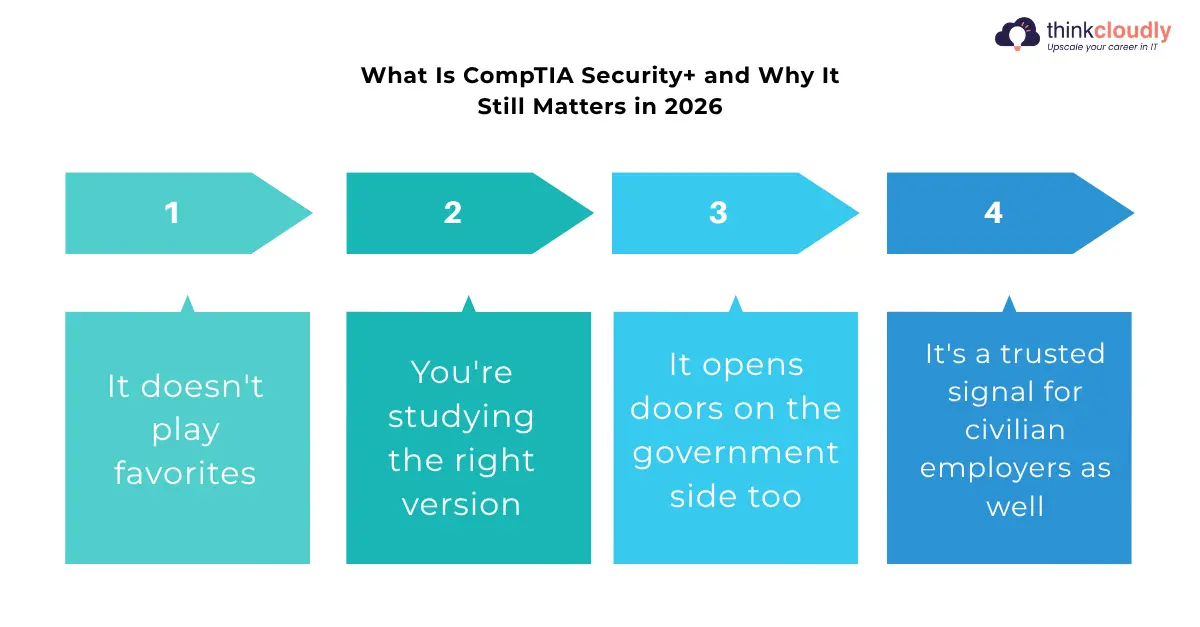 It doesn’t play favorites
CompTIA Security+ is a vendor-neutral cybersecurity certification, meaning it’s not built around any one company’s tools, whether that’s Microsoft, Cisco, or AWS. Instead, it sticks to the core ideas that hold true no matter what setup an organization is running. You can think of it as the bedrock that most advanced certifications eventually get stacked on top of.
You’re studying the right version
The exam currently in play is SY0-701, which came out in late 2023 and is still the active version heading through 2026. CompTIA usually updates its exams roughly every three years, and while people keep speculating about what’s next, nothing has been officially confirmed for 2026. So if you’re prepping right now, you’re working with the correct, current material, not something outdated.
It opens doors on the government side too
This certification carries real weight with the US Department of Defense, where it’s approved for certain government and military IT positions. It also checks the box for roles requiring IAM Level II and IAT Level II clearance, which matters a lot if you’re eyeing public sector or defense-related work.
It’s a trusted signal for civilian employers as well
Outside of government roles, this credential acts almost like a shorthand. When an employer sees it on a resume, it tells them the person understands the fundamentals of keeping systems, data, and networks safe, regardless of which industry they’re applying to.
CompTIA Security+ Exam Cost and Format in 2026
One of the first questions almost everyone asks is about the CompTIA Security+ exam cost, and the honest answer has a few layers to it.
The official exam voucher price in the United States is $425 for a single attempt, taken through Pearson VUE either at a physical testing center or via online remote proctoring. That fee alone covers exactly one attempt. If you do not pass, you will need to purchase another voucher at the same price to try again, which is why preparation matters so much.
However, the $425 voucher is rarely the full story. Most candidates also spend money on study materials, practice exams, or structured training courses. Based on what training providers have been tracking through 2025 and into 2026, most self-paced learners end up spending somewhere in the $600 to $1,000 range overall. If you go with a full bootcamp or instructor-led program instead, that number jumps up to anywhere between $1,500 and $3,500. There’s also a nice option for students, though: CompTIA’s academic program offers discounts of 40 to 50 percent, which can take a real bite out of that upfront cost.
Once you pass, CompTIA Security+ remains valid for three years. To keep it active, you need to earn 50 continuing education units within that period, which typically costs around $150 total when done through CompTIA’s official renewal pathway.
CompTIA Security+
|
Detail |
2026 Information |
|
Exam Code |
SY0-701 |
|
Released |
November 2023 |
|
Number of Questions |
Up to 90 |
|
Exam Duration |
90 minutes |
|
Passing Score |
750 out of 900 |
|
Exam Voucher Cost (US) |
$425 |
|
Realistic Total Cost (Self-Study) |
$600 to $1,000 |
|
Realistic Total Cost (Bootcamp) |
$1,500 to $3,500 |
|
Validity Period |
3 years |
|
Renewal Requirement |
50 CEUs, roughly $150 total |
|
Government Recognition |
DoD-approved, meets IAM/IAT Level II |
Core Skills You’ll Build With CompTIA Security+
Beyond the exam itself, it helps to understand what you are actually learning, because these are the skills that show up in real job descriptions across 2025 and 2026 postings. Here are four core areas this certification focuses on.
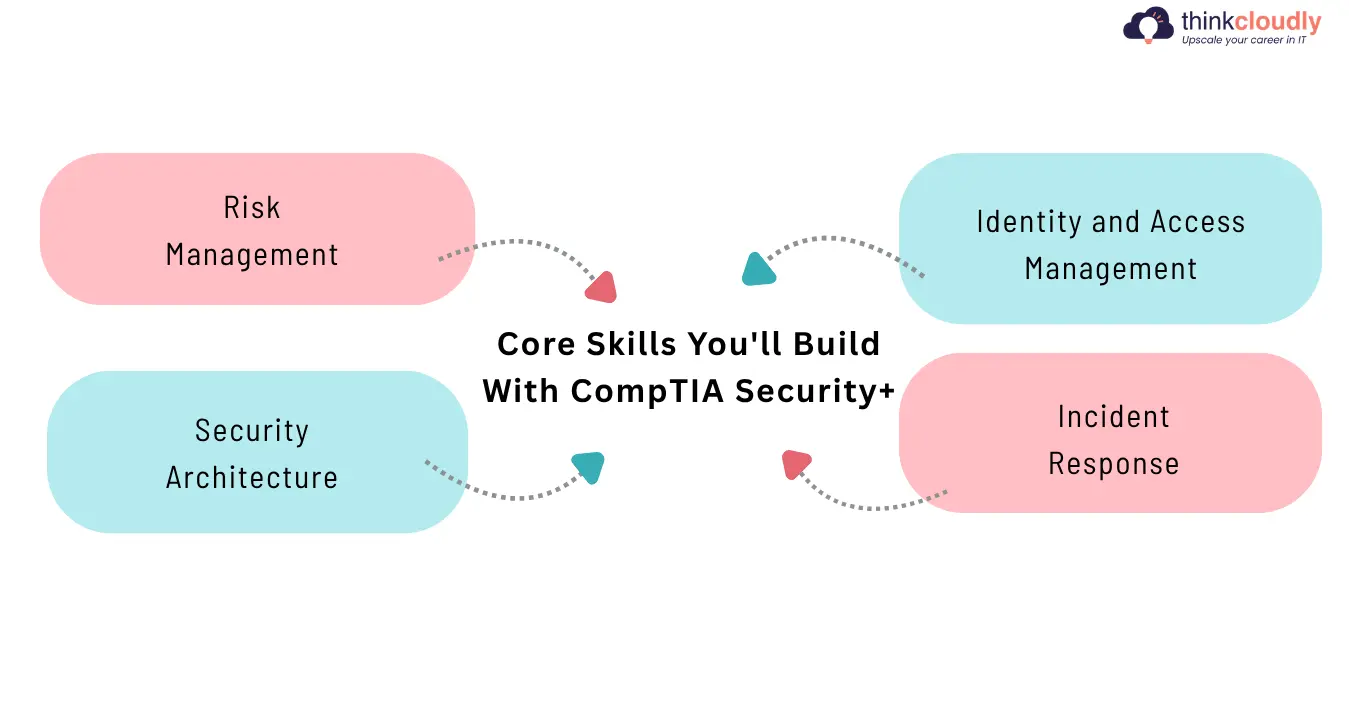 Risk Management
A big chunk of cybersecurity isn’t about scrambling to fix things after an attack happens; it’s about figuring out where an organization is vulnerable before anything goes wrong. CompTIA Security+ walks you through how to spot potential risks, weigh how likely they are and how much damage they could cause, and come up with practical ways to dial down that exposure. This kind of risk management mindset shows up everywhere in security work, from the entry-level analyst desk all the way up to the leadership table.
Identity and Access Management
This piece is all about controlling who gets access to what within an organization. It touches on things like passwords, multi-factor authentication, permission levels, and making sure people can only reach the systems and data they genuinely need for their job, nothing more. Identity and Access Management has gotten a lot more attention in 2026, mostly because so many companies now have remote and hybrid teams logging in from all over the place.
Security Architecture
This part is about how systems, networks, and cloud setups are built and structured to actually be secure from day one, not patched together afterward. It covers things like network segmentation, the basics of cloud security, and zero trust principles, and honestly, this area has gotten a lot more attention in the current exam compared to older versions.
Incident Response
Since no system is ever completely bulletproof, this section deals with what happens once something does go wrong. Incident Response covers spotting that a security event has actually occurred, containing the fallout, digging into what happened, and helping the organization bounce back and avoid a repeat. Given how much weight security operations carry on the current exam, this is probably one of the most genuinely useful skill areas the certification teaches.
CompTIA Security+ Career Value and Salary Outlook in 2026
This is usually where the real decision-making happens, and the 2026 numbers tell a fairly consistent story.
According to compensation data updated through mid-2026, certified professionals see a measurable salary boost compared to uncertified candidates, with most sources placing the bump for CompTIA Security+ specifically around an additional 11 percent, or roughly $15,000 to $20,000 more annually in many markets. Entry-level cybersecurity roles in the US, the kind that often list this credential as a requirement or strong preference, report average salaries in the range of $55,000 to $90,000 depending on location and employer, with some aggregated averages for entry-level cybersecurity positions reaching well over $100,000 in higher cost-of-living areas during 2026.
What makes this certification particularly valuable is not just the salary bump on its own but also what it unlocks afterward. It is frequently described as a stepping stone toward more specialized and higher-paying certifications like CySA+, CISSP, or cloud security credentials, each of which builds on the foundation this one provides. With cybersecurity job growth continuing to outpace the supply of qualified candidates through 2026, having this certification on your resume often shortens the time it takes to get noticed by recruiters and hiring managers in the first place.
Is CompTIA Security+ Worth It in 2026?
For most people seriously thinking about switching into IT or cybersecurity, the answer is a pretty clear yes, and here’s the reasoning behind that.
Even on the pricier end of self-study, you’re looking at around $1,000 total. That’s a small number when you compare it to the salary jump it usually triggers, often enough that it pays for itself within your first month or two on the job. There’s also no degree requirement, so if you’re coming from a completely unrelated field, the door is still open to you as long as you’re willing to put in the study hours.
With that said, let’s keep expectations grounded. This is an entry-level credential, plain and simple. By itself, it’s not going to hand you a senior leadership title or a six-figure paycheck overnight. What it does give you is something more practical: it gets you noticed, shows employers you’ve got the basics down, and sets you up nicely to chase bigger, more specialized certifications down the road.
Conclusion
CompTIA Security+ continues to hold its position as one of the most recognized entry points into the cybersecurity field heading into 2026. With a clear, current exam format, a manageable total cost when approached through self-study, and consistent recognition across both government and private sector job postings, it remains a practical first step for anyone serious about a career in this space. If you are weighing your options for 2026, this certification offers a strong balance of accessibility, recognition, and real career impact, particularly for those just starting out or transitioning from a different IT background.
Sources & Further Reading
The data and statistics in this article are drawn from the following sources:
- CertEmpire — CompTIA Security+ SY0-701 Exam Guide 2026 — Cited for the current exam format, domains, passing score, and exam cost.
- OpenExamPrep — Security+ SY0-701 Domain Weights and Percentages 2026 — Referenced for the exact weighting of each of the five SY0-701 domains.
- FlashGenius — How Much Does Security+ Cost in 2026? — Cited for voucher pricing, total investment ranges, and renewal cost breakdown.
- SecurityPlusCertPrep — CompTIA Security+ Exam Overview — Referenced for exam structure, domain breakdown, and performance-based question details.
- Unihackers — Security+ SY0-701 Guide 2026 — Cited for exam validity, renewal requirements, and current exam status.
- EpicDetect — CompTIA Security+ Certification: Complete 2026 Guide — Referenced for exam difficulty insights and study time expectations.
- SPOTO — How Much Does the CompTIA Security+ Exam Cost? — Cited for official voucher pricing and total certification cost ranges.
- Unihackers — Cybersecurity Salary Guide 2026 — Referenced for the salary boost associated with CompTIA Security+ and related certifications.
- KORE1 — Cybersecurity Salary Guide 2026: From SOC Analyst to CISO — Cited for entry-level salary premiums tied to CompTIA Security+ certification.
- CompareCheapSSL — Cybersecurity Job and Salary Statistics in 2026 — Referenced for the average salary boost percentages across major cybersecurity certifications.
- Leon Consulting — Is Cybersecurity in Demand? 2026 Salaries Exposed — Cited for entry-level cybersecurity salary ranges and overall job market demand in 2026.
- ZipRecruiter — Entry Level Cyber Security Salary, June 2026 — Referenced for average and percentile-based entry-level cybersecurity salary figures in the US.