
Here is a number that might change how you think about your next career move. As of 2025, fewer than 17,000 professionals worldwide hold the CRMA Certification, compared to hundreds of thousands of general internal auditors globally. If you have ever wondered why so few people pursue this credential despite its growing relevance to enterprise risk management, you are about to find out, and the answer might be exactly the opportunity you have been looking for.
The CRMA Certification, short for Certification in Risk Management Assurance, is issued by the Institute of Internal Auditors and is built specifically for professionals who want to specialize in risk assurance rather than stay generalists. It is not a starting point. It is a deliberate next step for internal auditors who already understand the basics and want to go deeper into how organizations identify, assess, and manage risk at a strategic level. This guide breaks down everything you need to know about the CRMA Certification in 2026, in plain language, with current data and no unnecessary jargon.
Why the CRMA Certification Matters More in 2026
Internal audit has changed. A decade ago, the role was largely about checking whether financial controls were followed correctly. Today, boards and audit committees expect internal auditors to do something much harder: independently evaluate whether an organization’s entire enterprise risk management framework is actually working, not just whether individual controls exist on paper.
This shift is exactly what the CRMA Certification was designed to address. It signals to employers that an internal auditor can step beyond routine compliance checks and provide genuine assurance on how risk is governed, assessed, and managed across an organization. According to data reported by the Institute of Internal Auditors, CRMA holders are increasingly listed as preferred candidates for Chief Audit Executive and Internal Audit Director roles at mid-to-large organizations, a trend that has strengthened noticeably heading into 2026.
What makes this particularly relevant right now is the regulatory environment. Organizations across financial services, healthcare, insurance, and manufacturing are under more pressure than ever to demonstrate that their risk oversight is not just a checkbox exercise. The CRMA Certification positions the holder as someone who can credibly assess that oversight and advise leadership on where the gaps actually are.
Who the CRMA Certification Is Really For
One thing that often surprises people researching this credential is that the CRMA Certification is not an entry-level qualification. To pursue it, candidates must already hold an active CIA, the Certified Internal Auditor designation, also issued by the Institute of Internal Auditors. This makes the CRMA a specialization rather than a foundation.
In practical terms, this credential tends to attract a specific group of professionals. Senior internal auditors who are ready to move into risk-focused leadership roles make up a large portion of candidates. Audit managers and directors overseeing risk-based audit plans pursue it to formalize expertise they are already applying daily. Enterprise risk management professionals with an internal audit background use it to bridge the gap between the two functions, which are increasingly expected to work closely together. Risk consultants serving regulated industries such as banking, insurance, and healthcare also pursue the CRMA because clients in those sectors specifically value the credential as a differentiator.
If none of those descriptions fit you yet but you are working toward becoming an internal auditor, the realistic path is to pursue your CIA first, build a few years of experience in risk-related audit work, and then consider the CRMA Certification once you are ready to specialize.
CRMA Exam Structure: What You’re Actually Being Tested On
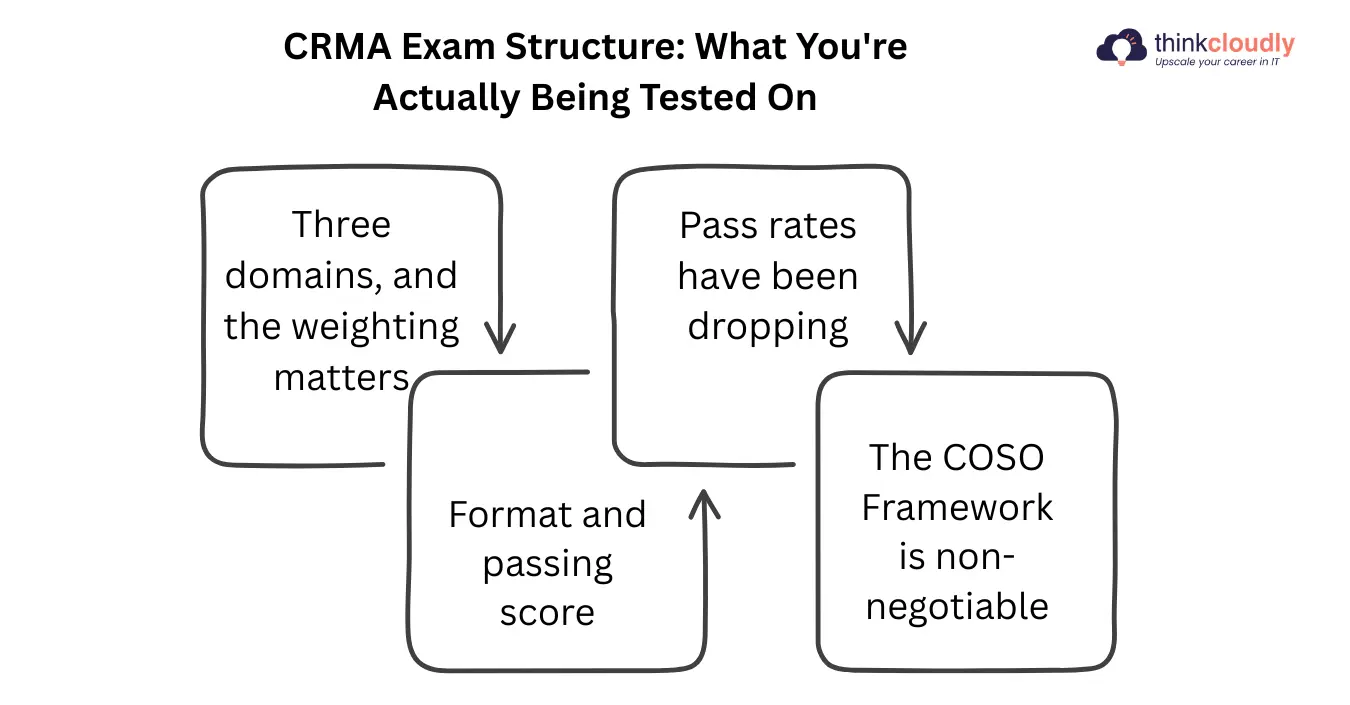
Three domains, and the weighting matters
The CRMA exam is built around three core domains, and knowing how much each one counts can completely change how you plan your study time.
Domain 1: Internal audit roles and responsibilities (around 20%)
This portion covers the foundational duties and positioning of internal audit within an organization, but it makes up the smallest slice of the exam.
Domain 2: Risk management governance (around 25%)
This domain looks at how risk management is governed at an organizational level, forming a solid but secondary chunk of the test.
Domain 3: Risk management and assurance (around 55%)
This is by far the largest domain, and for good reason. The heavy weighting here reflects exactly what the credential is meant to prove, that you can genuinely assess whether an organization’s risk management processes work in practice, not just on paper.
Format and passing score
The exam is multiple-choice, completed in a single sitting, and requires a scaled score of 600 out of 750 to pass.
Pass rates have been dropping
Based on exam data tracked through 2025, the pass rate sits around 45 percent, putting it roughly on par with the first part of the CIA exam. This is a real shift from earlier years when CRMA had a reputation for being easier, mainly because the IIA has tightened content depth and overall requirements.
The COSO Framework is non-negotiable
Throughout the exam, you’re expected to apply your knowledge of frameworks central to the profession, especially the COSO Framework for internal control and enterprise risk management. Understanding how it structures risk assessment, control environments, and governance isn’t optional. It’s a core part of being genuinely exam-ready.
What the CRMA Certification Costs in 2026
Cost is one of the most practical considerations, and it varies depending on your IIA membership status and location.
For candidates who are already IIA members, the typical breakdown includes a program application fee and a separate exam registration fee. Based on current 2025-2026 figures, the program application fee for IIA members runs in the range of $95, while non-members pay considerably more, often around $210. Exam registration fees vary by source and region, with some figures placing member exam costs in the $100 to $445 range depending on location and whether additional services are included, and non-member costs running higher still.
When you factor in IIA membership itself, which in the United States ranges from around $50 for students to roughly $270 for regular professional members, plus the cost of study materials and possibly a retake fee if needed, most candidates should budget somewhere between $800 and $1,200 total for the CRMA Certification process, assuming they already hold an active CIA. It is worth noting this total does not include the cost of obtaining the CIA itself, which is a separate and significant investment.
One detail worth flagging for 2026 specifically: the IIA updated its exam scoring process as of April 2026, and candidates now receive their official result within three weeks of their exam date, which is a notable improvement in turnaround time compared to previous years.
CRMA Certification at a Glance
|
Factor |
Details |
|
Issuing Body |
Institute of Internal Auditors (IIA) |
| Prerequisite |
Active CIA (Certified Internal Auditor) certification |
|
Exam Domains |
Internal audit roles (20%), risk governance (25%), risk management assurance (55%) |
| Passing Score |
600 out of 750 |
|
Pass Rate (2025 data) |
Approximately 45% |
| Estimated Total Cost |
$800 to $1,200 for IIA members (excluding CIA costs) |
|
CPE Requirement |
20 hours annually, including 2 hours of ethics |
|
Global Holders (2025) |
Approximately 17,000 |
| Result Turnaround (2026) |
Within 3 weeks of exam date |
How to Prepare for the CRMA Certification
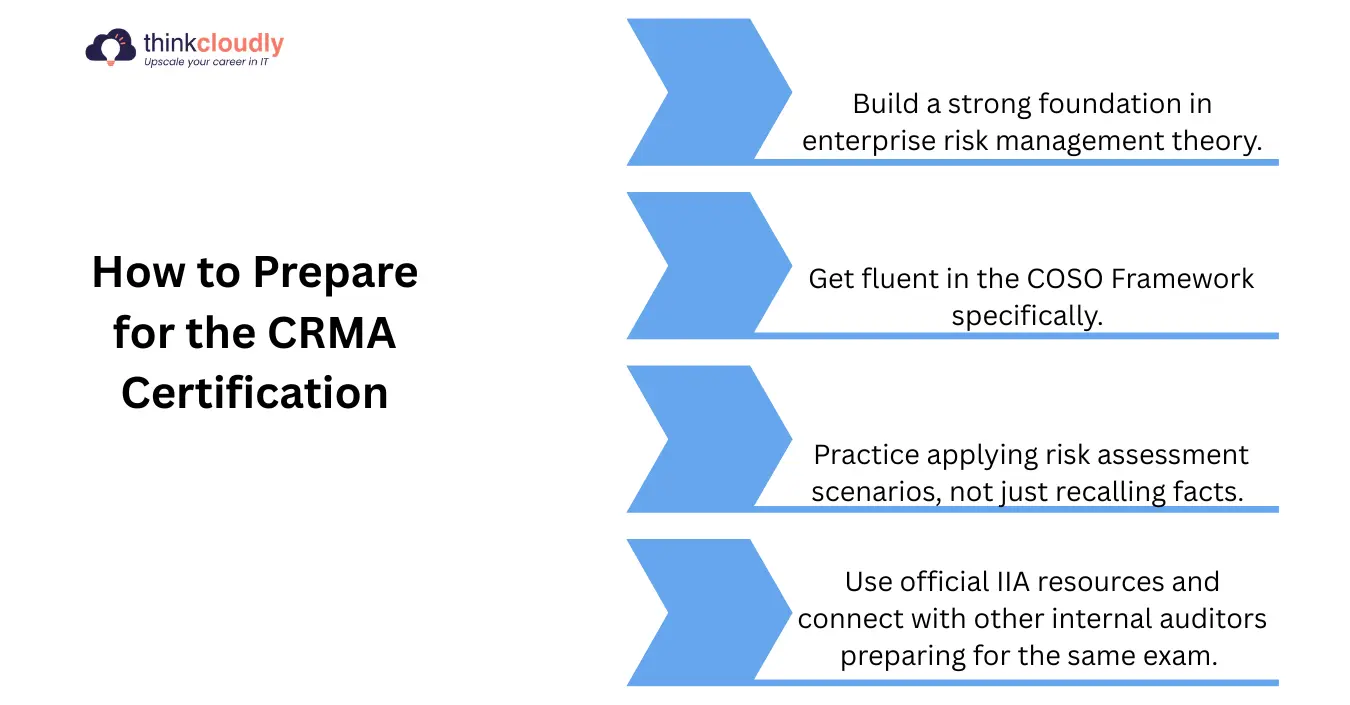
Build a strong foundation in enterprise risk management theory.
Before diving into practice questions, spend time genuinely understanding how an enterprise risk management framework operates end to end, from risk identification through to monitoring and reporting. The exam tests application, not memorization, so understanding why frameworks are structured the way they are matters more than knowing definitions.
Get fluent in the COSO Framework specifically.
Because the COSO Framework underpins so much of how risk management assurance is assessed globally, candidates who treat this as a core study area rather than a side topic consistently report feeling more prepared for the assurance-focused questions that dominate the exam.
Practice applying risk assessment scenarios, not just recalling facts.
Given that risk assessment is central to the largest exam domain, work through realistic scenarios where you have to judge whether a given risk response is adequate, identify gaps in a control environment, or evaluate the quality of an organization’s risk reporting. This scenario-based thinking is exactly what the exam rewards.
Use official IIA resources and connect with other internal auditors preparing for the same exam.
The IIA provides official study guides and practice materials, and given the declining pass rate, candidates who supplement official materials with peer study groups or structured review courses tend to perform more consistently than those relying on a single resource.
Maintaining the CRMA Certification
Once earned, the CRMA Certification requires ongoing maintenance to stay active. Members are required to log 20 hours of continuing professional education annually, with at least two of those hours specifically focused on ethics. This requirement applies on top of any CPE obligations tied to your underlying CIA certification, so internal auditors holding both credentials need to plan their professional development accordingly each year.
Conclusion
The CRMA Certification occupies a specific and increasingly valuable space in the internal audit world. It is not for everyone, and it is not meant to be a first step. But for internal auditors who already hold their CIA and want formal recognition of their ability to provide genuine assurance services around how an organization manages risk, it is one of the clearest signals available in 2026.
With pass rates declining and the exam content shifting to demand deeper application of frameworks like COSO, the CRMA Certification is becoming a more meaningful differentiator, not a less relevant one. For internal auditors looking to move into senior risk-focused roles, advise audit committees, or position themselves as trusted voices on enterprise risk management, the CRMA Certification remains one of the most direct paths to get there.
Sources & Further Reading
The information, eligibility requirements, exam details, and career insights in this article were compiled from the following sources:
- The Institute of Internal Auditors. CRMA Certification Overview and Eligibility Requirements. theiia.org (2026).
- The Institute of Internal Auditors North America. CRMA Certification Pages. na.theiia.org (2026).
- Chartered IIA. Certification in Risk Management Assurance Entry and Exit Requirements. charterediia.org (2025).
- IIA Singapore. Certification in Risk Management Assurance Program Details. iia.org.sg (2025).
- Accounting.com. CRMA Certification Complete Guide. accounting.com (2026).
- PayScale. Certification in Risk Management Assurance Salary Data. payscale.com (2026).
- iPassTheCIAExam. How to Become a CRMA: Pass Rate and Difficulty Analysis. ipasstheciaexam.com (2025).
- iPassTheCIAExam. CRMA Exam Fees Breakdown. ipasstheciaexam.com (2025).
- PracticeTestGeeks. CRMA Certification 2026 Overview and Career Paths. practicetestgeeks.com (2026).
- PracticeTestGeeks. Free CRMA Practice Test and Cost Breakdown. practicetestgeeks.com (2026).
- Sprinto. Top 10 GRC Certifications for 2026. sprinto.com (2026).
- Global Professional Certifications. CRMA Certification Training Program Overview. globalprofessionalcertifications.com (2026).