
As we know, there is an increasing demand for cybersecurity professionals as organizations are facing a rise in digital threats. A SOC Analyst is among the most critical roles in modern security operations. For building a strong cybersecurity career, you must have a basic understanding of the path, responsibilities, and growth opportunities of an analyst.
Cybersecurity jobs are expanding rapidly in today’s competitive job market, and companies across industries are spending heavily in Security Operations Centres (SOCs). This makes the role of an analyst the most accessible and productive entry point into cybersecurity jobs and builds a strong cybersecurity career with an attractive cybersecurity salary.
Who is a SOC Analyst?
A SOC Analyst (Security Operations Centre analyst) is mainly responsible for monitoring, detecting, analyzing, and responding to activities related to cybersecurity within an organization. The main objective of an analyst is to protect systems, networks, and data from cyber threats.
An analyst works inside an SOC environment where the activities are continuously monitored by the security tools. These professionals investigate alerts, analyze suspicious behaviour, and respond to activities before they can grow into major breaches.
Becoming a SOC analyst job professional is the first major step to enter the security domain for many professionals planning to start a cybersecurity career.
Key Responsibilities of a SOC Analyst
The daily responsibilities of a SOC analyst mainly revolve around detecting threats and incident response.
Some primary duties include:
- Monitoring of security alerts from SIEM tools
- Investigation of suspicious activities
- Performing log analysis
- Escalating threats that are confirmed
- Directly coordinating with the incident response team
- Documenting the incidents
Strong analytical skills and attention to detail are most important for an analyst job. Since threats are getting advanced continuously, an analyst must stay updated with the latest attack techniques and defence mechanisms.
Why Is SOC Analyst a Popular Entry Role?
Many professionals mostly enter the field of cybersecurity careers through a SOC analyst job because it offers direct exposure to cybersecurity jobs in a real-world environment:
- Provides practical application towards examining and managing actual threats.
- Exposes analysts to a range of available technologies for managing risk.
- Establishes a core understanding between incident response and effective management.
- Creates a pathway for finding specialization.
- It is in high demand, as it helps in developing skills rapidly.
An analyst job also welcomes the professionals with internships or basic knowledge, unlike other cybersecurity jobs that ask for years of experience or skills.
Skills Required to Become a SOC Analyst
You will need both technical and analytical skills to succeed in a SOC analyst job and grow in a cybersecurity career. These skills are:
|
Skill Category |
Skills |
|
Technical Skills |
Networking, SIEM Tools, Firewalls, IDS/IPS, Log Analysis |
|
Analytical Skills |
Critical Thinking, Threat Detection, Pattern Recognition |
|
Tools Knowledge |
Splunk, QRadar, Sentinel, Wireshark |
|
Soft Skills |
Communication, Documentation, Teamwork |
Certifications That Help a SOC Analyst
Having certifications can definitely boost your cybersecurity career and improve opportunities in cybersecurity jobs while increasing cybersecurity potential. Some of the popular certifications include:
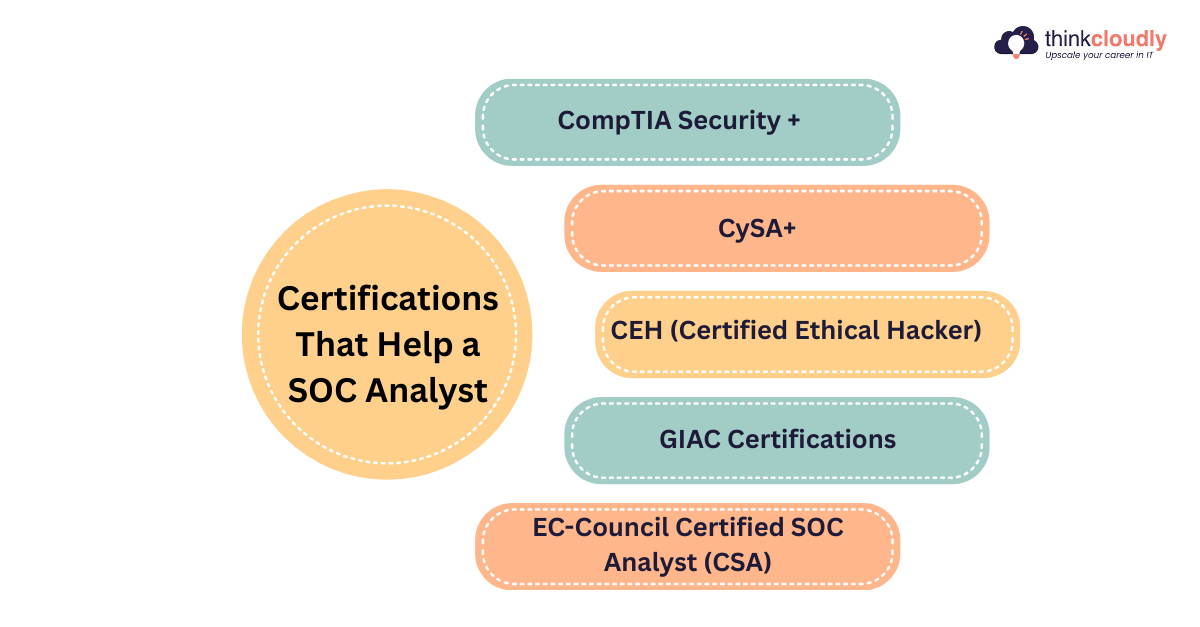
These certifications show your skills and readiness for an analyst job and improve your chances to be successful in the cybersecurity job market.
SOC Analyst Career Path
Do not consider a SOC analyst job as the end goal, as it is the beginning of your cybersecurity career.
|
Level |
Role Title |
Key Responsibilities |
Experienced Required |
|
Level 1 |
SOC Analyst (L1) |
Monitoring alerts, Prioritize incidents, Basic log analysis |
0-2 years |
|
Level 2 |
SOC Analyst (L2) |
Deep investigation, Threat correlation, Incident handling |
2-4 years |
|
Level 3 |
SOC Analyst (L3) |
Advanced threat analysis, Mentoring, Escalation handling |
4-6 years |
|
Advanced |
Incident Responder/Threat Hunter |
Proactive threat hunting, Forensic analysis |
5+ years |
|
Senior |
Security Engineer/Architect |
Security design automation, Strategic defense planning |
7+ years |
Each level creates deeper knowledge of security systems and response strategies, which further helps to strengthen your cybersecurity career and improve long-term cybersecurity salary growth with competitive cybersecurity jobs.
Cyber Security Salary Expectations
Cybersecurity salary is the biggest reason for attraction towards becoming an analyst. Entry-level SOC analyst professionals also earn attractive cybersecurity salary packages compared to many IT roles. Cybersecurity salary increases significantly with growing experience, especially for senior analysts and incident responders.
Factors that affect the cybersecurity salary are
- Location
- Certifications
- Industry
- Experience level
- Specialized skills
There is an increasing demand for the cybersecurity jobs, which ensures the steady cybersecurity salary growth for skilled professionals.
Challenges Faced by a SOC Analyst
As we know, a SOC analyst job comes with several real-world challenges, while being rewarding and critical in any organization’s cybersecurity framework. Understanding these challenges can help the professionals in cybersecurity jobs to prepare mentally and technically for long-term success in a cybersecurity career.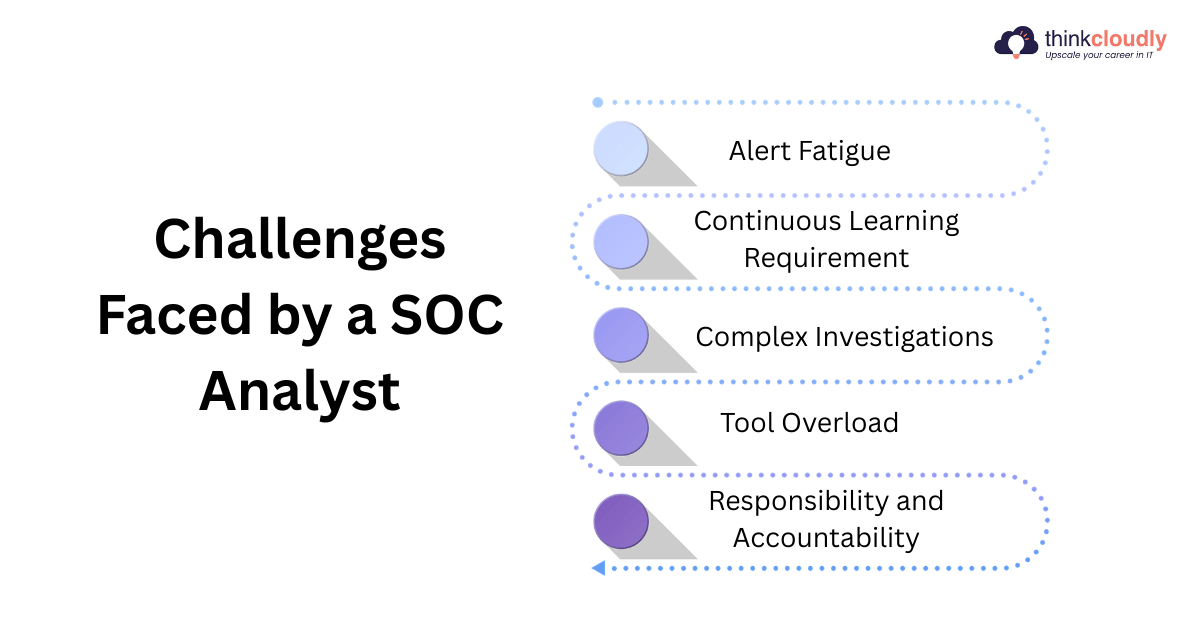
1. Alert Fatigue
Alter Fatigue is one of the most common challenges faced by SOC analyst job professionals. Thousands of alerts are generated daily by the security tools, and many of them are false alarms. Working continuously to review a large number of alerts can become overwhelming sometimes and may reduce efficiency.
For this, an analyst must develop strong skills to identify and separate real threats from unnecessary alerts. These skills grow over time with experience and help analysts to quickly recognize patterns and reduce unessential escalations.
2. Continuous Learning Requirement
With time cyber threats are evolving constantly. New malware, phishing techniques, and exploitation methods are being introduced by the attackers regularly.
To work smoothly, an analyst must stay updated with:
- Latest trends of the cyber attacks
- Feeds of threat intelligence
- Updates of the security tools
- Best practices among the industries
Continuous learning is most important for cybersecurity career growth in cybersecurity jobs.
3. Complex Investigations
Some attacks or cyber threats are not straightforward; they can remain hidden for weeks or months, like advanced persistent threats (APTs). For identifying them, an analyst must investigate deeply and connect small clues by correlating multiple logs.
This requires patience, analytical thinking, and a strong understanding of network behaviour.
4. Tool Overload
Multiple security tools are used by modern SOC environments, like SIEM, EDR, firewall logs, threat intelligence platforms, and more. Managing all of them simultaneously can be challenging sometimes. With growing experience and skills, an analyst learns to combine the tools efficiently and put repetitive tasks into automation whenever possible.
5. Responsibility and Accountability
A frontline defence role is played by SOC analyst job professionals, as missing any critical alerts can lead to serious consequences. This responsibility adds much pressure but also develops strong professional discipline. Analysts gain confidence and develop more structured workflows with experience to manage risks effectively.
SOC Analyst vs Other Cybersecurity Jobs
Many professionals compare a SOC analyst job with other cybersecurity job options while starting a cybersecurity career to basically understand which path suits them well. The basic work of all cybersecurity roles is to protect organizations from cyber threats, but they mostly differ on the topic of daily tasks. Understanding these differences helps you choose the right career path.
Here is the comparison table to show the basic differences among cybersecurity jobs:
|
Role |
Primary Focus |
Nature of Work |
Experience Level |
|
SOC Analyst |
Monitoring & Incident Response |
Defensive & Reactive |
Entry-Mid |
|
Penetration Tester |
Vulnerability Testing |
Offensive |
Mid |
|
Security Engineer |
Security Infrastructure |
Preventive |
Mid-Senior |
|
Threat Hunter |
Proactive Threat Detection |
Investigative |
Mid-Senior |
|
Incident Responder |
Breach Management |
Strategic Response |
Senior |
|
Security Architect |
Security Strategy & Design |
Strategic Planning |
Senior |
If you are new to the cybersecurity career field, an analyst role provides the foundational knowledge about real-world attacks, security tools, and how to respond to them.
Future of SOC Analyst
The SOC analyst job is evolving with the increasing number of cyber threats and AI-driven attacks. While the automation technique handles the repetitive tasks, the human brain of an analyst remains critical for:
- Complex investigations
- Correlating with threat intelligence
- Strategic response towards the incidents
The demand for cybersecurity jobs is increasing, especially for an analyst role, due to the growing number of attackers and new techniques used by them to harm any organization.
Conclusion
The main role of an analyst is not just monitoring alerts but also making sure that the digital assets are safe, responding to the threats, and strengthening the defence system of the organizations. As cyber threats are becoming more advanced nowadays, a skilled SOC analyst is becoming very important in the cybersecurity domain.
If you want to enter into a cybersecurity career, preparing to become an analyst can open doors for various cybersecurity jobs and help in long-term professional success. Developing technical skills and gaining experience can help you in establishing yourself as a competent SOC analyst and achieving steady growth in your cybersecurity career.

