
Are you all preparing for the next cyberattack, or are you still searching for the way to handle the previous one? In today’s modern digital environment, cybersecurity threats are not considered to be hidden incidents, as they are evolving continuously and increasingly intelligently, which makes vulnerability management a priority for GRC teams. The sensible way to security is not enough for GRC teams to handle this threat management.
As organizations are expanding digitally and introducing modern technologies, the complexity of managing risk is also increasing. From cloud to AI-driven systems, every layer introduces you to new cybersecurity threats. This is where strong IT risk management, dynamic threat management, and security risk management become the point of analysis.
In this blog, we’ll explore the most impactful cybersecurity threats that GRC teams must know about and how to develop a strategy to deal with them.
Why Are Cybersecurity Threats Increasing in 2026?
The modern digital environment is getting more complex day by day, and the same goes for risks. Organizations are working with a large amount of data and interconnected systems of advanced technologies. All of this can increase the risks of cybersecurity threats.
Core factors affecting cybersecurity threats are:
- Quick adoption of the cloud
- Use of AI and automation is increasing
- Remote and hybrid work environments
- Increase in the number of connected devices
These factors combine and make IT risk management more challenging and pay attention to the need for strong security risk management practices. As cybersecurity threats are growing, organizations must adopt strong vulnerability management strategies to stay protected.
Top Cybersecurity Threats GRC Teams Must Address
As organizations are becoming digitally involved, the complexity of cybersecurity threats is also increasing. GRC teams must work hard to identify these risks and act accordingly to protect important information before it can harm the data.
By merging both threat management and security risk management, organizations can deal with evolving cyber risks. Strong vulnerability management helps the organization to identify the weakness of the system and deal with these cybersecurity threats.
The top cybersecurity threats GRC teams must know about are: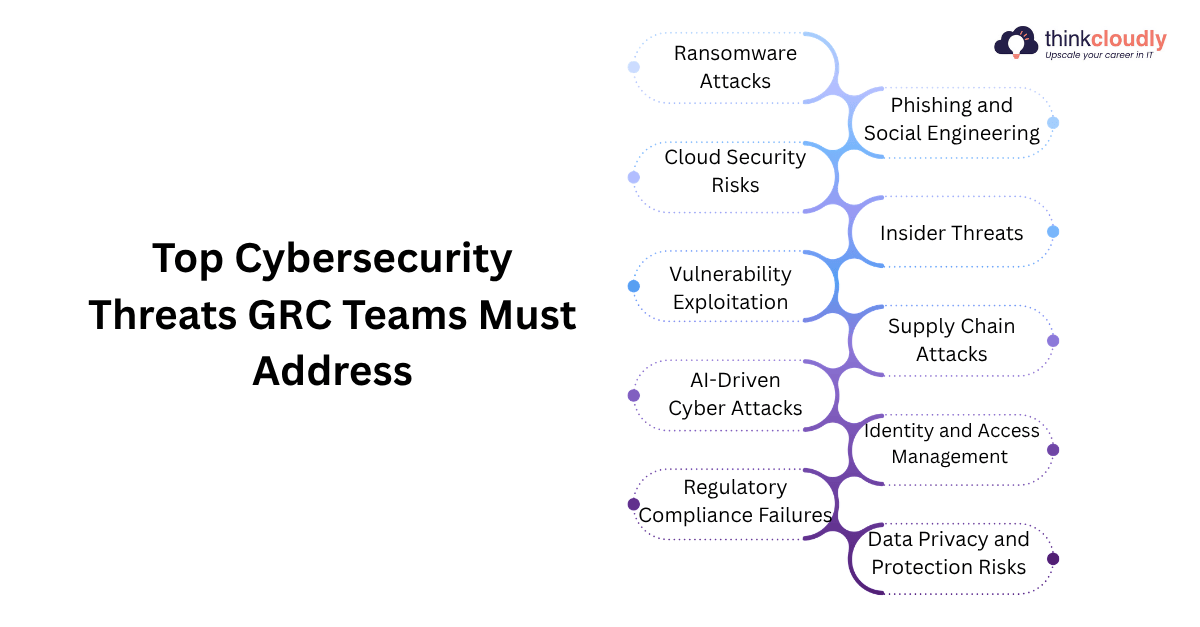
1. Ransomware Attacks
This is one of the most dangerous threats in today’s modern world. Attackers use advanced techniques like double extortion to interrupt the operations and affect the financial and digital conditions of the organization.
Key factors that indicate this risk are:
- Encrypts the sensitive data of the business
- Demands ransom for data recovery
- Can leak sensitive information
- Causes a delay in further operations
GRC teams must improve their threat management and IT risk management strategies to deal with this type of attack.
2. Phishing and Social Engineering
These attacks mainly target human vulnerabilities and turn out to be the most successful attack among the cybersecurity threats. Having strong vulnerability management can help to deal with this type of threats.
Their way of attack is:
- Use fake emails or messages
- Tricks the user into sharing sensitive information
- Leads to unauthorized access
- Breach from common entry points
Strong security risk management practices are important to reduce the risk.
3. Cloud Security Risks
Adopting the cloud has also increased the chances of new cybersecurity threats due to the lack of controls and misconfigurations.
Key risk indicators for it are:
- Unorganized storage with public access
- Weak authentication controls
- Cloud systems with a lack of visibility
- Risk of data exposure
GRC teams must work to arrange the cloud operation with IT risk management and threat management.
4. Insider Threats
Insider threats can be either intentional or accidental, which makes them difficult to detect and manage. This happens from inside the organization and can cause real harm to the system.
Some ways to increase the chances of this threat are:
- Misuse of access by the employees
- Handling the data carelessly
- Compromised user accounts
- Data leaks from internal sources
Controlling access is the main component of security risk management.
5. Vulnerability Exploitation
The unrepaired and outdated systems are an easy entry point for attackers to enter and become one of the major cybersecurity threats.
Some common reasons for this attack are:
- Outdated software and systems
- Security repair is missing
- Easily available weaknesses
- High risk of compromise of systems
These threats can be reduced by strong vulnerability management practices.
6. Supply Chain Attacks
These threats are growing as the organizations are highly dependent upon third-party vendors and increase the risk of getting affected by it.
Key risk indicators are:
- Vendors can be compromised
- Supply chain vulnerabilities of software
- Data exposure by partners
- Lack of vendor monitoring
GRC teams must focus on IT risk management for dealing with these type of attacks.
7. AI-Driven Cyber Attacks
In today’s world, attackers are using AI to generate more advanced cybersecurity threats that can run automatically, which affects vulnerability management strategies.
Common ways of these attacks are:
- Phishing attacks generated by AI
- Automated creation of malware
- Deepfake scams
- Faster execution of attacks
Advanced threat management and AI-based tools for detection help to deal with these attacks.
8. Identity and Access Management Weaknesses
Weak control over identity is the most common way of cybersecurity threats and harming the system, which is easy to access.
Reasons for these attacks are:
- Applying weak passwords
- Excessive advantage for the user
- Lack of multi-factor authentication
- Access monitoring is poor
GRC teams must work to create strong identity controls for security risk management.
9. Regulatory Compliance Failures
The failure to meet the requirements of regulatory compliance can result in serious consequences.
The effects of not meeting the requirements of regulatory compliance are:
- Legal penalties
- Financial losses
- Reputational damage
- Operational disturbance
Meeting the requirements of regulatory compliance can help to deal with these attacks.
10. Data Privacy and Protection Risks
The main priority is protecting the sensitive information, as data breaches are increasing quickly to affect the main part of the organization.
Reasons for these attacks are:
- Unauthorized data access
- Data leaks and breaches
- Privacy violations
- Regulatory compliance
GRC teams can merge data protection with IT risk management.
Cybersecurity Risk Management Framework
GRC teams must work to adopt a structured approach to manage these cybersecurity threats. Here is the tabular representation of this approach.
|
Area |
Description |
|
Threat Management |
Identify threats and respond to them. |
|
IT Risk Management |
Managing risks that are related to technology |
|
Security Risk Management |
Protection of systems and data |
|
Vulnerability Management |
Identify the weaknesses and fix them |
|
Regulatory Compliance |
Ensuring that the laws are being followed |
This structured approach will help the GRC teams in managing the cybersecurity threats. Vulnerability management plays an important role for identifying weaknesses of the system.
Conclusion
The cybersecurity threats are evolving with the development of modern technology. GRC teams must focus on taking the initiative to identify and deal with these risks accordingly for the purpose of protecting data.
Focusing on threat management, strengthening security risk management, and working with regulatory compliance helps organizations to build strong systems to protect the data accordingly. The vulnerability management and applying regulatory compliance will further enhance the position of security for the systems.
Addressing cybersecurity threats does not mean only protection; it is mainly for the growth and long-term success of the organizations.

