
Generative AI appears magical from the outside. You just input a sentence, press enter, and within seconds, you get an output. However, this is not magic under the hood. It’s a carefully planned distributed system powered by a gen AI models architecture that passes the input sentence through various stages, with real cost, scalability implications, and response time implications.
But this is a genuine question that arises in everyone’s mind: How AI generate text? What is the actual magic behind these responses? In this blog, how do gen AI models work under the hood? You will explore the AI text generation process from input to final output and how AI language models work.
What Are Gen AI Models?
Gen AI models or large language models are complex systems that are developed on vast volumes of text to understand the language of input and provide human-like responses. They help in providing you with tasks such as answering your questions, writing, and translating languages because they understand the context, patterns, and structure of the sentence. These systems are built on strong transformer models to predict and generate output through a specific AI text generation process.
- Provide answers to your questions
- Whenever you feel confused, it gives you content based on your input sentence
- Help you in translating languages
- It also acts as an AI word generator
Overview of Gen AI Model Architecture
Neural networks, particularly transformer models, are used in the framework of the gen AI model architecture that supports gen AI models. In simple words, this architecture works like the brain of an AI language model that helps you in understanding and generating output text in a structured and smart way. It divides the input into smaller parts, processes them through multiple layers, and applies algorithmic methods to produce accurate results. This division helps in modern AI text production is smooth and providing human-based content.
There are three components of an AI model architecture:
- Small pieces of input sentence or text (Token)
- Multiple layers of neural networks
- Algorithmic methods
With the help of these components, large language models are able to understand the content of text, predict the next text, and generate meaningful output from the given token. This is the exact process of how AI generates text by following a step-by-step AI text generation process.
What Are Tokens in a Gen AI Models?
Before moving forward with the AI text generation process, you should know what tokens in gen AI models are. Tokens are basically small units of sentences that the model understands to provide you with a meaningful output.
A token can be in any form:
- It can be a word
- A part of a word or sentence
- Or it can be a character
Let’s take an example to understand the context of a token:
“Artificial intelligence is powerful.”
In this example, tokens are Artificial| intelligence| is |powerful. As we know, AI doesn’t read the whole sentence in once; instead, it breaks it into smaller parts that are known as tokens.
AI Text Generation Process
After knowing all the basics of gen AI models, let’s understand the AI word generator process and how gen AI models create human-like output in just seconds. These AI language models use an advanced transformer model and the attention mechanism to turn your input into meaningful output by breaking it into smaller parts.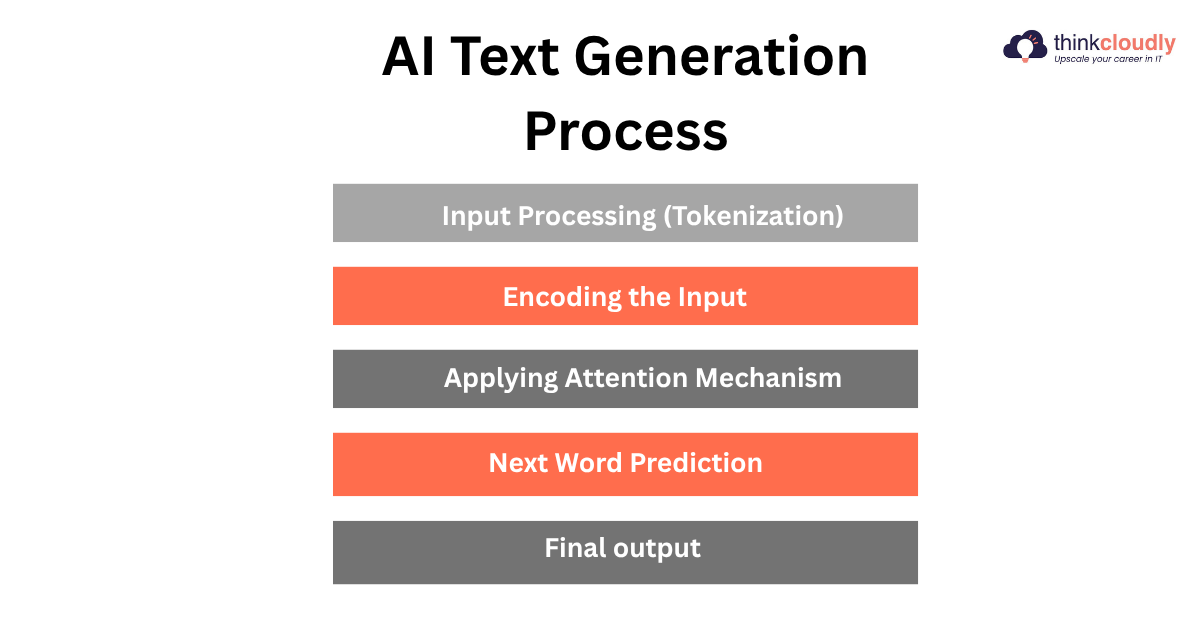
Input Processing (Tokenization)
In this first step of the process, once you provide an input text, the AI language model will break it down into smaller parts, which are known as tokens. A token can be words, part of words, or it can also be a character. It makes the process easy to understand and provides meaningful output.
Encoding the Input
Once tokenization is completed, the next step is to transform it into numbers, also known as vectors. These numerical values help the system to process language mathematically. To analyze the data deeply, it passes the encoded information into transformer models.
Applying Attention Mechanism
In the third step of this process, the attention mechanism helps to focus on the most important words in the sentence. It helps you to understand how words are related to each other and understand the concept. This helps in improving the accuracy and quality of AI text generation.
Next Word Prediction
After applying the attention mechanism, the model predicts the next sentence based on context and probability. It helps you in selecting the most suitable word from various options. This is how the system works in a step-by-step process, just like an AI word generator.
Final output
In the last step of this process, gen AI models keep on working till we get a meaningful response. This process continuously works and creates natural and meaningful text. This is how large language models work on generating human-like outputs.
Understanding the Attention Mechanism
The attention mechanism is the most important part of an AI model architecture. This helps to highlight the important words in a sentence. Instead of treating all words equally, it gives importance to relevant and important words. Gen AI models help in understanding the context and improve the accuracy of the content in AI text generation.
Let’s take an example to understand it clearly. “The dog sat on the mat because it was tired.” In this example, the model understands that “it” stands for “dog” here, using the attention mechanism.
Key Components of the AI Text Generation Process and Their Roles
|
Component |
Role in the AI text generation process |
|
Tokens |
An AI language model helps in processing the text into smaller units known as tokens |
|
Transformer models |
The role is to understand and process the relationships in text |
|
Attention mechanism |
It helps to highlight the important words for better content |
|
AI model architecture |
It helps to structure the entire system |
|
AI word generator |
The role is to predict the next word and generate a complete, meaningful output |
|
Large language models |
This is an advanced system that is trained to work on large datasets |
Challenges of Gen AI Models
With many advantages of gen AI models and large language models, there are some challenges, as they are not perfect as well. Understanding these problems will help the AI word generator. In the AI text generation process, there are some common challenges listed below: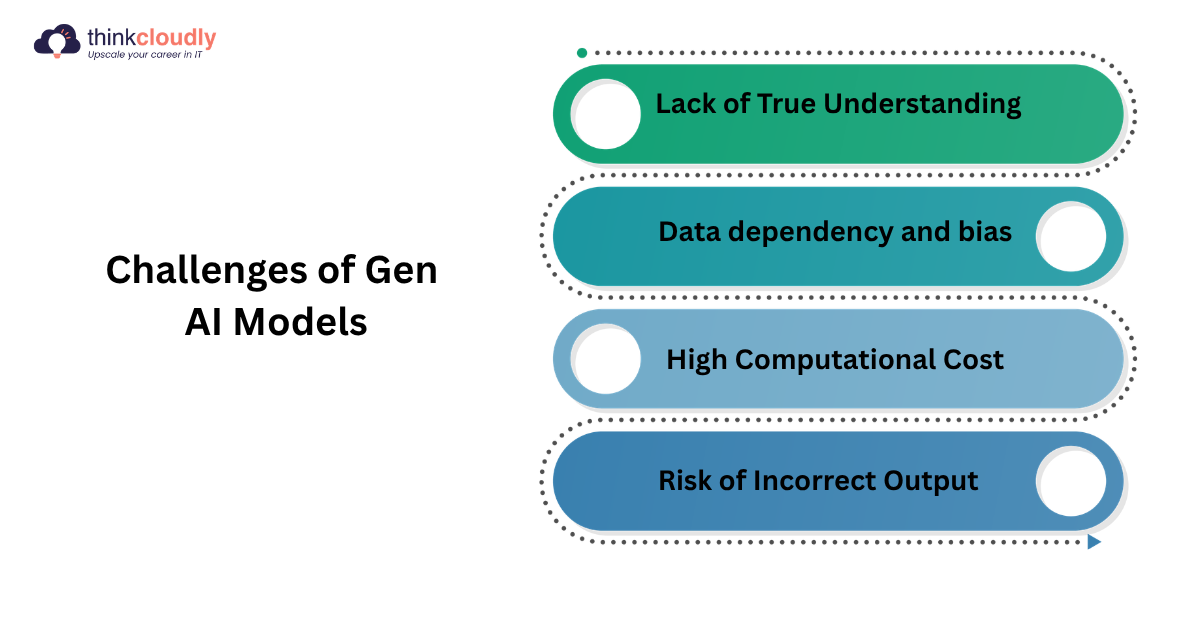
Lack of True Understanding
AI language models and GenAI models don’t generate text based on real understanding; instead, they generate text based on patterns. They usually don’t understand the content as humans do. Sometimes this can’t give you accurate human-based content as per your requirement.
Data dependency and bias
Large language models’ performance is based on the data they are trained on. If the information is incorrect and biased, then the AI text generation process can build misleading and biased output.
High Computational Cost
Because of its high computing power, which is used as a transformer model, it can be costly. This is the common challenge which usually every organization faces, like it can be expensive to run and train these models.
Risk of Incorrect Output
As gen AI can make mistakes too, the AI word generator works on probability, so it can also provide you with wrong information. Human review is needed for accuracy to deal with challenges in the AI word generator.
Benefits of Gen AI Models
After looking into the gen AI models’ challenges, there are a few benefits as well:
- It helps to create blogs, emails, and reports in milliseconds
- It helps to improve the productivity of your task by allowing experts to focus on important work while improving the productivity of your task.
- A Gen AI model is the best tool for communication. An AI language model helps you in creating well-professional emails and messages, improves clarity, and saves time.
- It supports large language models and can handle multiple tasks at once.
Conclusion
Gen AI models are helping most of us in changing the way we work, learn, and create content. The AI text generation process works on how we put the input text to generate meaningful output. AI language model have various benefits with some challenges as well. The benefits of AI model architecture are valuable for both businesses and individuals. They help you to focus on complex tasks and save your time, which helps to improve the productivity of your work.
Question arises: Are you ready to apply this knowledge in your real-life opportunities? If your answer is yes, then Thinkcloudly can help you to start your journey and make your concepts clear through practical knowledge as well.

