

In today’s complex business environment, organizations must successfully balance growth, risk management, and compliance. Integrating GRC business operations is necessary to achieve long- term growth and success. A GRC system offers a structured approach to solve challenges by helping organizations to automate operations and avoid costly penalties.
The question arises: how will you integrate a GRC system into your business smoothly? This blog will guide you through the process and steps to implement GRC integrated risk management into your regular operations without interfering with your productivity.
What is GRC in business operations?
Governance, risk, and compliance are strategic approaches used by organizations to align their objectives, ensure compliance, and identify and manage risk in line with relevant regulations, laws, and industry standards. GRC helps organizations to manage risks, Compliance management, and improve operational transparency. It is most effective when applied through a structured process and clear steps.
There are basically three business functions that are integrated by a GRC system:
- The set of rules, procedures, policies, and guidelines that give guidance and manage your organization.
- Risk management is the process of identifying, locating, and reducing potential risks of your organization.
- Making sure your company complies with all the relevant rules and laws and internal guidelines.
Importance of integrating GRC business operations
It is important for organizations to integrate governance, risk and compliance to maintain good corporate governance, manage risk and ensure compliance with regulations. This not only protects the organization’s reputation but also helps to avoid financial losses. It also strengthens business resilience by connecting processes through effective system integration and better decision-making.
Improve transparency and visibility into enterprise risk
A GRC framework helps organizations to provide a clear view of risk across departments. Businesses can identify risks early and take action with the help of GRC integrated risk management.
Strengthens compliance management
GRC helps organizations to ensure smooth and accurate compliance with the following relevant rules, industry standards, and regulations by reducing the risk of fines, legal consequences, and penalties.
Improve decision-making with real-time insights
GRC helps organizations to deliver real-time data insights for better decision-making. Risks get faster responses and improve overall business operations effectively and efficiently.
Risk mitigation
It helps organizations to identify, assess, and manage risk by including operational, financial, regulatory, and reputational risks. Companies can reduce their cost disruptions, reputational damage, and legal issues by actively addressing these risks.
Operational efficiency:
GRC helps organizations to improve their overall operational efficiency by simplifying governance, risk, and compliance processes. This includes automating workflows, reducing redundancies, and better decision-making.
Key components of successful GRC integration
|
Components |
Description |
|
Governance |
Define decision-making frameworks, roles, and policies. |
|
Risk management |
It helps to identify, assess, and mitigate enterprise risk. |
|
Compliance management |
Ensures compliance with laws, internal policies, and standards. |
|
System integration |
It helps to connect GRC tools with existing business systems for an easy and smooth workflow. |
|
Compliance automation |
Reduces manual efforts by automating repeated compliance tasks |
|
Business resilience |
It prepares organizations to respond to the disruptions effectively. |
Steps to integrate GRC into business operations
After understanding the importance of GRC integration, now let’s discover how to successfully integrate GRC into business operation: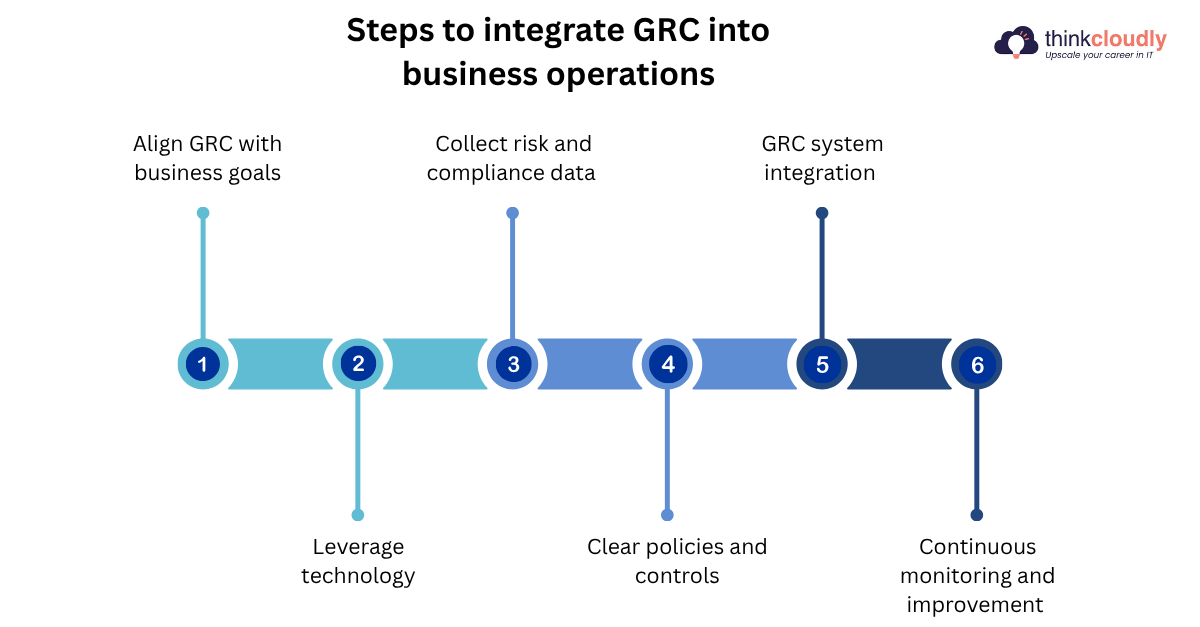
Align GRC with business goals
The first step is to align your GRC strategy by identifying your existing governance, risk, and compliance. This includes evaluating areas for improvement, identifying gaps, and simplifying opportunities. It is important to identify risk areas and compliance requirements that are relevant to your organization.
Collect risk and compliance data
It is a unified platform for GRC integrated risk management, which helps organizations to eliminate data silos. Collecting compliance and risk data ensures that all departments work with accurate and consistent information.
GRC system integration
This helps organizations to connect with GRC tools such as CRM, ERP, and other business applications. By placing GRC activities into your business process, such as project management, strategic planning, and operational decision-making.
Leverage technology
After system integration it is important to invest in technologies and tools such as compliance monitoring tools, data analytics platforms, and risk management software to ensure compliance and simplify your process.
Clear policies and controls
Establish rules, processes and internal controls that act in accordance with legal requirements. Effective compliance management guarantees team accountability. Also encourage GRC centric culture of compliance automation, risk awareness and ethical decision-making in your organization.
Continuous monitoring and improvement
GRC integration is not a one-time task it is important to regularly update and review your processes to ensure they remain effective and relevant in the evolving business environment and regulatory landscapes. Continuous monitoring helps organizations to adapt to changing regulations and risk scenarios.
Common challenges in GRC integration
It is a complex process to integrate GRC business operations into your daily workflows. Organizations often face various common challenges related to integration, managing enterprise risk and compliance management.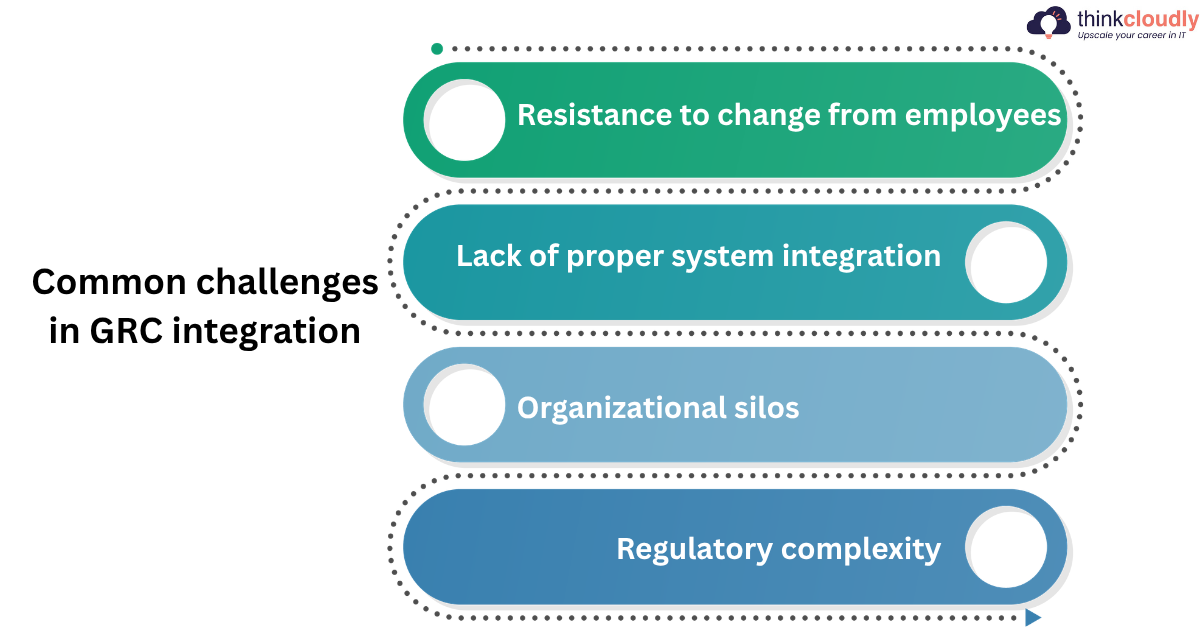
Resistance to change from employees
This is a common challenge where employees usually find it difficult to adapt to new processes and tools. This may affect the workflows and slow down the adoption of compliance. Training and awareness might help employees to understand the value of GRC integrated risk management.
Lack of proper system integration
GRC tools cannot smoothly integrate with current corporate activities in the absence of efficient integration. This will result in data sharing delays and inadequate compliance automation procedures. Well integrated system helps to improve the efficiency and supports better risk management.
Organizational silos
Many organizations struggle with breaking down the traditional silos within business operations where different teams often store data separately. This makes it difficult for the GRC Framework to provide a unified view of enterprise risk. The solution for this challenge is to break silos through system integration, which improves collaboration and decision-making.
Regulatory complexity
It is difficult for many organizations to handle multiple regulations; keeping track of all requirements takes a lot of time and effort without compliance automation. The GRC business operations approach makes compliance and helps to build strong business resilience.
GRC Tools & Technologies for Business Operations
There are several tools and technologies to seamlessly integrate GRC into business operations:
GRC management software
This platform helps organizations to manage enterprise risk, manage governance and compliance management in a controlled and centralized manner to improve the overall business resilience.
Risk management software
This tool supports organizations in authorizing GRC integrated risk management by providing a structured approach to assessing, identifying, and mitigating risk across strategic, financial, and operational areas.
Compliance monitoring and reporting tools
These solutions help to strengthen compliance management within GRC business strategy by staying updated with regulations and allowing compliance automation for real-time reporting and monitoring.
Data analytics and business intelligence tools
These tools help organizations to support GRC business techniques through advanced insights by identifying the data related to enterprise risk and improving overall business resilience through better decision-making.
Conclusion
Integrating GRC business operations into daily workflows requires proper planning with the help of the right tools, and a focus on continuous improvement. By aligning GRC integrated risk management, compliance management, and system integration, organizations can simplify business operations and improve the overall efficiency.
At Thinkcloudly, we understand how important it is to create a strong foundation that supports both long-term business resilience and enterprise risk management. Businesses can create a more connected and secure environment with the help of compliance automation and modern GRC practices.
A well-integrated GRC business operations strategy not only reduces risks but also strengthens compliance, supports sustainable business growth, and improves transparency.

