
Today, organizations are increasingly adopting Governance, Risk, and Compliance (GRC) frameworks to deal with risks and ensure compliance. GRC is really important, and a lot of companies still struggle due to GRC implementation challenges, which often lead to GRC implementation failures. It is mandatory to know why GRC (Governance, Risk, and compliance) implementation does not work for some companies.
There can be many reasons behind GRC implementation failures, such as poor planning, GRC strategy mistakes, and wrong GRC tool implementation. These issues often result in major GRC program failures.
To overcome these GRC implementation challenges, we have created this blog. Through this blog, we will talk about the common GRC mistakes people make with Governance, Risk and Compliance. We will also see the challenges companies face when they try to implement GRC (Governance, Risk and Compliance). I have tried to share the best GRC implementation strategy along with GRC implementation best practices.
What is GRC Implementation?
The process of integrating governance, risk management, and compliance practices into an organization is called GRC implementation, and it involves:
- Making clear rules and guidelines
- Finding possible problems and handling them
- Ensuring everything follows laws and rules
- Using tools and methods to track work and report them
Following GRC implementation best practices helps organizations reduce these challenges and avoid GRC implementation failures.
Top Common GRC Implementation Failures
GRC implementation is not just about tools; it is about the right strategy and execution. Many organizations face GRC implementation challenges due to common GRC mistakes, which ultimately result in GRC program failures.
If you want to build a successful GRC program, then avoiding these common mistakes are necessary.
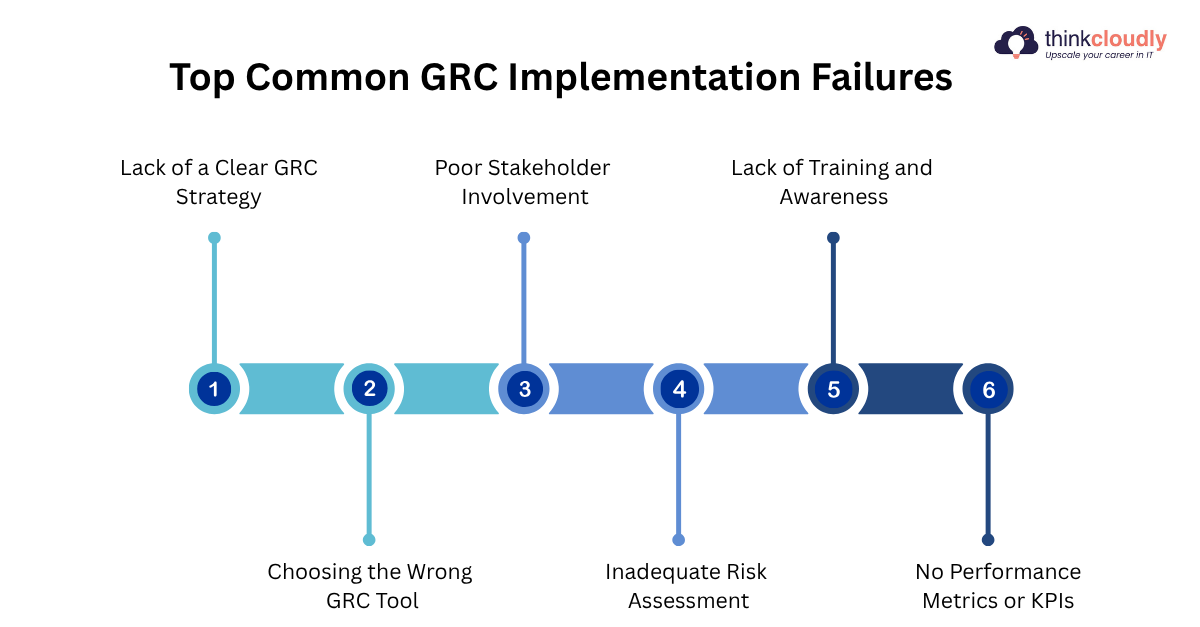
Lack of a Clear GRC Strategy
One of the most critical GRC strategy mistakes is starting without a clear plan. This is one of the main reasons why GRC implementation fails and leads to repeated GRC implementation failures. Without a clear plan, organizations face GRC implementation challenges and struggle to follow GRC implementation best practices.
Solution:
- Set clear goals and KPIs
- Align GRC with business objectives
- Define roles and responsibilities
- Create a step-by-step roadmap using the best GRC implementation strategy
Choosing the Wrong GRC Tool
If you are using the poor GRC tool implementation, then it can significantly impact the success of the entire GRC program.
Many organizations use complex tools with unnecessary features that cannot scale with their needs. Always try to use the right tools according to organizational needs because selecting the wrong tool adds complexity and confusion. It also creates dependency issues if it doesn’t integrate well with existing systems.
Solution:
- Evaluate tools based on business needs
- Ensure easy integration with existing systems
- Prioritize user-friendly interfaces
- Check scalability for future growth
Wrong tool selection is one of the most common GRC strategy mistakes and a key reason why GRC implementation fails. Always try to follow the right GRC implementation best practices for tool selection.
Poor Stakeholder Involvement
Lack of stakeholder involvement is one of the major common GRC mistakes. Because it can affect multiple departments such as IT, compliance, and finance. This issue is also a strong reason behind GRC program failures and explains why GRC implementations fail in many organizations. It creates silos and increases GRC implementation challenges, leading to GRC implementation failures.
Solution:
- Engage leadership and decision-makers
- Involve IT, compliance, legal, and finance teams
- Assign clear ownership for tasks
- Apply the best GRC implementation strategy and encourage collaboration across departments
Inadequate Risk Assessment
Risk assessment is a backbone of any GRC program. Weak risk assessment can be a key factor behind GRC implementation failures. Without proper risk identification and prioritization, organizations cannot focus on what truly matters, which increases GRC implementation challenges and leads to poor decision-making. It is one of the most overlooked and common GRC mistakes and a major reason why GRC implementations fail.
Solution:
- Conduct regular risk assessments
- Update risk registers frequently
- Use data-driven insights for decision-making
- Monitor emerging threats
Lack of Training and Awareness
Lack of training is one of the most repeated common GRC mistakes. If employees do not know how to use the strategies and tools, even the best ones will not work. This is a major problem in GRC implementation. A lot of organizations do not think that training is important, and they think that teams will just learn on their own. If employees are not aware of what to do, they will not do it. Without awareness, even the best GRC tool implementation can fail and lead to long-term GRC program failures.
Solution:
- Conduct regular training sessions
- Provide role-based learning programs
- Keep employees updated on new regulations
- Promote a culture of compliance and accountability
No Performance Metrics or KPIs
Organizations need goals to measure their GRC program’s success. Without these goals, they can’t track progress or identify problems. This often leads to GRC implementation failures and increases ongoing GRC implementation challenges, which further results in GRC program failures in the long run. KPIs help organizations see what’s working and what needs to get better. Without KPIs, they make decisions based on guesswork, which becomes one of the most common GRC strategy mistakes.
Solution:
- Define clear KPIs (risk reduction, compliance rate, audit success)
- Use dashboards for tracking performance
- Conduct regular audits and reviews
- Continuously improve based on insights
Conclusion
GRC is not just a process or tools you use; It is a complete strategy that helps organizations manage risks. It ensures compliance and improves decision-making. However, many organizations face GRC implementation failures because they do not plan well they do not know enough knowledge. Organizations that follow a structured GRC approach are better prepared to handle risks.
As we discussed, the most common GRC mistakes such as wrong tool selection, unclear strategy, lack of training, and missing KPIs often lead to serious GRC program failures. To make GRC work, we need to understand why it fails. Understanding GRC implementation is the first step toward building a strong and effective framework.
By doing this, companies can reduce GRC implementation challenges and avoid future GRC implementation failures.

