

What if your organization is secured but does not meet the requirements, or meets the requirements but is not fully secured? In today’s modern digital environment, being secure is not enough, organizations should also follow the regulations and meet the standards. This is the reason GRC security is introduced and plays an important role in making the connection between cybersecurity and GRC.
Organizations are dealing with advanced cyber risks and the challenges due to these attacks. Cybersecurity and GRC need to work together to deal with these risks and challenges. The merging of GRC cybersecurity with governance risk and compliance makes sure that risks are managed properly and ensures that regulations and requirements are met.
In this blog, you will explore how GRC security connects cybersecurity and GRC to create a smarter strategy for risk management. This merger also strengthens GRC risk management by ensuring the risk are identified and handled.
Understanding GRC Security and Cybersecurity
To understand the working of both GRC security and cybersecurity governance, it is necessary that you focus on them individually and see how GRC security helps to combine them. This plays an important role in improving GRC risk management.
The main focus of cybersecurity is to protect the data, and GRC makes sure that these protections are arranged properly. GRC security acts as the bridge that merges both into a single framework and makes them work together.
The main elements of GRC security and cybersecurity are:
- Cybersecurity protects the digital information security for the organization
- GRC makes sure governance risk and compliance
- Both work together as a single framework
- GRC security works to arrange both for structured GRC risk management
This merging of both helps in making strong information security and business strengths and highlights the importance of GRC cybersecurity.
Why Is GRC Security Essential in Modern Risk Management?
In today’s environment, organizations are facing complex risks that need more than remote solutions. GRC security makes sure that GRC risk management is arranged according to the needs of both security and compliance.
The main reasons GRC security is important are:
- An increasing number of cyber threats and the requirements of compliance
- The need for GRC risk management
- The demand for immediate visibility and control
- The growing importance of GRC cybersecurity governance
Organizations are moving from reactive to proactive GRC risk management by combining GRC cybersecurity with GRC governance.
Key Ways GRC Security Connects Cybersecurity and GRC
GRC security plays an important role in bringing cybersecurity and governance together and making a unified strategy. Instead of working separately, organizations need this approach where both work together and help in the risk management and compliance process accordingly. By the combination of GRC cybersecurity and GRC risk management, businesses can improve their visibility and can respond to evolving risks. This improves the cybersecurity governance.
The main ways to connect cybersecurity and GRC are:
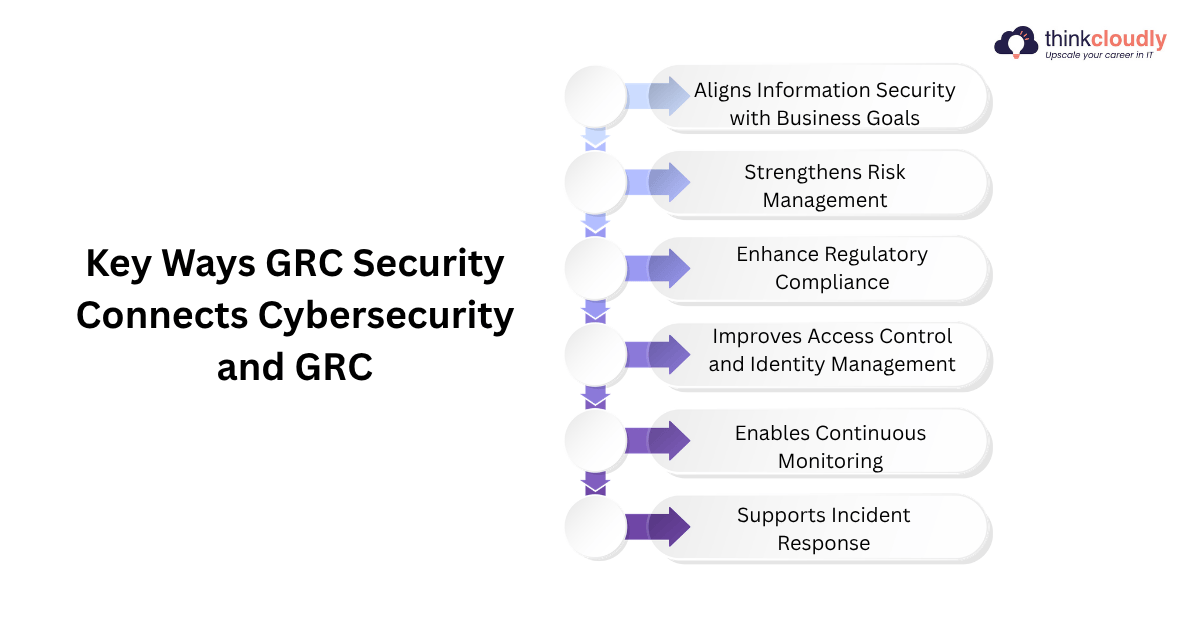
1. Aligns Information Security with Business Goals
One of the most essential roles of GRC security is to make sure that GRC cybersecurity supports the objectives of the business in place of working all alone. This improves cybersecurity governance in the organization.
Some ways of working for it are:
- Security policies are arranged with the business strategy
- Decisions must be taken based on risks.
- Merging with the governance risk and compliance framework
- Investment in information security must add value to the business
2. Strengthens Risk Management
A successful GRC risk management requires the collaboration between cybersecurity and GRC teams. GRC security makes sure that the risks are identified and managed properly.
The key benefits of it are:
- Good visibility of cyber risks
- Prioritization of important threats
- Monitoring and reporting continuously
- Improves decision-making
All this is done through advanced GRC solutions.
3. Enhance Regulatory Compliance
Compliance is one of the most important concerns for organizations. GRC security makes sure that GRC cybersecurity governance controls are in a condition to meet the requirements of regulatory compliance.
The main areas covered under this are:
- Regulation for data protection
- Standards for industry compliance
- Implementation of internal policy
- Automate the compliance processes
All this helps to reduce the manual effort with the help of risk compliance software.
4. Improves Access Control and Identity Management
Access control is an important area where cybersecurity governance overlaps with GRC. GRC security makes sure that the policies of access are both secure and compliant. Strong access control is important for securing systems. This improves information security.
The main practices for this are:
- Role-based access control
- Multi-factor authentication
- User monitoring continuously
- Reduces unauthorized access
This can be done with the help of access control, which improves information security. Access control helps to reduce internal and external risks.
5. Enables Continuous Monitoring
Modern organizations need immediate visibility for risks and compliance. GRC security is continuously monitoring the systems. It supports access control by tracking the activities of users.
The main benefits of this are:
- Real-time dashboards
- Automated alerts
- Early detection of threats
- Use of advanced GRC tools
All these help in the analysis of threats and dealing with them. Continuous monitoring of information security practices. This strengthens cybersecurity governance frameworks.
6. Supports Incident Response
If any security incident occurs, both cybersecurity and GRC must work together to deal with it. GRC security makes sure that these incidents are handled properly and in compliance with policies.
The main functions for this are:
- Documentation for the incidents
- Analysis of the root cause
- Reporting of compliance
- Improves the effectiveness of GRC cybersecurity
Overview of Framework for Cybersecurity and GRC
The main components of GRC security are given below in a tabular format.
|
Components |
Description |
Key Activities |
Benefit for the Business |
|
Governance |
Mainly defines the structure of policies and decision-making for security and compliance |
Create policies, supervision and access control |
Make sure to align with business goals and accountability |
|
Risk Management |
Identify, analyze, and manage risks across the organization |
Risk assessment, Risk prioritization and planning to reduce them |
Reduce the exposure to cyber and operational risks |
|
Compliance |
Ensures that regulatory and legal requirements are met |
Compliance tracking, audits and reporting |
Avoid penalties and maintain the trust of the regulatory authorities |
|
Cybersecurity |
Protects the systems and data from cybersecurity threats |
Threat detection, incident response and vulnerability management |
Strengthen the information security |
|
Monitoring & Reporting |
Provides continuous visibility of risks and compliance status |
Real-time monitoring, dashboards and alerts |
Enables faster decision-making and risk handling |
These frameworks are based upon governance risk and compliance principles.
Role of GRC Security Tools and Solutions
Modern technology plays an important role in implementing GRC security. Organizations depend on modern GRC tools to manage risk and compliance effectively.
Some common GRC tools and solutions are:
- GRC Risk management platform
- Systems for tracking compliance
- Audit management GRC tools
- Merging GRC solutions
Many security companies apply these GRC tools solutions to simplify complex environments.
Conclusion
In today’s digital environment, cybersecurity and GRC must work together to manage the risks properly. GRC security provides a proper unified framework that merges security, governance and compliance into a single strategy. Cybersecurity governance ensures long-term success.
By using GRC tools, it strengthens access control and aligns with governance risk and compliance frameworks, organizations can make secure systems with the help of this. While the challenges exist, GRC security is beneficial for us. Organizations must invest in GRC cybersecurity governance to stay secure. Strong information security and GRC tools are important for businesses.
GRC security with governance risk and compliance is not just about protecting the systems, it is about growth and building trust for long-term success. This improves the overall GRC risk management.

