

Diffusion models have emerged as one of the most powerful techniques in modern AI models in recent years, particularly in the area of score-based generative models. The AI image production process usually makes frequent use of these models, this technology allows you to produce extremely realistic images, movies, and even music. Diffusion probabilistic models in generative AI are continuously transforming the way machines produce content by using tools like image generators to advanced creative systems. However, how do these models work, and what are diffusion model examples and types? Let’s explore it in a straightforward manner.
What Are Diffusion Models?
Diffusion models are a type of generative AI model designed to show how the tiny particles slowly spread out from one place to another over time. Discover the process and learn the how to generate data by progressively introducing noise and then reversing the whole process.
In simple terms, they:
- To begin, start with clean and clear data (such as an image)
- Step by step add noise
- Just have a knowledge of how remove that noise to recreate the original data
How Diffusion Models Work in AI
There are two main steps for the workflow of the generative diffusion probabilistic models: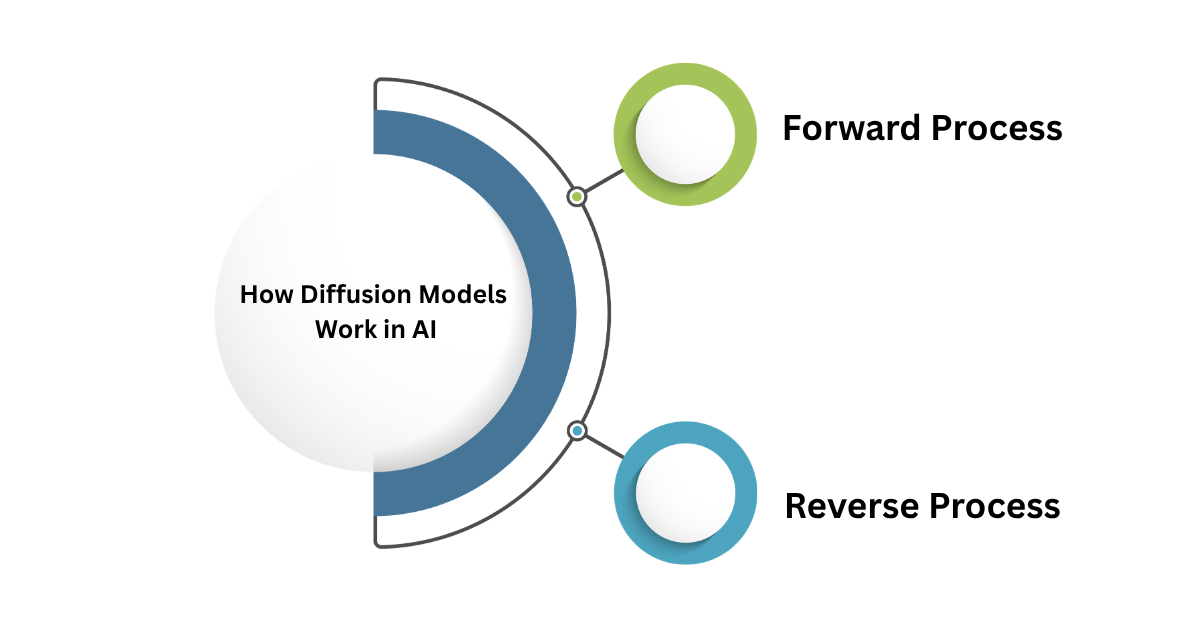
1. Forward Process (Adding Noise)
In this forward process, the functioning of this model is to slowly add random noise to the data. For an example, an image becomes more and more distorted until it turns into pure noise. This step helps the model to understand how data changes over time, which is important for building powerful models.
2. Reverse Process (Removing Noise)
In this reverse process, the model will help you to remove the noise step by step. The process starts from random noise and gradually reconstructs a meaningful image or data. This is the most important process of generative ai models, diffusion probabilistic models learn how to create patterns and recreate high-quality outputs.
Why It Matters in AI
By improving both the quality and accuracy of generated data, diffusion probabilistic models are crucial to contemporary models. Their increasing application in generative AI models demonstrates how successful they are at producing different and realistic results.
Stability and Diversity in Outputs
Diffusion generative models are used for producing strong and high-quality results in models. Different traditional generative AI models like GANs help to avoid repeating similar outputs and create more realistic and diverse ones.
Rapid Adoption in AI Image Generation Process
Diffusion models in generative AI are widely used in the AI image generation process, such as text-to-image and image editing. There are various tools like Stable Diffusion that use the latent diffusion approach to create detailed and high-quality visuals from simple text inputs.
Expanding Applications Beyond Images
Diffusion probabilistic models are now used in audio, healthcare, and other industries. These types of diffusion model examples help to generate accurate data by making them useful in real-world AI models just beyond the images.
Types of Diffusion Models
There are three main types of diffusion models that are mostly used in modern approach, each model is designed to handle the AI image generation process in different ways. These generative AI models usually follow the same concepts, but they use different techniques to generate high-quality and realistic outputs.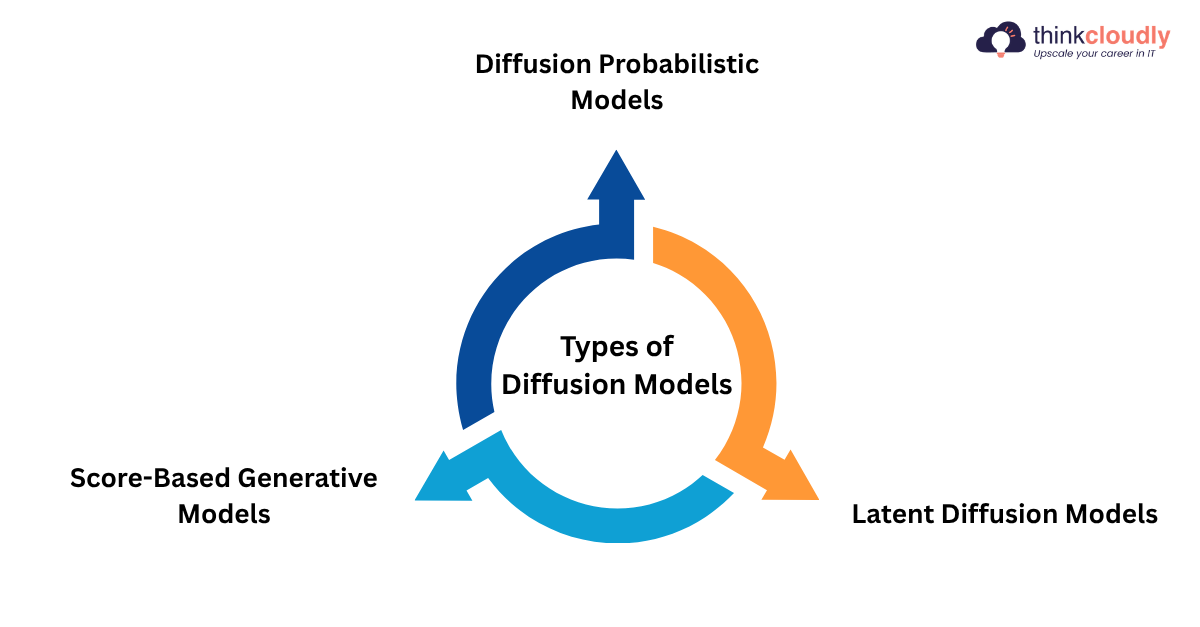
Diffusion Probabilistic Models
These are the most commonly used diffusion models in generative AI. They work by adding noise to data and then understanding how to step by step reverse the noise. In simple terms, we can say that this model helps us to understand how data gets distorted and bring it back to its original form, like it was before. This makes them very effective in the AI image generation process and other applications where accuracy is important.
Score-Based Generative Models
These score-based generative models focus on learning how to improve noisy data by estimating the direction in which the data should be adjusted to become clearer. Score-based generative models are known for producing high-quality and stable outputs in generative AI models. They are especially useful when creating detailed images, as they refine the data gradually for better results.
Latent Diffusion Models
This is a little bit different from other models, as latent diffusion models do not work directly on full-size images. Instead, they operate in a smaller or compressed representation of the data. This approach makes them faster and more efficient, as in this model, computational power is very low according to other types. Because of this technology, they are widely used in real-world tools for AI image generation and applications where speed and performance are important.
Difference between Diffusion Models vs LLM Models
Diffusion score-based generative models are mainly used for generating videos, images, and other media by transforming noise into realistic outputs. Whereas LLM models (Large Language Models) are designed to understand and generate more human text. As per my analysis, both types of models have their importance, but they focus on different types of data and cases.
|
Feature |
Diffusion models |
LLM Models (Large Language Models) |
|
Primary Use |
It is used for media and image generation |
It is used for language and text generation |
|
Data type |
It specializes in audio, video, and images. |
It specializes in language data and text |
|
Working approach |
It helps to refine noise into clean data step by step. |
It helps to generates text based on data |
|
Common application |
Design tools, AI image generation |
Content writing, translation and chatbots |
|
Role in generative AI |
Its role is to create visual content |
Its role is to generate text-based task and language |
Challenges of Diffusion Models
While there are many benefits of diffusion ai models because of their powerful and generative modern AI, they also come with certain challenges. It’s important to analyze challenges for developers and businesses before implementing them in real-world applications. These limitations mainly relate to performance, speed, and the complexity of building and training such models.
Require high computational power
Diffusion models need strong hardware like GPUs to process large amounts of data. This can increase costs and make them less accessible for smaller teams or beginners.
Slower compared to some other AI models
These models follow a process to work step-by-step to refine noise, which is time-consuming. Compared to faster models, this can affect real-time performance in some use cases.
Complex training process
Training score-based generative models involves multiple steps and advanced techniques. It requires strong technical knowledge to build, train, and optimize these models effectively.
Future of Diffusion Models in AI
The future of diffusion models in generative AI looks very promising. As nowadays technology evolves, these models will become faster, more efficient, and more accessible.
They are expected to play a major role in:
- Content creation
- Design automation
- Virtual environments
Conclusion
Diffusion models are transforming the way modern AI tools to generate content. From the AI image generation process to advanced creative tools, they are the most important section of many innovations in generative AI models.
By understanding how diffusion probabilistic models, score-based generative models, and latent diffusion models work, businesses and professionals can better leverage AI for creative and practical applications.

