

What if you just write an idea about something and get a full explanation with everything you want instantly, an article, an image or even a working app in just one click? This is not just a thought anymore. That’s generative AI in 2026.
From creating impressive AI image designs to working on the operations of the company by the use of AI tools, generative AI has been the most powerful development in modern AI technology. Understanding the concepts of generative AI is important for students, working professionals, AI in business or AI in healthcare for the purpose of AI generation.
In this detailed guide for beginners, you will explore everything you need to know, from basics to real-world applications and future trends, about this AI technology.
What is Generative AI?
Generative AI is among the types of AI that can create new content from itself, in place of just analyzing the existing data. It learns from different patterns and uses them to create original results like text, images, audio and video. Unlike traditional AI technology, generative AI doesn’t just respond, but creates.
Some common examples of generative AI are:
- Writing blogs, emails and reports
- Creating a realistic AI image
- Generating code and software according to the requirements
- Produce music or videos
This process can be called as AI generation, where machines produce the content by using AI tools based on the prompts given by humans. Implementing AI in business is beneficial for the organizations in many ways.
How does Generative AI Work?
Generative AI works on the process of learning different patterns from a large amount of data and then using these patterns for creating new and original content based on the given instructions. It analyzes information using AI tools and produces text, images, code or audio with the help of AI generation.
Step-by-Step Working of Generative AI
To understand the working of Gen AI properly, it is important to break down the process into simpler steps. These steps will help you to know how the system learns from data and processes user input to generate meaningful outputs by using AI technology for AI generation.
The steps to show the working of Gen AI are: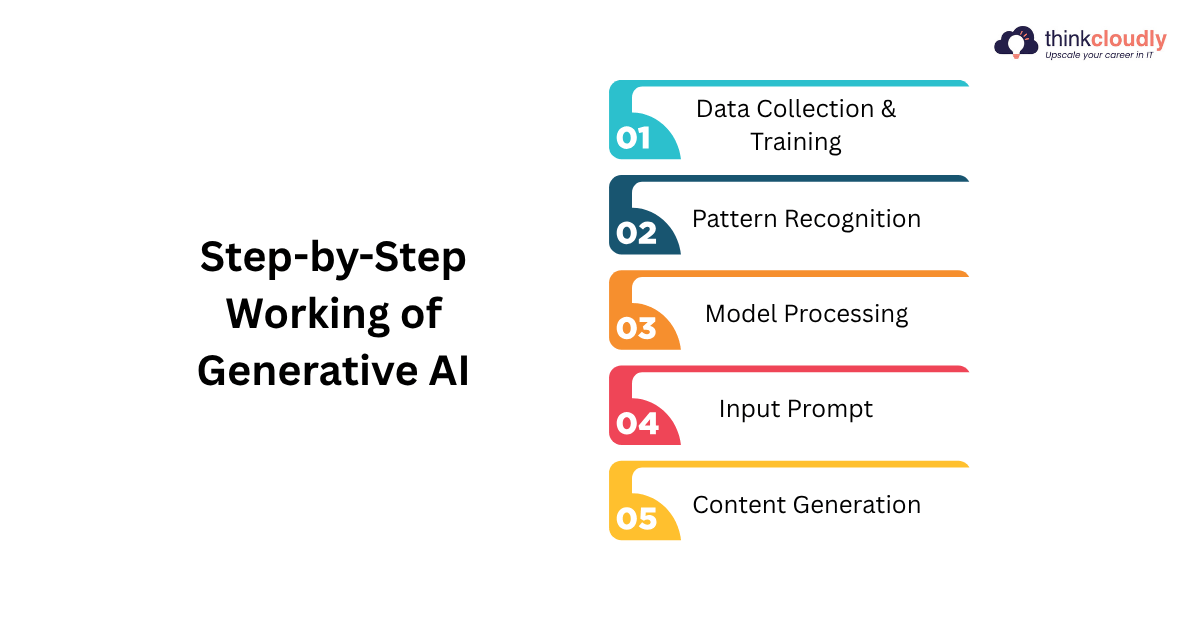
1. Data Collection & Training
To work with generative AI, you have to train it by using huge datasets such as text, images or videos.
The process followed by Gen AI is:
- Learns from different sources like books and websites
- Understand the patterns and structure of data
- Builds a strong AI generation foundation
- Improves the quality of the text of AI image
The quality of data impacts the output directly.
2. Pattern Recognition
After proper training, the system is capable of identifying the patterns and relationships between the data.
Gen AI recognize the patterns by:
- Learning grammar and the structure of sentences
- Recognizing shapes, colors and styles for AI image
- Detecting the sequence and logical connections between the data
- Understanding the difference between the data elements
AI technology, like neural networks, is used in this step for AI generation.
3. Model Processing
The input processing in Gen AI is done by using deep learning models such as transformers.
The input processing is done by:
- Breaking them into simple and smaller units, such as tokens
- Analyzing the context and meaning of the input
- Predicting the output on the basis of probability
- Refining the result continuously to maintain accuracy
This is the core processing AI technology of generative AI.
4. Input Prompt
This is the step where the user provides the instructions, known as a prompt, to guide the AI technology.
Working in this step are:
- Accepts the text-based input in the AI tools
- Understands the instruction given in the prompt
- Adjust the result according to the requirements of the user
- Different formats are used, like text, code, or an AI image, according to the requirement
The instructions should be like “Write a blog on AI in healthcare” or “Create an AI image of a futuristic plan”.
5. Content Generation
Finally, after following all the steps, the system creates new content based on the data patterns and input.
The result is like:
- Produces text, emails or code
- Creates different designs and AI image
- Create audio or video too
- Gives fast result with the help of AI generation
This is the final step where the output is prepared in the AI tools.
Different Types of AI
Understanding different types of AI is helpful to see where generative AI stands among the different kinds of AI technology for AI generation.
|
Types of AI |
Description |
Key Features |
Examples |
|
Narrow AI (Weak AI) |
This is designed to perform limited tasks |
Task-specific, limited scope and no self-awareness |
Chatbots, voice assistants |
|
General AI (Strong AI) |
This is capable of doing the conceptual task that a human can do |
Human-like intelligence, reasoning ability and adaptability |
It is still not fully developed |
|
Super AI |
This is the AI that overshadowed human intelligence |
Self-learning, highly autonomous and superior decision-making |
It is considered a future concept |
|
Generative AI |
This is the AI that creates new content by learning the patterns and datasets |
Creative output and pattern-based generation |
ChatGPT, AI Image generators |
These are the various types of AI technology that are used for AI generation.
Key Benefits of Generative AI
The use of Gen AI is increasing among different types of AI because of its wide range of advantages. It is helpful in many ways to make human work easy.
The major benefits of generative AI are: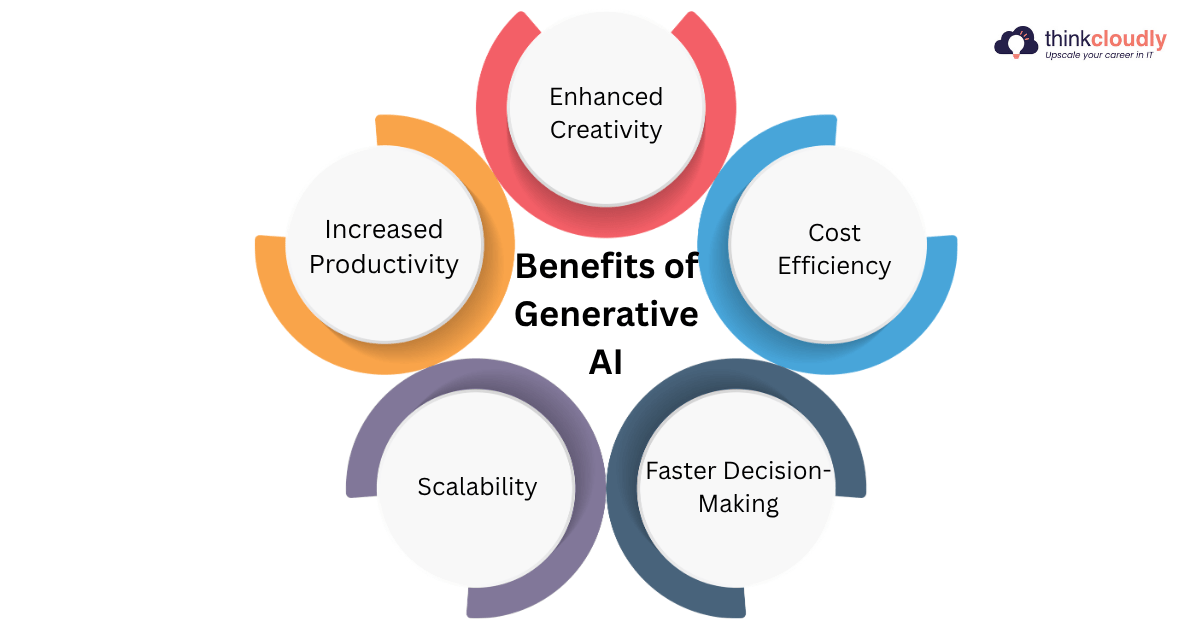
- Increased Productivity: The lengthy tasks that take more time than required can now be done in minutes by using Gen AI.
- Enhanced Creativity: From writing content to generating AI image design, Gen AI helps users to explore new possibilities of creativity.
- Cost Efficiency: This AI technology helps reduce the costs of operations by doing the repetitive tasks by using automation.
- Faster Decision-Making: It helps to give immediate information and automated output to improve the speed of decisions.
- Scalability: Organizations can spread the operations easily by using AI tools.
Real-World Applications of Gen AI
Generative AI is working to develop industries by automating tasks, enhancing creativity and improving the efficiency of work. From creating the content and solving some complex problems, these applications are used in different sectors. Many companies depend upon theAI generation for their problems.
Some of these real-world applications are: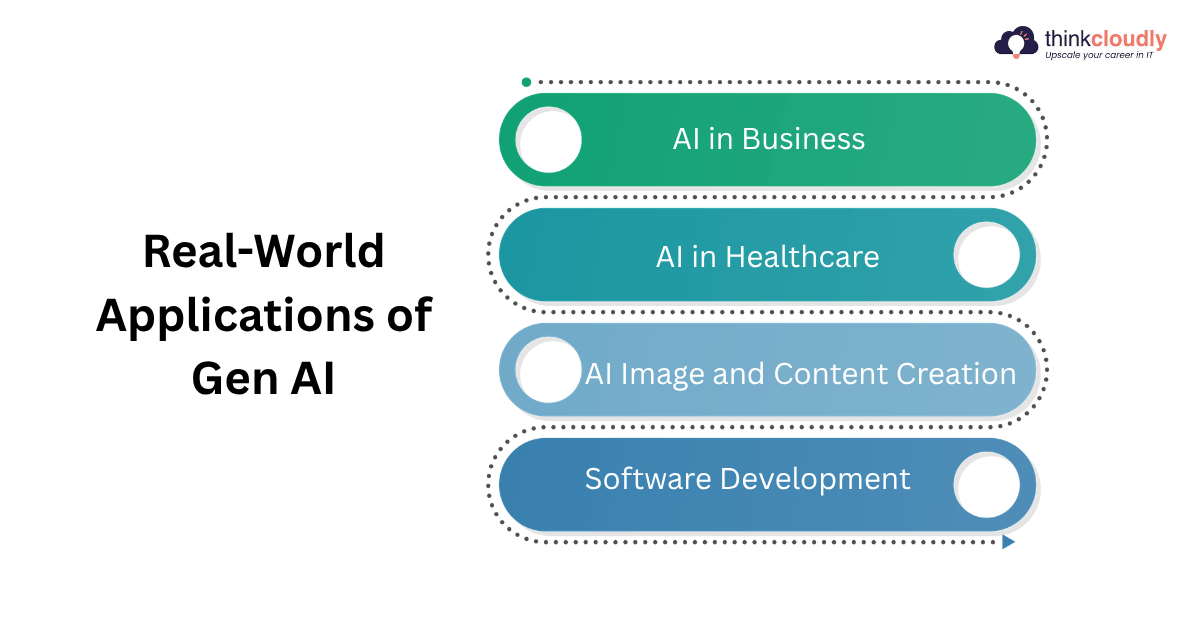
1. AI in Business
Generative AI has a proper impact on AI in business, and helps organizations to improve productivity and reduce costs.
Key benefits of AI in business are:
- Creating content automatically (blogs, ads and emails) by AI tools
- Creating AI-powered chatbots for customer support
- Generating reports and data analysis
- Creating personalized marketing campaigns
AI in business is among the types of AI that is used to follow structured operations and enhance decision-making skills.
2. AI in Healthcare
Generative AI is a game-changer for AI in healthcare that helps in improving the diagnostic, research and care of patients.
The main benefits of AI in healthcare are:
- Discovery of drugs and medical research
- Creating proper documentation and medical reports
- Analyzing images related to medical
- Personalized planning of the treatment by AI tools
AI in healthcare is among the types of AI that helps professionals to make accurate decisions.
3. AI Image and Content Creation
Gen AI tools are mostly used to create AI images and digital content.
The benefits of AI image by AI tools are:
- Branding and graphical design
- Creating content for social media
- Generating video and animation
- Designing games and virtual environments
These types of AI shows how the AI generation is working to develop the creative industries.
4. Software Development
Generative AI is an AI technology that is used by developers to speed up coding and improve efficiency.
The key benefits of it are:
- Generating code and debugging
- Automated documentation
- Assisting in software testing
- Support in app development
It reduces the time of development and enhances the productivity of the application.
Limitations of Generative AI
We know that Gen AI is developing the digital world in a promising way, but it still faces some real-world challenges in the process of AI generation.
A few limitations of using Gen AI are: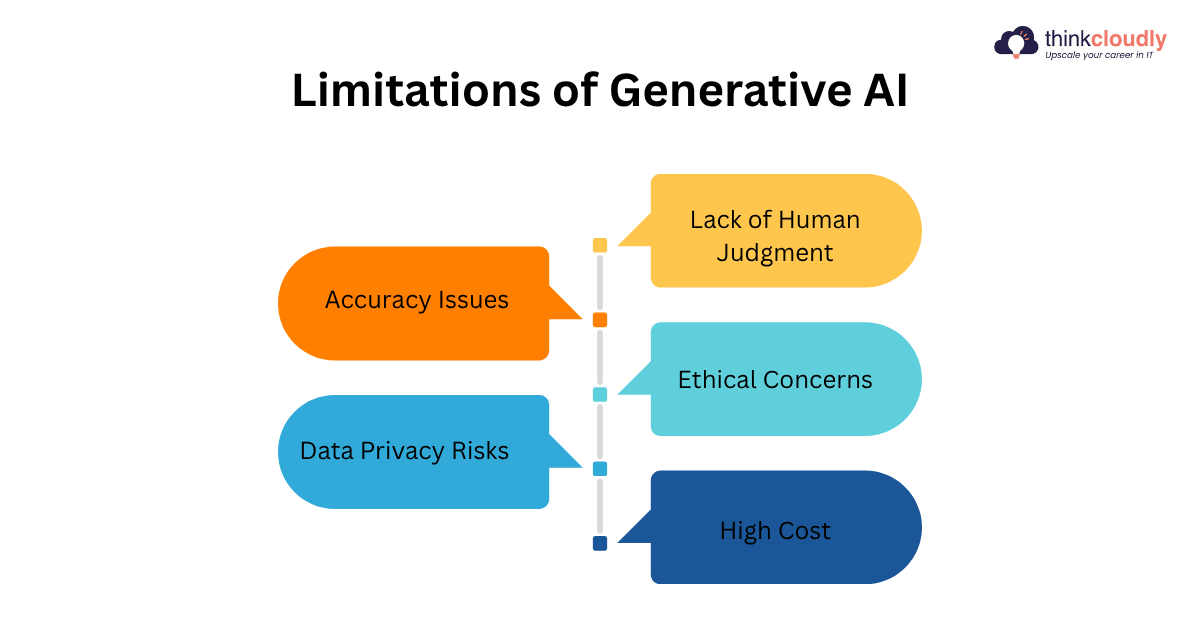
- Accuracy Issues: Sometimes Gen AI can give misleading or incomplete information, which can cause confusion and harm the data. Specially for AI in business and AI in healthcare.
- Lack of Human Judgment: Gen AI tools cannot think on their own, and only work based on given instructions.
- Data Privacy Risks: It can misuse the sensitive information uploaded by us, as it does not have any privacy.
- Ethical Concerns: Gen AI can use your personal information for deepfakes or misinformation.
- High Cost: Implementing Gen AI in business requires resources and a high investment, which can be a little expensive.
Future of Generative AI
The future of generative AI is surely promising, as it is definitely transforming the digital environment in many ways. All types of AI will be improving with better capabilities to learn.
Some key trends used in generative AI are:
- Advanced and intelligent AI tools
- Immediate capabilities for AI generation
- Use in AI in business and AI in healthcare
- Improved accuracy and personalization
As the AI technology develops, Gen AI will be more powerful and accessible in the future.
Conclusion
Generative AI is more than just a trend among all types of AI. It is a proper transformation of the traditional digital environment to a modern one. From generating an AI image to help industries like AI in business and AI in healthcare, it has an impact everywhere.
Understanding Generative AI is the first step for beginners before learning its full potential. The future of AI in business and AI in healthcare depends upon AI and automation.
In future, generative AI will be able to define the way of creation, innovation and interact with AI tools and AI technology.

