

General AI has transformed the way we create smart systems, produce documents, automate tasks, and generate human text in a short time. Recurrent neural networks work as the powerful basis for all generative AI models, whether they are used to create realistic visuals, write code, design products, or create unique user experiences. They allow robots to process vast amounts of data, recognize patterns, and generate new data by simulating the human brain.
If you want to become a generative AI expert and pursue a career in this machine learning subject, the most important and fundamental step is to understand AI neural systems. This blog gives a clear understanding of non-technical deep learning introductions to the workings of intelligent models in generative AI applications and also covers what the functions of recurrent neural networks are, types, their architectures, how they are used in practice, and how they are trained.
What is a Neural Network?
An AI neural system works like a human brain that helps computers to process information and learn from data. It comprises layers of connected nodes (also called neurons) that work together to analyze inputs and produce outputs.
In simple terms, we can say that:
- First step is to take data input
- Then after input, process it through multiple layers.
- Later, after analyzing the input data, it helps to produce a meaningful output.
Neural are a key part of machine learning and are widely used in deep learning models for providing output from data input.
How Neural Networks Work in Generative AI
There is a three-step process of how AI neural models work in generative AI to learn patterns, generate content, and understand how to analyze data sets to create output. They analyze input data through step-by-step relationships and multiple layers, identifying features. They can generate new content such as text, images, or audio that is closely similar to the real data by using this learning.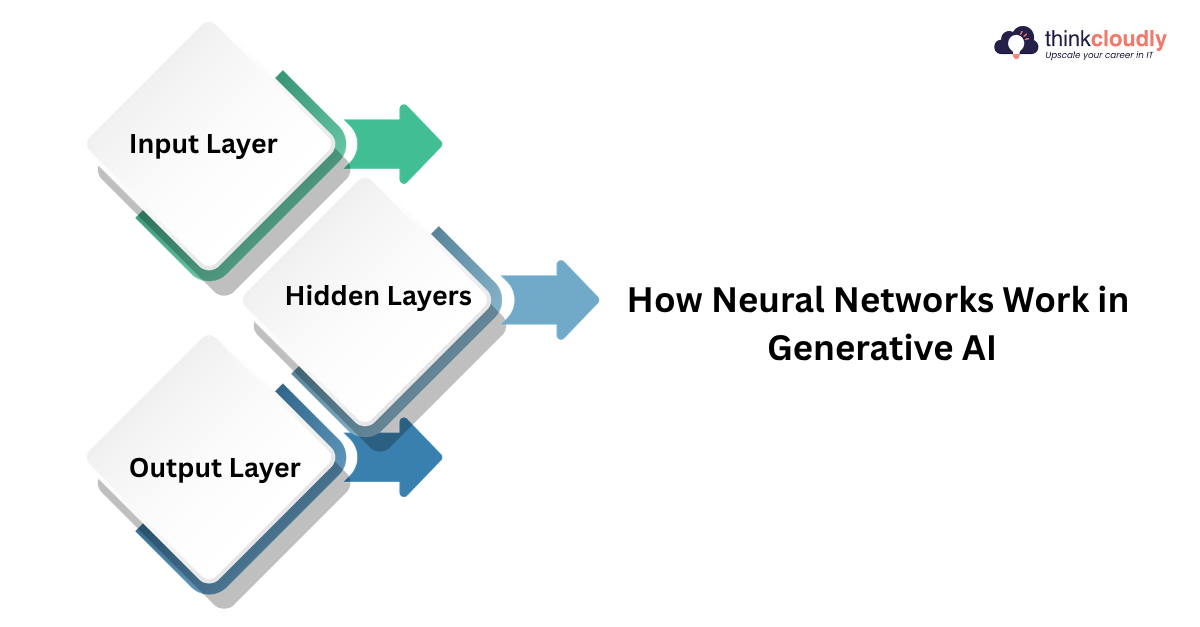
Input Layer
This is the first layer where the AI neural receives input in the form of raw data such as text, images, or numbers. It does not process the data but simply passes it to the next layers. This layer acts as the entry point for all information in the AI neural.
Hidden Layers
It is the main process where input starts processing to work inside the network. These layers identify patterns, perform calculations, and learn relationships step-by-step from the data. In this deep learning, having multiple hidden layers helps the model to understand the complex data more accurately.
Output Layer
This is the final step where the neural produces output based on the input data. It can generate outputs like predicted values, text, or images in a short time. This layer gives the final answer or decision made by the neural network.
Why Neural Networks Is Important In Generative AI
Generative AI models are best to create tasks that involve creativity, imagination, and understanding context. This requires strong AI network capabilities, as they help systems to learn patterns and generate meaningful outputs from the given raw input data.
Here are a few points to make it more clear why to choose it:
- The main function is to identify the patterns that cannot be coded by human beings.
- They provide meaningful output from the given raw input automatically based on data.
- To perform the task, they use large-scale architectures such as GPT and diffusion models.
- They create high-quality and valuable content without losing the worth.
Types of Neural Networks in Gen AI
There are three main types of AI neural models, which are used depending on the task. Their works differ from technology according to their functions.
Convolutional Neural Network (CNN)
It is designed to create image-related tasks. It helps organizations to recognize machine patterns in images such as their shapes, sizes, colours, and objects. CNNs are widely used in facial recognition, image generation, and medical imaging. They are essential in applications where visual data is involved.
Recurrent Neural Networks (RNNs)
Recurrent neural networks are used to work with sequential data such as speech and text. They remember previous inputs and make them useful for language-based tasks. RNNs are commonly used in text translation, speech recognition systems, and generation.
Neural Networks in Large Language Models (LLMs)
Modern large language models like GPT are built for using advanced AI networks. These models are trained on large sets of datasets to generate human-like text. They are widely used in content creation, chatbots, and AI assistants and are an important part of Generative AI.
Key Components of a Neural Network
|
Components |
Description |
|
Input Layer |
The main function is to receive the raw input data for processing |
|
Hidden Layers |
It works as a main function and processes data to extract patterns. |
|
Output Layer |
This is the last step to produce the final output from the raw input. |
|
Weights |
It determines the importance of input data |
|
Backpropagation |
It improves the accuracy of model by reducing errors. |
Backpropagation in Neural Networks
The backpropagation algorithm is the main process that is used to train neural models. It helps the model to improve the accuracy of the output by learning from the mistakes created in the past.
- Here, back propagation is used to make a prediction.
- The main function is to compare the prediction with the actual output.
- At the end, error is calculated and sent backward
This process of prediction and correction is known as back propagation, which adjusts the weights of the network to improve actual performance and output. It is essential for training both deep learning models and machine learning.
Applications of Neural Networks in Generative AI
Intelligent AI networks are widely used across various industries. Here are some key applications: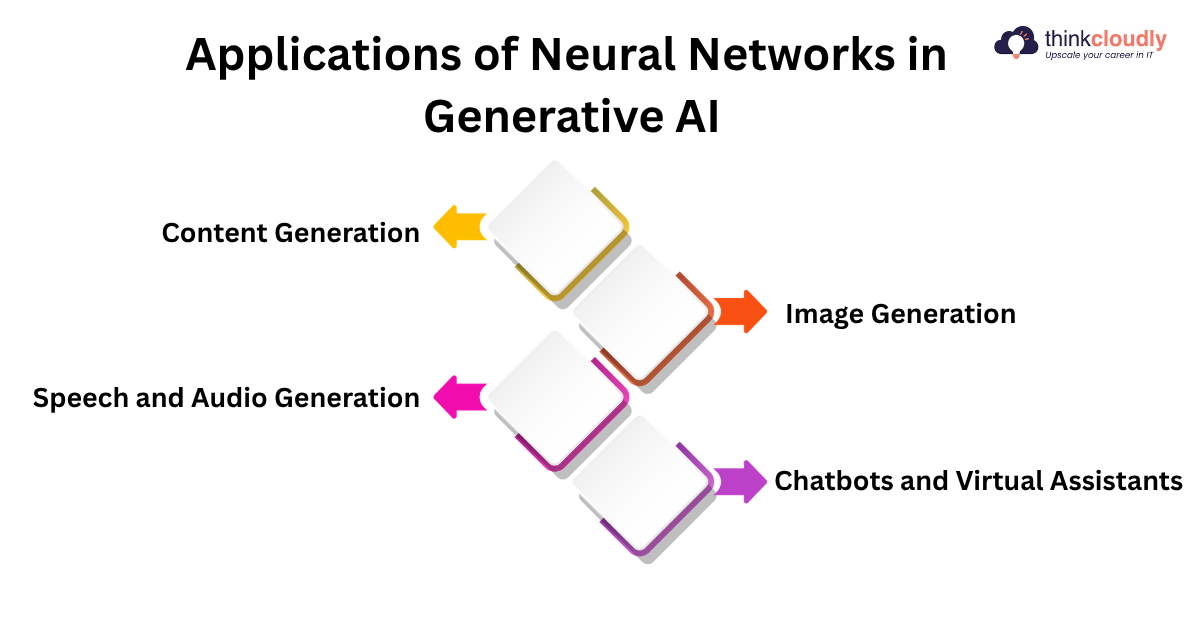
Content Generation
AI Neural help organizations generate humanized blogs, articles, and social media content by providing input to get human-based output. This is widely used in AI writing tools powered by large language models.
Image Generation
AI systems use intelligent network models to create realistic images and artwork. Tools like AI image generators rely heavily on deep learning techniques.
Speech and Audio Generation
Neural networks can generate realistic human-like speech by providing them with text. This is also used to generate audio-based applications and voice assistants.
Chatbots and Virtual Assistants
Intelligent network model power intelligent chatbots that understand and respond to users. These systems use machine learning and NLP for better interaction.
Challenges of Neural Network in Generative AI
AI neural network models play a most important role in generative AI and deep learning to produce expected output, but they also come with several practical challenges. These challenges can affect the performance, cost, and efficiency of machine learning systems.
High Computational
Cost Intelligent network models require high-performance hardware such as GPUs or cloud platforms for training and processing. This increases the overall cost of implementing deep learning solutions. For beginners and small businesses, managing this cost in machine learning projects can be challenging.
Complex Training Process
There are multiple steps like data preparation, model tuning, and performance evaluation. It requires strong knowledge of deep learning and machine learning concepts. Building efficient AI neural models can be difficult without proper understanding of the process.
Data Dependency
Network performance depends on large volumes of high-quality data. In generative AI, poor or biased data can lead to inaccurate data output. To overcome this challenge, it is important to collect data, and preprocessing is essential for improving machine learning results.
Future of Neural Networks in Generative AI
The future of AI neural model technology in Generative AI can be encouraging. It is becoming more efficient with the advancements in deep learning and neural systems.
They are expected to play a major role in:
- AI-driven content creation
- Advanced automation systems
- Smart virtual environments
As technology gets advanced, neural model will continue to improve and expand their applications across industries.
Conclusion
An intelligent neural model is the backbone of modern machine learning and deep learning systems. In Generative AI, neural models are used to create human-based content like blogs, articles, and social media content, solve complex problems by predicting past mistakes, and help to improve decision-making.
We have discussed these three types of networks, which include Convolutional recurrent neural networks, AI neural model and large language models, these technologies are shaping the future of AI. Understanding how neural networks work can help professionals and businesses to use AI effectively without losing the human effect.

