

Did you know that teams who clearly distinguish between their product backlog and their sprint backlog ship features up to three times faster during backlog refinement?
According to industry guides, proper backlog management makes sprint planning three times faster because work is already clear, estimated, and ready to go. Yet in practice, most agile teams—especially those new to the Scrum backlog system—treat these two lists as the same thing. That one misunderstanding quietly derails sprint goals, confuses developers, and adds hours of unnecessary debate to every planning session.
Let’s do it immediately. This guide is designed in simple, basic language—no jargon wall, no assumptions you already know the Agile Framework inside out. Whether you are a product manager, a business stakeholder, or someone just getting their feet wet in a Scrum team, you will leave knowing exactly what Product Backlog versus Sprint Backlog means, why the difference matters, and how getting it right can directly improve what your team delivers.
Product Backlog vs Sprint Backlog: The Simplest Way to Understand It
The product backlog is, for example, the entire architectural plan of a house—every room, every fixture, every finish that will eventually make the house complete. The sprint backlog, on the other hand, is the list of tasks your crew commits to completing this week—installing the kitchen cabinets, tiling the bathroom floor, and wiring the ground-floor lights. Both lists matter. But they serve completely different purposes, operate at different time horizons, and are owned by different people. Mixing them up is like asking your crew to build the whole house in a single week—that’s how scope creep, burnout, and missed sprint goals happen.
According to the 2026 Scrum Methodology Guide by FWC Tecnologia, the Scrum Guide officially defines three Scrum artifacts, each paired with a commitment:
- Product Backlog → Product Goal
- Sprint Backlog → Sprint Goal
- Increment → Definition of Done
This pairing is not cosmetic. The product goal is the medium-term destination—the outcome the product is working toward over the next quarter or year. The Sprint Goal is the short-term reason this sprint exists. Confusing the two artifacts is, quite literally, confusing where you’re going with what you’re doing right now.
What Is the Product Backlog? A Closer Look
The product backlog is a prioritized, living list of everything the product might ever need—new features, bug fixes, performance improvements, regulatory changes, and anything else that could add value to users or the business. It is never “done.”
The Atlassian Agile Guide (February 2026) describes it as “a dynamic, prioritized list of all the features, functions, requirements, enhancements, and fixes necessary for a project.” That word, “dynamic,” is the key one. Unlike a traditional project requirements document, the Product Backlog never gets locked and filed away. It reflects the current best understanding of what the product should become — and that understanding changes.
Who Owns the Product Backlog?
The Product Owner has sole responsibility for the Product Backlog. They decide what goes in, what comes out, and in what order items are ranked. Ranking matters more than most teams realize. Items near the top should be fully detailed, estimated, and ready for a sprint. Items near the bottom can be rough, vague, and not yet estimated—because there’s no point over-investing in detail for something the team won’t touch for six months.
What Makes a Healthy Product Backlog?
According to the Agile Framework, a healthy Product Backlog follows six core principles:
- Align with Vision—Every item connects to the Product Goal and justifies the “why” behind the work.
- Prioritize Ruthlessly — High-impact features stay at the top; everything else waits its turn.
- Refine Continuously — Regular backlog refinement keeps items clear, sized, and testable.
- Maintain a Manageable Size — An oversized backlog is a graveyard. Remove items that haven’t moved in months.
- Embrace Change — The backlog adapts to new priorities, not the other way around.
- Collaborate — Input from stakeholders, developers, and designers keeps the list grounded in reality.
What Is the Sprint Backlog? A Closer Look
The Sprint Backlog is a subset of the Product Backlog. At the start of each sprint (a set period of time, often two weeks), the team picks the highest-priority items from the product backlog and commits to delivering them. The selected items and the precise work needed to deliver each item are maintained in the sprint backlog. The Product Backlog is owned by the Product Owner; the Sprint Backlog is owned by the development team. Crucially, once a sprint starts, the sprint backlog is fixed. No new work can be added in the middle of a sprint without a discussion, and the team only works from what is already on the sprint backlog. It’s a purposeful consistency, giving the team a focus to really accomplish things instead of continuously changing context.
The Sprint Goal: The Soul of the Sprint Backlog
Every sprint backlog must be anchored to a sprint goal—a single, clear outcome that explains why this sprint matters. The 2026 FWC Scrum Methodology Guide puts it sharply: “‘Ship tickets 241, 242, and 243′ is not a Sprint Goal.” Make signup work on iOS and cut drop-off under 30%’. ” The Sprint Goal protects the team. If something unexpected comes up mid-sprint, the team uses it as a compass: does this new thing jeopardize the sprint goal? If not, it waits. If yes, the team has a structured conversation rather than silently absorbing more work.
Backlog Refinement: The Bridge Between the Two
Backlog refinement is the activity that keeps the product backlog vs. sprint backlog working smoothly as a system. That is a significant productivity gain — and it comes entirely from preparation. Well-refined items mean sprint planning sessions are decision meetings, not discovery sessions. Without regular backlog refinement, sprint planning drags on for hours, the team debates the meaning of half-finished stories, and the sprint backlog gets filled with items that aren’t actually ready. The 2026 Scrum Methodology Guide makes this blunt: “If planning regularly runs past two hours for a two-week sprint, the diagnosis is almost always an under-refined backlog, not bad planners.”
Product Backlog vs Sprint Backlog: Side-by-Side Comparison
Here is a full comparison of both Scrum artifacts so you can see the differences at a glance:
|
Attribute |
Product Backlog |
Sprint Backlog |
|
Definition |
Master list of everything the product might ever need |
Tasks committed for the current sprint only |
|
Commitment |
Product Goal (medium-term outcome) |
Sprint Goal (short-term outcome) |
|
Owned by |
Product Owner |
Development Team |
|
Scope |
Entire product lifetime |
One sprint (typically 2 weeks) |
|
Level of Detail |
High-level at bottom; detailed at top |
Highly granular — broken into individual tasks |
|
Flexibility |
Continuously updated and reprioritised |
Fixed once sprint begins |
|
Visibility |
Transparent to all stakeholders |
Internal to the development team |
|
Size |
Large—can contain hundreds of items |
Small — only what fits in one sprint |
|
Source |
Business goals, user feedback, market needs |
Selected from the top of the Product Backlog |
|
Managed with |
JIRA, Confluence, Trello, Azure DevOps |
JIRA Sprint Board, Scrum Board, Kanban columns |
|
Key Activity |
Backlog Refinement |
Sprint Planning, Daily Scrum |
|
Framework role |
Core Agile Framework artifact — whole product vision |
Core Agile Framework artifact — current sprint plan |
Source: Atlassian Agile Guide (2026)
How They Connect: The Sprint Planning Flow
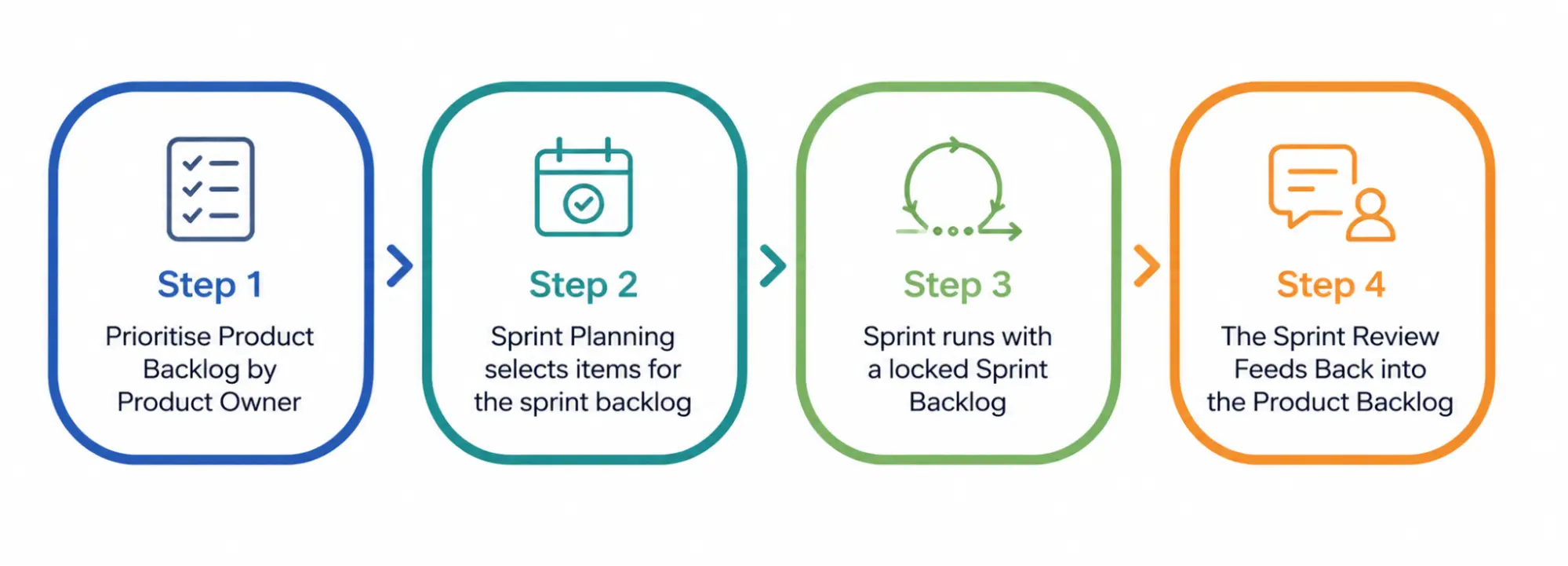
Understanding the product backlog versus the sprint backlog is also understanding the process that ties them. Here’s how it actually works, step by step:
Step 1: Prioritise Product Backlog by Product Owner
The Product Owner orders the Product Backlog items (based on business value, customer impact, and urgency) before any sprint begins. Top things must be properly refined, that is, clearly documented, estimated, and with approval criteria. During Sprint Planning, the product owner brings prioritized product backlog items for development, and the team utilizes the definition of done and the team capacity to determine what is achievable.
Step 2: Sprint Planning selects items for the sprint backlog
The development team looks at the top items in the product backlog, looks at how much they think they can get done in the next sprint, and pulls items they think they can finish. The selected items and the work required to implement those items form the sprint backlog.
Step 3: Sprint runs with a locked Sprint Backlog
The sprint backlog provides the team with daily guidance during the sprint. The Daily Scrum meetings are to inspect progress, raise impediments, and make sure everyone is aligned with the Sprint Goal. The sprint backlog is only changed if the sprint goal becomes obsolete.
Step 4: The Sprint Review Feeds Back into the Product Backlog
At the end of the sprint stakeholders review what was built. Their feedback (new ideas, revised priorities, and found holes) gets sent back into the product backlog for future sprints. This is the iterative loop that makes Scrum an agile framework and not a one-time strategy.
Why Does This Distinction Matters in 2026?
Getting the product backlog vs. sprint backlog right has never mattered more. Here’s what the latest data tells us:
According to ProProfs Project’s 2026 Scrum Statistics Report, 84% of organizations now report AI adoption inside their agile framework workflows. AI tools are being used specifically for backlog refinement, sprint analysis, and risk detection. The Springer Nature XP 2026 research study found that 72–87% of Scrum practitioners either currently use or plan to use large language models for core refinement tasks—including writing Product Backlog items, defining non-functional requirements, and improving Sprint Goals.
This means teams that already understand the difference between their product backlog and sprint backlog will adopt these AI tools more effectively—because they understand what each tool is supposed to improve. Teams that treat both lists as one muddled backlog will simply use AI to create a faster version of the same confusion.
Common Mistakes Teams Make With Product Backlog vs Sprint Backlog
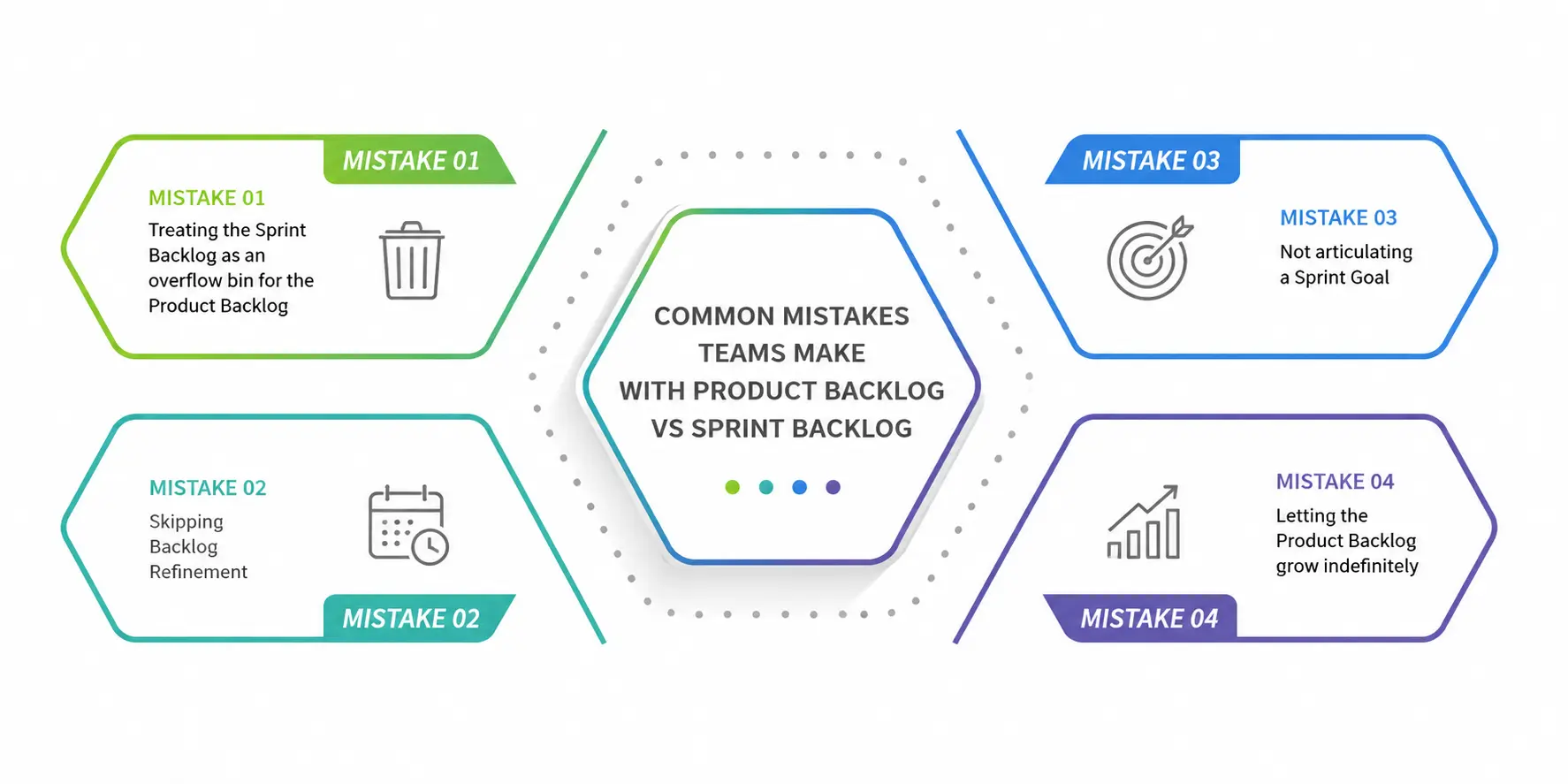
Even experienced Scrum teams get this wrong. Here are the most frequent errors and what they actually cost:
Mistake 1: Treating the Sprint Backlog as an overflow bin for the Product Backlog
Teams dump everything “sort of urgent” into the sprint backlog and then wonder why velocity is unpredictable. The Sprint Backlog must contain only items the team commits to completing within the sprint.
Mistake 2: Skipping Backlog Refinement
When backlog refinement doesn’t happen, sprint planning becomes a research session. Items arrive vague and unestimated, the team spends the planning meeting debating what things mean, and the sprint starts late and underpowered.
Mistake 3: Not articulating a Sprint Goal
A Sprint Backlog without a Sprint Goal is just a task list. The Sprint Goal is what allows the team to make intelligent decisions mid-sprint when unexpected work arrives. Without it, everything feels equally urgent—and nothing gets fully done.
Mistake 4: Letting the Product Backlog grow indefinitely
A bloated product backlog is demoralizing and misleading. It indicates that if items haven’t been touched for several months, they should be removed or moved to a separate “parking lot”—they are not truly part of the active Scrum backlog.
Conclusion
When you understand the product backlog vs. the sprint backlog clearly—and treat them as the distinct Scrum artifacts they are—your entire delivery process sharpens. The Product Backlog keeps your team pointed at the right long-term destination via the Product Goal. The Sprint Backlog focuses that same team on a single short-term outcome via the Sprint Goal. And backlog refinement is what keeps the bridge between them strong.
In 2026, with AI entering Scrum workflows at scale, teams that master these fundamentals will get more value from every tool they adopt—because they know what they’re trying to improve and why it matters. Don’t let a blurry understanding of product backlog vs. sprint backlog be the bottleneck in an otherwise capable team. The agile framework was designed to make delivery visible, predictable, and adaptive—but only when its Scrum artifacts are used with intention.