
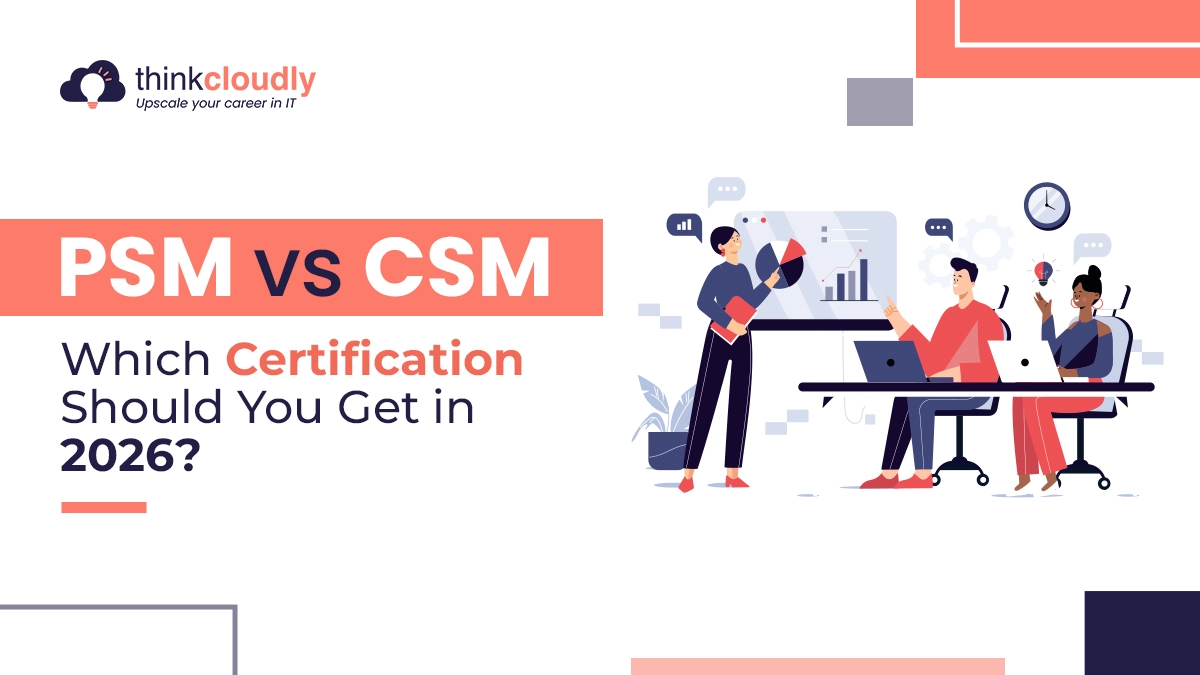
Here is a number worth sitting with for a moment. Scrum Masters who hold a recognized certification earn up to 16% more than those without one, according to 2025 compensation data. In a job market where agile roles are being created faster than companies can fill them, the question has shifted from whether to get certified to which one is actually worth your time and money. That is exactly what the PSM vs CSM debate comes down to.
Two names dominate that conversation every single time. PSM, the Professional Scrum Master certification from Scrum.org, and CSM, the Certified Scrum Master certification from the Scrum Alliance. Both are globally recognized. Both are legitimate credentials that appear regularly in job postings. But they are built on different structures, assessed differently, and carry different reputations depending on where you want to work.
This guide walks through everything that matters about PSM vs. CSM in 2026, written in plain language so you can make a confident, informed decision about your Scrum Master certification without getting lost in industry jargon.
What Is the PSM Certification?
The Professional Scrum Master certification comes from Scrum.org, the organization co-founded by Ken Schwaber, one of the two original creators of Scrum. That founding connection gives PSM training a level of foundational credibility that matters to many hiring managers, particularly in organizations that take their agile practice seriously.
PSM is structured across three progressive levels. PSM I is the entry point, designed for professionals who want to validate their understanding of Scrum fundamentals. PSM II builds on that with a deeper focus on practical application in complex organizational environments. PSM III is the most advanced level, targeting practitioners who coach and lead Scrum adoption across entire organizations.
For most people considering this path for the first time, PSM I is the starting point and the level most commonly compared against the CSM in any PSM vs. CSM discussion.
One of the defining features of the PSM pathway is that no mandatory training is required before taking the exam. You pay the assessment fee, work through the learning materials available on Scrum.org, and sit the exam when you feel ready. The PSM I assessment includes 80 multiple-choice questions to be completed within 60 minutes, with a passing score set at 85%. That threshold is deliberately high and contributes directly to its reputation for rigor.
The exam currently costs $200 per attempt, and once you pass, the certification does not expire. There are no renewal fees and no continuing education requirements to maintain it.
What Is the CSM Certification?
The Certified Scrum Master certification is issued by the Scrum Alliance, one of the oldest and most established bodies in the agile certification space. The CSM has been in circulation since 2001 and has built one of the largest certification communities in the world across virtually every industry sector.
The structure of the CSM pathway differs significantly from PSM. Before sitting for the exam, candidates are required to complete a two-day training course delivered by a Certified Scrum Trainer. This training can be completed in person or through a live online format depending on what is available in your area. The mandatory training is a deliberate part of the Scrum Alliance model and is built into the total cost of obtaining this Scrum Master certification.
Following the training, candidates take the CSM exam online. It consists of 50 multiple-choice questions with a passing score of 74%, and candidates have 60 minutes to complete it. Two exam attempts are included within the training package.
The total cost of a CSM varies because individual trainers set their own fees, but candidates should realistically budget between $1,000 and $1,500 when the training course is factored in. The certification remains valid for two years and requires 20 Scrum Education Units alongside a renewal fee to keep it active.
For those who want to advance further, the Scrum Alliance certification pathway continues through the Advanced Certified Scrum Master and the Certified Scrum Professional Scrum Master levels.
PSM vs CSM
|
Factor |
PSM (Scrum.org) |
CSM (Scrum Alliance) |
|
Issuing Body |
Scrum.org |
Scrum Alliance |
|
Mandatory Training |
No |
Yes, two-day course required |
|
Exam Format |
80 questions, 60 minutes |
50 questions, 60 minutes |
|
Passing Score |
85% |
74% |
|
Cost |
$200 (exam only) |
$1,000 to $1,500 (training plus exam) |
|
Expiry |
Does not expire |
Expires every two years |
|
Renewal Required |
No |
Yes, 20 SEUs plus renewal fee |
|
Exam Attempts |
Unlimited (pay per attempt) |
Two attempts included |
|
Difficulty Reputation |
Higher |
Moderate |
|
Community Size |
Large and growing |
Very large, established |
|
Best For |
Self-directed learners, technical professionals |
Career changers, those who prefer structured learning |
CSM Exam Difficulty vs PSM Exam Difficulty: The Honest Picture
This comparison comes up in almost every conversation about PSM vs. CSM, and it deserves a straight answer.
The CSM exam is generally considered more accessible than the PSM I assessment. The passing score of 74% gives candidates more room to work with, and the mandatory training course prepares candidates specifically for the exam content. Most people who complete the training and spend time reviewing the material pass on their first attempt without significant difficulty.
PSM exam difficulty is a step up by design. The 85% passing threshold leaves considerably less margin for error, and because there is no guided training built into the process, candidates are entirely responsible for reaching that standard through self-directed preparation. The questions tend to be more scenario-based and nuanced, testing not just familiarity with Scrum rules but genuine understanding of why those rules exist and how they apply in real situations.
That said, PSM I should not be treated as unpassable. Candidates who work through the learning materials on Scrum.org carefully, take the free practice assessments repeatedly until they are scoring consistently above 85%, and spend focused time understanding the reasoning behind Scrum principles typically pass within two to four weeks of preparation.
The straightforward summary is this: CSM is easier to pass with less independent effort. PSM demands more from you in preparation but costs considerably less and never expires. That tradeoff is really the heart of the PSM vs. CSM decision.
What Employers Actually Want in 2026
This is the practical question at the center of the whole debate, and the answer is more nuanced than most certification guides will tell you.
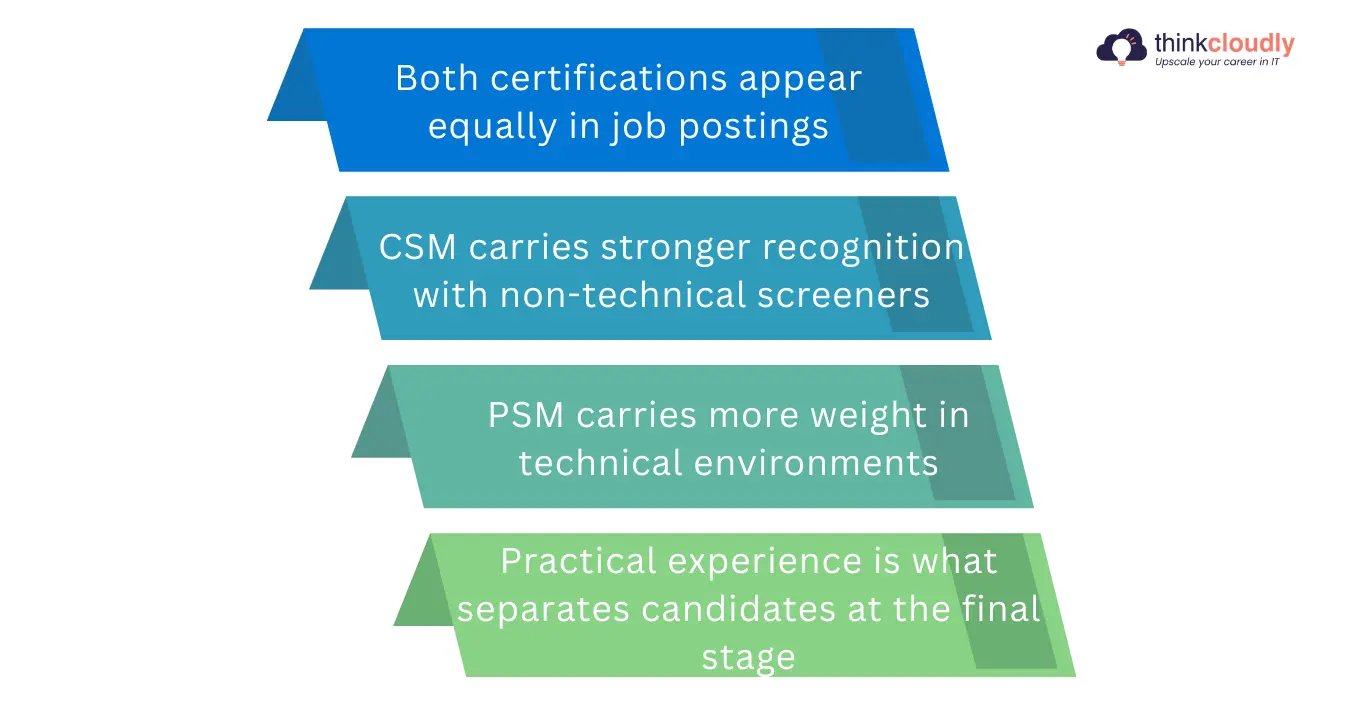
In North America and the UK, PSM and CSM show up with broadly similar frequency in Scrum Master job postings, according to 2025 data. Neither consistently dominates the other in terms of raw employer demand. What actually varies is the context in which each certification carries more weight, and that context matters more than the raw numbers suggest.
The CSM has historically had stronger name recognition with HR departments and non-technical hiring managers. The Scrum Alliance built its community earlier and more broadly over the past two decades, which means the CSM name is simply more familiar to people who did not grow up in agile environments. If the person reviewing your resume does not have a deep agile background, CSM may register as the more immediately trusted credential.
In technology-focused organizations, consultancies, and companies with mature agile practices, PSM is gaining increasing respect. Engineering managers and experienced agile practitioners who understand what an 85% passing threshold actually demands tend to view PSM as the more credible signal of genuine Scrum knowledge. In those rooms, the rigor of the exam is the point.
For most roles in 2026, either certification gets you through the door. What differentiates candidates once they are inside the process is not which badge they hold but how confidently and concretely they can speak about Scrum in real situations. The certification opens the conversation. Experience and judgment are what close it.
The Cost Reality Nobody Talks About Directly
The financial difference between these two certifications is significant enough to deserve its own section, and it is a major factor in any PSM vs. CSM decision.
PSM I costs $200. That is the full cost to sit the exam, and if you pass, you are done. No renewal fees, no continuing education units, and no expiry date to worry about.
CSM typically costs between $1,000 and $1,500 by the time you factor in the mandatory training. And that cost recurs every two years when renewal comes due.
For anyone self-funding their professional development, that gap is meaningful. The money saved by going the PSM route could fund additional certifications, cover the cost of professional tools, or simply stay in your pocket.
For someone whose employer is covering the cost, or for someone who genuinely learns better in a structured classroom environment with real interaction and worked examples, the CSM training experience provides value beyond just the credential. A good Certified Scrum Trainer brings scenarios, facilitated discussions, and practical context that self-study alone does not always replicate.
Your learning style and your budget are both legitimate factors in making this decision, and both matter a great deal when weighing PSM vs. CSM.
PSM vs CSM: Which One Is Right for You?
Choose PSM if you are comfortable studying independently without a structured course to keep you on track, you are working in or targeting a technology-focused environment where the PSM’s rigorous reputation is recognized and valued, you want a certification that does not carry ongoing renewal costs or expiry dates, and you are cost-conscious and want a well-respected credential without a large upfront investment.
Choose CSM if you are new to Scrum and would genuinely benefit from a guided two-day learning experience with a qualified trainer; you are transitioning into an agile role from a different career background and want structured support during the learning process; you are targeting organizations where the Scrum Alliance certification name carries established recognition with hiring managers; or your employer is funding the certification and the cost difference is not a factor in your decision.
Can you get both?
Yes, and many experienced Scrum practitioners do. Holding both PSM and CSM removes any question about which credential a particular employer might prefer and signals genuine commitment to the field. Given that PSM I costs $200, adding it after completing your CSM is a relatively affordable way to strengthen your professional profile considerably.
Conclusion
The PSM vs. CSM question does not have a universal right answer, but it does have a clearer answer once you understand what you are actually optimizing for.
If you want the most cost-efficient path to a rigorous, internationally recognized Scrum Master certification that never expires and requires no ongoing renewal, PSM is the stronger choice. If you value structured learning, benefit from instructor-led training, and are targeting employers where the Certified Scrum Master credential carries immediate name recognition, CSM is the better fit.
In 2026, both certifications open genuine doors across industries. Whether you lean toward PSM or CSM, both are respected, both are relevant, and both are worth having. The most important step in the PSM vs. CSM journey is choosing one, preparing thoroughly, and combining that credential with real-world practice as quickly as possible. A certification signals your knowledge. What you do with it builds your career.
Sources and References
Scrum.org. Professional Scrum Master Certification: PSM I Assessment Details and Pricing.
Scrum Alliance. Certified Scrum Master Certification Requirements and Renewal Policy.
Project Management Institute. Pulse of the Profession 2025: Agile and Hybrid Project Approaches.
LinkedIn Talent Insights. 2025 Most In-Demand Agile and Scrum Skills in the US and UK Job Market.
Glassdoor. Scrum Master Salary Report: Impact of Certification on Compensation 2025.
Indeed Hiring Lab. Agile Roles and Certification Demand: Job Market Data 2025.